Church
Ascension Church, Zhujiajiao
朱家角耶稣升天堂zhū jiā jiǎo yē sū shēng tiān táng
Brick-and-timber church with a separate Gothic tower, in a Dianshan Lake water town; in 1980 it was the first suburban Catholic church to reopen.
Directory and photographs supplied by 中二halo君. Photographs used with permission. · Xiaohongshu · Bilibili
- Built
- 1883–1909
- Architect
- Not recorded
- Style
- chinese-western, gothic-revival
- Heritage listing
- Registered immovable cultural relic of Shanghai (上海市登记不可移动文物) · municipal · 2006
- Status
- Visitor access not yet confirmed
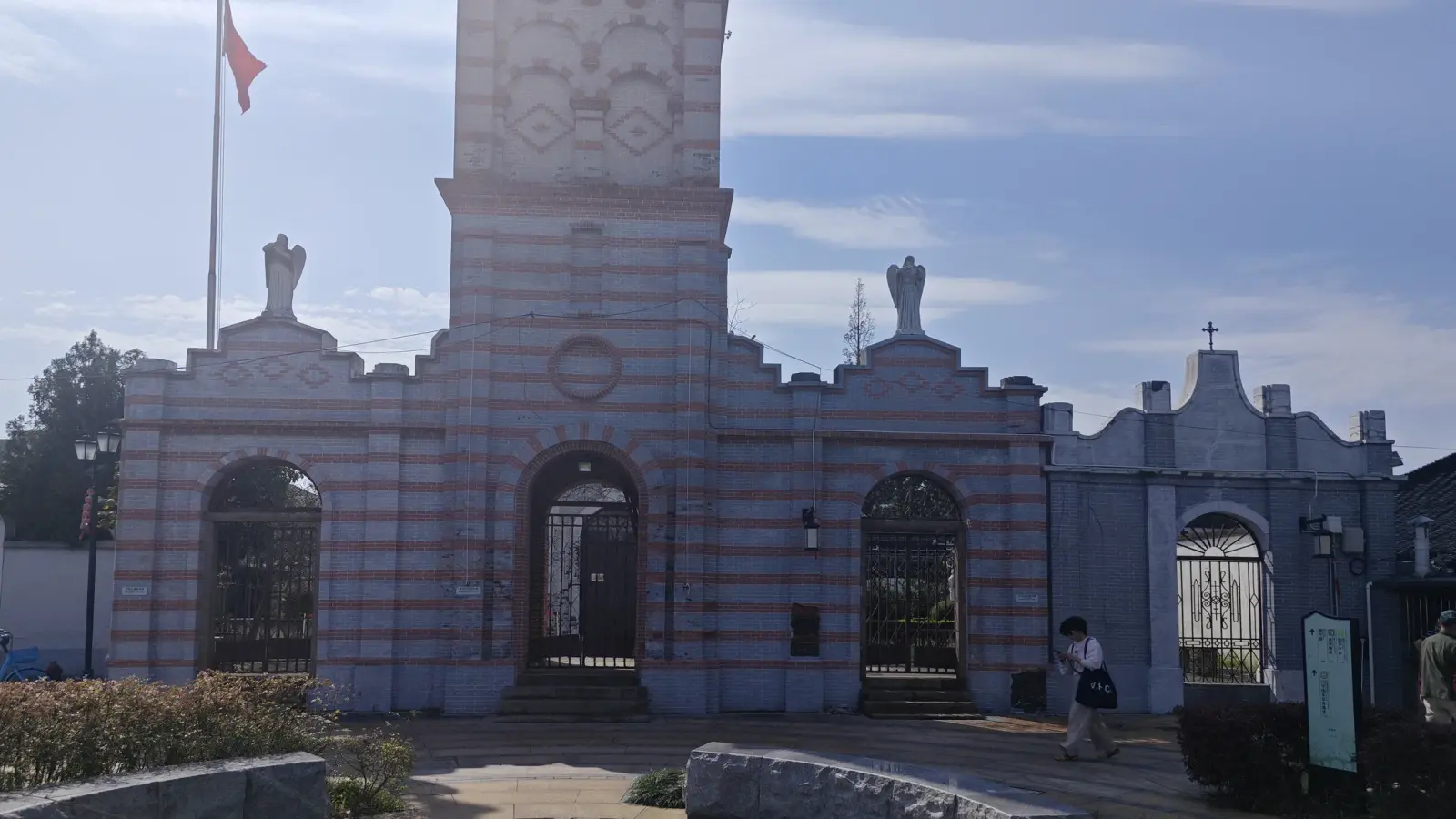
The grey-and-pink striped masonry west front and central tower, with three arched doorways.
Photo: 中二halo君 · used with permission · Xiaohongshu · BilibiliWhat you're looking at
- A Gothic bell tower standing apart from the nave, in red and grey striped brick
- The grey brick front and the boards over the doors
- The Marian grotto of 1989
- Photographs of the parish on display in the main hall
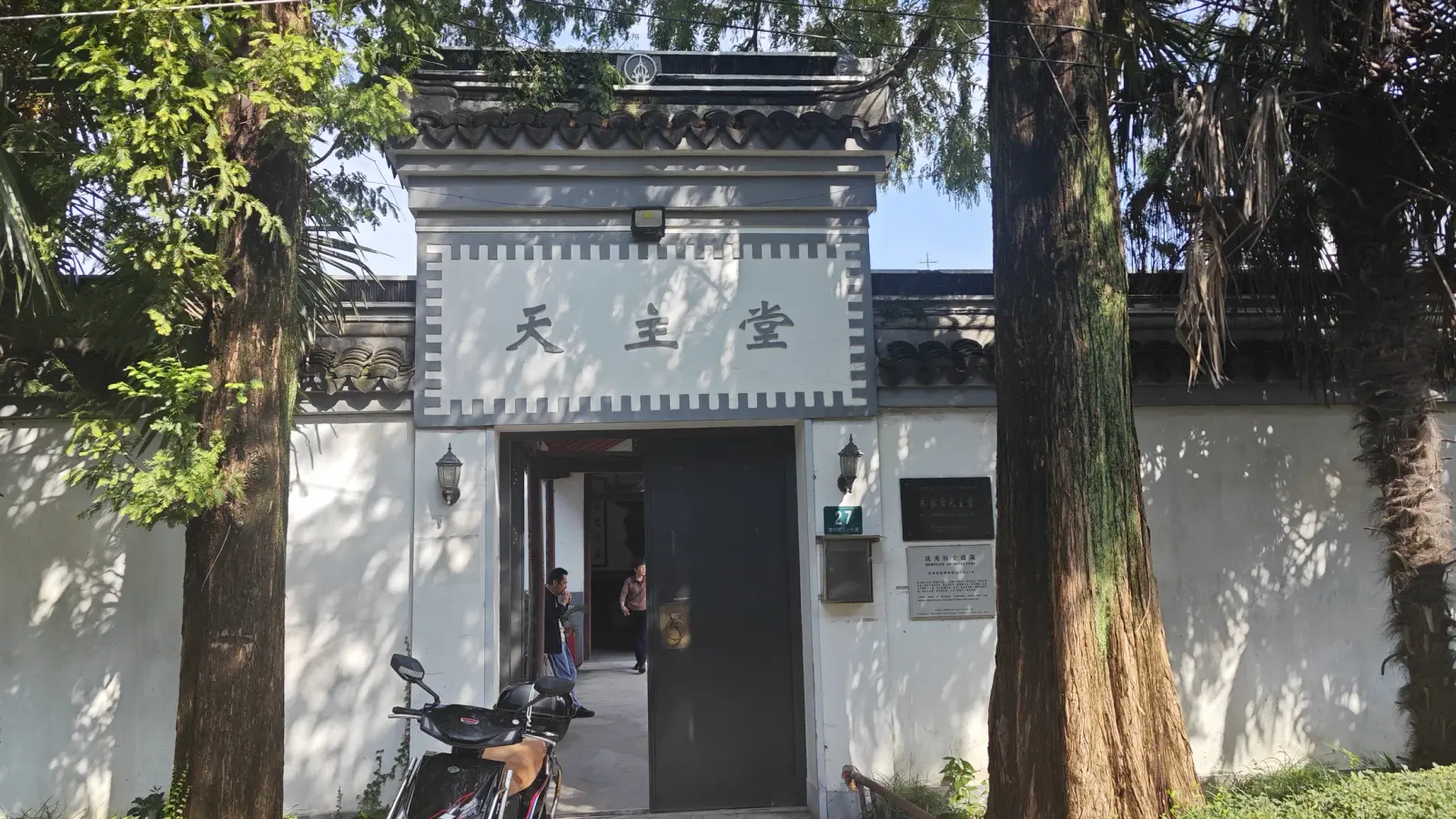
The courtyard gateway beneath its tiled roof, with the characters for 'Catholic Church' on the lintel.
Photo: 中二halo君 · used with permission · Xiaohongshu · Bilibili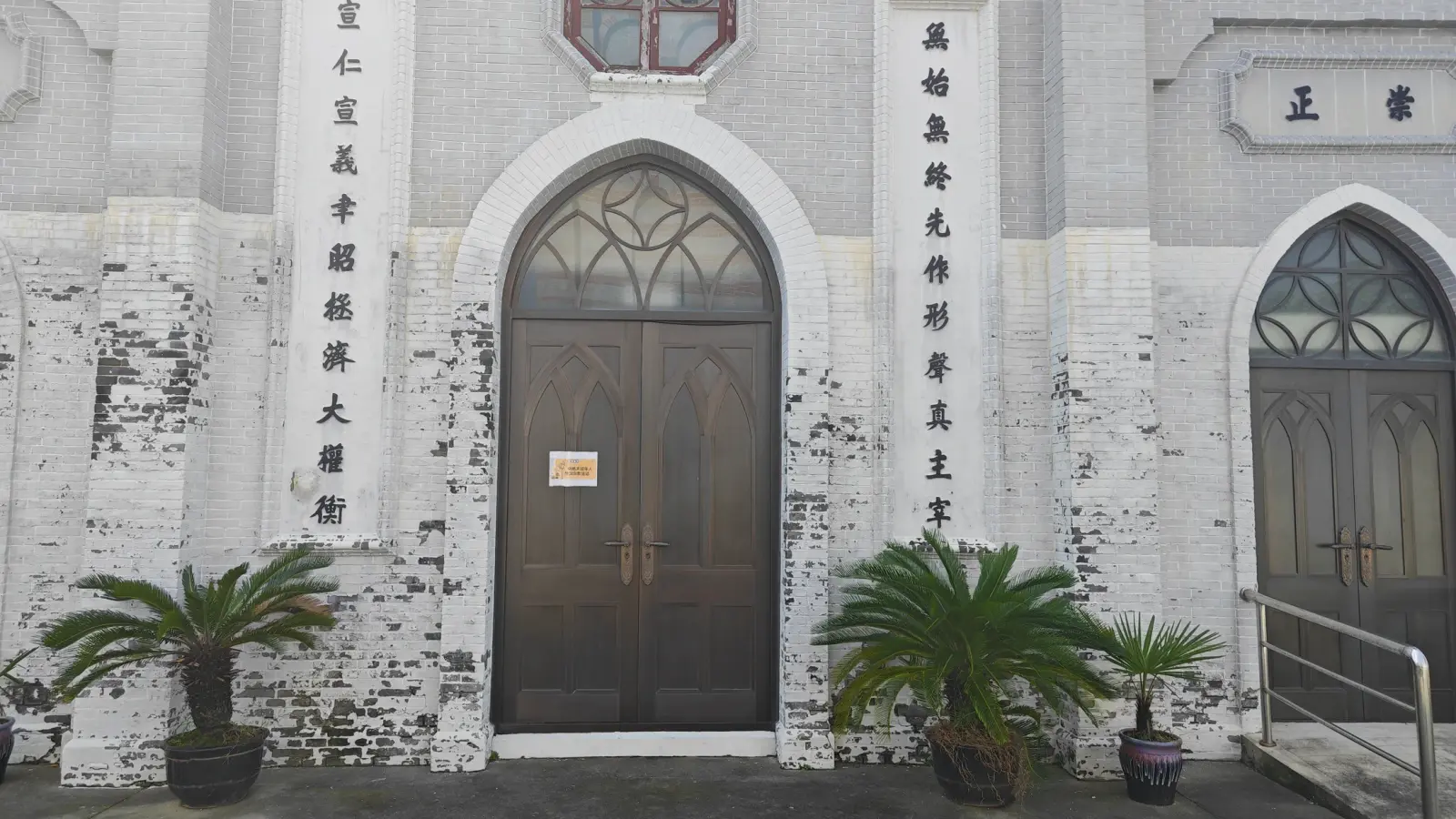
The pointed-arch wooden doors of the main church, flanked by vertical Chinese inscriptions on the weathered wall.
Photo: 中二halo君 · used with permission · Xiaohongshu · Bilibili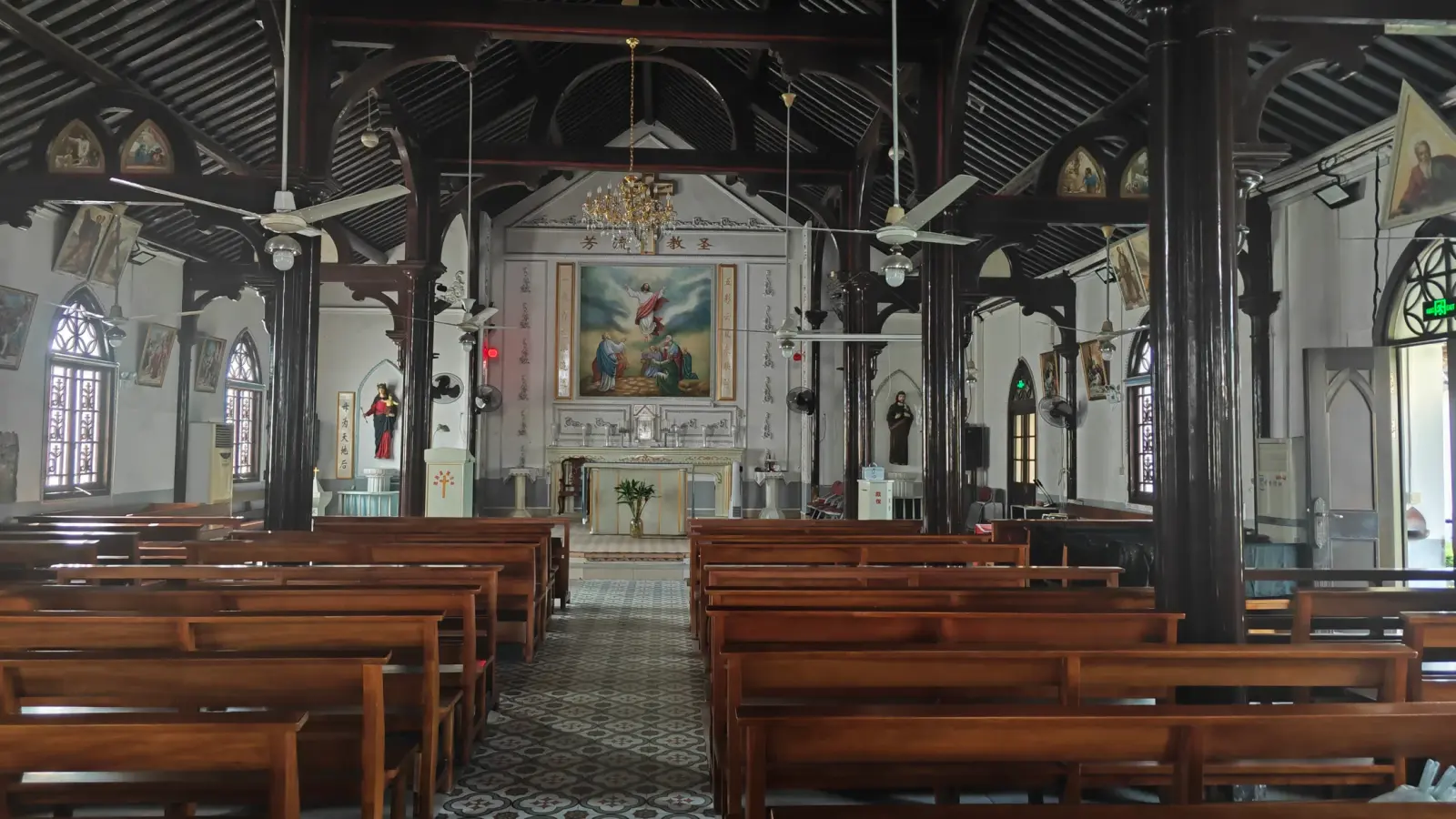
The nave looking toward the altar, with dark timber columns and rows of wooden benches.
Photo: 中二halo君 · used with permission · Xiaohongshu · Bilibili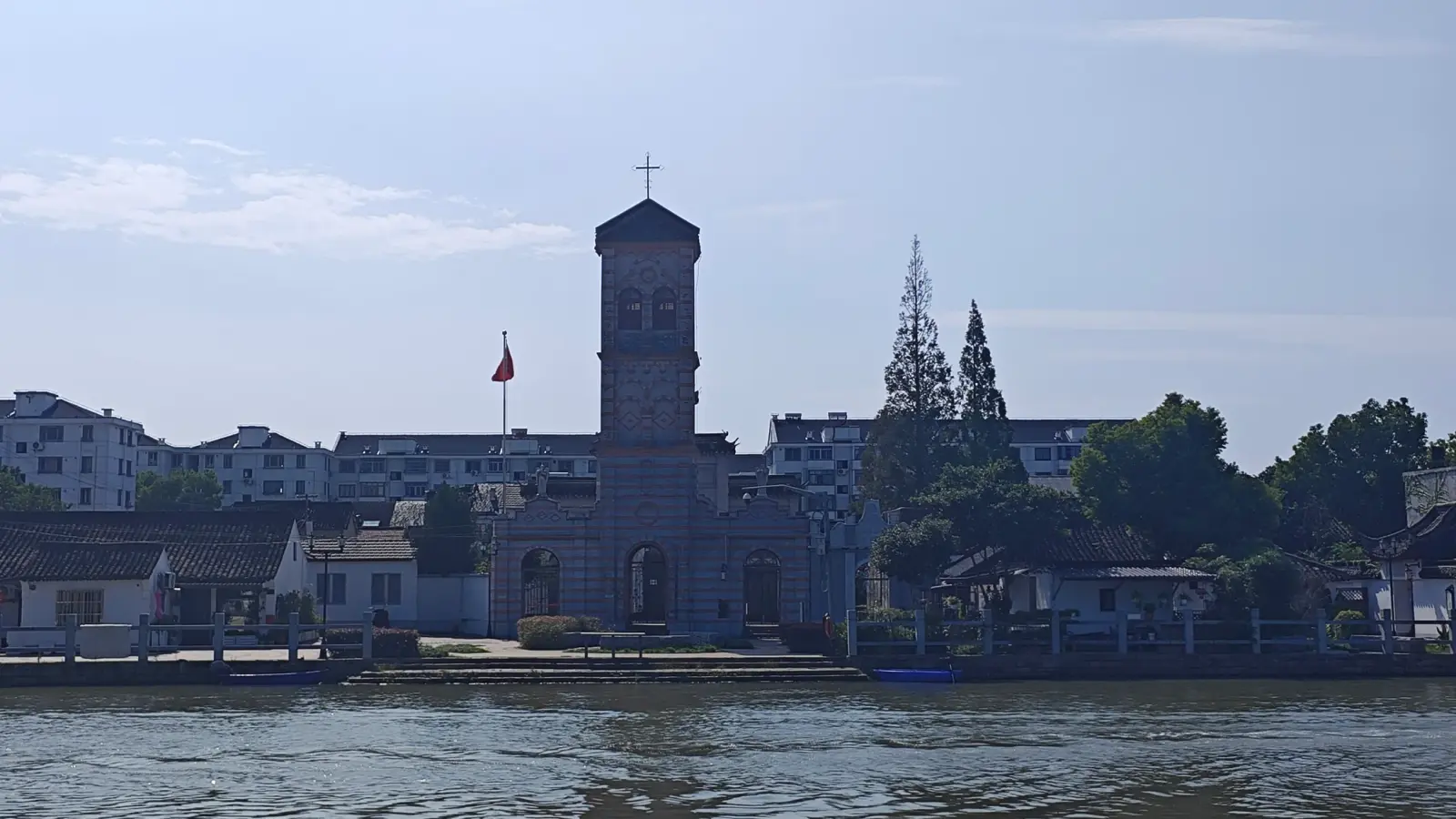
The church tower and low buildings seen from the canal.
Photo: 中二halo君 · used with permission · Xiaohongshu · Bilibili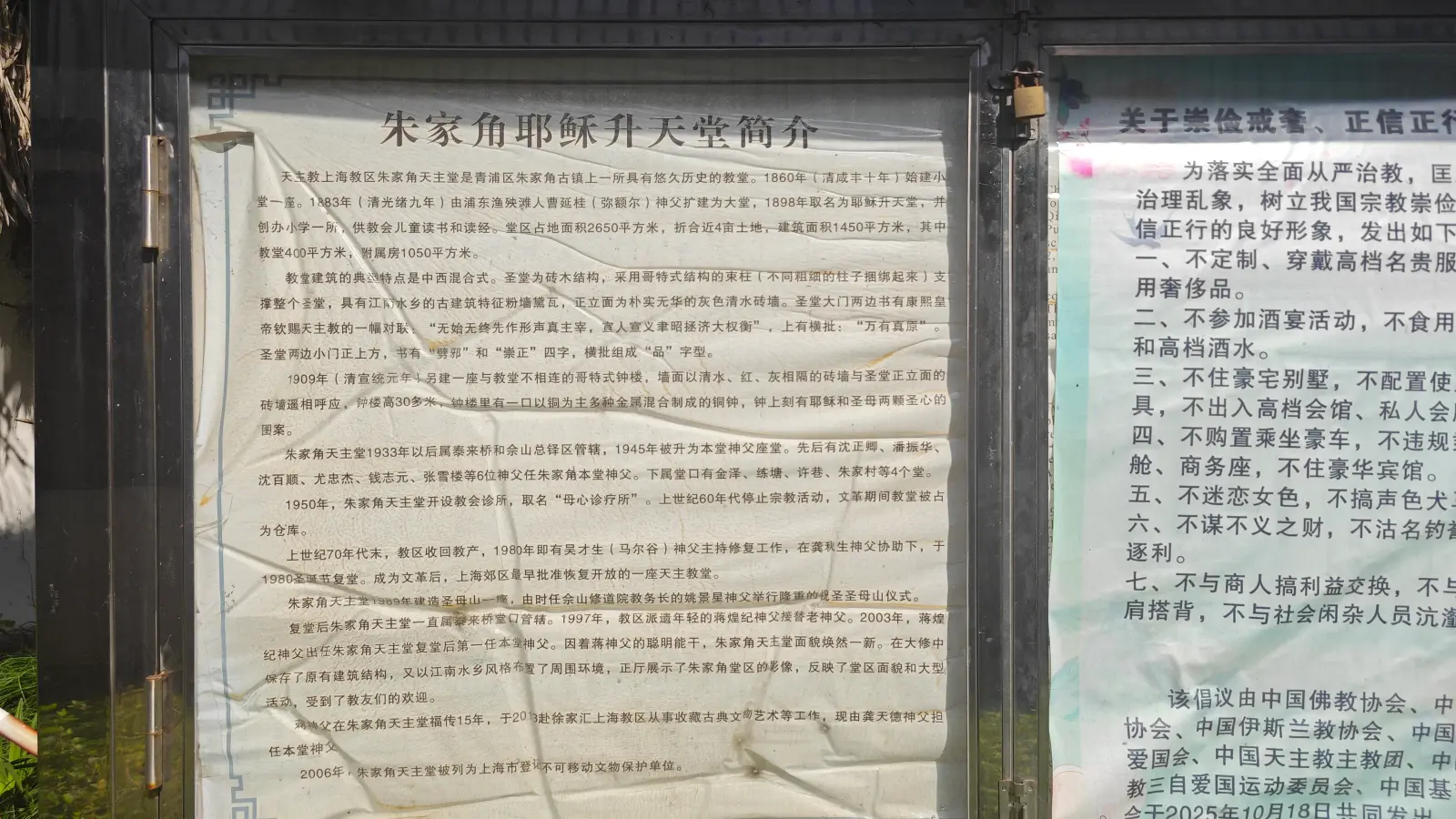
A Chinese introduction to Zhujiajiao Ascension Church on a notice board, beside a separate public notice.
Photo: 中二halo君 · used with permission · Xiaohongshu · Bilibili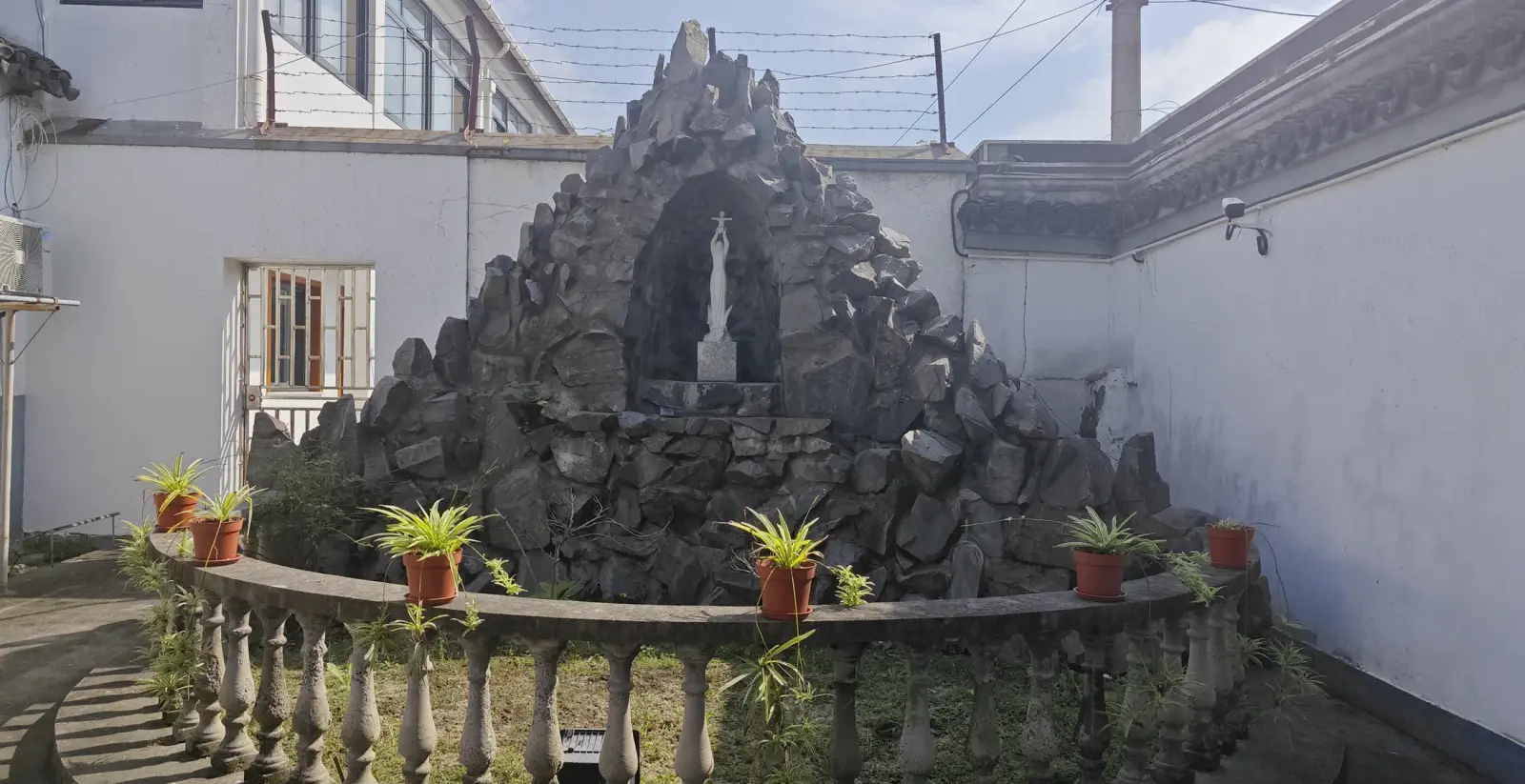
A rock grotto with a statue of Mary in a walled corner of the grounds, ringed by a balustrade and potted plants.
Photo: 中二halo君 · used with permission · Xiaohongshu · Bilibili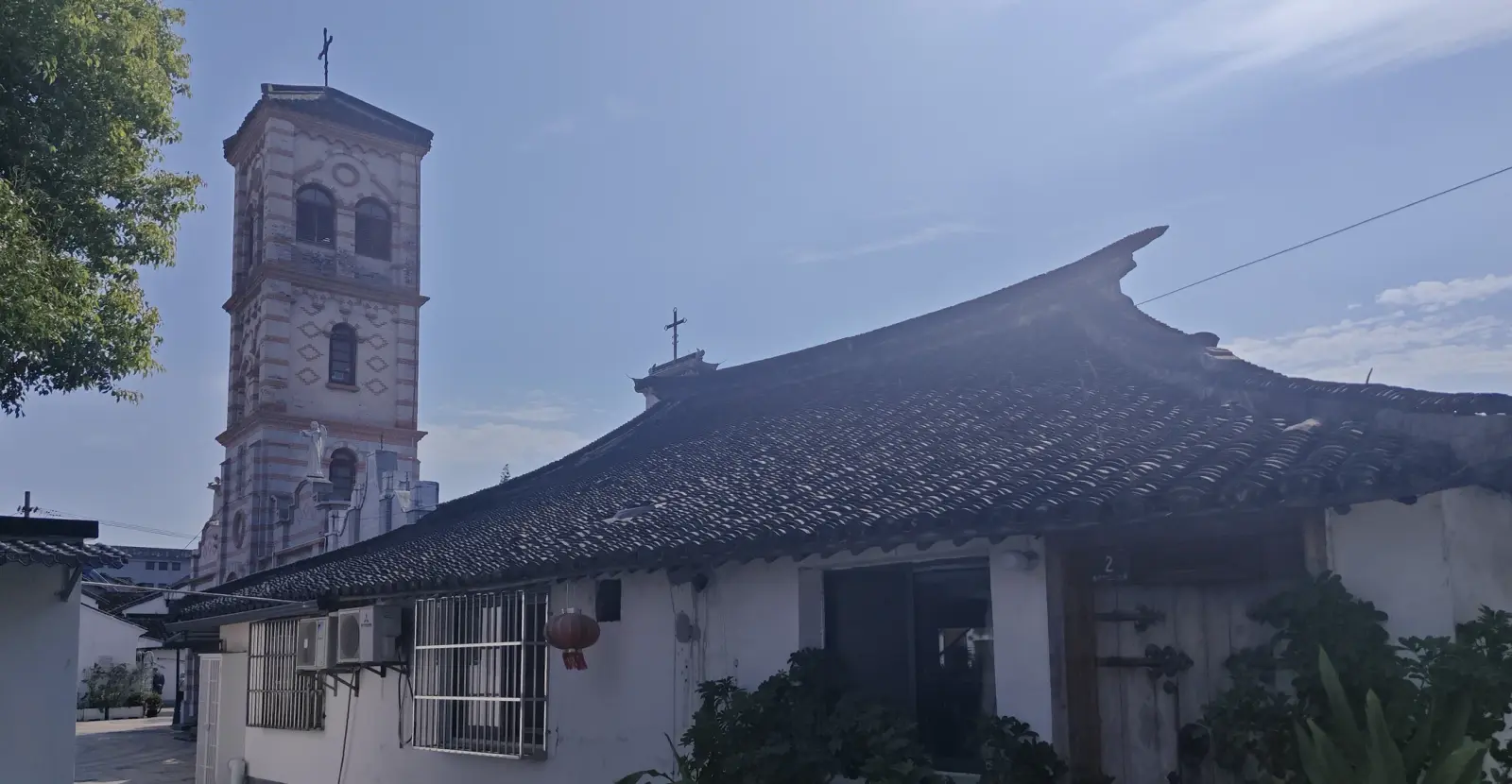
The slender tower rising behind the curved tiled roof of an older building.
Photo: 中二halo君 · used with permission · Xiaohongshu · BilibiliThe story
Ascension Church (朱家角耶稣升天堂, Zhūjiājiǎo Yēsū Shēngtiān Táng) sits in the lanes of Zhujiajiao (朱家角, Zhūjiājiǎo), the water town on the Dianshan Lake side of Qingpu. It pairs a plain Chinese-style nave with a Gothic bell tower built apart from it, and in 1980 it became the first Catholic church in Shanghai’s suburbs to reopen after the Cultural Revolution.
A chapel that grew with a fishing congregation
A small chapel went up in 1860. In 1883 it was enlarged into a proper church and given the Ascension dedication; the church’s own plaque says the name was adopted in 1898, so the sources differ on that detail. Most worshippers were boat fishermen. The county gazetteer counts roughly a thousand Catholics, and the church held about 700 people. At first it came under the Tailaiqiao church; in 1945 it became a parish seat with outstation churches, among them Jinze, Liantang and Xuxiang.
Why does a Gothic tower stand apart from a Chinese-looking nave?
The nave is brick and timber, with white walls and dark roof tiles in the style of the water towns, but the roof is carried on clustered columns of Gothic type. The front is plain grey brick. The bell tower was added in 1909 and does not touch the church; its walls alternate red and grey brick to echo the front. Sources give its height as over 20 m or over 30 m. The bell inside is cast with the Sacred Hearts of Jesus and Mary.
From warehouse to the first reopening
Services stopped in the 1960s and the church served as a warehouse during the Cultural Revolution. In August 1980 the diocese paid 30,000 yuan for repairs, and the church reopened at Christmas that year under Fr Gong Qiusheng, with more than 2,000 people. A Marian grotto was added in 1989. The plaque records its listing as a registered cultural relic in 2006.
What to look for
Find the entrance lane (Lane 317, Caohe Street) and look first at the tower, with its bands of red and grey brick, then at the grey brick front of the church. Above the doors are painted boards, including 劈邪 and 崇正 over the two side doors. The grotto stands in the grounds, and inside the main hall a display of photographs shows parish life.
Signs at the church, in full (2)
The wording of plaques and notices as photographed. Timetables and rules may have changed since.
Mass times and address board at the Ascension Church, Zhujiajiao
朱家角耶稣升天堂弥撒时间与地址牌
English printed on the sign
Mass Schedule
Sunday 8:00 a.m.
Monday to Saturday 7:30 a.m.
Address
No.27 Lane 317 Caohe Street Zhujiajiao Town QingPu District, Shanghai
Our translation of the Chinese
Mass schedule
Sundays: 08:00
Weekdays: 07:30 (the board's English specifies Monday to Saturday)
Benediction of the Blessed Sacrament is held after the first Sunday of each month.
Church address
No. 27, Lane 317, Caohe Street,
Zhujiajiao Town, Qingpu District, Shanghai
Entrance
Chinese text
弥撒时间
主日 上午8:00
平日 上午7:30
每月首主日后举行
圣体降福
圣堂地址
上海市青浦区朱家角镇
漕河街317弄27号
进口
Zhujiajiao Church of the Ascension of Jesus: An Introduction
朱家角耶稣升天堂简介 · see the photo
Our translation of the Chinese
Zhujiajiao Catholic Church, in the Diocese of Shanghai, is a church with a long history in Zhujiajiao Ancient Town, Qingpu District. A small chapel was first built in 1860, the tenth year of the Xianfeng reign of the Qing dynasty. In 1883, the ninth year of the Guangxu reign, Father Cao Yangui (Michael), a native of Yuyangtan in Pudong, enlarged it into a main church. In 1898 it was named the Church of the Ascension of Jesus, and a primary school was founded for Catholic children to study and read scripture. The parish occupies 2,650 square metres, equivalent to nearly four mu of land. Its building area is 1,450 square metres, comprising 400 square metres for the church and 1,050 square metres for ancillary buildings.
The church's characteristic architectural feature is its combination of Chinese and Western styles. It has a brick-and-timber structure, with Gothic-style bundled columns—columns of different thicknesses grouped together—supporting the whole church. Its white walls and dark roof tiles are characteristic of old buildings in the waterways of Jiangnan, while its front is a plain facade of exposed grey brick. On either side of the main church doorway is a couplet described as a gift from the Kangxi Emperor to the Catholic Church: “Without beginning or end, before form and sound, the true Lord of all; proclaiming humanity and righteousness, he manifests the great measure of salvation and deliverance.” Above it is the horizontal inscription: “The true origin of all existence.”
Directly above the small doorways on either side of the church are the inscriptions “Cut away evil” and “Honor what is right.” Together with the main horizontal inscription, they form the triangular arrangement of the Chinese character 品.
In 1909, the first year of the Xuantong reign, a separate Gothic bell tower was built, detached from the church. Its exposed brickwork, alternating red and grey, echoes the brickwork of the church's front. The tower is more than 30 metres high and contains a bell made from a mixture of metals, mainly copper. The bell bears images of the Sacred Hearts of Jesus and Mary.
After 1933, Zhujiajiao Catholic Church was under the Tailaiqiao and Sheshan deaneries. In 1945 it became the church where a parish priest was based. Six priests successively served as parish priest of Zhujiajiao: Shen Zhengqing, Pan Zhenhua, Shen Baishun, You Zhongjie, Qian Zhiyuan and Zhang Xuelou. Four churches were under its administration: Jinze, Liantang, Xuxiang and Zhujiacun.
In 1950, Zhujiajiao Catholic Church opened a church clinic named Muxin (“Mother's Heart”) Clinic. Religious activities stopped in the 1960s, and during the Cultural Revolution the church was occupied as a warehouse.
In the late 1970s, the diocese recovered the church property. In 1980, Father Wu Caisheng (Mark) directed restoration work, assisted by Father Gong Qiusheng. The church reopened at Christmas 1980, becoming the first Catholic church in suburban Shanghai to receive approval to reopen after the Cultural Revolution.
A Marian grotto was built at Zhujiajiao Catholic Church in 1989. Father Yao Jingxing, then dean of studies at Sheshan Seminary, conducted a solemn blessing of the grotto.
Following its reopening, Zhujiajiao Catholic Church remained under Tailaiqiao Church. In 1997, the diocese sent the young Father Jiang Huangji to succeed the elderly priest. In 2003, Father Jiang Huangji became Zhujiajiao Catholic Church's first parish priest since its reopening. Through Father Jiang's ability and resourcefulness, the church took on a new appearance. Major repairs preserved the original building structure, while the surroundings were arranged in the style of a Jiangnan water town. The main hall displayed photographs of the Zhujiajiao parish, showing its appearance and major events, which were welcomed by parishioners.
Father Jiang carried out evangelizing work at Zhujiajiao Catholic Church for 15 years. In 2013, he went to the Diocese of Shanghai in Xujiahui to work on collecting historic cultural objects, art and related materials. At the time of the board's account, Father Gong Tiande was serving as parish priest.
In 2006, Zhujiajiao Catholic Church was listed as a Shanghai municipal registered immovable cultural relic protection site.
Chinese text
天主教上海教区朱家角天主堂是青浦区朱家角古镇上一所具有悠久历史的教堂。1860年(清咸丰十年)始建小堂一座。1883年(清光绪九年)由浦东渔殃滩人曹延桂(弥额尔)神父扩建为大堂,1898年取名为耶稣升天堂,并创办小学一所,供教会儿童读书和读经。堂区占地面积2650平方米,折合近4亩土地,建筑面积1450平方米,其中教堂400平方米,附属房1050平方米。
教堂建筑的典型特点是中西混合式。圣堂为砖木结构,采用哥特式结构的束柱(不同粗细的柱子捆绑起来)支撑整个圣堂,具有江南水乡的古建筑特征粉墙黛瓦,正立面为朴实无华的灰色清水砖墙。圣堂大门两边书有康熙皇帝钦赐天主教的一幅对联:“无始无终先作形声真主宰,宣人宣义聿昭拯济大权衡”,上有横批:“万有真原”。
圣堂两边小门正上方,书有“劈邪”和“崇正”四字,横批组成“品”字型。
1909年(清宣统元年)另建一座与教堂不相连的哥特式钟楼,墙面以清水、红、灰相隔的砖墙与圣堂正立面的砖墙遥相呼应,钟楼高30多米,钟楼里有一口以铜为主多种金属混合制成的铜钟,钟上刻有耶稣和圣母两颗圣心的图案。
朱家角天主堂1933年以后属泰来桥和佘山总铎区管辖,1945年被升为本堂神父座堂。先后有沈正卿、潘振华、沈百顺、尤忠杰、钱志元、张雪楼等6位神父任朱家角本堂神父。下属堂口有金泽、练塘、许巷、朱家村等4个堂。
1950年,朱家角天主堂开设教会诊所,取名“母心诊疗所”。上世纪60年代停止宗教活动,文革期间教堂被占为仓库。
上世纪70年代末,教区收回教产,1980年即有吴才生(马尔谷)神父主持修复工作,在龚秋生神父协助下,于1980圣诞节复堂。成为文革后,上海郊区最早批准恢复开放的一座天主教堂。
朱家角天主堂1989年建造圣母山一座,由时任佘山修道院教务长的姚景星神父举行隆重的祝圣圣母山仪式。
复堂后朱家角天主堂一直属泰来桥堂口管辖。1997年,教区派遣年轻的蒋煌纪神父接替老神父。2003年,蒋煌纪神父出任朱家角天主堂复堂后第一任本堂神父。因着蒋神父的聪明能干,朱家角天主堂面貌焕然一新。在大修中保存了原有建筑结构,又以江南水乡风格布置了周围环境,正厅展示了朱家角堂区的影像,反映了堂区面貌和大型活动,受到了教友们的欢迎。
蒋神父在朱家角天主堂福传15年,于2013赴徐家汇上海教区从事收藏古典文物艺术等工作,现由龚天德神父担任本堂神父。
2006年,朱家角天主堂被列为上海市登记不可移动文物保护单位。
How to visit
- Status
- Visitor access not yet confirmed
- Opening times and prices not yet confirmed; check before you go.
- Nearest metro
- Metro directions will be added after a site visit.Plan a metro journey here →
Chinese address — show this to a taxi driver
朱家角镇漕河街317弄27号
27, Lane 317, Caohe Street, Zhujiajiao Town, Qingpu District, Shanghai
Amap (高德地图) works best in mainland China; Apple Maps on iPhone. Both open in the app when it is installed.
The map position is approximate; the entrance has not been checked.
Nearby
Loading map…
Within a 10-minute walk
- Zhujiajiao朱家角古镇7 min walk
Sources
- 1.Qingpu County Gazetteer, Catholicism (青浦县志 · 天主教), Shanghai Local Chronicles Office — 朱家角天主堂gazetteer
- 2.Shanghai Religion Gazetteer, Catholicism, Open Churches (with table of other open churches) (上海宗教志 · 第四编天主教 · 第一节 开放教堂(附:其他开放教堂一览表)), Shanghai Local Chronicles Office — 六、朱家角耶稣升天堂gazetteer
- 3.Photographs of Shanghai churches and their signs, by 中二halo君 (上海教堂实拍照片(中二halo君)), 中二halo君, 中二halo君, 2026 — sign photographed at the churchfieldwork
- 4.Qingpu County Gazetteer 1985-2000, Catholicism (青浦县志1985-2000 · 第四节 天主教), Shanghai Local Chronicles Office — 朱家角天主堂gazetteer