Church · in Former French Concession
Christ the King Church
君王堂Jūnwáng Táng
A Catholic church founded in 1928 for English-speaking foreigners; the original is gone, and the 1993 Julu Road church has a Good Shepherd mosaic.
Directory and photographs supplied by 中二halo君. Photographs used with permission. · Xiaohongshu · Bilibili
- Built
- 1993
- Architect
- Not recorded
- Style
- modernist
- Heritage listing
- Not recorded
- Status
- Open to visitors
- Then in
- French Concession1914–1943Close to a boundary drawn along today's streets; it may have fallen on either side.
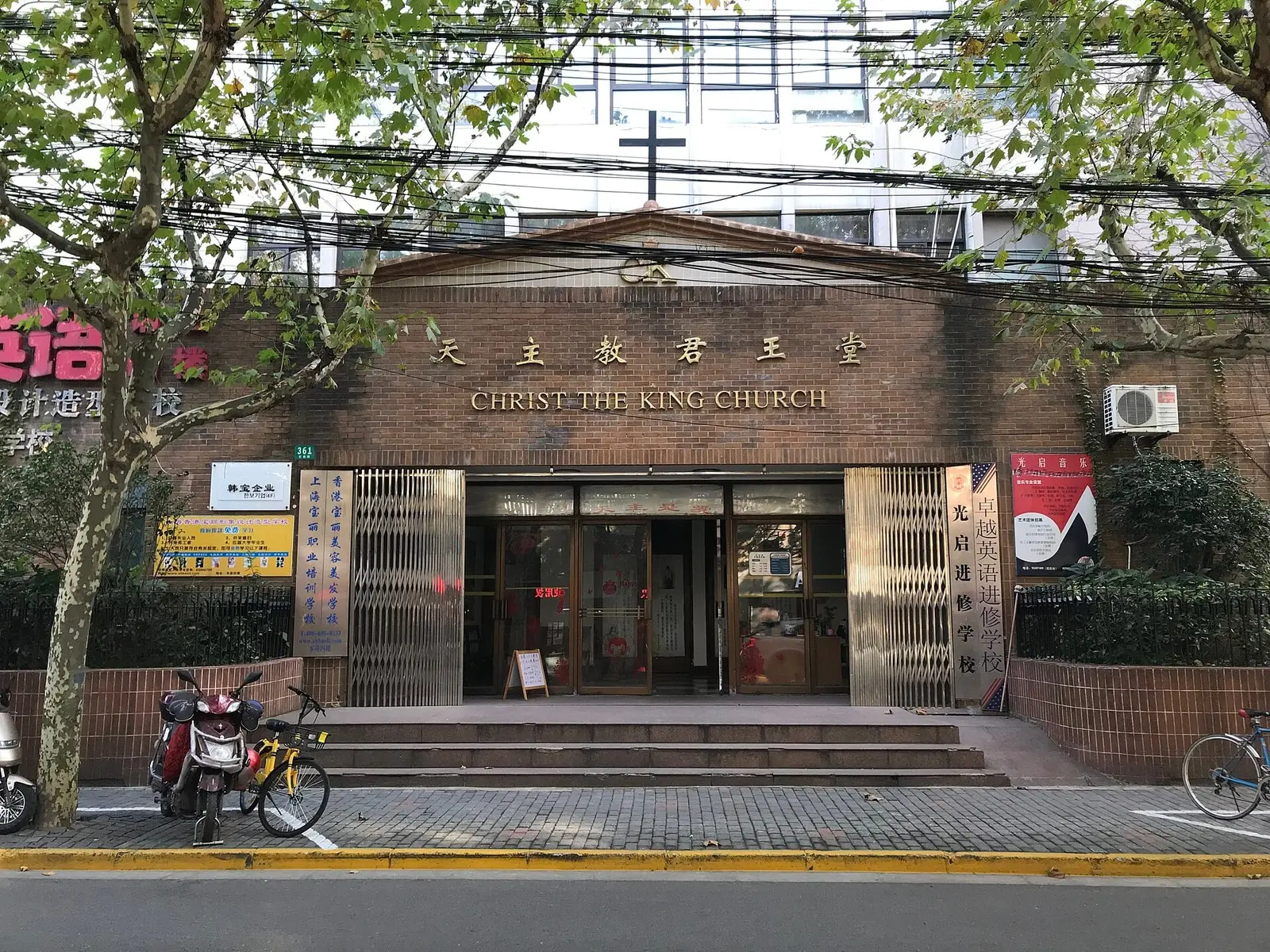
The street entrance of Christ the King Church, with its bilingual name board and cross above the doors.
Photo: Fayhoo (resized) · CC BY-SA 3.0
What you're looking at
- The Good Shepherd mosaic covering the whole left wall inside, about 20 m by 6 m.
- The plain modern church built into the base of an office block on Julu Road.
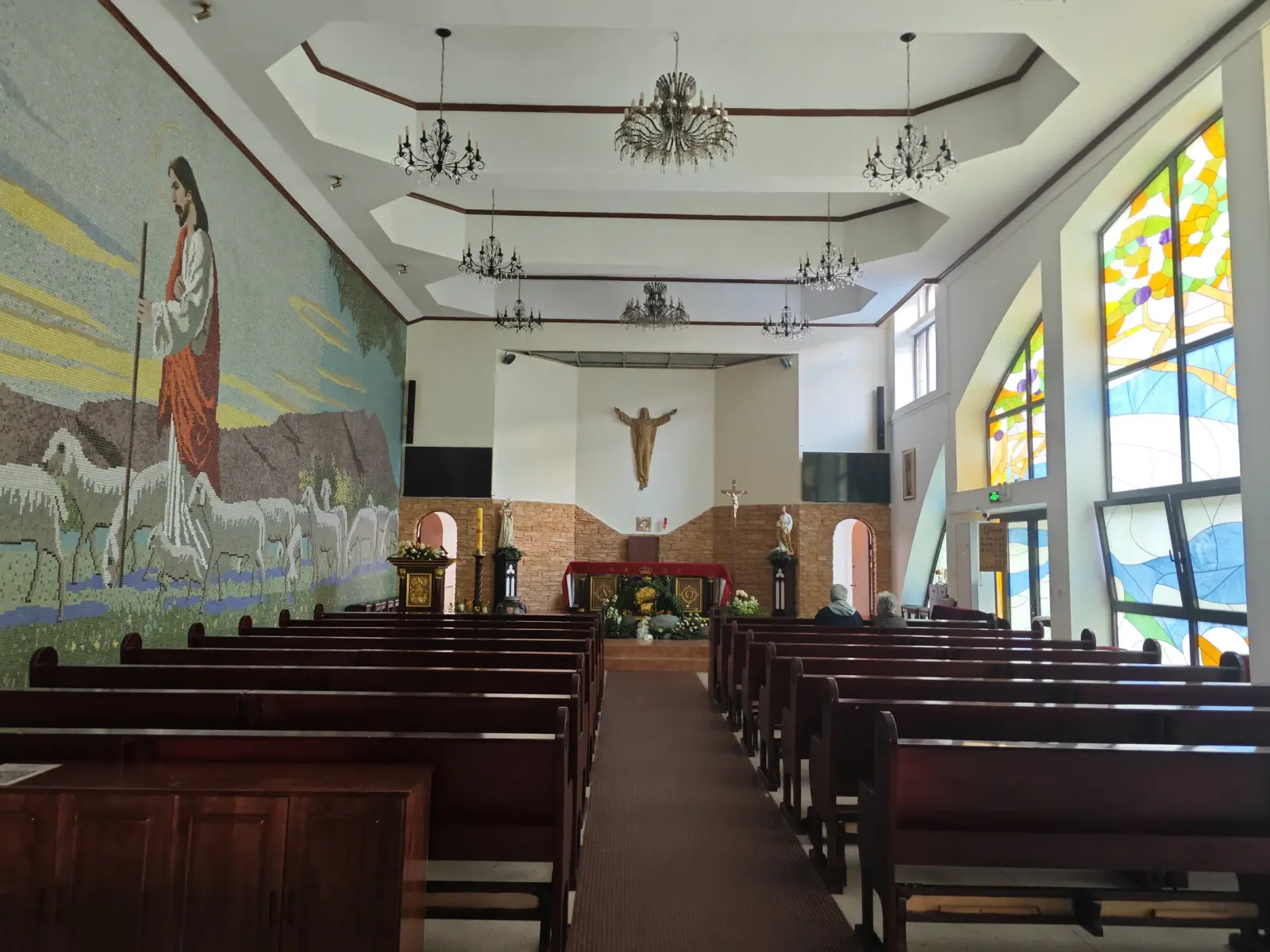
The nave looking toward the sanctuary, with coloured glass windows on the right and a large mosaic on the left wall.
Photo: 中二halo君 · used with permission · Xiaohongshu · Bilibili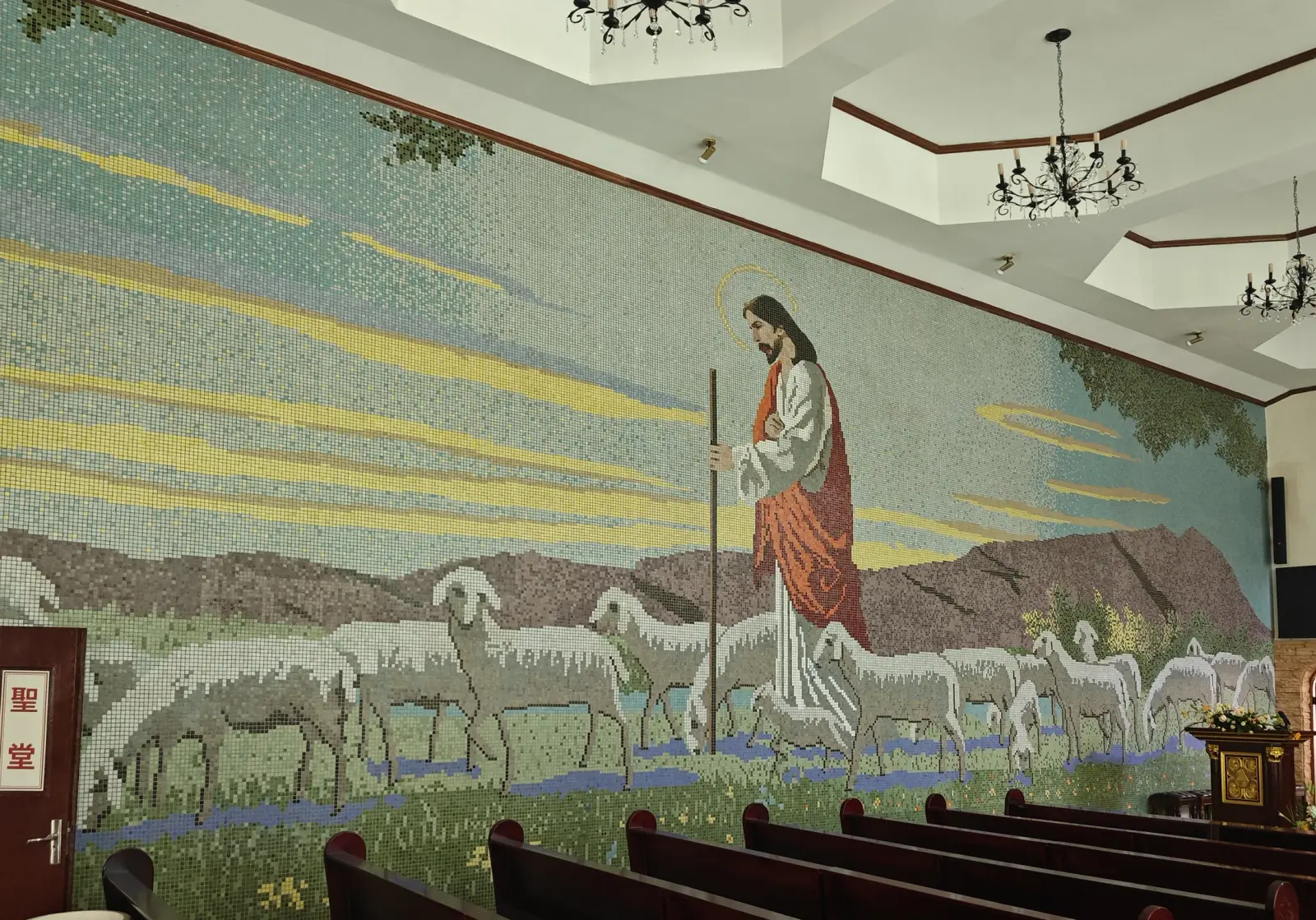
A large wall mosaic of the Good Shepherd with his flock beside the sanctuary.
Photo: 中二halo君 · used with permission · Xiaohongshu · Bilibili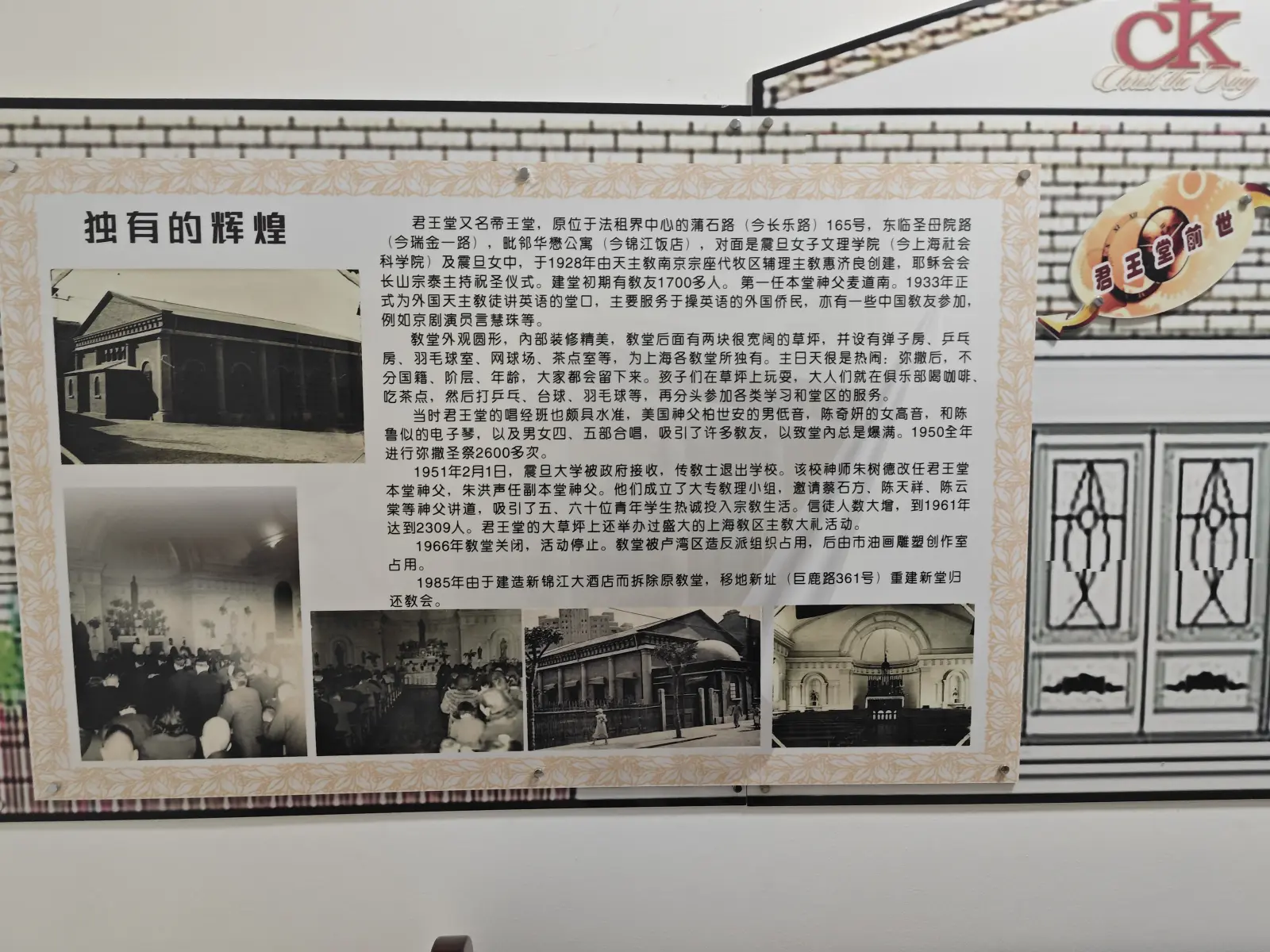
A display board inside the church telling the parish history in Chinese, with archive photographs of earlier buildings.
Photo: 中二halo君 · used with permission · Xiaohongshu · Bilibili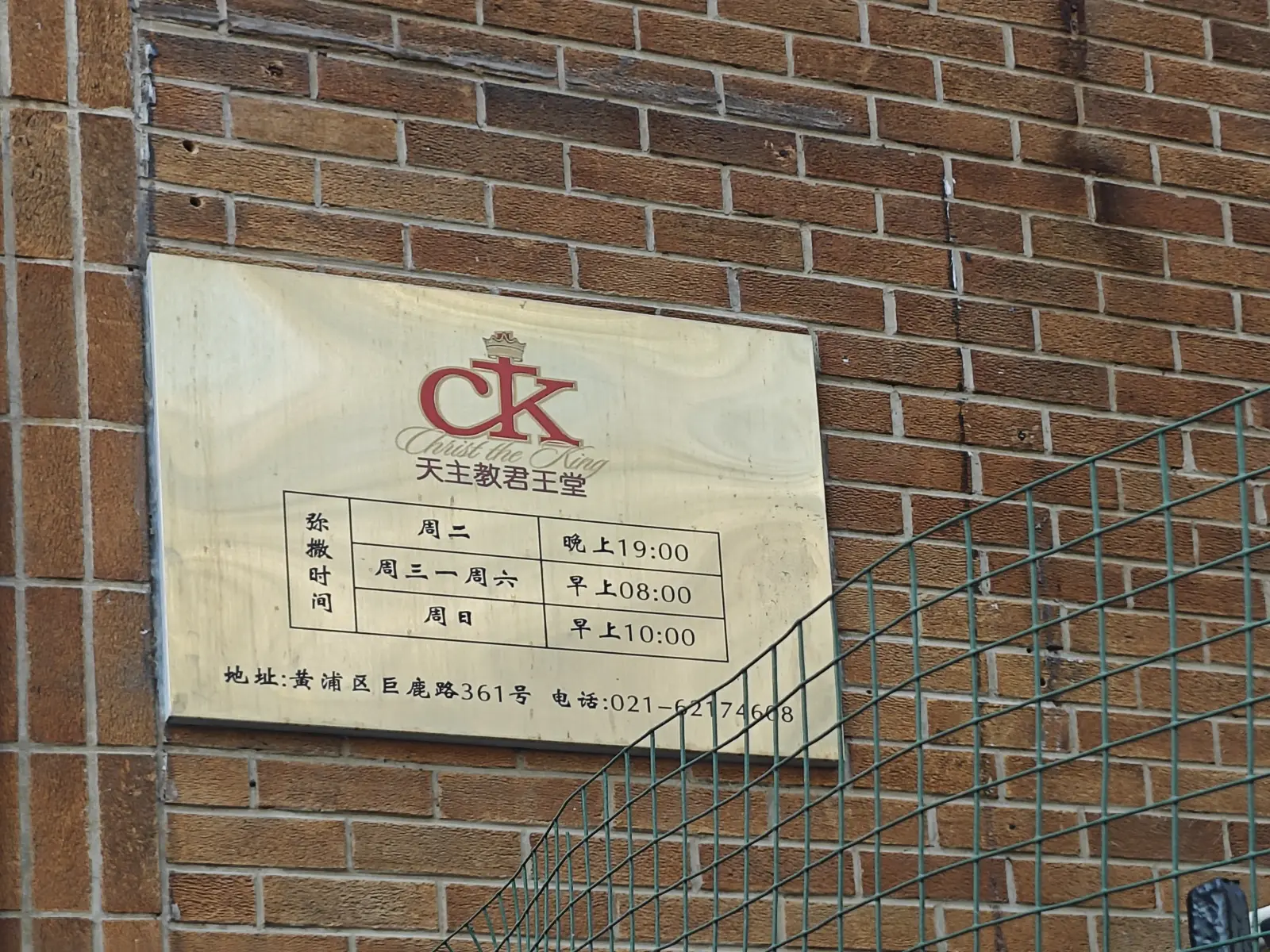
The church's name plate and Mass schedule beside the entrance.
Photo: 中二halo君 · used with permission · Xiaohongshu · BilibiliThe story
Christ the King Church (君王堂, Jūnwáng Táng) is a Catholic church built into the ground floor of an office tower at 361 Julu Road. From the street it is easy to miss; inside, a mosaic of Christ the Good Shepherd, 20 metres long and 6 metres high, fills the east wall. When the Religion Gazetteer was written in the 1990s, it was the only church in the diocese with a regular Mass in English; Xujiahui Cathedral now has one too.
A church for the foreign community
The first Christ the King Church opened in 1928 at 165 Pushi Road (now Changle Road), beside the Cathay Mansions in the former French Concession. Jesuits from California ran it and used it as their Shanghai office, and it became a full parish in 1934 under an English Jesuit, Father McDonald. Most of the congregation worked for foreign trading firms, and consular and military families came on feast days. Chinese Catholics were at first not admitted to Mass.
It was a social club as much as a church: there were lawns, a billiard room, tennis courts, a table-tennis room and a tea room, and people stayed after Mass to play and talk. The church’s history display counts 1,700 members in its early years and 2,309 in 1961.
Closed, then moved for a hotel
The church closed in 1966 and was used by a local group and then by the Shanghai Oil Painting and Sculpture Studio. When the site was needed for the New Jin Jiang Hotel, the diocese agreed to move. The Religion Gazetteer dates the move to 1982; the church’s own display says the old building came down in 1985.
The architect Ai Zupan (艾祖盘) proposed a 17-storey block with the church on the ground floor, parish rooms on the next three floors and flats above for relocated residents and hotel staff. The plan was adopted in 1987, the building was finished in 1991, and Bishop Jin Luxian (金鲁贤) said the opening Mass on 25 April 1993.
How the mosaic was made
The Good Shepherd image began as a holy card, 5 by 3 centimetres, found at Xujiahui. About ten students, among them the architect’s son from Tongji University, spent more than twenty summer days laying out over 260,000 tiles in about 20 colours on a school playground at full size. The design was then cut into 30-centimetre panels and fixed to the wall. Because of it, the church is also called the Good Shepherd Church.
What to look for
Stand at the back of the nave to take in the whole mosaic on the east wall. The carved, gilded linden-wood altar and wooden pews date from 2013. The large semicircular window on the west side was replaced from 2024 with stained glass showing three trunks joining into a single tree of life.
Signs at the church, in full (4)
The wording of plaques and notices as photographed. Timetables and rules may have changed since.
Christ the King Church: A Unique Splendour
君王堂:独有的辉煌 · see the photo
Our translation of the Chinese
Christ the King Church, also known as Diwang Church, originally stood at 165 Pushi Road (蒲石路, now Changle Road), in the centre of the French Concession. To its east was Shengmuyuan Road (圣母院路, now Ruijin No. 1 Road). It adjoined the Cathay Mansions (now the Jin Jiang Hotel), and opposite stood Aurora Women's College of Arts and Sciences (now the Shanghai Academy of Social Sciences) and Aurora Girls' Middle School. It was founded in 1928 by Hui Jiliang (惠济良), auxiliary bishop of the Catholic Apostolic Vicariate of Nanjing. Shan Zongtai (山宗泰), the Jesuit superior, presided over its consecration. In its early years the church had more than 1,700 parishioners. Its first parish priest was Mai Daonan (麦道南). In 1933 it formally became an English-speaking church for foreign Catholics, serving mainly foreign residents who spoke English. Some Chinese Catholics also attended, among them the Peking opera performer Yan Huizhu (言慧珠).
The church had a circular exterior and a finely decorated interior. Behind it were two very spacious lawns, along with a billiards room, a table-tennis room, a badminton room, a tennis court and a refreshment room—facilities unique among Shanghai's churches. Sundays were lively: after Mass, everyone stayed, regardless of nationality, social class or age. Children played on the lawns while adults drank coffee and ate refreshments in the club, then played table tennis, billiards or badminton, before separating into groups for various classes and parish services.
The church choir was also highly accomplished. The bass voice of the American priest Bai Shi'an (柏世安), the soprano of Chen Qiyan (陈奇妍), Chen Lusi's (陈鲁似) electronic keyboard, and mixed four- and five-part choral singing drew many worshippers, so that the church was always packed. More than 2,600 Masses were celebrated during 1950.
On 1 February 1951, Aurora University was taken over by the government, and the missionaries left the university. Its chaplain, Zhu Shude (朱树德), became parish priest of Christ the King Church, with Zhu Hongsheng (朱洪声) as assistant parish priest. They formed a catechism group for college and university students and invited priests including Cai Shifang (蔡石方), Chen Tianxiang (陈天祥) and Chen Yuntang (陈云棠) to preach. This attracted fifty or sixty young students to participate enthusiastically in religious life. The number of Catholics grew substantially, reaching 2,309 in 1961. The church's large lawns also hosted grand episcopal ceremonies of the Diocese of Shanghai.
The church closed in 1966 and religious activities stopped. It was occupied by a rebel organisation from Luwan District, and later by the municipal Oil Painting and Sculpture Studio.
In 1985, the original church was demolished to make way for the new Jin Jiang Tower hotel. A replacement church was built at a different site, 361 Julu Road, and returned to the Church.
Chinese text
君王堂又名帝王堂,原位于法租界中心的蒲石路(今长乐路)165号,东临圣母院路(今瑞金一路),毗邻华懋公寓(今锦江饭店),对面是震旦女子文理学院(今上海社会科学院)及震旦女中,于1928年由天主教南京宗座代牧区辅理主教惠济良创建,耶稣会会长山宗泰主持祝圣仪式。建堂初期有教友1700多人。第一任本堂神父麦道南。1933年正式为外国天主教徒讲英语的堂口,主要服务于操英语的外国侨民,亦有一些中国教友参加,例如京剧演员言慧珠等。
教堂外观圆形,内部装修精美,教堂后面有两块很宽阔的草坪,并设有弹子房、乒乓房、羽毛球室、网球场、茶点室等,为上海各教堂所独有。主日天很是热闹:弥撒后,不分国籍、阶层、年龄,大家都会留下来。孩子们在草坪上玩耍,大人们就在俱乐部喝咖啡、吃茶点,然后打乒乓、台球、羽毛球等,再分头参加各类学习和堂区的服务。
当时君王堂的唱经班也颇具水准,美国神父柏世安的男低音,陈奇妍的女高音,和陈鲁似的电子琴,以及男女四、五部合唱,吸引了许多教友,以致堂内总是爆满。1950全年进行弥撒圣祭2600多次。
1951年2月1日,震旦大学被政府接收,传教士退出学校。该校神师朱树德改任君王堂本堂神父,朱洪声任副本堂神父。他们成立了大专教理小组,邀请蔡石方、陈天祥、陈云棠等神父讲道,吸引了五、六十位青年学生热诚投入宗教生活。信徒人数大增,到1961年达到2309人。君王堂的大草坪上还举办过盛大的上海教区主教大礼活动。
1966年教堂关闭,活动停止。教堂被卢湾区造反派组织占用,后由市油画雕塑创作室占用。
1985年由于建造新锦江大酒店而拆除原教堂,移地新址(巨鹿路361号)重建新堂归还教会。
Christ the King Church: A Unique Mural
君王堂:独有的壁画
Our translation of the Chinese
On 25 April 1993, Christ the King Church held the opening Mass for its new church at 361 Julu Road, presided over by Bishop Jin Luxian (金鲁贤).
The most striking feature of the newly built Christ the King Church was the immense mosaic, The Good Shepherd, which covers the entire east wall. Its rich colours, finely worked composition and great scale attracted admiration from Chinese and foreign Catholics, as well as considerable interest from art enthusiasts. Ai Zupan (艾祖盘), the designer of the church's rebuilding scheme, later recalled:
Around 1985, a friend at the Jin Jiang Group approached me, saying that they wanted to build a church and asking me to help design it. I was delighted and surprised: my friend did not know I was Catholic, yet had thought of asking me! I was also quite familiar with the old Christ the King Church and knew that behind the church there had been another 4,300 square metres of buildings for the priests' accommodation and club activities. As a Catholic, I instinctively felt that I must do as much as possible to safeguard the Church's interests. After consulting a great deal of material on modern churches abroad, I decided to design a seventeen-storey building. The first (ground) floor would house the church; the second, third and fourth floors would be rooms for activities; and the fifth floor and above would be residential apartments, allocated to relocated households and Jin Jiang staff. This would meet all three sets of needs.
Two years later, in 1987, the scheme was accepted and construction was approved. A new challenge now confronted us: because of the constraints of the high-rise building, the church's exterior could not be particularly distinctive. We could only create a feature with its own character inside the church. After discussing several options, we finally decided to cover an entire wall with a mosaic mural. This would complement the simple decoration while allowing a modern church to carry forward the Church's traditional art. Religious policy had only recently begun to be implemented, and the Church was at a stage when everything needed rebuilding; material and information of every kind were limited. I searched through material at Xujiahui Cathedral and found a colour holy picture of The Good Shepherd measuring 5 cm by 3 cm that appealed to me. Turning it into a picture measuring 20 metres by 6 metres, however, would require more people and painstaking work. I thought of my son, who was then studying at Tongji University's College of Urban Construction. He brought a group of fellow students to help. They enlarged the small holy picture tenfold to make a working drawing, added a grid of small squares, and numbered and classified the different colours. With help from the Shanghai Glass and Enamel Research Institute, we contacted a mosaic factory in Wuxi that could supply loose pieces in all those colours.
The factory packed the mosaic pieces of every colour into sacks and delivered two full truckloads for us to sort ourselves. The students knelt or lay on the ground, choosing pieces of the right colours and assembling them on the underlying drawing, then marking them with codes identifying their positions. There was a school beside St Thérèse's Church on Datian Road, and its summer holiday had just begun. The school agreed to let us use its playground to lay out and check the whole picture. We therefore assembled it in the playground at its full, 1:1 size. Once we had checked that everything was correct, workers collected and packed the mosaic sections, which had already been fixed into squares 30 cm on each side, and transported them to Christ the King Church, where they were laid on the wall one by one. About a dozen students spent roughly twenty-odd days of their summer holiday on the work, using nearly twenty colours and more than 260,000 mosaic pieces. At last, the mosaic of The Good Shepherd was complete.
Chinese text
1993年4月25日君王堂在新址(巨鹿路361号)举行了新堂开堂弥撒,由金鲁贤主教主持。
新建的君王堂,吸睛之作当数那铺满整面东墙的巨幅马赛克壁画《耶稣善牧》。丰富的色彩、细腻的构图和巨大的画面,不仅受到中外教友们的追捧,还引起了一些艺术爱好者的浓烈兴趣。当年君王堂重建方案的设计师艾祖盘先生曾回忆:
1985年左右,锦江集团的一位朋友找到我,说要造一座教堂,请我帮忙设计。我非常惊喜:朋友并不知道我是天主教徒,竟然会想到我!而且,我对以前的君王堂比较熟悉,知道在圣堂后面,还有4300平米的建筑,供神父居住和俱乐部活动。出于教友的本能,我也必须要尽量保全教会的利益。我查阅了很多国外新式教堂的资料,决定设计一幢17层的大楼,一楼做圣堂用;二、三、四楼作为活动用房,五楼以上是民用住宅房,安排动迁户和锦江职工分配用房。这样才能满足三重需求。
两年后的1987年,方案被采纳,决定建设了。新的课题又摆在面前了:受高层大楼的限制,教堂的外形没法出彩,只能在圣堂内部,设计一个具有个性化的亮点。商量了好几个方案,最后确定用一整面的墙来镶嵌马赛克壁画,既配合简约的装饰风,又能让新式圣堂传承出圣教会的传统艺术。那时刚落实宗教政策,教会处于百废待兴的阶段,各方面的资料、信息都有限。我到徐家汇教堂去翻找资料,看中一张5cm*3cm的《耶稣善牧》的彩色圣像。但要把它变成20米*6米那么大面积的画,需要更多的人手以及细致的作业。我就想到了当时还在同济大学城建学院上学的儿子。儿子叫上一帮同学帮忙:把小圣像放大十倍打样,画上小方格,按各种颜色编号分类。在上海玻搪研究所的帮助下,联系到了无锡的一家马赛克厂,能提供出那么多颜色的散片。
厂家把所有颜色的马赛克,用麻袋装了整整两卡车,让我们自己挑选。同学们趴在地上,挑选合适颜色的马赛克拼在底图上,再标上位置代码的编号。大田路小德肋撒教堂旁是个学校,正好开始放暑假了。学校同意我们在操场上进行整个画面的试拼检查工作。这样,我们按1比1的实际尺寸,在操场上镶拼,并确认无误后,由工人把已经固定成30cm见方的大块马赛克,收好打包,运到君王堂,一块一块铺到墙面上。整个制作工程,十来个学生利用暑假的近二十多天,共用了近20种颜色,26万多块马赛克。一幅《耶稣善牧》的马赛克壁画终于完工了。
Christ the King Church: Adding New Splendour / Still More Splendour
君王堂:再添新彩/锦上溢彩
Our translation of the Chinese
Adding New Splendour
In May 2013, under the leadership of the then parish priest, Father Zhao Baojun (赵保军), parishioners of Christ the King Church voluntarily raised funds to renovate the sanctuary. They removed the railings, repositioned the tabernacle, commissioned a gilded and carved linden-wood altar and lectern, and replaced the seating for worshippers with solid-wood pews. The overall renovation made the sanctuary layout more coherent and contemporary, improved the quality and finish of the altar, and enriched the presentation of liturgical symbols and elements of faith. After five months, the work was finally completed. The renewed sanctuary shone with light, looking more solemn—and more splendid!
Still More Splendour
In late summer 2024, the newly appointed priest in charge of Christ the King Church, Father Ma Dachao (马大超), began a programme to renovate the church and create areas for parish activities. With strong support from the Diocese of Shanghai, the work ranged from improving the church's surroundings to a major renewal of its internal equipment; from refining details around the altar to establishing a permanent remembrance corner at the back of the church. It felt as though every part and every inch of the sanctuary was filled with God's grace. In particular, the large semicircular window on the west side was replaced with stained glass. The design consists of three separate tree trunks, symbolising the Trinity, which extend upwards into many branches and join one another to form a single tree of life. It signifies that we all live within the Holy Trinity and must bear the fruit of eternal life. The tree of life is prominently described both at the opening of Genesis and in the final chapter of Revelation. Its appearance at the beginning and end of the whole of Scripture is no coincidence, but God's wonderful arrangement. It is an emblem of our faith and also a very important liturgical symbol.
The abstract, symbolic stained-glass window now forms a perfect correspondence with the figurative, realistic mosaic of The Good Shepherd on the opposite wall. Together with the decorative elements of the altar, they complete a perfect circle linking the “beginning” and the “end”. One parishioner expressed these feelings in a poem:
“Coo-coo, coo-coo”—the morning birds, like an alarm clock, sing a song that wakes me from my dreams,
Leading me along Eden's broad path at the dawn of creation.
I have found the tree of life, still lush and green,
And heard, yes heard, the call that crosses the boundless sky.
Its sturdy trunk sometimes lets me lean against it, sometimes folds me in its embrace,
Its dense layers of leaves shelter me, and now and then invite me to a gentle dance.
Look! Each glistening, plump grape is the drink of life for which I long,
And makes me repent my countless transgressions, shattering my indolence and pride.
The afternoon sunlight is like a robe woven from golden threads,
Wrapping me in its warmth.
I wander beneath the tree, then chase the waves beside the river,
Until, exhilarated and spent, I still feel not the slightest weariness.
Ah, tree of life, you stand beside the throne, flourishing through every generation,
You are the bread of life that endures for ever, the medicine that heals.
Satisfied, I walk the golden homeward path spread by the setting sun,
While the little white dove still sings, still sings, that song which wakes me from my dreams.
Chinese text
再添新彩
2013年5月,君王堂教友们在时任本堂赵保军神父的统帅下,自发自筹捐款,修缮了圣堂的祭坛部分:拆除围栏,调整圣体龛,打造了描金雕花的椴木祭台和读经台,更换了实木的参礼座椅。整体修缮方案,完善了祭坛布局的合理性和时代感,提升了祭台的品质和档次,丰富了礼仪标记和信仰元素的呈现。历时5个月,修缮工程终于完成。整修一新的圣殿,熠熠生辉,更显庄严。也更辉煌!
锦上溢彩
2024年夏末,新上任的君王堂主任司铎马大超神父,启动了圣堂的修缮及堂区活动区域的打造工程。在上海教区的大力支持下,,从圣堂外部环境,到内部设备大更新;从祭台部分的细节精致化,到圣堂后设置常年追思角,感觉圣殿内的每一方每一寸都充满了天主的恩宠;特别是把西面大面积的半圆窗户更换成了彩色玻璃。这面彩色玻璃的设计构思是由三株独立树干组成,象征三位一体、向上伸展出众多的枝条,并彼此连接而成合一的生命树。寓意着我们都是生活在天主圣三内的,并且要结永生的果实。生命树在圣经的《创世纪》开篇和《默示录》的最后一章中,都有突出描写,整部圣言的开头和结尾都有生命树的出现,决不是巧合,而是天主的美妙安排。它是我们的信仰图腾,也是非常重要的一个礼仪标记。
至此,抽象隐喻的花玻璃窗,与对墙具象写实的《耶稣善牧》马赛克画,形成了完美的呼应,再与祭台的装饰元素连接成一个“元始”与“终末”的完美闭环。一位教友以诗歌感慨抒情:
“咕咕,咕咕”,晨鸟好似闹钟,在唱着惊梦的歌谣,
引领我踏入了创世之初的伊甸大道。
我找到了那翠绿依旧的生命树,
还听到了,听到了那穿越长空的呼召。
粗壮的树干时而让我依靠,时而又把我环抱,
那层层茂密的枝叶庇荫着我,偶尔也发出轻舞的相邀。
看!颗颗晶莹饱满的葡萄果实,是我贪恋的生命饮料,
也让我追悔无数的过犯,击碎我的惰情与骄傲。
午后的阳光犹如金丝编织的外袍,
将我暖暖地包裹围绕,
我在树下徜徉,又到河边逐浪,
直至酣畅力竭,也未觉倦意丝毫。
啊!生命树,你与宝座同在,万代繁茂,
你是亘古永存的生命之粮、疗愈之药。
饱饫的我走在夕阳铺撒的金色归途上,
小白鸽依然唱着,唱着那惊梦的歌谣。
Christ the King Church Mass times
天主教君王堂弥撒时间 · see the photo
English printed on the sign
CK
Christ the King
Our translation of the Chinese
Christ the King Catholic Church
Mass times: Tuesday at 19:00; Wednesday–Saturday at 08:00; Sunday at 10:00.
Address: 361 Julu Road, Huangpu District.
Telephone: 021-62174668.
Chinese text
天主教君王堂
弥撒时间:周二,晚上19:00;周三—周六,早上08:00;周日,早上10:00。
地址:黄浦区巨鹿路361号
电话:021-62174668
How to visit
- Status
- Open to visitors
- Opening times and prices not yet confirmed; check before you go.
- Nearest metro
- Middle Huaihai Road淮海中路Line 13· 4 min walkMetro and walking details are automatic and not yet checked on the ground.Plan a metro journey here →
Chinese address — show this to a taxi driver
上海市黄浦区巨鹿路361号
361 Julu Road, Huangpu District
Amap (高德地图) works best in mainland China; Apple Maps on iPhone. Both open in the app when it is installed.
The map position is approximate; the entrance has not been checked.
Nearby
Loading map…
Within a 10-minute walk
- Moller Villa马勒别墅6 min walk
- Jin Jiang Hotel锦江饭店7 min walk
- Middle Huaihai Road Shopping District淮海中路商圈9 min walk
- Cathay Theatre国泰电影院9 min walk
- Zhang Yuan张园10 min walk
Within a 20-minute walk
- Russian Orthodox Cathedral of the Mother of God东正教圣母大堂12 min walk
Sources
- 1.Chinese Wikipedia (article given in each fact's locator) (中文维基百科), Wikimedia Foundation — https://zh.wikipedia.org/wiki/君王堂#历史; https://zh.wikipedia.org/wiki/君王堂#1949年以前; https://zh.wikipedia.org/wiki/君王堂#1949年至1978年; https://zh.wikipedia.org/wiki/君王堂#建筑wikipedia
- 2.Photographs of Shanghai churches and their signs, by 中二halo君 (上海教堂实拍照片(中二halo君)), 中二halo君, 中二halo君, 2026 — sign photographed at the church; sign photographed at Xujiahui Cathedralfieldwork
- 3.Shanghai Religion Gazetteer, Catholicism, Open Churches (with table of other open churches) (上海宗教志 · 第四编天主教 · 第一节 开放教堂(附:其他开放教堂一览表)), Shanghai Local Chronicles Office — 十六、巨鹿路君王堂gazetteer