Church
Immaculate Conception Church, Tailaiqiao
泰来桥无原罪始胎圣母堂tài lái qiáo wú yuán zuì shǐ tāi shèng mǔ táng
Qingpu's largest Catholic church, rebuilt in 1937 with a 33 m tower; it once served a huge fishing congregation and is a district-listed site.
Directory and photographs supplied by 中二halo君. Photographs used with permission. · Xiaohongshu · Bilibili
- Built
- c. 1927–1937
- Architect
- Not recorded
- Style
- romanesque-revival, gothic-revival
- Heritage listing
- Qingpu District protected cultural relic site (青浦区文物保护单位) · district · 2001
- Status
- Visitor access not yet confirmed
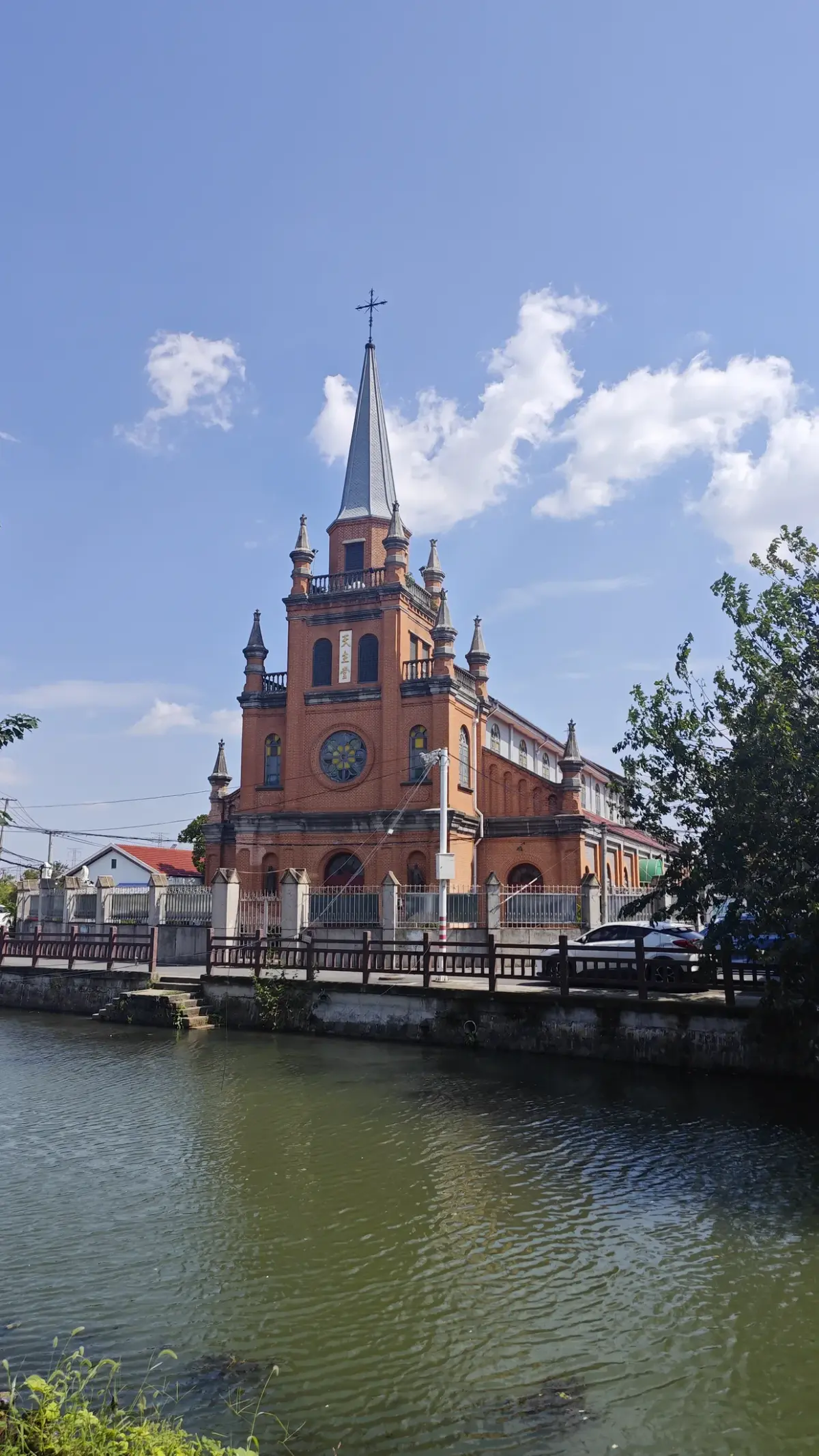
The orange-brick church with its spired tower, across the water.
Photo: 中二halo君 · used with permission · Xiaohongshu · BilibiliWhat you're looking at
- The 33 m bell tower beside the river
- The two-storey outline of the nave, with a gallery inside
- The size of the compound, with former school and orphanage buildings
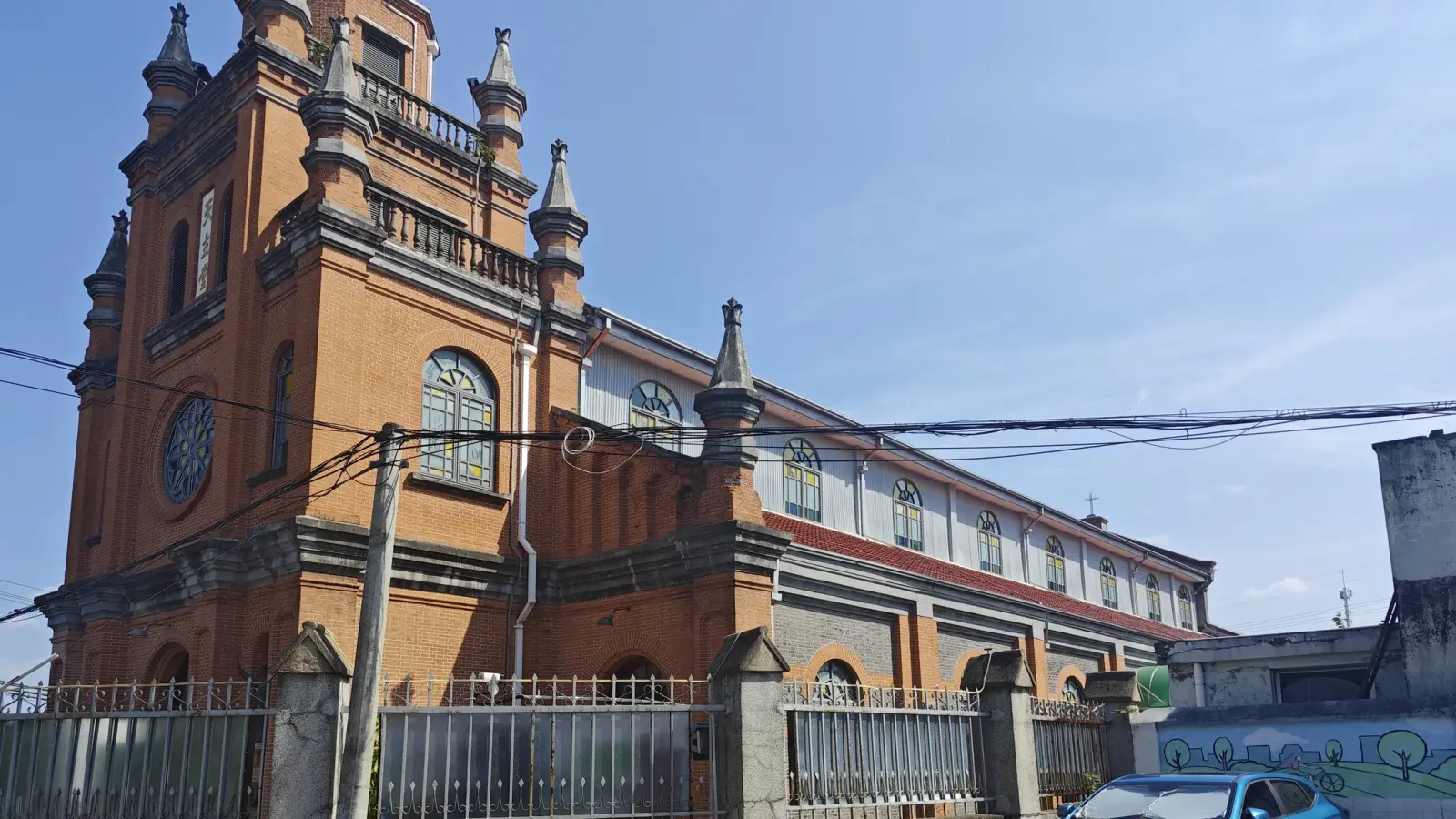
The west front and tower in strong sun, with the long nave roof running back.
Photo: 中二halo君 · used with permission · Xiaohongshu · Bilibili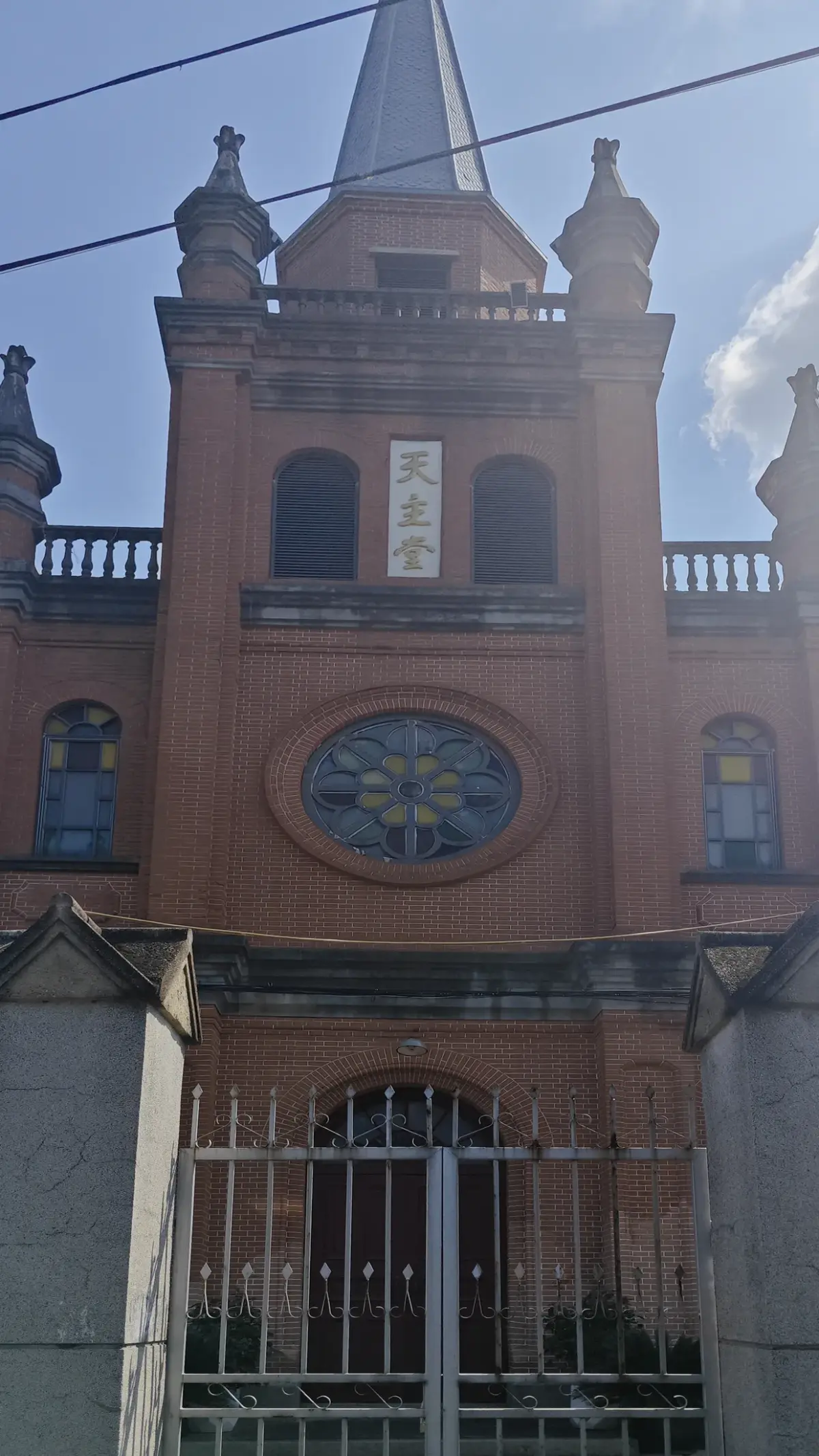
Looking up at the tower, with its clock-like round window and spire.
Photo: 中二halo君 · used with permission · Xiaohongshu · Bilibili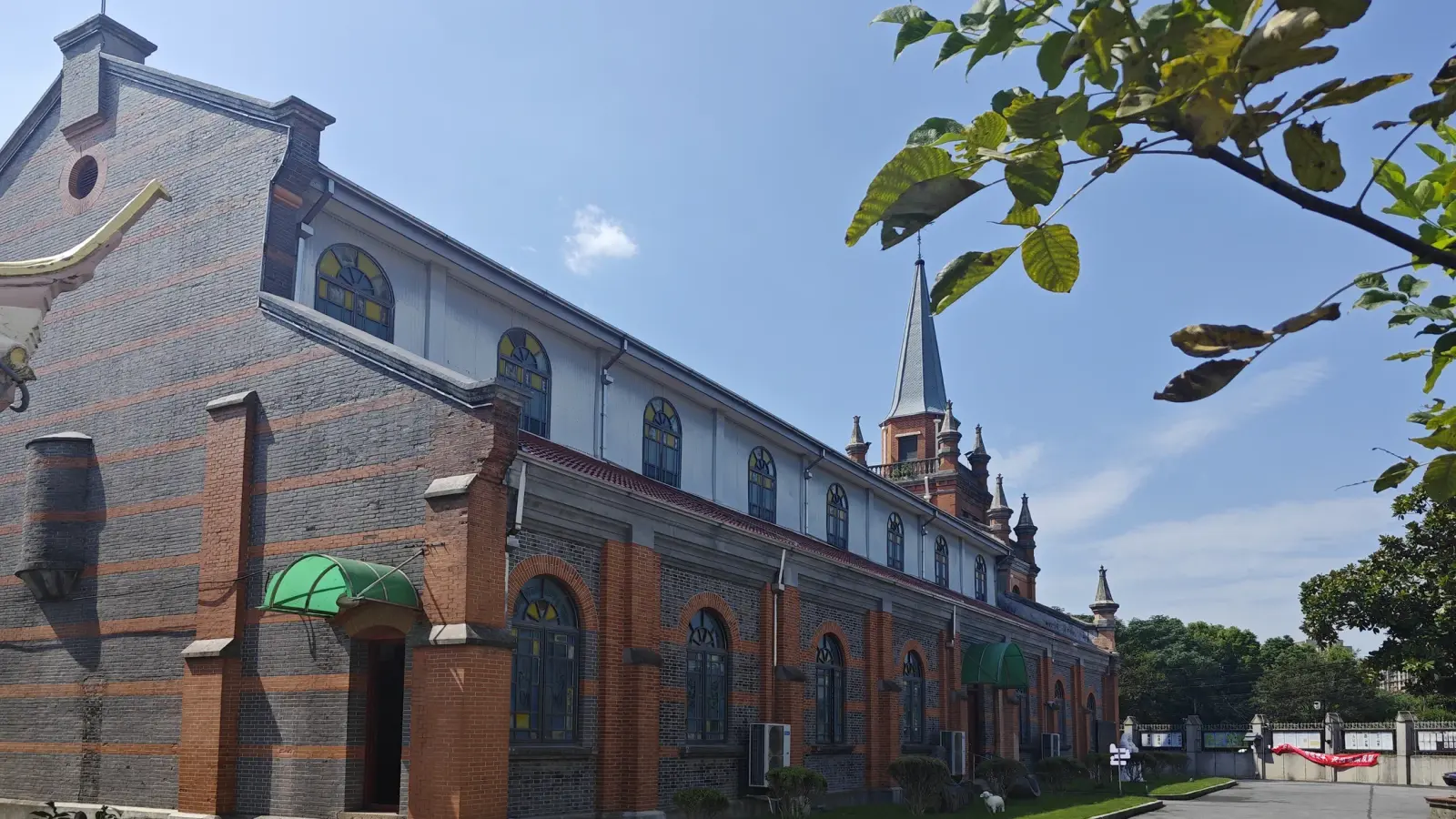
The long brick side wall with arched windows and the spire at the far end.
Photo: 中二halo君 · used with permission · Xiaohongshu · Bilibili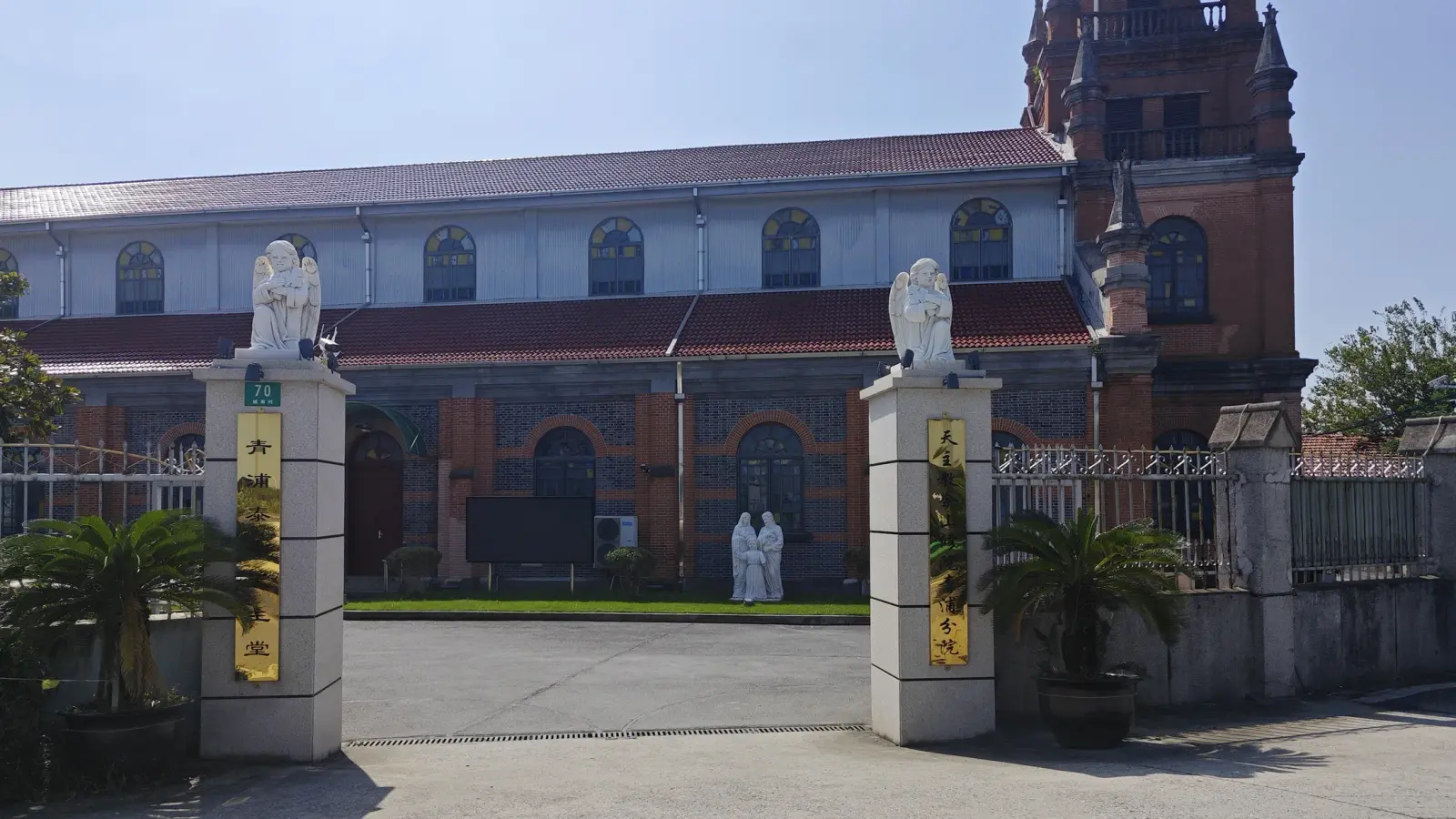
Gate piers topped with angel statues frame the churchyard and the nave behind.
Photo: 中二halo君 · used with permission · Xiaohongshu · Bilibili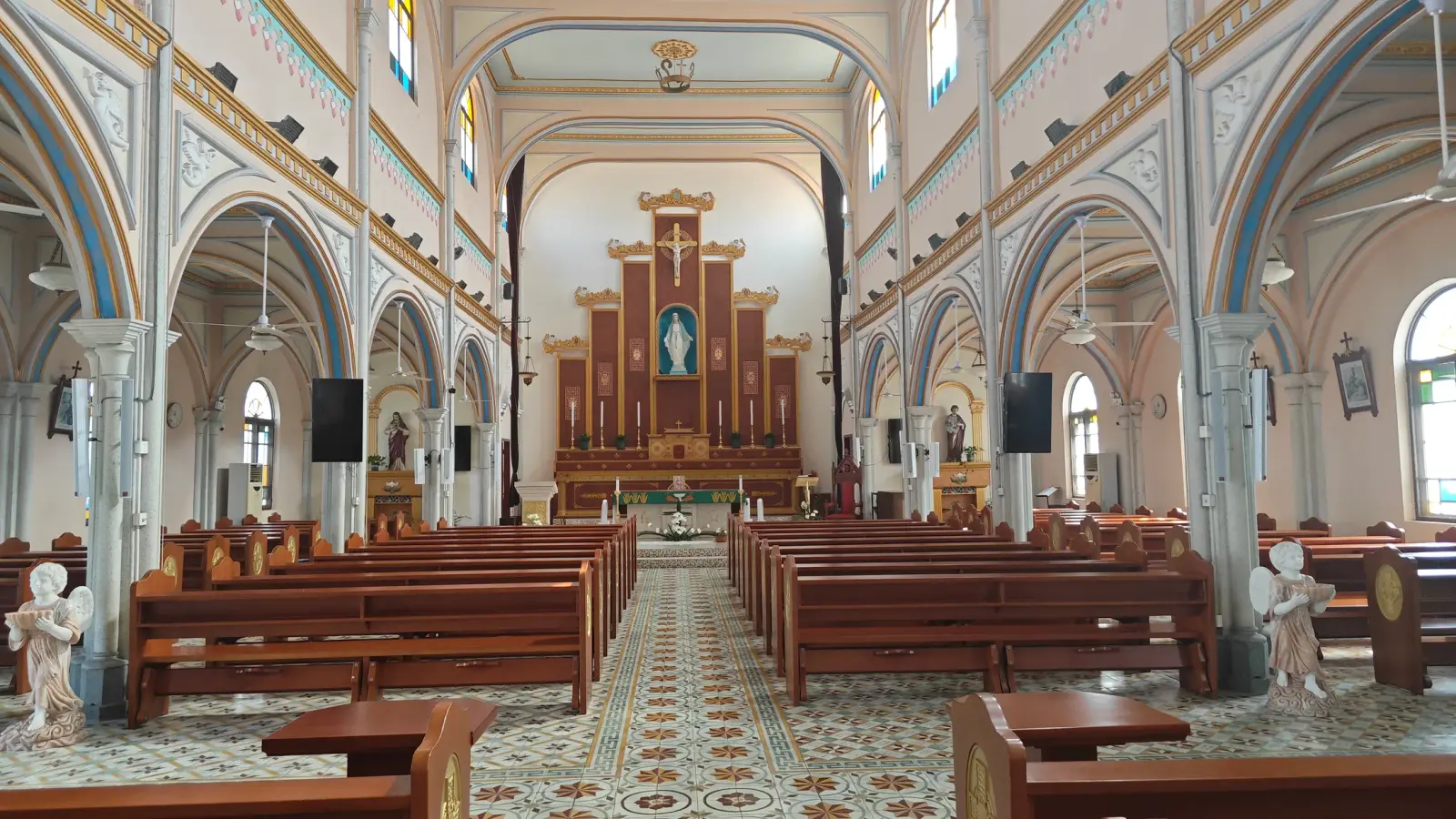
The nave looking to the altar, with painted arches, patterned floor tiles and wooden pews.
Photo: 中二halo君 · used with permission · Xiaohongshu · Bilibili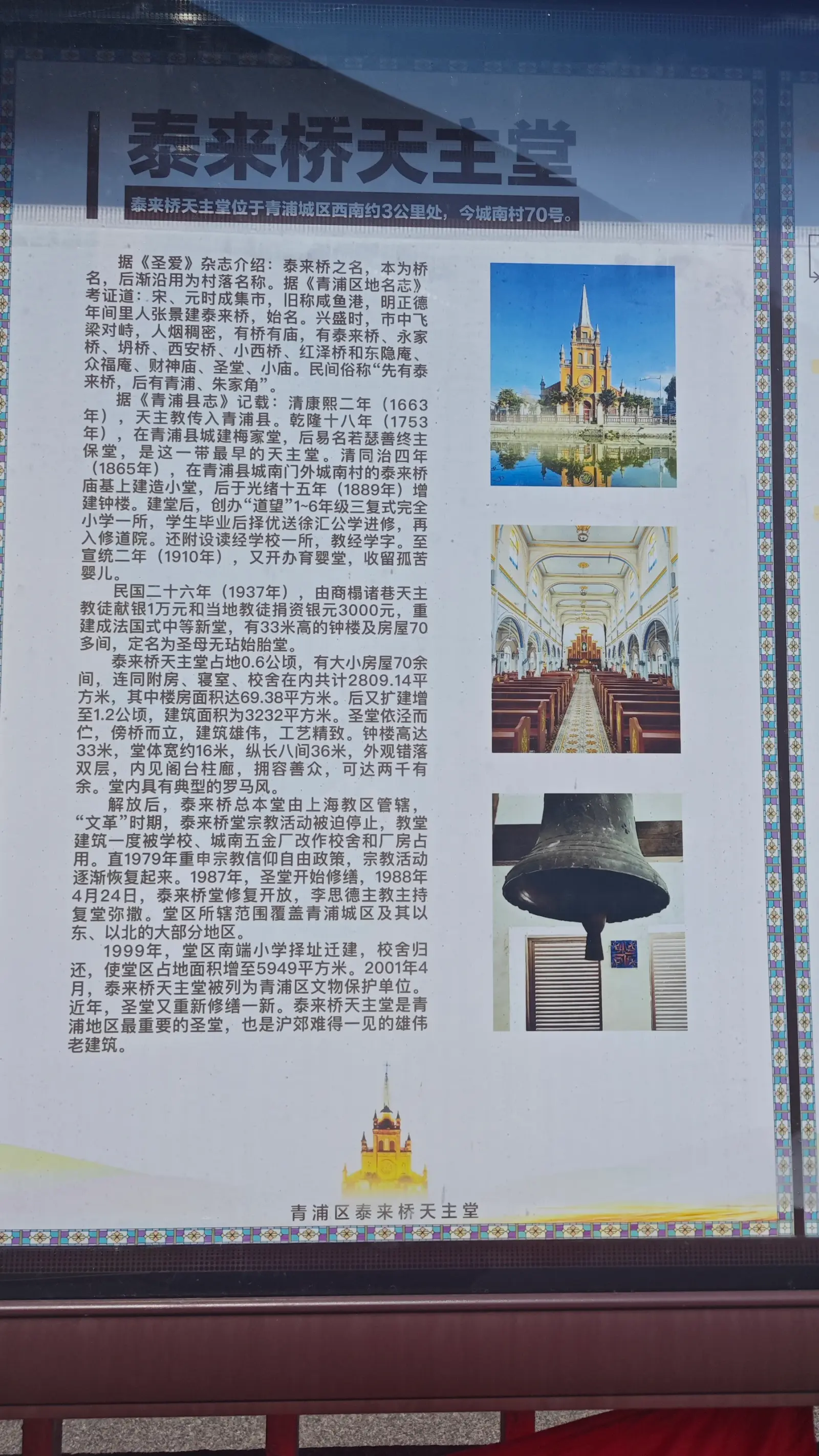
A Chinese history panel titled 泰来桥天主堂, with photographs of the church, its interior and a bell.
Photo: 中二halo君 · used with permission · Xiaohongshu · Bilibili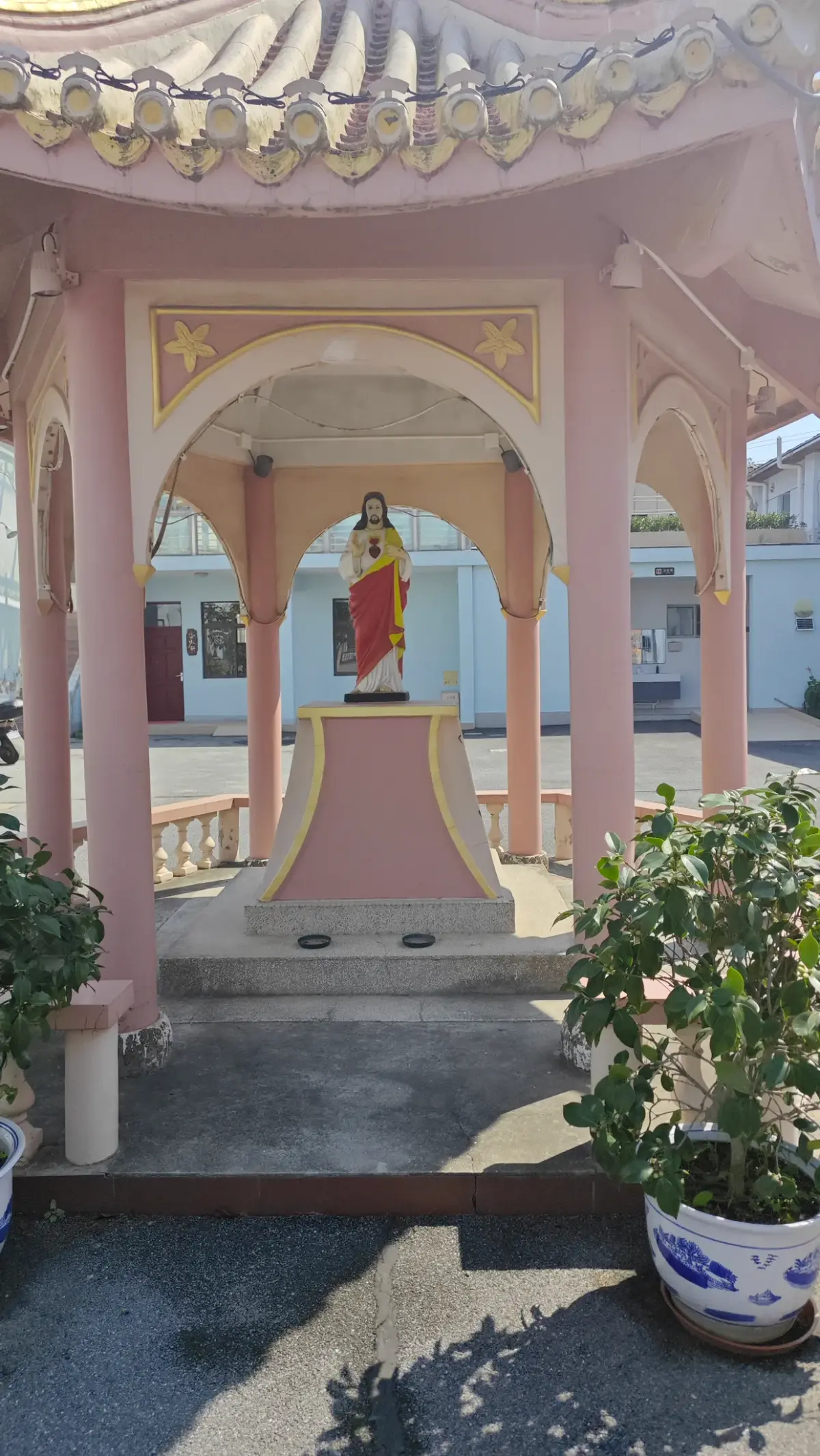
A pink pavilion sheltering a statue of the Sacred Heart in the churchyard.
Photo: 中二halo君 · used with permission · Xiaohongshu · BilibiliThe story
Immaculate Conception Church (泰来桥无原罪始胎圣母堂, Tàiláiqiáo Wúyuánzuì Shǐtāi Shèngmǔ Táng) is the largest Catholic church in Qingpu, on a river bank about 3 km southwest of the town centre. The tower stands 33 m high and, by the plaque’s count, the nave could hold 2,000 people.
Why was such a large church built here?
Tailaiqiao (泰来桥) was the centre of a Catholic fishing population on the waterways around Qingpu. A small church went up on a temple site in 1865 and a bell tower followed in 1889. The parish ran a school, a Bible school and, from 1910, an orphanage. Its fishermen members, among them a group of grain-boat people, ranged far from the village. In 1933 it became the seat of a Qingpu deanery, though Sheshan took that role back two years later.
When was the present church built?
Sources disagree. The Qingpu County Gazetteer says the church was begun in 1927 with money from Zhou De’an of Zhuxiang, handled by Fr Zhang Shilang. The plaque and the 1985-2000 gazetteer give 1937 and say 10,000 yuan came from Zhuxiang Catholics plus 3,000 from local people. The style is also described differently: the Religion Gazetteer says Gothic, the plaque says Romanesque inside.
Closure and reopening
In the Cultural Revolution the buildings housed a school and a hardware factory. Repairs began in 1987 and the church reopened on 24 April 1988 with Bishop Li Side; the Religion Gazetteer gives 2 April. A branch of Sheshan seminary used the compound from 1990. Qingpu District listed the church as a cultural relic site in April 2001.
What to look for
Look at the tower first, rising beside the water, then at the long nave, about 36 m from front to back, which the plaque describes as having two tiers on the outside and a columned gallery inside. The compound is far larger than the church itself: the former school and orphanage buildings account for much of it.
Signs at the church, in full (2)
The wording of plaques and notices as photographed. Timetables and rules may have changed since.
Tailaiqiao Catholic Church Mass times and AED notice
泰来桥天主堂弥撒时间与急救设备告示
Our translation of the Chinese
Tailaiqiao Catholic Church
Mass times
Weekdays: 08:00
Sundays: 09:00
Parish priest's contact telephone
18918795912
AED
External defibrillator
Article 184 of the Civil Code:
A person who voluntarily provides emergency assistance bears no civil liability for harm caused to the recipient as a result of that assistance.
Amoul Medical
National toll-free technical-service hotline: 400 9969 120
Fire-extinguisher location
How to use a fire extinguisher
Fire emergency telephone: 119
[Instructions below and small print in the background: illegible]
Chinese text
泰来桥天主堂
弥撒时间
平日 08:00
主日 09:00
本堂神父联系电话
18918795912
AED
体外除颤器
民法典第184条:
因自愿实施紧急救助行为造成受助人损害的,救助人不承担民事责任!
Amoul 安保医疗
全国免费技术服务热线:400 9969 120
灭火器放置点
灭火器使用方法
火警电话119
[下方使用说明及背景小字:辨读不清]
Tailaiqiao Catholic Church
泰来桥天主堂 · see the photo
Our translation of the Chinese
Tailaiqiao Catholic Church stands approximately 3 kilometres southwest of central Qingpu, at what is now 70 Chengnan Village.
According to Sheng'ai (“Holy Love”) magazine, Tailaiqiao was originally the name of a bridge and gradually became the name of the village. The Qingpu District Gazetteer of Place Names records that a market developed here during the Song and Yuan dynasties. Formerly called Xianyugang, the settlement acquired its present name after the local resident Zhang Jing built Tailai Bridge during the Zhengde reign of the Ming dynasty. At its height, bridges faced one another across the waterways and the market settlement was densely populated, with bridges and temples. These included Tailai Bridge, Yongjia Bridge, Tan Bridge, Xi'an Bridge, Xiaoxi Bridge and Hongze Bridge, as well as Dongyin Nunnery, Zhongfu Nunnery, the Temple of the God of Wealth, a Catholic church and a small temple. A local saying holds: “Tailaiqiao came before Qingpu and Zhujiajiao.”
According to the Qingpu County Gazetteer, Catholicism reached Qingpu County in 1663, the second year of the Kangxi reign of the Qing dynasty. In 1753, the 18th year of the Qianlong reign, Meijia Church was built in Qingpu's county town. Later renamed the Church of St Joseph, Patron of a Happy Death, it was the earliest Catholic church in this area. In 1865, the fourth year of the Tongzhi reign, a small chapel was built on the site of a temple at Tailaiqiao in Chengnan Village, outside the southern gate of Qingpu's county town. A bell tower was added in 1889, the 15th year of the Guangxu reign. After the church was built, a complete primary school called Daowang was established, teaching grades 1–6 in three combined-grade classes. Promising graduates were selected to continue their studies at Xuhui College before entering the seminary. A school for religious reading was also attached to the church, teaching scripture and literacy. By 1910, the second year of the Xuantong reign, an infant home had also been opened to care for orphaned and destitute babies.
In 1937, the 26th year of the Republic, Catholics from Zhuxiang in Shangta donated 10,000 yuan in silver, and local Catholics contributed 3,000 silver dollars. The church was rebuilt as a new, medium-sized French-style church with a bell tower 33 metres high and more than 70 rooms. It was named the Church of the Immaculate Conception of Mary.
Tailaiqiao Catholic Church occupied 0.6 hectares and had more than 70 rooms of different sizes. Including ancillary buildings, bedrooms and schoolrooms, the total floor area was 2,809.14 square metres, of which 69.38 square metres were in multi-storey buildings. Later extensions increased the site to 1.2 hectares and the building area to 3,232 square metres. The church stands beside a waterway and a bridge, with imposing architecture and fine workmanship. Its bell tower rises to 33 metres. The body of the church is approximately 16 metres wide and extends eight bays, or 36 metres, in length. The exterior has a varied, two-level composition; inside are galleries and colonnades, with room for more than 2,000 worshippers. The interior has a characteristic Roman style.
After the founding of the People's Republic of China, Tailaiqiao's principal parish came under the Diocese of Shanghai. During the Cultural Revolution, religious activities were forced to stop, and the church buildings were occupied for a time by a school and the Chengnan Hardware Factory, which used them as classrooms and workshops. After the policy of freedom of religious belief was reaffirmed in 1979, religious activities gradually resumed. Repairs to the church began in 1987. On 24 April 1988, Tailaiqiao Church reopened following restoration, with Bishop Li Side presiding at the reopening Mass. The parish covered central Qingpu and much of the area to its east and north.
In 1999, the primary school at the southern end of the parish grounds moved to a new site and its former buildings were returned, bringing the parish site area to 5,949 square metres. In April 2001, Tailaiqiao Catholic Church was designated a Qingpu District protected cultural relic site. In recent years, the church has again been renovated. Tailaiqiao Catholic Church is the most important church in the Qingpu area and an imposing old building rarely seen in Shanghai's suburbs.
Tailaiqiao Catholic Church, Qingpu District
Chinese text
泰来桥天主堂位于青浦城区西南约3公里处,今城南村70号。
据《圣爱》杂志介绍:泰来桥之名,本为桥名,后渐沿用为村落名称。据《青浦区地名志》考证道:宋、元时成集市,旧称咸鱼港,明正德年间里人张景建泰来桥,始名。兴盛时,市中飞梁对峙,人烟稠密,有桥有庙,有泰来桥、永家桥、坍桥、西安桥、小西桥、红泽桥和东隐庵、众福庵、财神庙、圣堂、小庙。民间俗称“先有泰来桥,后有青浦、朱家角”。
据《青浦县志》记载:清康熙二年(1663年),天主教传入青浦县。乾隆十八年(1753年),在青浦县城建梅家堂,后易名若瑟善终主保堂,是这一带最早的天主堂。清同治四年(1865年),在青浦县城南门外城南村的泰来桥庙基上建造小堂,后于光绪十五年(1889年)增建钟楼。建堂后,创办“道望”1~6年级三复式完全小学一所,学生毕业后择优送徐汇公学进修,再入修道院。还附设读经学校一所,教经学字。至宣统二年(1910年),又开办育婴堂,收留孤苦婴儿。
民国二十六年(1937年),由商榻诸巷天主教徒献银1万元和当地教徒捐资银元3000元,重建成法国式中等新堂,有33米高的钟楼及房屋70多间,定名为圣母无玷始胎堂。
泰来桥天主堂占地0.6公顷,有大小房屋70余间,连同附房、寝室、校舍在内共计2809.14平方米,其中楼房面积达69.38平方米。后又扩建增至1.2公顷,建筑面积为3232平方米。圣堂依泾而伫,傍桥而立,建筑雄伟,工艺精致。钟楼高达33米,堂体宽约16米,纵长八间36米,外观错落双层,内见阁台柱廊,拥容善众,可达两千有余。堂内具有典型的罗马风。
解放后,泰来桥总本堂由上海教区管辖,“文革”时期,泰来桥堂宗教活动被迫停止,教堂建筑一度被学校、城南五金厂改作校舍和厂房占用。直1979年重申宗教信仰自由政策,宗教活动逐渐恢复起来。1987年,圣堂开始修缮,1988年4月24日,泰来桥堂修复开放,李思德主教主持复堂弥撒。堂区所辖范围覆盖青浦城区及其以东、以北的大部分地区。
1999年,堂区南端小学择址迁建,校舍归还,使堂区占地面积增至5949平方米。2001年4月,泰来桥天主堂被列为青浦区文物保护单位。近年,圣堂又重新修缮一新。泰来桥天主堂是青浦地区最重要的圣堂,也是沪郊难得一见的雄伟老建筑。
青浦区泰来桥天主堂
How to visit
- Status
- Visitor access not yet confirmed
- Opening times and prices not yet confirmed; check before you go.
- Nearest metro
- Metro directions will be added after a site visit.Plan a metro journey here →
Chinese address — show this to a taxi driver
夏阳街道城南村70号
70 Chengnan Village, Xiayang Subdistrict, Qingpu District, Shanghai
Amap (高德地图) works best in mainland China; Apple Maps on iPhone. Both open in the app when it is installed.
The map position is approximate; the entrance has not been checked.
Nearby
Loading map…
No other places on the site are within a 20-minute walk yet.
Sources
- 1.Qingpu County Gazetteer, Catholicism (青浦县志 · 天主教), Shanghai Local Chronicles Office — 泰来桥天主堂gazetteer
- 2.Shanghai Religion Gazetteer, Catholicism, Open Churches (with table of other open churches) (上海宗教志 · 第四编天主教 · 第一节 开放教堂(附:其他开放教堂一览表)), Shanghai Local Chronicles Office — 十一、泰来桥圣母无原罪始胎堂gazetteer
- 3.Photographs of Shanghai churches and their signs, by 中二halo君 (上海教堂实拍照片(中二halo君)), 中二halo君, 中二halo君, 2026 — sign photographed at the churchfieldwork
- 4.Qingpu County Gazetteer 1985-2000, Catholicism (青浦县志1985-2000 · 第四节 天主教), Shanghai Local Chronicles Office — 泰来桥天主堂gazetteer