Church
Jinqiao Zhangjialou Catholic Church
张家楼耶稣圣心堂zhāng jiā lóu yē sū shèng xīn táng
Pudong's oldest Catholic congregation, founded in 1744, moved in 2003 to Jinqiao, where it now holds the district's English-language Mass.
Directory and photographs supplied by 中二halo君. Photographs used with permission. · Xiaohongshu · Bilibili
- Built
- 2002–2003
- Architect
- Not recorded
- Style
- romanesque-revival
- Heritage listing
- Not recorded
- Status
- Visitor access not yet confirmed
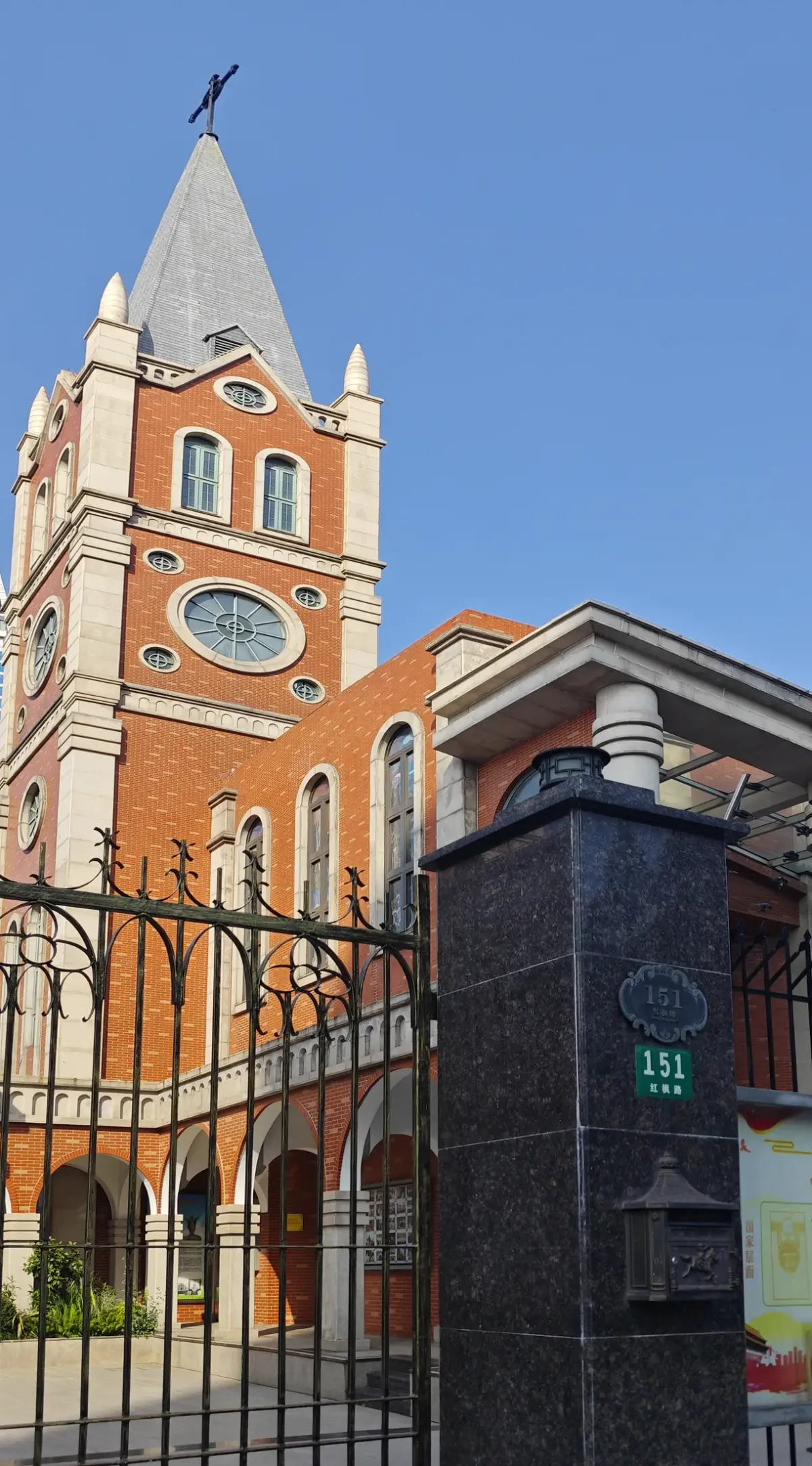
The orange-brick clock tower and slender spire seen beyond the gate post.
Photo: 中二halo君 · used with permission · Xiaohongshu · BilibiliWhat you're looking at
- The cross-topped tower, which the church's own history board describes as Romanesque in style
- The foundation tablet dated 25 April 2002, which records the move from Zhangjialou
- The bilingual notice boards: this is the church's Chinese and international community in one building
- The history display inside, which traces the congregation back to 1744
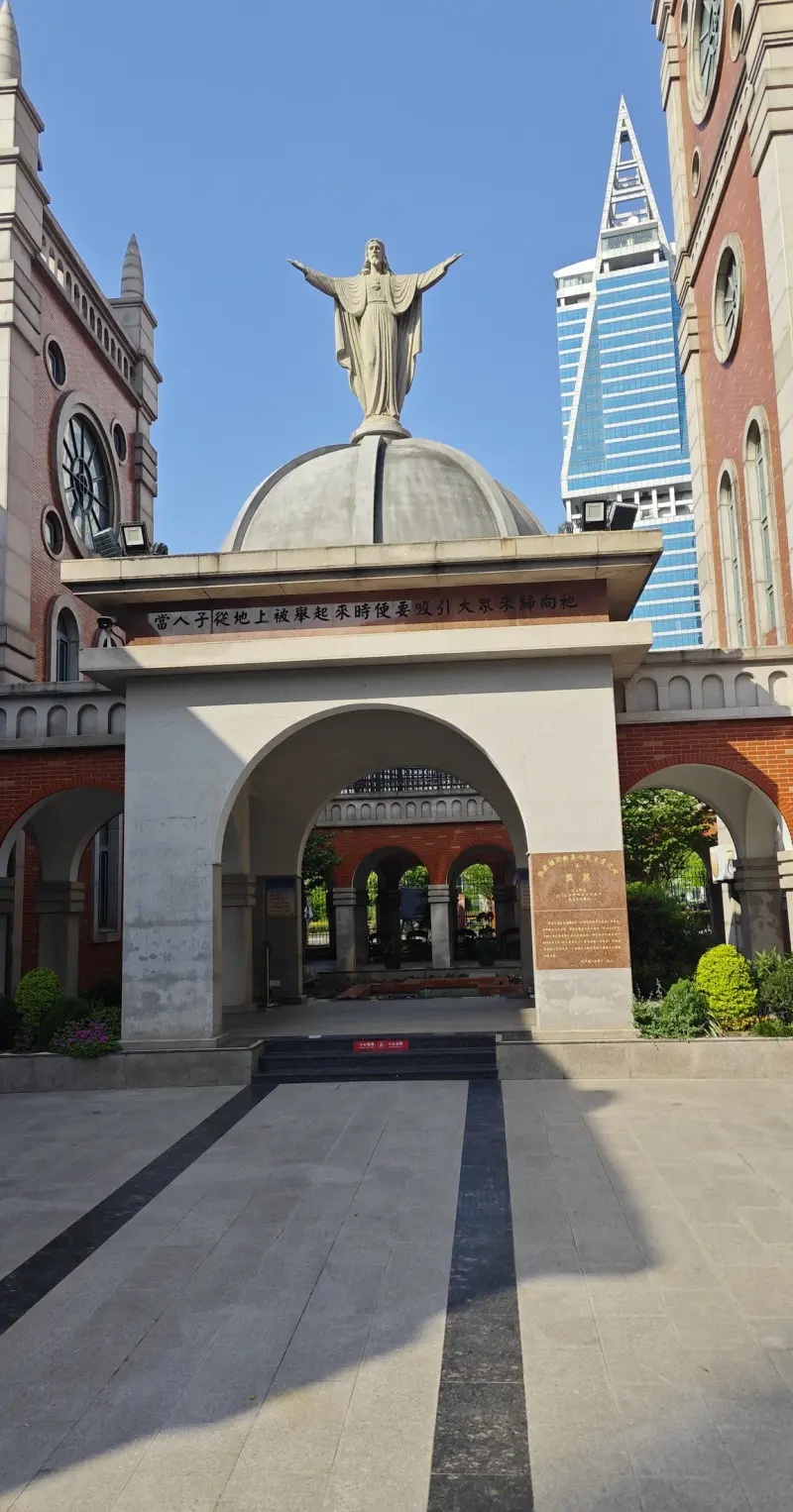
The arched gateway porch topped by a domed statue of Christ, with the church tower behind.
Photo: 中二halo君 · used with permission · Xiaohongshu · Bilibili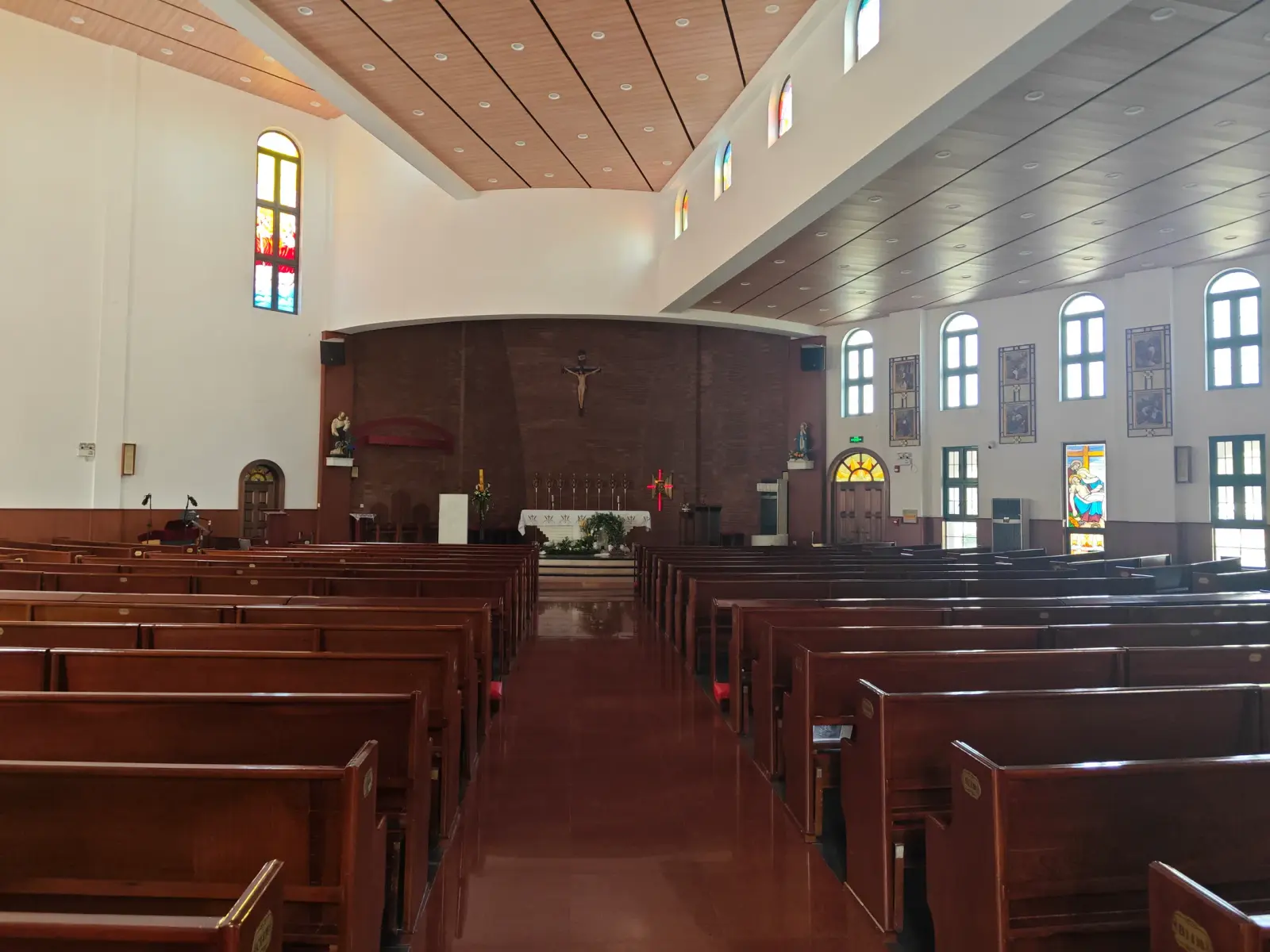
The nave, with polished wooden pews, a timber-panelled ceiling and a brown stone apse behind the crucifix.
Photo: 中二halo君 · used with permission · Xiaohongshu · Bilibili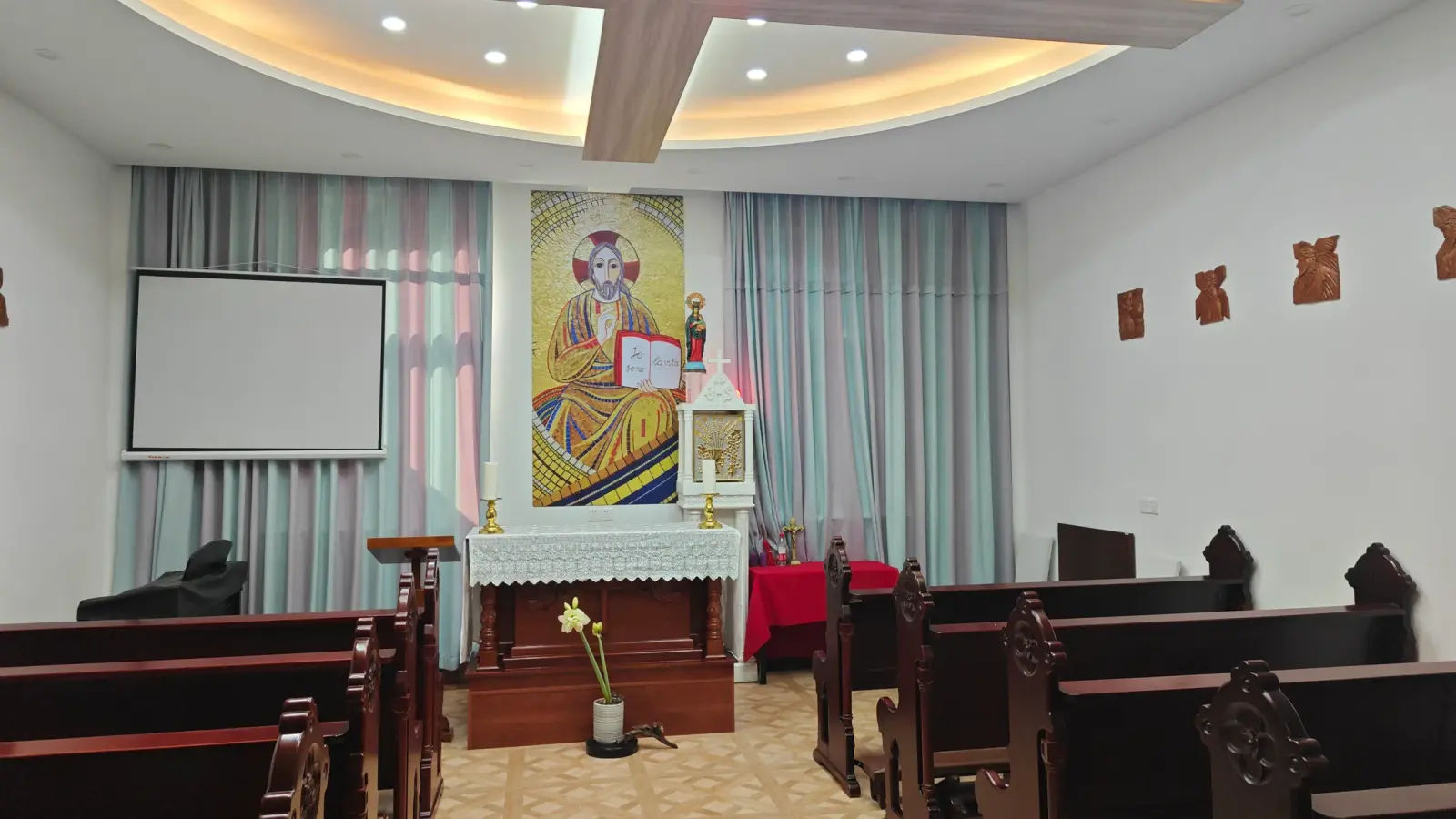
A small side chapel with an altar table and a gold mosaic of Christ.
Photo: 中二halo君 · used with permission · Xiaohongshu · Bilibili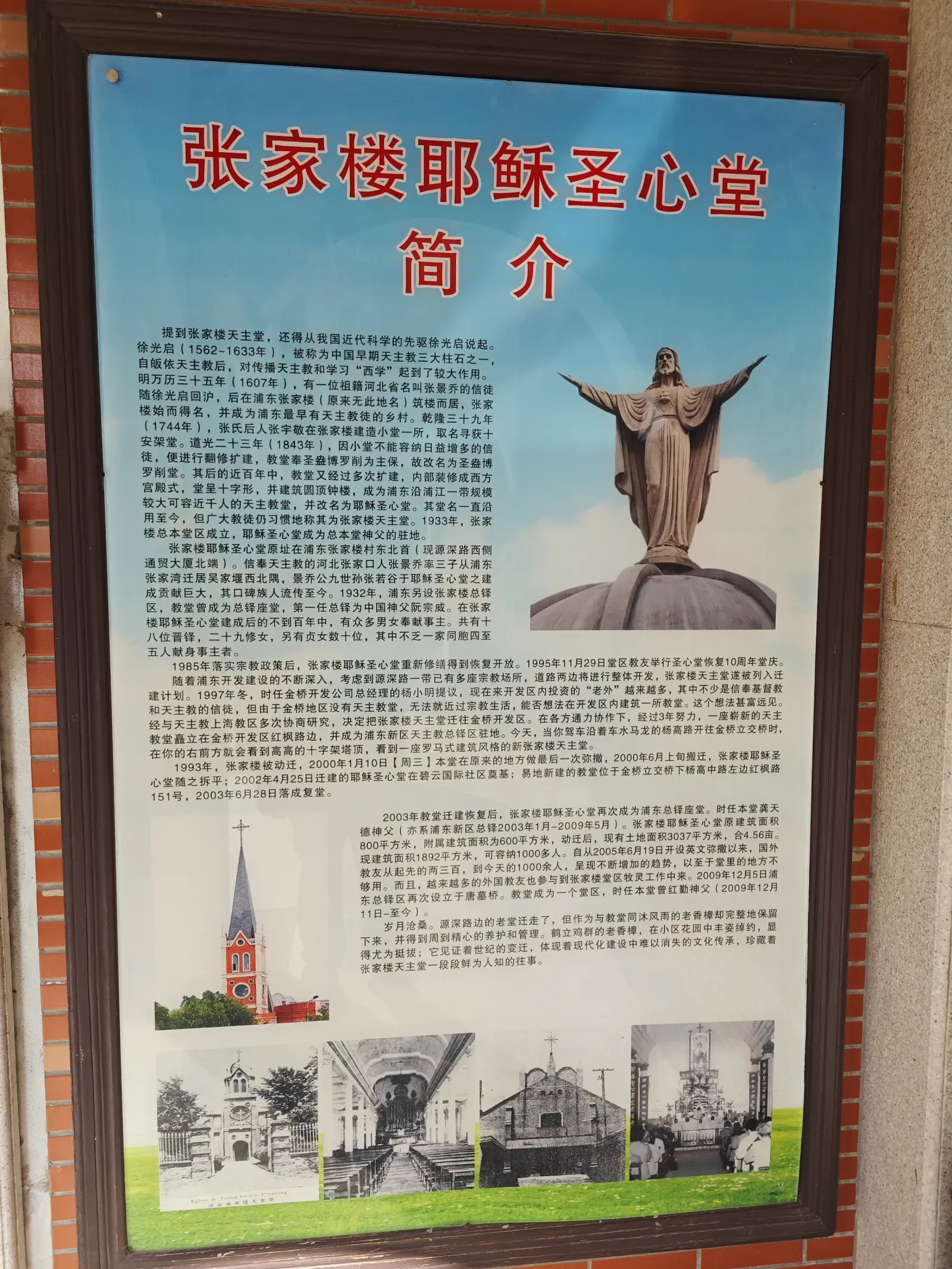
A framed history panel with a statue of Christ and four historic pictures of earlier church buildings.
Photo: 中二halo君 · used with permission · Xiaohongshu · Bilibili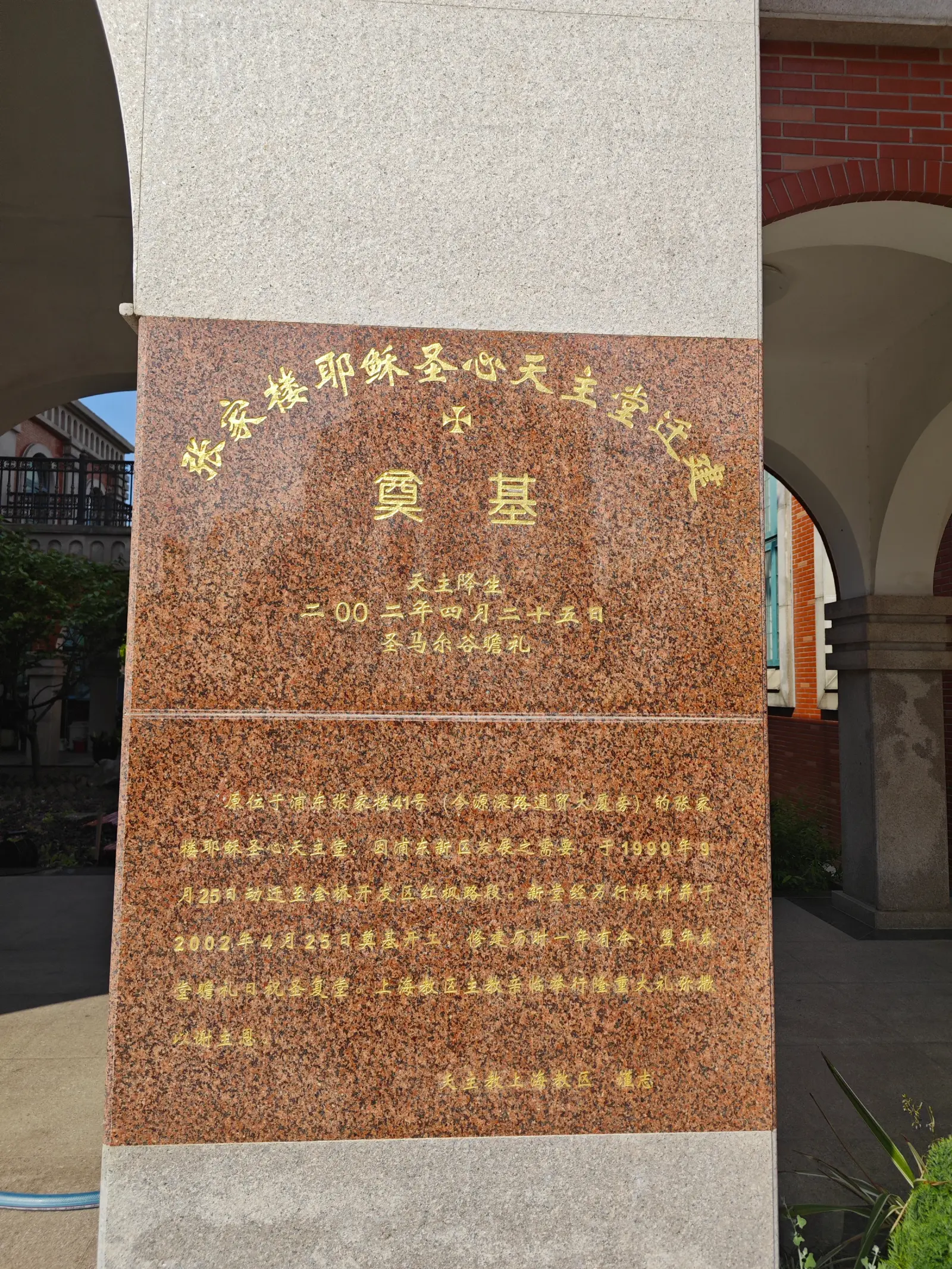
A red granite foundation stone with gilded Chinese inscription, dated 2002 according to its text.
Photo: 中二halo君 · used with permission · Xiaohongshu · BilibiliThe story
Zhangjialou (张家楼, Zhāngjiālóu) is the church where Catholic life in Pudong started, and it still carries that history even though the building is new. The congregation dates its founding to 1744, was moved across the district in 2003, and today is the main place in Pudong where foreign residents attend Mass in English.
Where did the name Zhangjialou come from?
Local accounts tie the village to the scholar Xu Guangqi (徐光启), the Shanghai-born Catholic convert. In 1607, according to the Pudong gazetteer, a believer surnamed Zhang travelled south with him and built a house in Pudong. People began calling the spot “Zhang family tower”, and it became the first village in Pudong with Catholics. The on-site history board adds a name, Zhang Jingqiao, and a northern hometown; the gazetteers do not, so treat these details as local tradition.
How did a village chapel grow into a cathedral-sized church?
A small chapel, the Finding of the Holy Cross, was built here in 1744. In 1843 it was enlarged, renamed for St Ambrose and given a seminary. Six years later the parish priest was made a coadjutor bishop, and the bishop’s office moved into the church. In 1865 the building was enlarged for about 700 people and took its present name, Sacred Heart of Jesus. A further enlargement in 1896 gave it a cross-shaped plan for nearly 1,000, and a domed bell tower followed. In 1932 Zhangjialou became the seat of a deanery for the whole of Pudong. One date is disputed: the gazetteers say 1744 for the first chapel, while the Shanghai religion gazetteer and the history board cite the 39th year of Qianlong, which would be 1774.
The board says the parish sent eighteen priests, twenty-nine nuns and dozens of consecrated women into church service.
Why was the old church pulled down?
The original church stood at 41 Zhangjialou, where Tongmao Building now stands beside Yuanshen Road. It had been closed in the Cultural Revolution, used by a school, and reopened in 1985. Pudong’s redevelopment then required the site. The foundation tablet puts the move in 1999; the history board records a last Mass on 10 January 2000. The Pudong gazetteer gives a different, earlier date of 1993, with a temporary church on Yinshan Road.
The congregation moved to Hongfeng Road in the Jinqiao development zone. According to the board, the zone’s general manager, Yang Xiaoming, had suggested a church there in 1997 because more foreign residents, many of them Christians, were arriving. The foundation ceremony took place on 25 April 2002, and Bishop Jin Luxian led the opening Mass on 28 June 2003.
What changed after the move?
On 19 June 2005 the first English-language Mass in Pudong was held here; more than 400 foreign worshippers came. The board says the number of foreign worshippers has since passed a thousand, and that more of them now take part in the parish’s pastoral work.
What to look for
Stand on Hongfeng Road and look up at the tower: the church’s display describes the building as Romanesque, topped with a cross. Inside the compound, find the foundation tablet dated 25 April 2002. The notice boards are in Chinese and English, which shows who uses the building today. Inside, the history display tells the story above in Chinese.
Signs at the church, in full (4)
The wording of plaques and notices as photographed. Timetables and rules may have changed since.
Jinqiao Zhangjialou Catholic Church: plaque and Mass times
金桥张家楼天主堂铭牌及弥撒时间
English printed on the sign
CATHOLIC DIOCESE OF SHANGHAI
JINQIAO ZHANGJIALOU CATHOLIC CHURCH
151 Hong Feng Road, Shanghai 201206
MASS SCHEDULE
Sunday Mass: 9:00 (Chinese) 11:00 (English)
Weekday Mass: Tuesday to Saturday (Chinese) 8:00
OPENING HOURS
Tuesday to Sunday: 8:00 to 17:00
Our translation of the Chinese
Catholic Diocese of Shanghai
Jinqiao Zhangjialou Catholic Church
Mass times
Sunday: Chinese Mass at 9:00; English Mass at 11:00
Weekdays: Chinese Mass, Tuesday–Saturday at 8:00
Opening hours
Tuesday–Sunday: 8:00–17:00
[The left part of the poster heading is outside the photograph] and catechumen courses
[Text outside the left edge] in Christ, he is a new creation;
[Text outside the left edge] has passed away; behold, all has become new.
2 Corinthians 5:17
Chinese text
天主教上海教區
金橋張家樓天主堂
彌撒時間
周日 中文弥撒9:00 英文弥撒11:00
平日 中文弥撒 周二至周六8:00
開放時間
周二至周日:上午8:00至下午17:00
[海报左侧标题超出画面]和慕道课程
[左侧文字超出画面]若在基督内,他就是一个新受造物,
[左侧文字超出画面]的已成过去,看,都成了新的。
格后5:17
Relocation of Zhangjialou Sacred Heart of Jesus Church: Foundation Stone
张家楼耶稣圣心天主堂迁建:奠基碑 · see the photo
Our translation of the Chinese
Relocation and Rebuilding of Zhangjialou Sacred Heart of Jesus Catholic Church
Foundation Stone
In the Year of Our Lord
25 April 2002
Feast of St Mark
Zhangjialou Sacred Heart of Jesus Catholic Church originally stood at 41 Zhangjialou, Pudong, beside what is now Tongmao Tower on Yuanshen Road. To meet the development needs of Pudong New Area, it was relocated on 25 September 1999 to the Hongfeng Road area of the Jinqiao Development Zone. A new design was prepared for the church, and the foundation stone was laid and construction began on 25 April 2002. Building work took more than a year; the following year, the church was consecrated and reopened on the parish's patronal feast day. The Bishop of Shanghai attended in person and celebrated a solemn Mass of thanksgiving for God's grace.
Respectfully recorded by the Catholic Diocese of Shanghai
Chinese text
张家楼耶稣圣心天主堂迁建
奠基
天主降生
二〇〇二年四月二十五日
圣马尔谷瞻礼
原位于浦东张家楼41号(今源深路通贸大厦旁)的张家楼耶稣圣心天主堂,因浦东新区发展之需要,于1999年9月25日动迁至金桥开发区红枫路段。新堂经另行设计并于2002年4月25日奠基开工,修建历时一年有余,翌年本堂瞻礼日祝圣复堂。上海教区主教亲临举行隆重大礼弥撒以谢主恩。
天主教上海教区 谨志
Zhangjialou Sacred Heart of Jesus Church: posted church rules
张家楼耶稣圣心堂昭示堂规
English printed on the sign
INTERNATIONAL CATHOLIC COMMUNITY
SACRED HEART OF JESUS CHURCH
151 Hong Feng Road, Pudong, Shanghai 201206, China
Facility Use Manual and Guidelines
Dear brothers and sisters, welcome back! Peace be with you!
(the rest of the English is too small to read in the photograph)
Our translation of the Chinese
Posted Church Rules
Dear friends, welcome. May the Lord grant you peace!
[The Chinese fine print in this photograph is not fully legible. The following complete account of the rules is based on the more legible English printed alongside it on the same sign; it is not presented as a verified word-for-word translation of the unreadable Chinese.]
Purpose
The church is not only God's temple, a holy place, but also our home. We need to love and care for it and preserve its holiness and beauty. Love this home as you love God.
Mission
Let God come and see what we have done in his name, and let him see that we have fulfilled his will.
Words from the priest
The two communities in this parish believe in one God, share the same faith, and share an understanding and pursuit of truth, mercy and blessing, although they have different cultural backgrounds, customs, habits and ways of expressing themselves. The church is a sign of God's presence on earth, where he meets us and refreshes our minds and bodies. It is a place of holiness, solemnity, serenity, cleanliness and order. We gather here to listen to his word and find peace in him. Persevere in prayer, rejoice in hope, be merciful and grateful, and remain modest, friendly, selfless and patient. God loves you: please love his home.
Inside the church
1. Enter modestly and appropriately dressed, remembering that this is a holy place. Hats, slippers, shorts and revealing clothing are prohibited.
2. People who are drunk must not enter the sanctuary, as they may disturb others.
3. People with contagious diseases should not attend Mass. People whose mental illness prevents them from controlling their behaviour should attend with a companion.
4. Sit, stand and kneel appropriately. Crossing the legs and removing shoes are prohibited.
5. Do not litter in our church home.
6. If you pass in front of the altar or tabernacle, genuflect or bow reverently.
7. God is not found amid noise and restlessness. Keep your voice down and be considerate whenever moving or opening and closing doors.
8. Stay focused in prayer and do not be easily distracted by people entering and leaving.
9. Do not eat, drink, smoke or chew inside the church. Running, littering and spitting are prohibited.
10. Look after your personal belongings to guard against theft.
11. Do not bring large items such as luggage into the church.
12. Children should be supervised by adults.
Outside the church
1. Care for the trees, plants and flowers as members of one family.
2. Follow the staff's parking directions and use the designated areas.
Use of rooms and equipment
1. Facilities may be used only by applicants approved in advance by a diocesan priest.
2. Parish facilities must not be used for personal purposes. Altering or removing facilities without approval is prohibited.
3. Request permission at least three days before using a room or facility. Leave it clean and in the condition in which it was found.
4. Obtain approval before using parish-hall kitchen appliances, clean them before leaving, and return all equipment in the operating condition in which it was received.
5. Personal meals and food service are prohibited.
6. Do not use nails, screws, tape or permanent hardware on building walls. Use only removable poster tape when putting up posters or signs.
Care of property and user responsibilities
1. Return Mass books and hymnals to the designated place after worship.
2. Videos, films and exhibition photos are limited to events and areas approved in advance.
3. Care for parish facilities and equipment. Do not use or move items without approval.
4. Parish facilities and furniture, including tables, chairs, curtains, projectors, microphones, air conditioners and their remote controls, are for parish functions and must not be removed. A person or group requesting or using an item is responsible for damage, repairs or replacement.
5. Conserve water and energy. Switch off lights and air conditioning after use.
6. Do not leave personal belongings in the church; take them away so that they are not treated as rubbish. Personal blessed objects no longer in use cannot be stored in the church because space is limited.
Cleaning
1. Pay attention to sanitation and hygiene. Where possible, wash your hands with soap and clean running water before handling food or eating, and after using the toilet.
2. The parish's two communities should keep the church clean. Users are responsible for cleaning the toilets; remind and supervise one another.
Chinese text
昭示堂规
亲爱的朋友:欢迎您,主赐平安!
目的:[本段中文细字模糊,未能逐字可靠辨清。]
宗旨:[本段中文细字模糊,未能逐字可靠辨清。]
本堂神父寄语:[本段中文细字模糊,未能完整转录。]
室内:
1.[有关衣着的中文细字模糊,未能完整转录。]
2.[有关酒后入堂的中文细字模糊,未能完整转录。]
3.[有关传染性疾病及陪同入堂的中文细字模糊,未能完整转录。]
4.[有关坐、立、跪姿及脱鞋的中文细字模糊,未能完整转录。]
5.[本条中文细字模糊,未能可靠辨清。]
6.请不要在圣台前穿行,[后半句细字模糊,未能可靠辨清]。
7.[有关保持安静及轻声进出的中文细字模糊,未能完整转录。]
8.[有关专心祈祷的中文细字模糊,未能完整转录。]
9.[有关堂内饮食、吸烟及卫生的中文细字模糊,未能完整转录。]
10.请保管好自己的私人物品,防止[后半句细字不清]。
11.请不要携带[字迹不清],行李等大件物品进入教堂。
12.儿童天性,[后四字未能可靠辨清]。
室外:
1.请爱护堂区内花草树木。
2.[有关车辆停放的中文细字模糊,未能完整转录。]
[房间、设备使用栏目,标题细字未完全辨清]:
1.[有关设备使用权限的中文细字模糊,未能完整转录。]
2.[有关设施公用及搬动的中文细字模糊,未能完整转录。]
3.[有关提前三天申请使用房间或设备的中文细字模糊,未能完整转录。]
4.[有关厨房使用与清洁的中文细字模糊,未能完整转录。]
5.[有关私人用餐的中文细字模糊,未能完整转录。]
6.[有关墙壁钉钉或张贴物品的中文细字模糊,未能完整转录。]
[物品及使用者责任栏目,标题细字未完全辨清]:
1.[有关归还弥撒书和歌本的中文细字模糊,未能完整转录。]
2.[有关摄像、拍照、录像需本堂神父许可的细字模糊,未能完整转录。]
3.[有关爱护设施和物品的中文细字模糊,未能完整转录。]
4.[有关堂区设施、设备的公用及损坏责任的细字模糊,未能完整转录。]
5.[有关节水节电及关闭灯具、空调的中文细字模糊,未能完整转录。]
6.[有关个人物品不得存放教堂内的细字模糊,未能完整转录。]
卫生[后两字未完全辨清]:
1.[有关公共卫生的中文细字模糊,未能完整转录。]
2.一个堂区,两个团体[其余细字模糊,未能完整转录]。
Zhangjialou Sacred Heart of Jesus Church: An Introduction
张家楼耶稣圣心堂:简介 · see the photo
Our translation of the Chinese
The story of Zhangjialou Catholic Church begins with Xu Guangqi (徐光启), a pioneer of modern science in China. Xu Guangqi (1562–1633), known as one of the Three Pillars of early Chinese Catholicism, played a considerable role in spreading Catholicism and studying “Western learning” after his conversion. In the thirty-fifth year of the Wanli reign (1607), a Catholic named Zhang Jingqiao (张景乔), whose ancestral home was in Hebei Province, accompanied Xu Guangqi back to Shanghai. He later built a multistorey house in Pudong and settled there. The place, which had not previously borne that name, consequently became known as Zhangjialou, “the Zhang family's multistorey house”, and became the earliest village in Pudong to have Catholic inhabitants. In the thirty-ninth year of the Qianlong reign (1744, as printed), a descendant of the Zhang family, Zhang Yujing (张宇敬), built a small chapel at Zhangjialou, naming it the Church of the Finding of the Cross [the Chinese name is printed as 寻获十安架堂, with 安 in place of the standard 字 in “cross”]. In the twenty-third year of the Daoguang reign (1843), the small chapel could no longer accommodate the growing congregation, so it was rebuilt and enlarged. St Ambrose was chosen as its patron, and it was renamed St Ambrose's Church. Over the next nearly one hundred years, it was extended several more times. The interior was decorated in the manner of a Western palace, the church had a cruciform plan, and a domed bell tower was built. It became one of the larger Catholic churches along the Huangpu River in Pudong, accommodating nearly a thousand people, and was renamed the Sacred Heart of Jesus Church. That name has remained in use, though most Catholics still habitually call it Zhangjialou Catholic Church. In 1933, the Zhangjialou main parish district was established, and the Sacred Heart Church became the residence of its senior parish priest.
The original site of Zhangjialou Sacred Heart of Jesus Church was at the northeastern end of Zhangjialou Village in Pudong, now north of Tongmao Tower on the west side of Yuanshen Road. Zhang Jingqiao, a Catholic from Zhangjiakou in Hebei, moved with his three sons from Zhangjiawan in Pudong to the northwestern corner of Wujiayan. His ninth-generation descendant, Zhang Ruogu (张若谷), made a major contribution to the completion of the Sacred Heart Church, and his reputation is still passed down among the family. In 1932, a separate Zhangjialou deanery was established in Pudong, and the church served as its seat. Its first dean was the Chinese priest Ruan Zongwei (阮宗威). In the less than one hundred years following the completion of Zhangjialou Sacred Heart of Jesus Church, many men and women dedicated themselves to serving God: eighteen were ordained as priests, twenty-nine became nuns, and several dozen more became consecrated virgins. There were even families in which four or five siblings entered religious service.
After the implementation of religious policy in 1985, Zhangjialou Sacred Heart of Jesus Church was repaired and reopened. On 29 November 1995, parishioners celebrated the tenth anniversary of its restoration.
As the development and construction of Pudong continued, Zhangjialou Catholic Church was included in a relocation and rebuilding programme. There were already several religious sites around Yuanshen Road, and comprehensive redevelopment was planned on both sides of the road. In the winter of 1997, Yang Xiaoming (杨小明), then general manager of the Jinqiao Development Company, proposed the following: increasing numbers of “foreigners” were investing in the development zone, and many were Protestant or Catholic, but because there was no Catholic church in Jinqiao, they could not practise their religion nearby. Could a church be built within the development zone? This was a far-sighted idea. After repeated consultations and discussions with the Catholic Diocese of Shanghai, it was decided to move Zhangjialou Catholic Church to the Jinqiao Development Zone. Through the combined efforts of all parties over three years, a brand-new Catholic church rose beside Hongfeng Road in the development zone and became the seat of the Catholic deanery for Pudong New Area. Today, as you drive along busy Yanggao Road towards the Jinqiao overpass, you can see a tall cross-topped tower ahead on your right: the new Zhangjialou Catholic Church, built in the Romanesque style.
In 1993, Zhangjialou was subject to relocation. On 10 January 2000 [Wednesday, as printed], the parish celebrated its last Mass at the original site. The move took place in early June 2000, after which Zhangjialou Sacred Heart of Jesus Church was demolished. On 25 April 2002, the foundation stone of the relocated Sacred Heart of Jesus Church was laid in Biyun International Community. The newly built church, on a different site, stands at 151 Hongfeng Road, to the left of Middle Yanggao Road below the Jinqiao overpass. It was completed and reopened on 28 June 2003.
Following its relocation and reopening in 2003, Zhangjialou Sacred Heart of Jesus Church once again became the seat of the Pudong deanery. Its parish priest at that time was Father Gong Tiande (龚天德), who was also dean of Pudong New Area from January 2003 to May 2009. The original church had a floor area of 800 square metres, with 600 square metres of ancillary buildings. After relocation, the site occupied 3,037 square metres, equivalent to 4.56 mu. The present building has a floor area of 1,892 square metres and can accommodate more than 1,000 people. Since an English-language Mass was introduced on 19 June 2005, the number of foreign Catholics has grown steadily, from two or three hundred initially to more than 1,000 today, to the point that there is insufficient space in the church. More and more foreign Catholics have also become involved in the pastoral work of Zhangjialou parish. On 5 December 2009, the Pudong deanery was established again at Tangmuqiao. The church became a parish, with Father Zeng Hongqin (曾红勤) as parish priest from 11 December 2009 to the present.
Much has changed over the years. The old church beside Yuanshen Road has moved away, but the old camphor tree that weathered the years alongside it has been preserved intact and receives careful maintenance and management. Rising conspicuously above its surroundings, the graceful old tree stands especially tall in the residential garden. It has witnessed the changes of a century, embodies a cultural inheritance that is difficult to erase through modernisation, and safeguards many little-known stories of Zhangjialou Catholic Church.
Chinese text
提到张家楼天主堂,还得从我国近代科学的先驱徐光启说起。徐光启(1562~1633年),被称为中国早期天主教三大柱石之一,自皈依天主教后,对传播天主教和学习“西学”起到了较大作用。明万历三十五年(1607年),有一位祖籍河北省名叫张景乔的信徒随徐光启回沪,后在浦东张家楼(原来无此地名)筑楼而居,张家楼始而得名,并成为浦东最早有天主教徒的乡村。乾隆三十九年(1744年),张氏后人张宇敬在张家楼建造小堂一所,取名寻获十安架堂。道光二十三年(1843年),因小堂不能容纳日益增多的信徒,便进行翻修扩建,教堂奉圣盎博罗削为主保,故改名为圣盎博罗削堂。其后的近百年中,教堂又经过多次扩建,内部装修成西方宫殿式,堂呈十字形,并建筑圆顶钟楼,成为浦东沿浦江一带规模较大可容近千人的天主教堂,并改名为耶稣圣心堂。其堂名一直沿用至今,但广大教徒仍习惯地称其为张家楼天主堂。1933年,张家楼总本堂区成立,耶稣圣心堂成为总本堂神父的驻地。
张家楼耶稣圣心堂原址在浦东张家楼村东北首(现源深路西侧通贸大厦北端)。信奉天主教的河北张家口人张景乔率三子从浦东张家湾迁居吴家堰西北隅,景乔公九世孙张若谷于耶稣圣心堂之建成贡献巨大,其口碑族人流传至今。1932年,浦东另设张家楼总铎区,教堂曾成为总铎座堂,第一任总铎为中国神父阮宗威。在张家楼耶稣圣心堂建成后的不到百年中,有众多男女奉献事主。共有十八位晋铎,二十九修女,另有贞女数十位,其中不乏一家同胞四至五人献身事主者。
1985年落实宗教政策后,张家楼耶稣圣心堂重新修缮得到恢复开放。1995年11月29日堂区教友举行圣心堂恢复10周年堂庆。
随着浦东开发建设的不断深入,考虑到源深路一带已有多座宗教场所,道路两边将进行整体开发,张家楼天主堂遂被列入迁建计划。1997年冬,时任金桥开发公司总经理的杨小明提议,现在来开发区内投资的“老外”越来越多,其中不少是信奉基督教和天主教的信徒,但由于金桥地区没有天主教堂,无法就近过宗教生活,能否想法在开发区内建筑一所教堂。这个想法甚富远见。经与天主教上海教区多次协商研究,决定把张家楼天主堂迁往金桥开发区。在各方通力协作下,经过3年努力,一座崭新的天主教堂矗立在金桥开发区红枫路边,并成为浦东新区天主教总铎区驻地。今天,当你驾车沿着车水马龙的杨高路开往金桥立交桥时,在你的右前方就会看到高高的十字架塔顶,看到一座罗马式建筑风格的新张家楼天主堂。
1993年,张家楼被动迁,2000年1月10日【周三】本堂在原来的地方做最后一次弥撒,2000年6月上旬搬迁,张家楼耶稣圣心堂随之拆平;2002年4月25日迁建的耶稣圣心堂在碧云国际社区奠基;易地新建的教堂位于金桥立交桥下杨高中路左边红枫路151号,2003年6月28日落成复堂。
2003年教堂迁建恢复后,张家楼耶稣圣心堂再次成为浦东总铎座堂。时任本堂龚天德神父(亦系浦东新区总铎2003年1月-2009年5月)。张家楼耶稣圣心堂原建筑面积800平方米,附属建筑面积为600平方米,动迁后,现有土地面积3037平方米,合4.56亩。现建筑面积1892平方米,可容纳1000多人。自从2005年6月19日开设英文弥撒以来,国外教友从起先的两三百,到今天的1000余人,呈现不断增加的趋势,以至于堂里的地方不够用。而且,越来越多的外国教友也参与到张家楼堂区牧灵工作中来。2009年12月5日浦东总铎区再次设立于唐墓桥。教堂成为一个堂区,时任本堂曾红勤神父(2009年12月11日-至今)。
岁月沧桑。源深路边的老堂迁走了,但作为与教堂同沐风雨的老香樟却完整地保留下来,并得到周到精心的养护和管理。鹤立鸡群的老香樟,在小区花园中丰姿绰约,显得尤为挺拔;它见证着世纪的变迁,体现着现代化建设中难以消失的文化传承,珍藏着张家楼天主堂一段段鲜为人知的往事。
How to visit
- Status
- Visitor access not yet confirmed
- Opening times and prices not yet confirmed; check before you go.
- Nearest metro
- Metro directions will be added after a site visit.Plan a metro journey here →
Chinese address — show this to a taxi driver
金桥镇红枫路151号
151 Hongfeng Road, Jinqiao Town, Pudong, Shanghai
Amap (高德地图) works best in mainland China; Apple Maps on iPhone. Both open in the app when it is installed.
The map position is approximate; the entrance has not been checked.
Nearby
Loading map…
No other places on the site are within a 20-minute walk yet.
Sources
- 1.Pudong New Area Gazetteer 1993-2009, main religious venues, Catholic churches (浦东新区志(1993-2009) · 第三章 主要宗教活动场所及其活动 · 第三节 天主教堂), Shanghai Local Chronicles Office — 第三节 张家楼天主堂gazetteer
- 2.Shanghai Religion Gazetteer, Catholicism, Open Churches (with table of other open churches) (上海宗教志 · 第四编天主教 · 第一节 开放教堂(附:其他开放教堂一览表)), Shanghai Local Chronicles Office — §九 张家楼耶稣圣心堂; §九gazetteer
- 3.Photographs of Shanghai churches and their signs, by 中二halo君 (上海教堂实拍照片(中二halo君)), 中二halo君, 中二halo君, 2026 — sign photographed at the churchfieldwork
- 4.Chuansha County Gazetteer, notable churches (川沙县志 · 第三节 著名教堂), Shanghai Local Chronicles Office — 张家楼耶稣圣心堂gazetteer