Church
Our Lady of the Rosary Church, Nanhui
南汇玫瑰圣母堂nán huì méi guī shèng mǔ táng
A 1906 church beside Nanhui's old moat, once attended by fishing families who came by boat; restored in 2015 after tile cladding hid its walls.
Directory and photographs supplied by 中二halo君. Photographs used with permission. · Xiaohongshu · Bilibili
- Built
- 1906
- Architect
- Not recorded
- Style
- Not recorded
- Heritage listing
- Registered immovable cultural relic of former Nanhui District (南汇区登记不可移动文物) · district · 2003
- Status
- Visitor access not yet confirmed
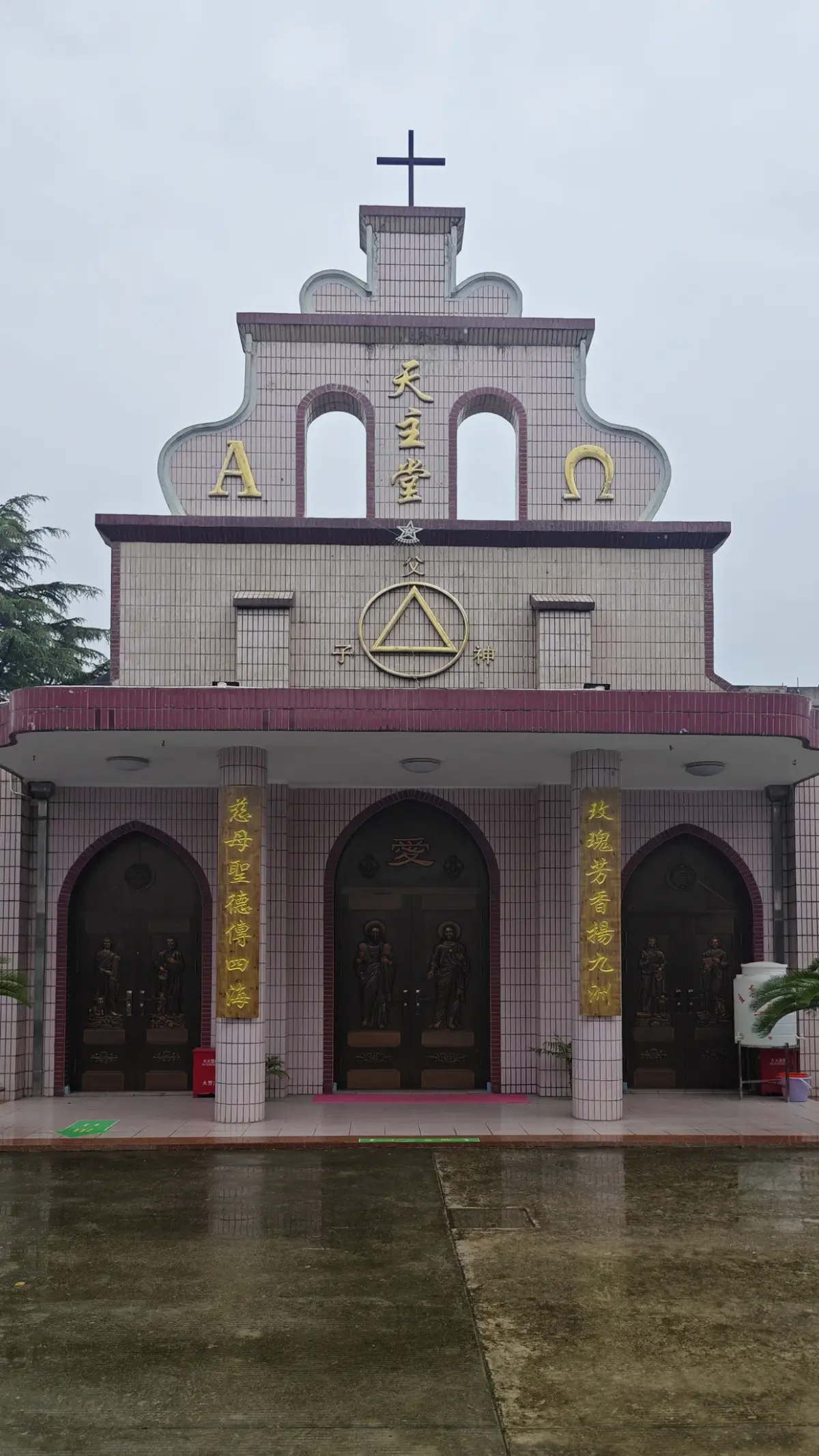
The pink-tiled front with a stepped gable, cross, Alpha and Omega symbols and three arched doorways.
Photo: 中二halo君 · used with permission · Xiaohongshu · BilibiliWhat you're looking at
- The bell tower at the south end, about 30 metres tall, which marks the original entrance
- The three-storey gate front on the north side, where the entrance was moved in 1986
- The line of the old moat beside the church, which explains the nickname West Gate Church
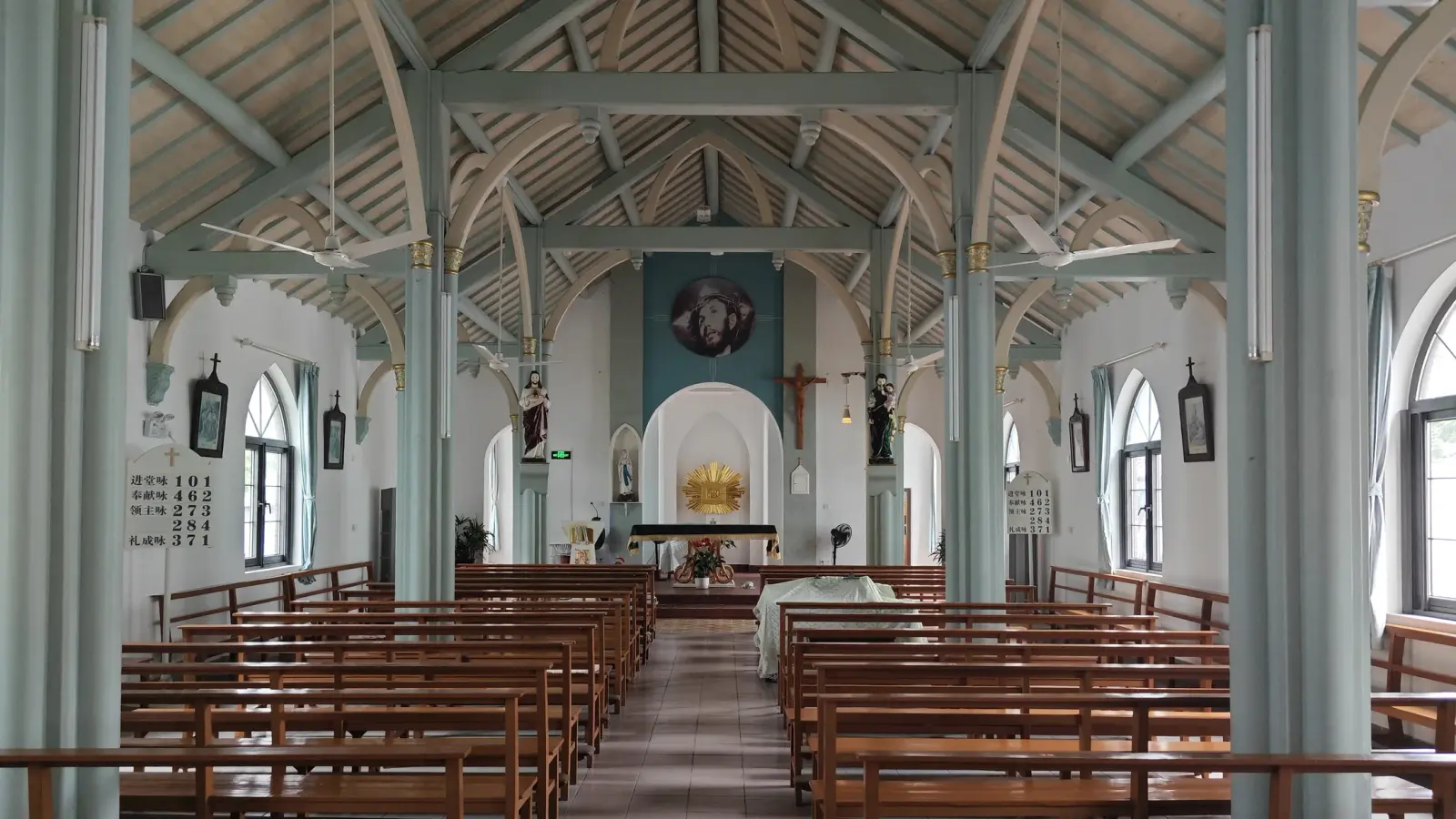
The interior, with pale green columns supporting an open timber roof and wooden pews leading to the sanctuary.
Photo: 中二halo君 · used with permission · Xiaohongshu · Bilibili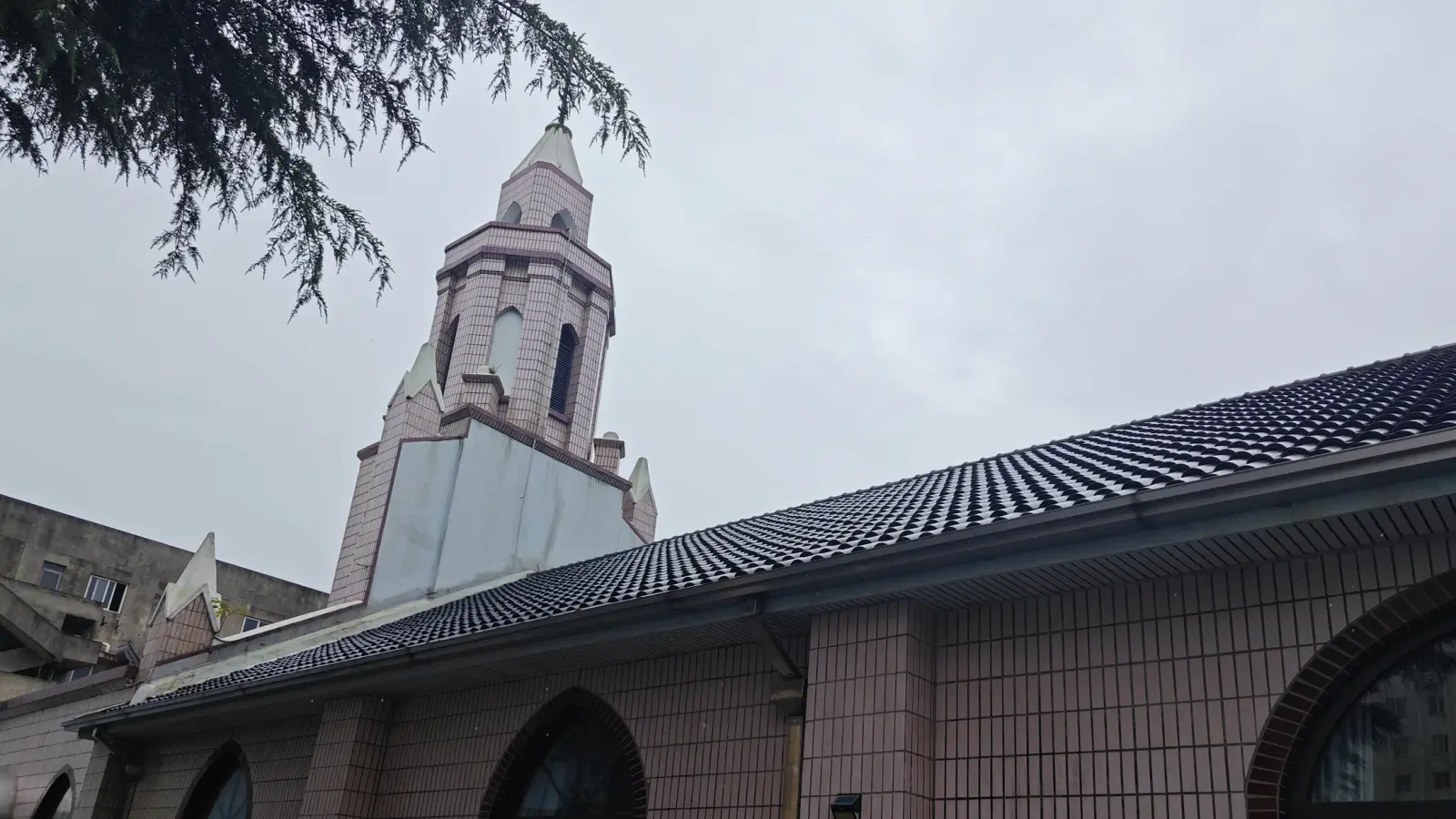
The bell tower and the long side of the church with its pointed-arch windows.
Photo: 中二halo君 · used with permission · Xiaohongshu · Bilibili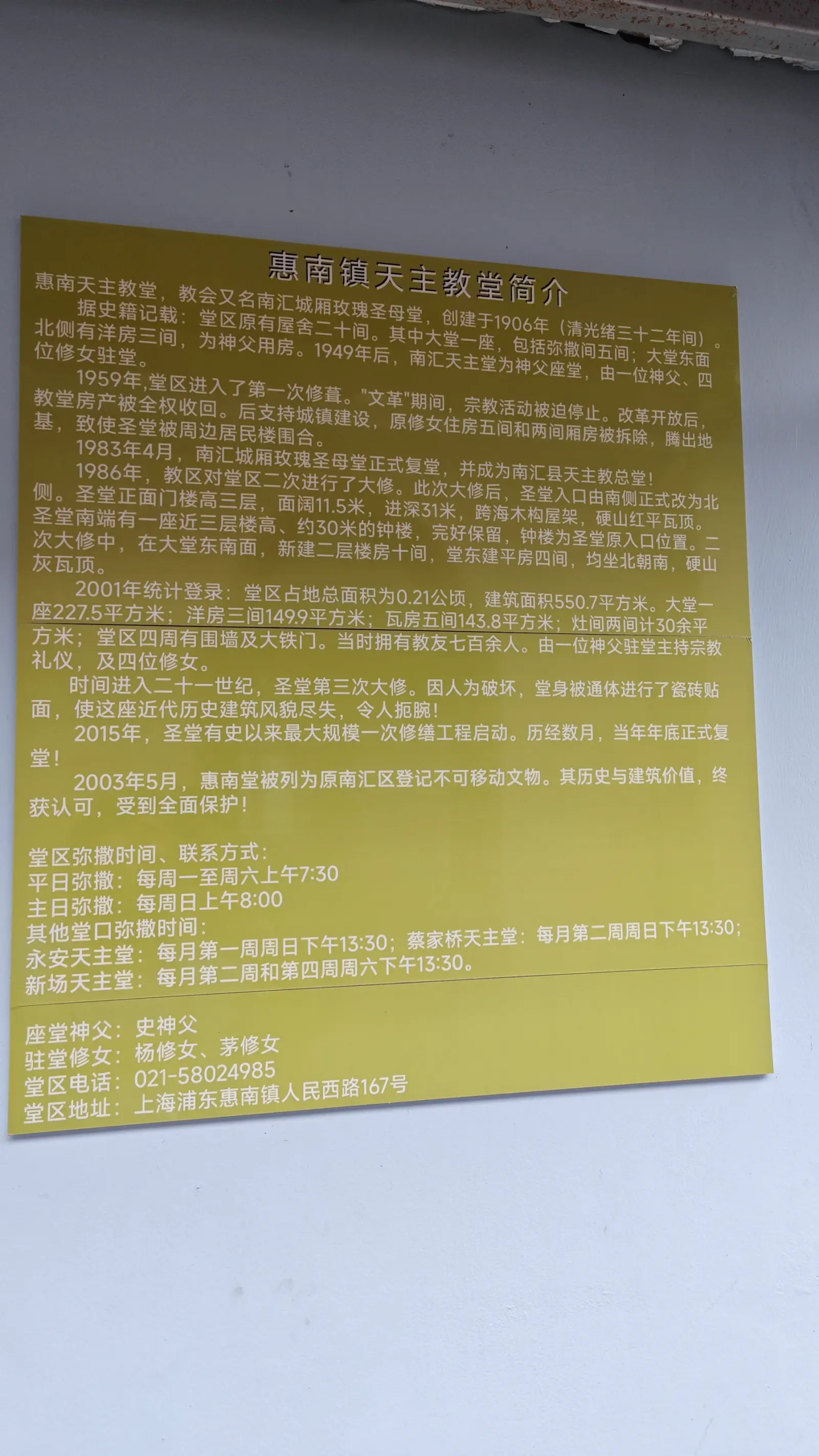
A yellow information board in Chinese giving the church history and Mass times.
Photo: 中二halo君 · used with permission · Xiaohongshu · Bilibili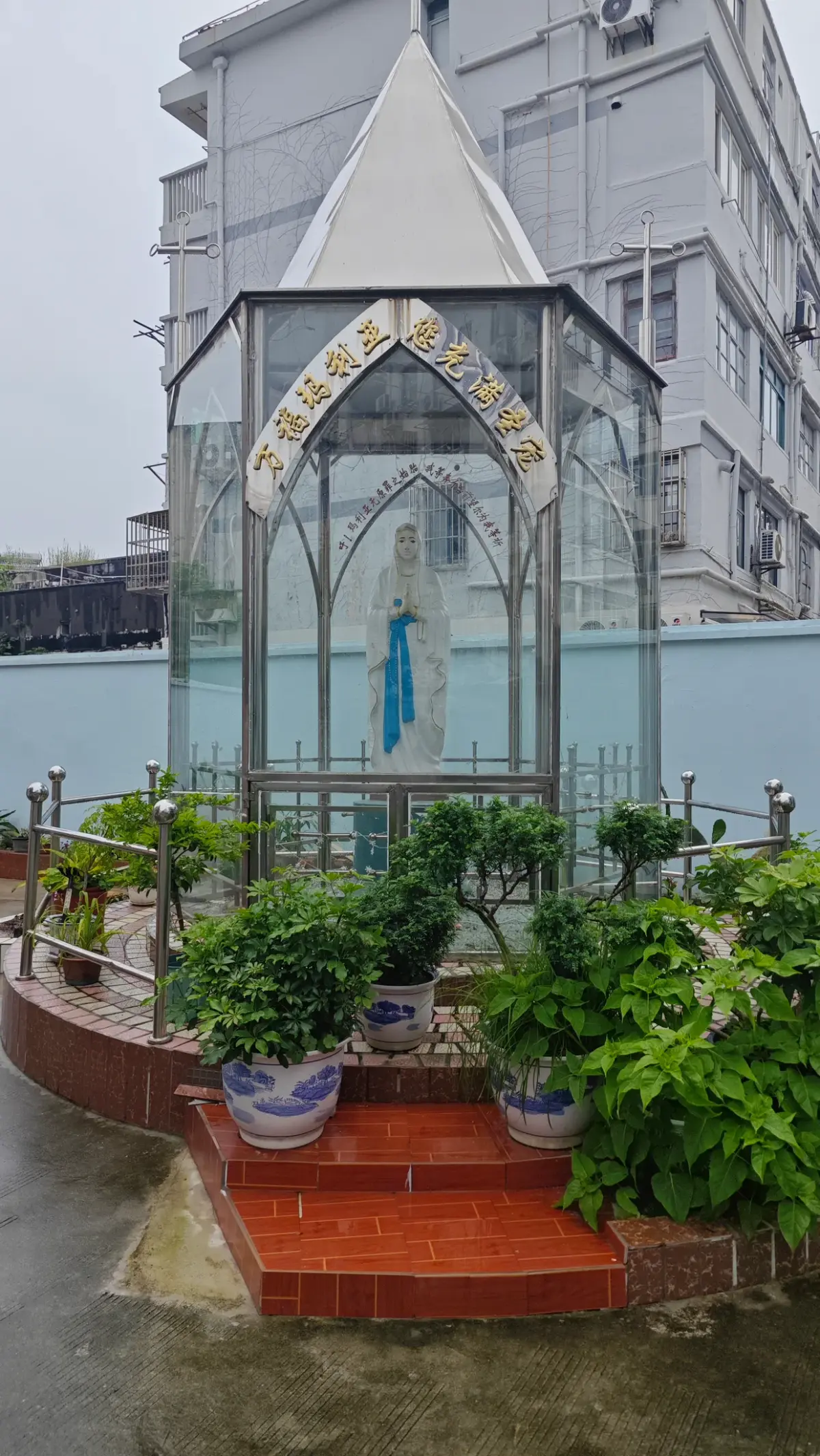
A glass shrine with a statue of the Virgin, surrounded by potted plants.
Photo: 中二halo君 · used with permission · Xiaohongshu · BilibiliThe story
Our Lady of the Rosary Church in Nanhui (南汇, Nánhuì) was built in 1906 beside the town’s moat, just inside the west gate. Local people called it the West Gate Church, and its tall bell tower still stands over the blocks around it.
Why was it known as the West Gate Church?
The church stood within the city wall, against the moat on the west side. Before 1949 most of its parishioners were fishermen, and they rowed along the canals to reach Mass. The compound began with 20 rooms: a hall with five Mass bays, three Western-style houses for the priests, and smaller buildings. After 1949 it was the priest’s seat church, with one priest and four nuns living there.
What happened to the compound?
During the Cultural Revolution the county housing office took over the buildings and turned them into a yard for casting cement parts. After the church was returned, the nuns’ quarters and two side rooms were pulled down to clear ground for town building, and apartment blocks now surround the church. It reopened in April 1983 as the main Catholic church in Nanhui county, and repairs in 1986 moved the entrance from the south to the north side. The tower, about 30 metres tall, stands at the south end where the original entrance was. The new gate front is three storeys high, 11.5 metres wide and 31 metres deep, with a timber-trussed roof and a gabled roof of red tile.
What went wrong with the walls?
The introduction board is frank about it. In the early 2000s the whole building was covered in ceramic tile, and the board says this stripped it of its historic look. In 2015 a major restoration began, and the church reopened at the end of that year. In May 2003 it had already been registered as an immovable cultural relic by the former Nanhui District.
How big is it?
A 2001 count gave a site of 0.21 hectares with 550.7 square metres of buildings, including a hall of 227.5 square metres. About 700 believers belonged to the parish. The hall holds around 300 people, with more than 260 kneelers.
What to look for
Walk to the south end first and look up at the bell tower, which marks the first entrance. Then go round to the north front, where the three-storey gate house is now the way in. Note how closely apartments crowd the site, and look for the line of the old moat that gave the church its nickname.
Signs at the church, in full (1)
The wording of plaques and notices as photographed. Timetables and rules may have changed since.
Huinan Town Catholic Church: An Introduction
惠南镇天主教堂简介 · see the photo
Our translation of the Chinese
Introduction to Huinan Town Catholic Church
Huinan Catholic Church, also known within the Church as Nanhui Chengxiang Our Lady of the Rosary Church, was founded in 1906, the 32nd year of the Guangxu reign of the Qing dynasty.
According to historical records, the parish originally had 20 rooms. These included one main church with five rooms for Mass, and a three-room Western-style building to the north of the church's east side, used as the priest's residence. After 1949, Nanhui Catholic Church became the church where the priest was based, with one priest and four sisters in residence.
The parish underwent its first repairs in 1959. Religious activities were forced to stop during the Cultural Revolution. After reform and opening up, full control of the church property was recovered. Later, to support urban construction, five rooms formerly occupied by the sisters and two side rooms were demolished to release the land. As a result, the church became surrounded by nearby residential buildings.
In April 1983, Nanhui Chengxiang Our Lady of the Rosary Church formally reopened and became the principal Catholic church of Nanhui County!
In 1986, the diocese undertook a second major renovation of the parish. Following this work, the church entrance was formally moved from the south side to the north side. The gatehouse at the front of the church is three storeys high; the church measures 11.5 metres across and 31 metres deep, with timber roof trusses described in the original as “spanning the sea,” and a flush-gable roof covered with flat red tiles. At the southern end of the church, a bell tower described as nearly three storeys high and approximately 30 metres tall survives intact. It marks the position of the church's original entrance. During the second renovation, a new two-storey building containing ten rooms was built southeast of the main church, and four single-storey rooms were built to its east. All face south and have flush-gable roofs covered with grey tiles.
Statistics registered in 2001 recorded a total parish site area of 0.21 hectares and a building area of 550.7 square metres. The main church occupied 227.5 square metres; the three-room Western-style building, 149.9 square metres; five tiled-roof rooms, 143.8 square metres; and two kitchen rooms, more than 30 square metres. The parish grounds were enclosed by walls and a large iron gate. There were more than 700 parishioners at the time, with one resident priest conducting religious services and four sisters.
In the 21st century, the church underwent its third major renovation. Through human-caused damage, the whole exterior was covered in tiles, causing this historic building to lose its original appearance—a regrettable loss!
In 2015, the largest restoration project in the church's history began. After several months of work, it formally reopened at the end of that year!
In May 2003, Huinan Church was entered on the register of immovable cultural relics of the former Nanhui District. Its historical and architectural value finally received recognition and comprehensive protection!
Parish Mass times and contact information recorded on the photographed board:
Weekday Mass: Monday to Saturday, 7:30 a.m.
Sunday Mass: Sunday, 8:00 a.m.
Mass times at other churches:
Yong'an Catholic Church: the first Sunday of each month, 13:30.
Caijiaqiao Catholic Church: the second Sunday of each month, 13:30.
Xinchang Catholic Church: the second and fourth Saturdays of each month, 13:30.
Resident priest: Father Shi
Resident sisters: Sister Yang and Sister Mao
Parish telephone: 021-58024985
Parish address: 167 Renmin West Road, Huinan Town, Pudong, Shanghai
Chinese text
惠南镇天主教堂简介
惠南天主教堂,教会又名南汇城厢玫瑰圣母堂,创建于1906年(清光绪三十二年间)。
据史籍记载:堂区原有屋舍二十间。其中大堂一座,包括弥撒间五间;大堂东面北侧有洋房三间,为神父用房。1949年后,南汇天主堂为神父座堂,由一位神父、四位修女驻堂。
1959年,堂区进入了第一次修葺。“文革”期间,宗教活动被迫停止。改革开放后,教堂房产被全权收回。后支持城镇建设,原修女住房五间和两间厢房被拆除,腾出地基,致使圣堂被周边居民楼围合。
1983年4月,南汇城厢玫瑰圣母堂正式复堂,并成为南汇县天主教总堂!
1986年,教区对堂区二次进行了大修。此次大修后,圣堂入口由南侧正式改为北侧。圣堂正面门楼高三层,面阔11.5米,进深31米,跨海木构屋架,硬山红平瓦顶。圣堂南端有一座近三层楼高、约30米的钟楼,完好保留,钟楼为圣堂原入口位置。二次大修中,在大堂东南面,新建二层楼房十间,堂东建平房四间,均坐北朝南,硬山灰瓦顶。
2001年统计登录:堂区占地总面积为0.21公顷,建筑面积550.7平方米。大堂一座227.5平方米;洋房三间149.9平方米;瓦房五间143.8平方米;灶间两间计30余平方米;堂区四周有围墙及大铁门。当时拥有教友七百余人。由一位神父驻堂主持宗教礼仪,及四位修女。
时间进入二十一世纪,圣堂第三次大修。因人为破坏,堂身被通体进行了瓷砖贴面,使这座近代历史建筑风貌尽失,令人扼腕!
2015年,圣堂有史以来最大规模一次修缮工程启动。历经数月,当年年底正式复堂!
2003年5月,惠南堂被列为原南汇区登记不可移动文物。其历史与建筑价值,终获认可,受到全面保护!
堂区弥撒时间、联系方式:
平日弥撒:每周一至周六上午7:30
主日弥撒:每周日上午8:00
其他堂口弥撒时间:
永安天主堂:每月第一周周日下午13:30;蔡家桥天主堂:每月第二周周日下午13:30;
新场天主堂:每月第二周和第四周周六下午13:30。
座堂神父:史神父
驻堂修女:杨修女、茅修女
堂区电话:021-58024985
堂区地址:上海浦东惠南镇人民西路167号
How to visit
- Status
- Visitor access not yet confirmed
- Opening times and prices not yet confirmed; check before you go.
- Nearest metro
- Metro directions will be added after a site visit.Plan a metro journey here →
Chinese address — show this to a taxi driver
惠南镇人民西路167号
167 Renmin West Road, Huinan Town, Pudong, Shanghai
Amap (高德地图) works best in mainland China; Apple Maps on iPhone. Both open in the app when it is installed.
The map position is approximate; the entrance has not been checked.
Nearby
Loading map…
No other places on the site are within a 20-minute walk yet.
Sources
- 1.Nanhui District Gazetteer, Catholicism (南汇区志 · 第四章 天主教), Shanghai Local Chronicles Office — 一、南汇天主堂gazetteer
- 2.Nanhui County Gazetteer, churches (南汇县志 · 教堂), Shanghai Local Chronicles Office — 西门天主堂gazetteer
- 3.Photographs of Shanghai churches and their signs, by 中二halo君 (上海教堂实拍照片(中二halo君)), 中二halo君, 中二halo君, 2026 — sign photographed at the churchfieldwork
- 4.Nanhui County Gazetteer, continuation, selected religious venues (南汇县续志 · 宗教场所选介), Shanghai Local Chronicles Office — 西门玫瑰圣母堂gazetteer