Church
St Andrew's Church, Yangziwei
杨字圩圣安德肋堂yáng zì xū shèng ān dé lèi táng
Built for boat families in 1850 and moved in 2007; its congregation once gathered by boat at festivals and rowed to Sheshan each May.
Directory and photographs supplied by 中二halo君. Photographs used with permission. · Xiaohongshu · Bilibili
- Built
- 2006–2007
- Architect
- Not recorded
- Style
- Not recorded
- Heritage listing
- Not recorded
- Status
- Visitor access not yet confirmed
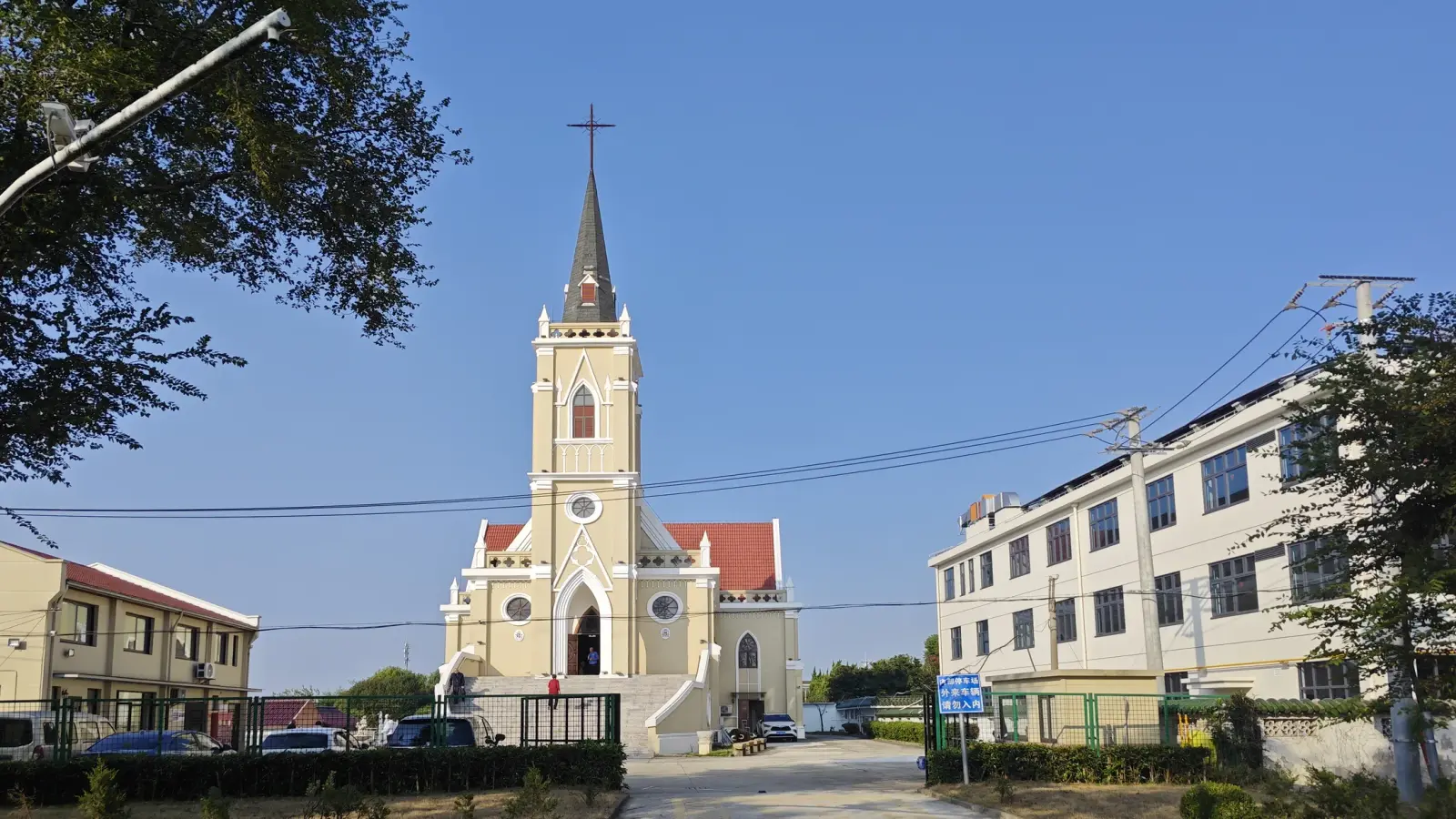
The cream-coloured church with its tall dark spire and red-tiled roof, seen across the forecourt.
Photo: 中二halo君 · used with permission · Xiaohongshu · BilibiliWhat you're looking at
- The two-storey church with a bell tower, similar in look to Caojiadu's St Michael's
- The Our Lady pavilion with its couplet
- The memorial stone for the move, inscribed by Bishop Jin Luxian
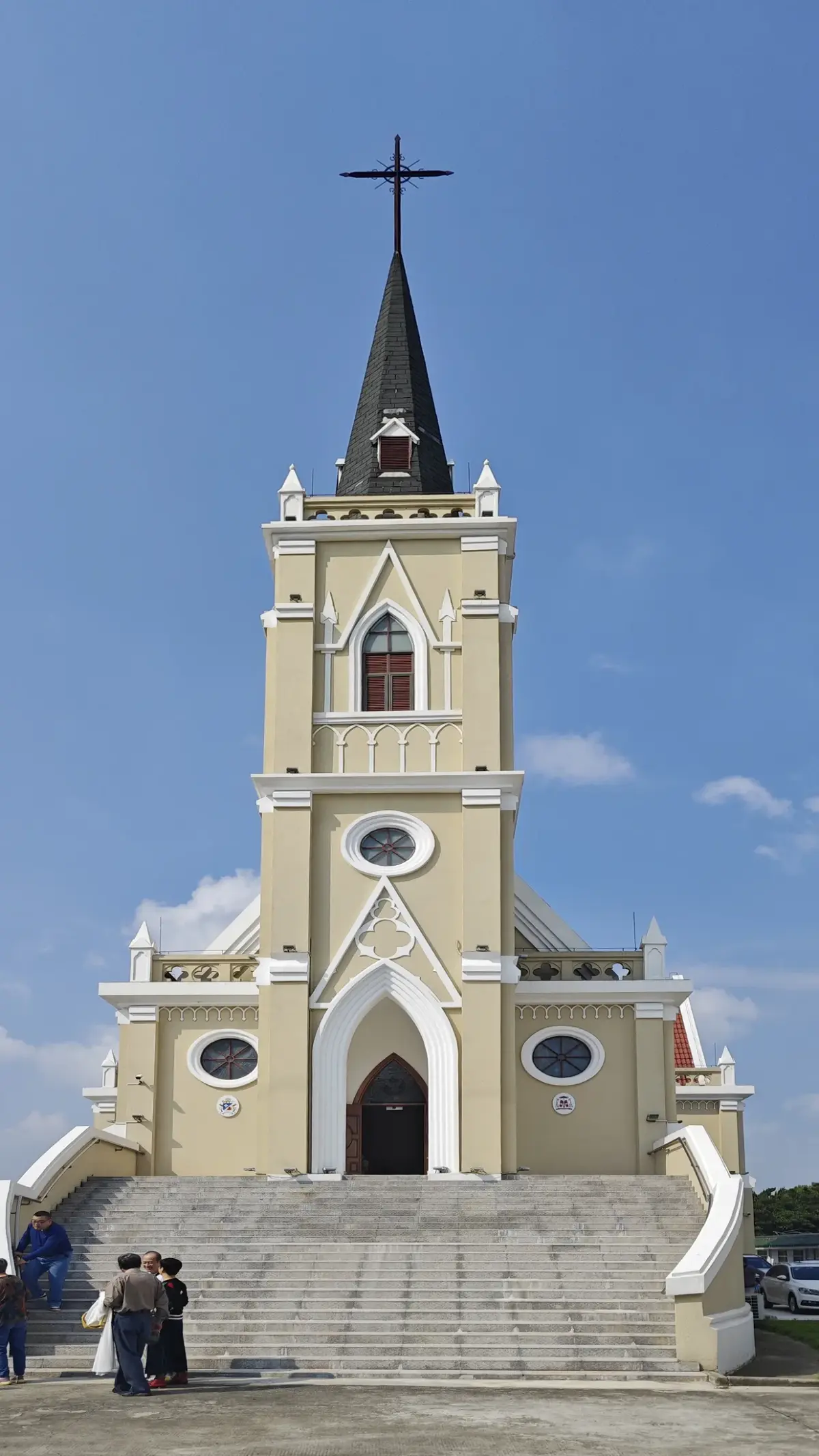
A wide flight of steps leads up to the arched doorway at the foot of the tower.
Photo: 中二halo君 · used with permission · Xiaohongshu · Bilibili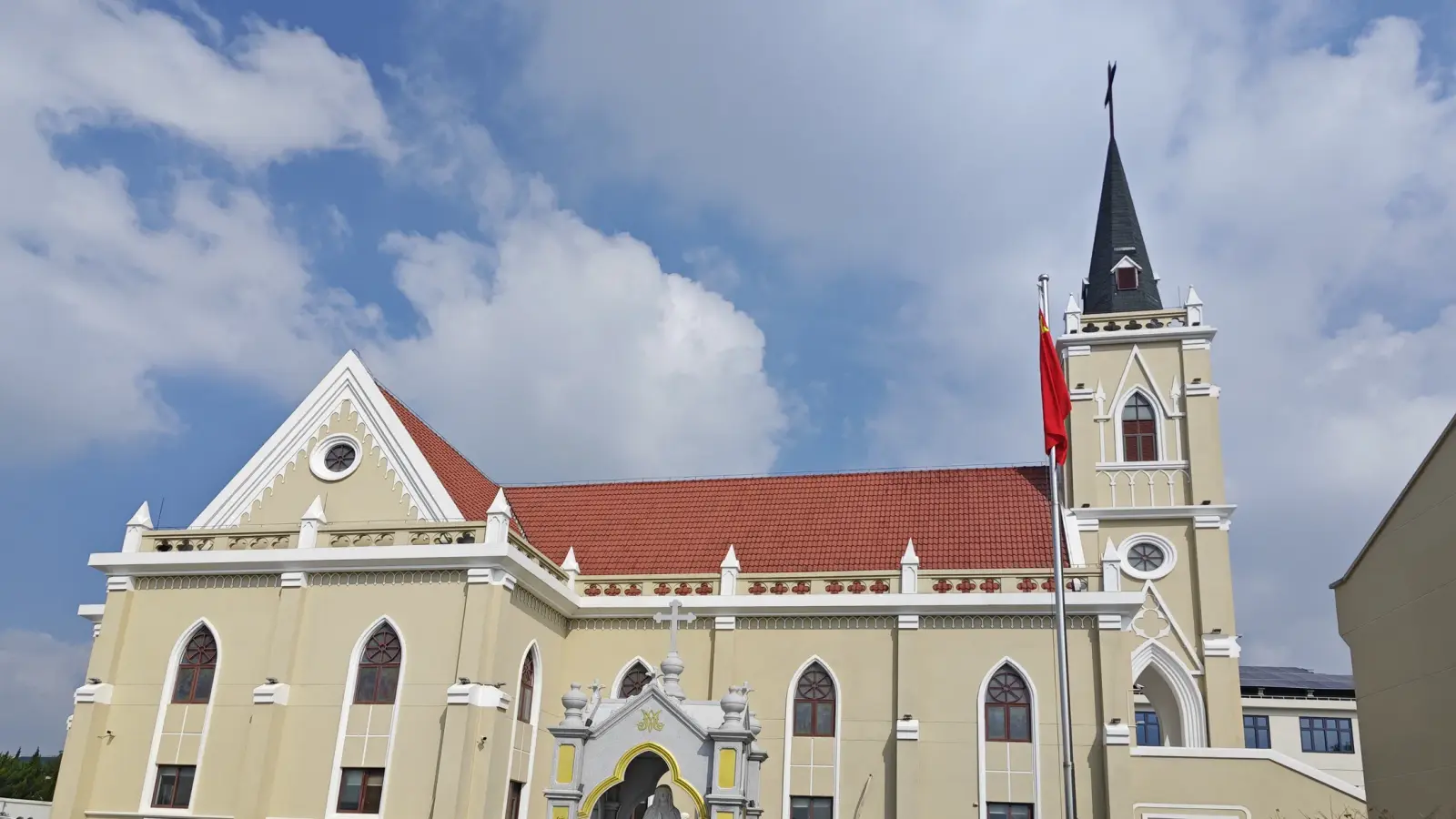
The long side of the church, with pointed windows and a small canopied side door under the red roof.
Photo: 中二halo君 · used with permission · Xiaohongshu · Bilibili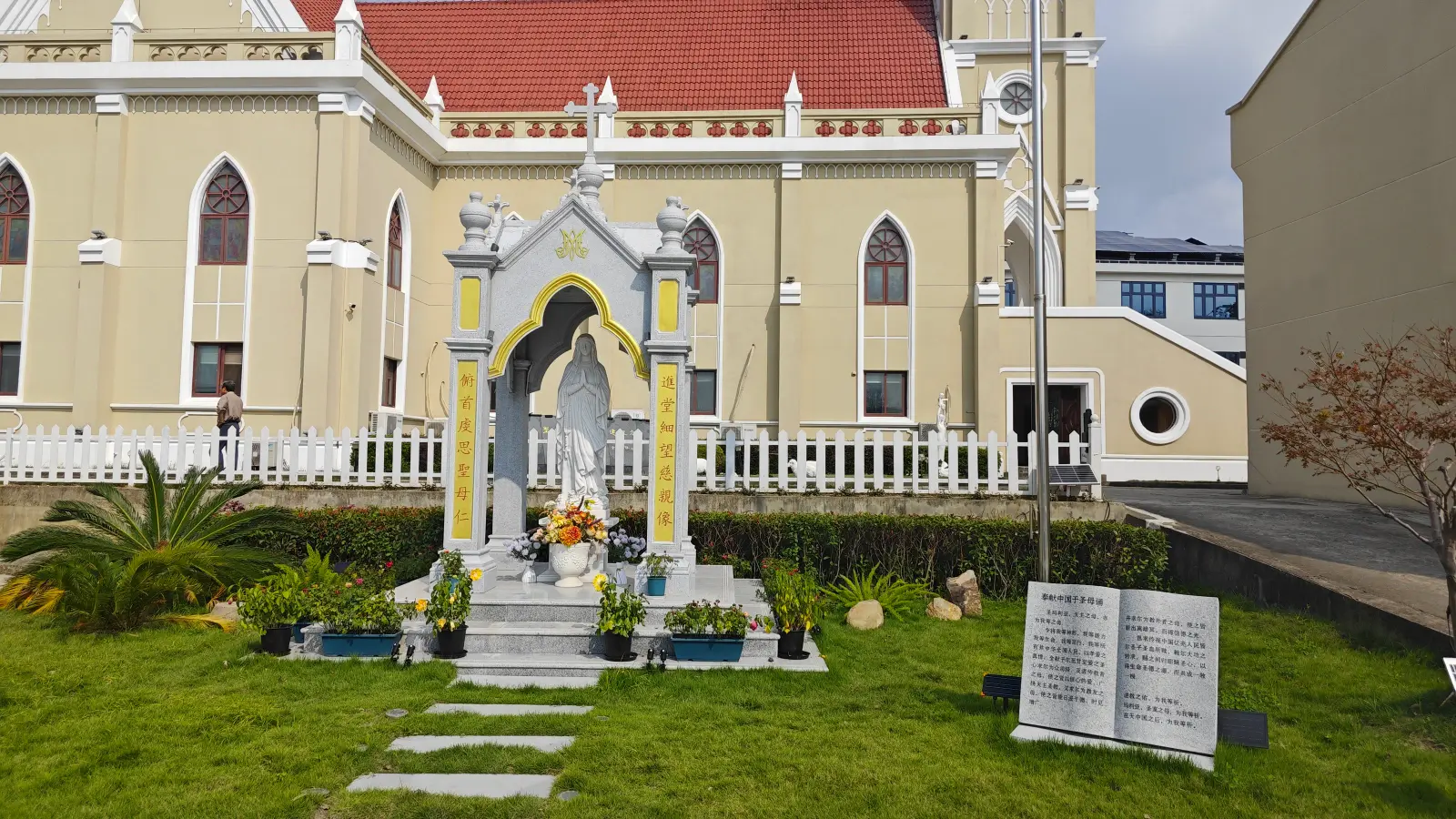
A small Gothic canopy shrine with a statue of Mary stands in the lawn beside the church.
Photo: 中二halo君 · used with permission · Xiaohongshu · Bilibili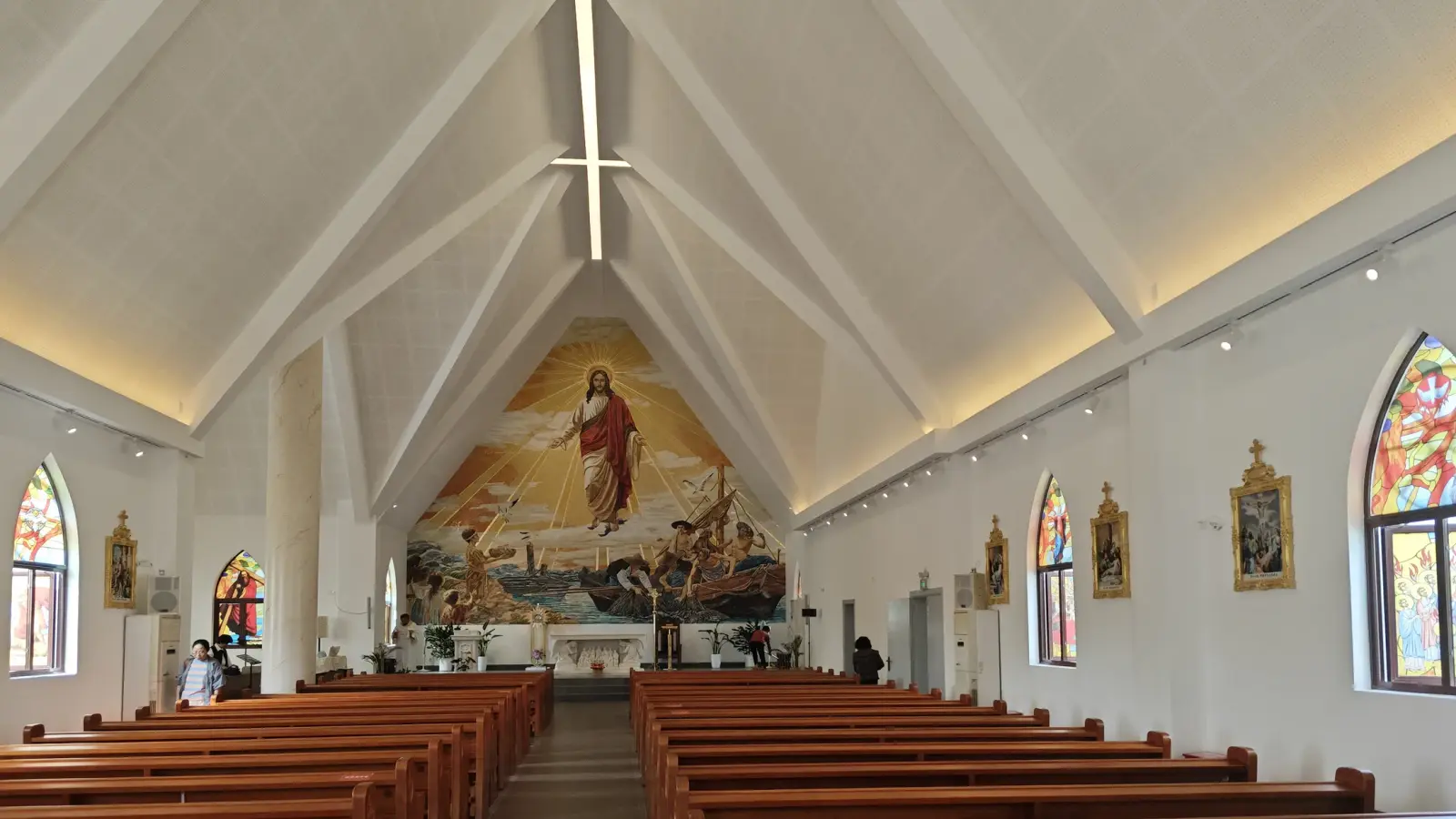
The nave, with a large painting of Christ behind the altar, a white pitched ceiling and stained glass.
Photo: 中二halo君 · used with permission · Xiaohongshu · Bilibili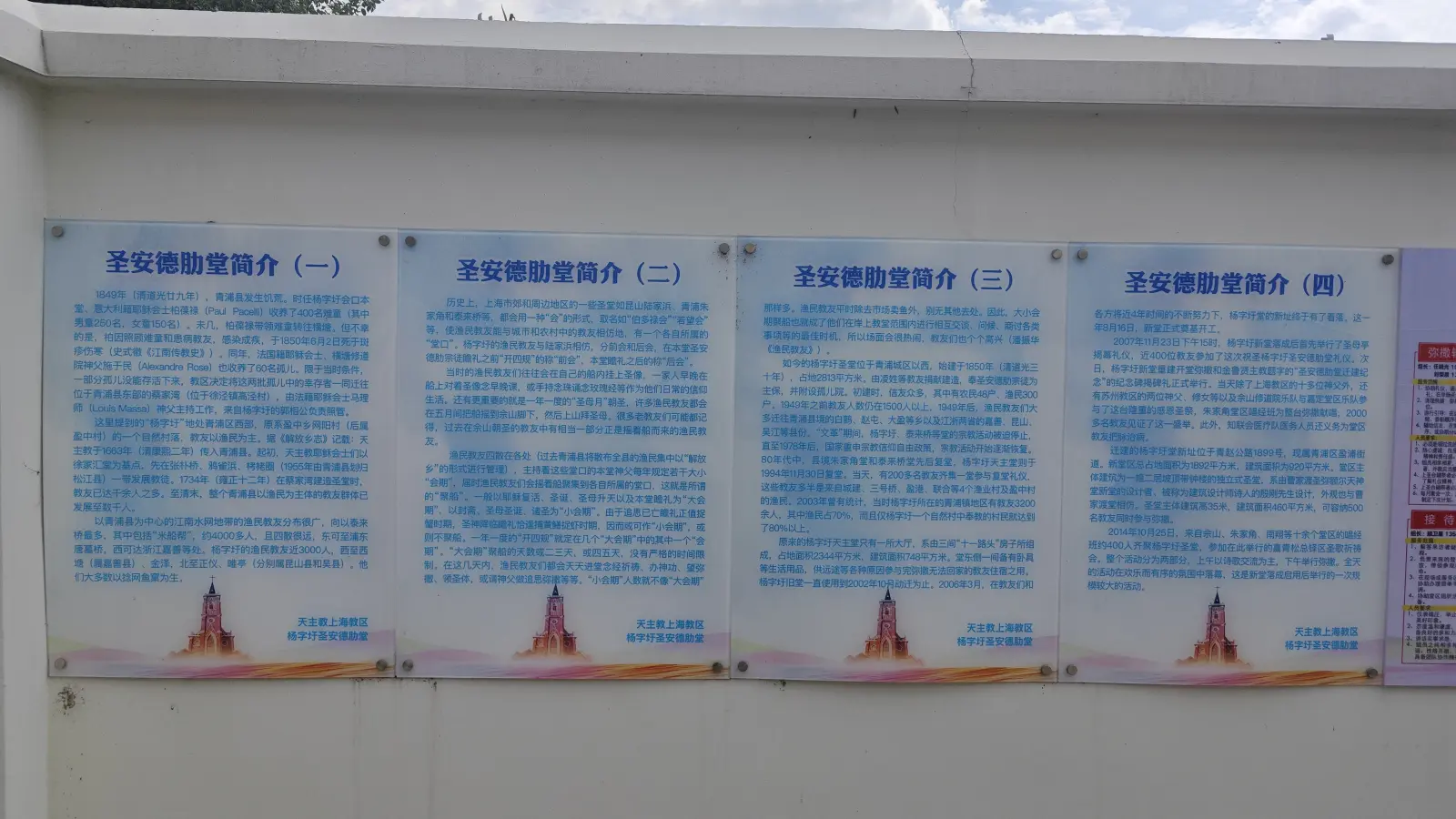
Four blue notice boards in Chinese present the history of the church.
Photo: 中二halo君 · used with permission · Xiaohongshu · Bilibili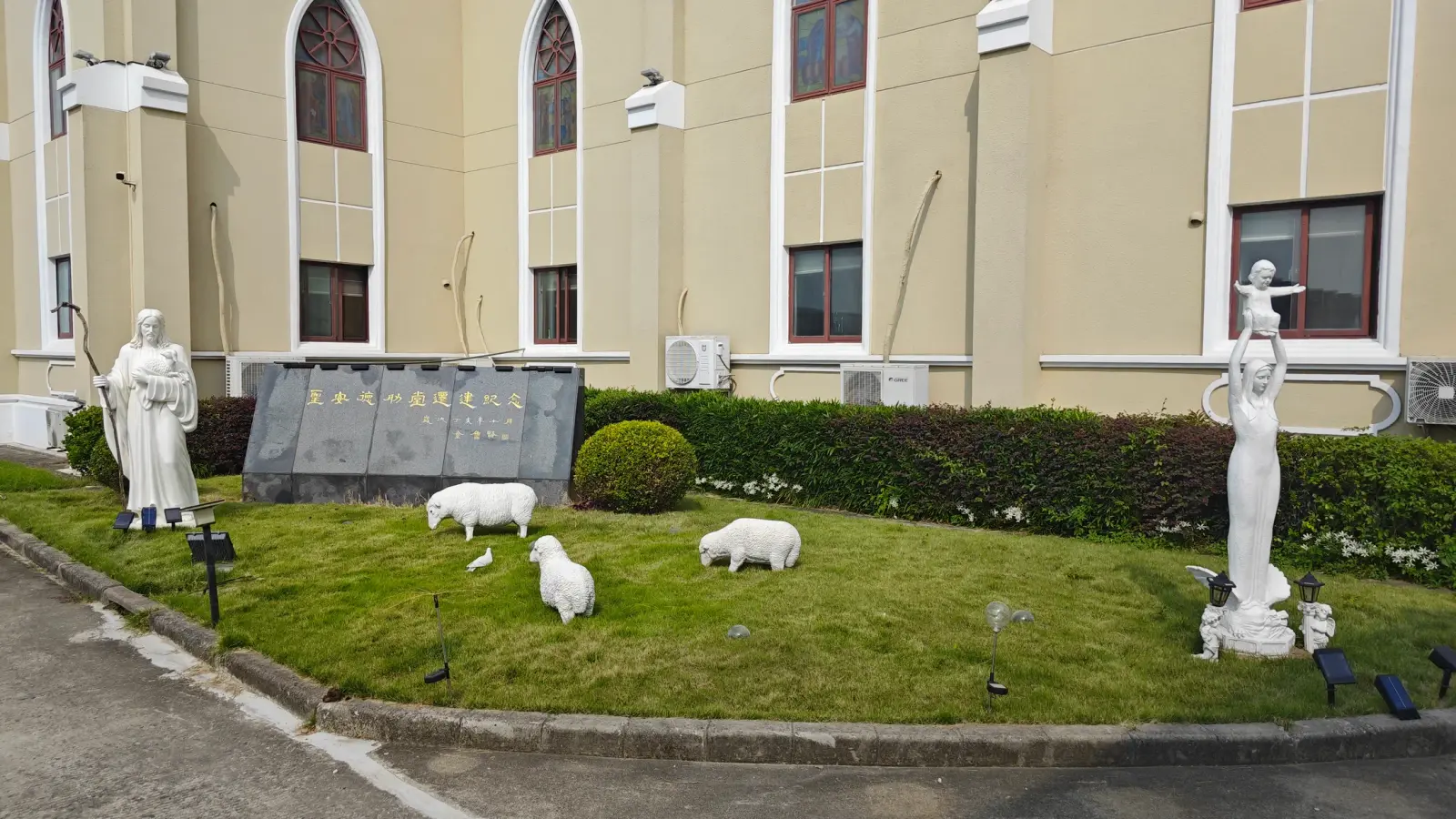
White statues of a saint and a figure raising a child stand among sheep sculptures on the church lawn.
Photo: 中二halo君 · used with permission · Xiaohongshu · BilibiliThe story
St Andrew’s Church (杨字圩圣安德肋堂, Yángzìwéi Shèng Āndélèi Táng) was built for fishing families on the waters west of Qingpu. The present church on Qingzhao Highway dates from 2007, when the congregation moved from the old village site.
A parish of boats
Yangziwei (杨字圩, Yángzìwéi) was a hamlet whose Catholics mostly lived on boats. The church was built in 1850 with gifts from families surnamed Ling, dedicated to St Andrew, and started with an orphanage. At the start the parish had 48 farming and 300 fishing households; by 1949 it had over 1,500 members. A plaque says nearly 3,000 fishing Catholics belonged to it.
How did a fishing congregation worship?
On major feast days the boats came to the church and stayed for days of Mass and prayer, a custom called juchuan (聚船, ‘boats gathering’). Families kept holy pictures on the boats and prayed the rosary aboard. In May many rowed to the foot of Sheshan to make the pilgrimage.
The orphans of 1849
The plaque tells of the 1849 famine, when the Italian Jesuit Paul Pacelli took in 400 children and died of typhus in June 1850. Survivors were moved, with 60 orphans from Hengtang, to Caijiawan.
Closure and a new church
Services ended in 1957. The church reopened on 30 November 1994 with over 200 people and kept going until the old site was demolished in October 2002. A new church was begun on 16 August 2006 and dedicated on 23-24 November 2007. It was designed by Yin Gang, who also designed the new St Michael’s at Caojiadu, and rises 35 m with space for 500.
What to look for
The two-storey church with its bell tower, the Our Lady pavilion with its couplet, and the memorial stone for the move are the main things to see. The old church, a plain three-bay hall, no longer exists.
Signs at the church, in full (1)
The wording of plaques and notices as photographed. Timetables and rules may have changed since.
Introduction to St Andrew's Church (panels 1–4)
圣安德肋堂简介(一至四) · see the photo
Our translation of the Chinese
Introduction to St Andrew's Church (1)
In 1849, the twenty-ninth year of the Daoguang reign of the Qing dynasty, famine struck Qingpu County. The Italian Jesuit Paul Pacelli (柏葆禄), then the priest serving the Yangziyu Catholic community, took in 400 displaced children: 250 boys and 150 girls. Soon afterwards, he took the children to Hengtang. Unfortunately, while caring for the children and sick parishioners, he contracted an illness and died of typhus on 2 June 1850 (Shi Shihui, History of the Jiangnan Mission). In the same year, the French Jesuit Alexandre Rose (施于民), a priest at Hengtang Seminary, also took in 60 orphans. Given the conditions at the time, some of the orphans did not survive. The diocese decided to move the survivors from both groups together to Caijiawan in eastern Qingpu County, in Gaojing Village, Xujing Town. The French Jesuit Father Louis Massa (马理师) directed the work, with Guo Xianggong from Yangziyu responsible for their care.
The Yangziyu mentioned here lies in western Qingpu District. It was originally a hamlet in Wangyang Village, Yingzhong Township, later part of Yingzhong Village. Most of its Catholics were fishing people. According to the Gazetteer of Jiefang Township, Catholicism reached Qingpu County in 1663, the second year of the Kangxi reign. At first, Jesuit missionaries used Xujiahui Church as their base and developed congregations around Zhangpuqiao, Yaque-bang, and Kaolaoquan, the last of which was transferred from Qingpu County to Songjiang County in 1955. By the time a church was built at Caijiawan in 1734, the twelfth year of the Yongzheng reign, the congregation numbered more than a thousand. By the end of the Qing dynasty, the Catholic population throughout Qingpu County, chiefly fishing people, had grown to several thousand.
Catholic fishing communities were widely dispersed across the waterways of Jiangnan around Qingpu County. Tailaiqiao traditionally had the largest number, including the group known as the “rice-boat community”: more than 4,000 people in all. They were scattered over a wide area, reaching Tangmuqiao in Pudong to the east and Jiashan in Zhejiang to the west. Yangziyu had nearly 3,000 Catholic fishing people, extending west to Xitang in Jiashan County and Jinze, and north to Zhengyi and Weiting, then in Kunshan County and Wu County respectively. Most made their living through fishing with nets and fish traps, described on the panel as “捻网鱼窠”.
Catholic Diocese of Shanghai
St Andrew's Church, Yangziyu
Introduction to St Andrew's Church (2)
Historically, churches around suburban Shanghai and neighbouring areas, including Lujiabang in Kunshan and Zhujiajiao and Tailaiqiao in Qingpu, organised fishing Catholics into associations called hui. Names such as the “St Peter Association” and “St John Association” gave fishing communities a church to which they belonged, much as Catholics living in towns and villages had their own parishes. As at Lujiabang, the Yangziyu fishing congregation was divided into an “earlier association” and a “later association”. Those who held the annual observance called kai sigui before the feast of the parish's patron, St Andrew the Apostle, belonged to the earlier association; those who held it after the patronal feast belonged to the later association.
At that time, Catholic fishing families often hung holy images inside their boats. Their daily religious life included saying morning and evening prayers together before these images, or holding prayer beads and reciting the Rosary. An even more important occasion was the annual pilgrimage during the “Month of Mary”. Many fishing Catholics rowed to the foot of Sheshan in May, then climbed the hill to honour Our Lady. Many older Catholics may remember that a substantial proportion of pilgrims at Sheshan in the past were fishing people who had arrived by boat.
The fishing Catholics were scattered in many places. In the past, Qingpu County administered fishing people dispersed throughout the county together under the name “Jiefang Township”. Each year, the priests serving these communities set several major and minor gathering periods, or huiqi. At those times, fishing Catholics rowed to the church to which they belonged. This was known as “gathering the boats”. Easter, Christmas, the Assumption of Our Lady, and the parish's patronal feast were generally major gatherings; Lent, the Nativity of Our Lady, and All Saints were minor gatherings. As All Souls fell during the crab-catching season, and Pentecost coincided with catching swamp eels and shrimp, these occasions might be minor gatherings or might involve no gathering of boats at all. The annual observance called kai sigui was held during one of the major gathering periods. The boats stayed for two or three days, or four or five, with no strict time limit. During these days, the fishing Catholics went to church daily to recite prayers, perform devotional practices, attend Mass, receive Communion, or ask a priest to offer a Mass for the dead. The minor gatherings did not draw as many people as the major ones—
Catholic Diocese of Shanghai
St Andrew's Church, Yangziyu
Introduction to St Andrew's Church (3)
—did. Apart from going to market to sell fish, fishing Catholics ordinarily had nowhere else to go. Thus, both major and minor gatherings of boats became their best opportunities to talk, greet one another, and discuss matters within the grounds of the church on shore. The scene was therefore lively, and everyone was happy (Pan Zhenhua, “Catholic Fishing Communities”).
The Yangziyu church lies west of urban Qingpu. It was first built in 1850, the thirtieth year of the Daoguang reign, on a site of 2,813 square metres. Catholics including members of the Ling family donated towards its construction. It was dedicated to St Andrew the Apostle and had an attached orphanage. There were many believers when it was founded, including 48 farming households and 300 fishing households. The Catholic population still exceeded 1,500 before 1949. After 1949, most fishing Catholics moved to Baihe, Zhaotun, Daying, and other townships within Qingpu County, or to Jiashan, Kunshan, Wujiang, and other counties in Jiangsu and Zhejiang. During the Cultural Revolution, religious activities at Yangziyu, Tailaiqiao, and other churches were forced to stop. They gradually resumed after 1978, when the state reaffirmed its policy of freedom of religious belief. In the mid-1980s, Zhujiajiao and Tailaiqiao churches in the county reopened in succession. Yangziyu Catholic Church reopened on 30 November 1994. More than 200 Catholics gathered for the reopening liturgy, most of them fishing people from the four fishing villages of Chengjian, Sanhaoqiao, Yinggang, and Lianhe, as well as Yingzhong Village. Figures recorded in 2003 put the Catholic population of the Qingpu Town area, which included Yangziyu, at more than 3,200, of whom 70% were fishing people. In the hamlet of Yangziyu itself, more than 80% of residents were Catholic.
The original Yangziyu Catholic Church had a single large hall made up of three houses described as “eleven-lutou” buildings. It occupied a site of 2,344 square metres and had a floor area of 748 square metres. A room on its eastern side contained bedding and other necessities for parishioners who could not return home after Mass because of long journeys or other reasons. The old Yangziyu church remained in use until its relocation in October 2002. In March 2006, after parishioners and—
Catholic Diocese of Shanghai
St Andrew's Church, Yangziyu
Introduction to St Andrew's Church (4)
—other parties had worked continuously for almost four years, a new site for Yangziyu Church was finally secured. The foundation was formally laid and construction began on 16 August that year.
At 15:00 on 23 November 2007, following completion of the new church, the first ceremony held was the unveiling of the Marian pavilion. Nearly 400 Catholics attended this ceremony for the blessing of St Andrew's Church at Yangziyu. The next day, the Mass marking the opening of the rebuilt church and the unveiling of a monument inscribed by Bishop Jin Luxian with the words “Commemorating the relocation and rebuilding of St Andrew's Church” formally took place. In addition to more than ten priests from the Diocese of Shanghai, two priests and religious sisters from the Diocese of Suzhou, together with the bands of Sheshan Seminary and Jiading parish, took part in this solemn celebration of the Eucharist. The Zhujiajiao parish choir sang throughout the Mass. More than 2,000 Catholics witnessed the occasion. Medical staff from the intellectuals association's medical team also volunteered to examine parishioners' pulses and provide treatment.
The relocated Yangziyu church stands at 1899 Qingzhao Road, now within Yingpu Subdistrict, Qingpu District. The new parish site covers 1,892 square metres, with a total floor area of 920 square metres. Its main building is a detached, two-storey church with a pitched roof and bell tower. It was designed by Yin Gang, described as an architect and poet, who also designed the new Church of St Michael the Archangel at Caojiadu. Its appearance resembles the Caojiadu church. The main church building is 35 metres high, has a floor area of 460 square metres, and can accommodate 500 people attending Mass at the same time.
On 25 October 2014, about 400 choir members from more than ten parishes, including Sheshan, Zhujiajiao, and Nanxiang, gathered at Yangziyu Church for a sacred-music prayer gathering of the Jia-Qing-Song deanery. The programme had two parts: an exchange of hymns in the morning and Mass in the afternoon. The day's activities ended in a joyful and orderly atmosphere. It was one of the larger events held after the new church opened.
Catholic Diocese of Shanghai
St Andrew's Church, Yangziyu
Chinese text
圣安德肋堂简介(一)
1849年(清道光廿九年),青浦县发生饥荒。时任杨字圩会口本堂、意大利籍耶稣会士柏葆禄(Paul Pacelli)收养了400名难童(其中男童250名,女童150名)。未几,柏葆禄带领难童转往横塘。但不幸的是,柏因照顾难童和患病教友,感染成疾,于1850年6月2日死于斑疹伤寒(史式徽《江南传教史》)。同年,法国籍耶稣会士、横塘修道院神父施于民(Alexandre Rose)也收养了60名孤儿。限于当时条件,一部分孤儿没能存活下来,教区决定将这两批孤儿中的幸存者一同迁往位于青浦县东部的蔡家湾(位于徐泾镇高泾村),由法籍耶稣会士马理师(Louis Massa)神父主持工作,来自杨字圩的郭相公负责照管。
这里提到的“杨字圩”地处青浦区西部,原系盈中乡网阳村(后属盈中村)的一个自然村落,教友以渔民为主。据《解放乡志》记载:天主教于1663年(清康熙二年)传入青浦县。起初,天主教耶稣会士们以徐家汇堂为基点,先在张朴桥、鸦雀浜、栲栳圈(1955年由青浦县划归松江县)一带发展教徒。1734年(雍正十二年)在蔡家湾建造圣堂时,教友已达千余人之多。至清末,整个青浦县以渔民为主体的教友群体已发展至数千人。
以青浦县为中心的江南水网地带的渔民教友分布很广,向以泰来桥最多,其中包括“米船帮”,约4000多人,且四散很远,东可至浦东唐墓桥,西可达浙江嘉善等处。杨字圩的渔民教友近3000人,西至西塘(属嘉善县)、金泽,北至正仪、唯亭(分别属昆山县和吴县)。他们大多数以捻网鱼窠为生。
天主教上海教区
杨字圩圣安德肋堂
圣安德肋堂简介(二)
历史上,上海市郊和周边地区的一些圣堂如昆山陆家浜、青浦朱家角和泰来桥等,都会用一种“会”的形式,取名如“伯多禄会”“若望会”等,使渔民教友能与城市和农村中的教友相仿地,有一个各自所属的“堂口”。杨字圩的渔民教友与陆家浜相仿,分前会和后会,在本堂圣安德肋宗徒瞻礼之前“开四规”的称“前会”,本堂瞻礼之后的称“后会”。
当时的渔民教友们往往会在自己的船内挂上圣像,一家人早晚在船上对着圣像念早晚课,或手持念珠诵念玫瑰经等作为他们日常的信仰生活。还有更重要的就是一年一度的“圣母月”朝圣,许多渔民教友都会在五月间把船摇到佘山脚下,然后上山拜圣母。很多老教友们可能都记得,过去在佘山朝圣的教友中有相当一部分正是摇着船而来的渔民教友。
渔民教友四散在各处(过去青浦县将散布全县的渔民集中以“解放乡”的形式进行管理),主持着这些堂口的本堂神父每年规定若干大小“会期”,届时渔民教友们会摇着船聚集到各自所属的堂口,这就是所谓的“聚船”。一般以耶稣复活、圣诞、圣母升天以及本堂瞻礼为“大会期”,以封斋、圣母圣诞、诸圣为“小会期”。由于追思已亡瞻礼正值捉蟹时期,圣神降临瞻礼恰逢捕黄鳝捉虾时期,因而或可作“小会期”,或则不聚船。一年一度的“开四规”就定在几个“大会期”中的其中一个“会期”。“大会期”聚船的天数或二三天,或四五天,没有严格的时间限制。在这几天内,渔民教友们都会天天进堂念经祈祷、办神功、望弥撒、领圣体,或请神父做追思弥撒等等。“小会期”人数就不像“大会期”
天主教上海教区
杨字圩圣安德肋堂
圣安德肋堂简介(三)
那样多。渔民教友平时除去市场卖鱼外,别无其他去处。因此,大小会期聚船也就成了他们在岸上教堂范围内进行相互交谈、问候、商讨各类事项等的最佳时机,所以场面会很热闹,教友们也个个高兴(潘振华《渔民教友》)。
如今的杨字圩圣堂位于青浦城区以西,始建于1850年(清道光三十年),占地2813平方米。由凌姓等教友捐献建造,奉圣安德肋宗徒为主保,并附设孤儿院。初建时,信友众多,其中有农民48户、渔民300户。1949年之前教友人数仍在1500人以上,1949年后,渔民教友们大多迁往青浦县境的白鹤、赵屯、大盈等乡以及江浙两省的嘉善、昆山、吴江等县份。“文革”期间,杨字圩、泰来桥等堂的宗教活动被迫停止,直至1978年后,国家重申宗教信仰自由政策,宗教活动开始逐渐恢复。80年代中,县境朱家角堂和泰来桥堂先后复堂,杨字圩天主堂则于1994年11月30日复堂。当天,有200多名教友齐集一堂参与复堂礼仪,这些教友多半是来自城建、三号桥、盈港、联合等4个渔业村及盈中村的渔民。2003年曾有统计,当时杨字圩所在的青浦镇地区有教友3200余人,其中渔民占70%,而且仅杨字圩一个自然村中奉教的村民就达到了80%以上。
原来的杨字圩天主堂只有一所大厅,系由三间“十一路头”房子所组成,占地面积2344平方米,建筑面积748平方米。堂东侧一间备有卧具等生活用品,供远途等各种原因参与完弥撒无法回家的教友住宿之用。杨字圩旧堂一直使用到2002年10月动迁为止。2006年3月,在教友们和
天主教上海教区
杨字圩圣安德肋堂
圣安德肋堂简介(四)
各方将近4年时间的不断努力下,杨字圩堂的新址终于有了着落。这一年8月16日,新堂正式奠基开工。
2007年11月23日下午15时,杨字圩新堂落成后首先举行了圣母亭揭幕礼仪,近400位教友参加了这次祝圣杨字圩圣安德肋堂礼仪。次日,杨字圩新堂重建开堂弥撒和金鲁贤主教题字的“圣安德肋堂迁建纪念”的纪念碑揭碑礼正式举行。当天除了上海教区的十多位神父外,还有苏州教区的两位神父、修女等以及佘山修道院乐队与嘉定堂区乐队参与了这台隆重的感恩圣祭,朱家角堂区唱经班为整台弥撒献唱,2000多名教友见证了这一盛举。此外,知联会医疗队医务人员还义务为堂区教友把脉治病。
迁建的杨字圩堂新址位于青赵公路1899号,现属青浦区盈浦街道。新堂区总占地面积为1892平方米,建筑面积为920平方米。堂区主体建筑为一幢二层坡顶带钟楼的独立式圣堂,系由曹家渡圣弥额尔天神堂新堂的设计者、被称为建筑设计师诗人的殷刚先生设计,外观也与曹家渡堂相仿。圣堂主体建筑高35米,建筑面积460平方米,可容纳500名教友同时参与弥撒。
2014年10月25日,来自佘山、朱家角、南翔等十余个堂区的唱经班约400人齐聚杨字圩圣堂,参加在此举行的嘉青松总铎区圣歌祈祷会。整个活动分为两部分,上午以诗歌交流为主,下午举行弥撒。全天的活动在欢乐而有序的氛围中落幕,这是新堂落成启用后举行的一次规模较大的活动。
天主教上海教区
杨字圩圣安德肋堂
How to visit
- Status
- Visitor access not yet confirmed
- Opening times and prices not yet confirmed; check before you go.
- Nearest metro
- Metro directions will be added after a site visit.Plan a metro journey here →
Chinese address — show this to a taxi driver
导航地址:青赵公路1899号 登记地址:青浦镇青赵路七号桥
Navigation address in the supplied directory: 1899 Qingzhao Highway; registered address: No. 7 Bridge, Qingzhao Road, Qingpu Town, Qingpu District, Shanghai
Amap (高德地图) works best in mainland China; Apple Maps on iPhone. Both open in the app when it is installed.
The map position is approximate; the entrance has not been checked.
Nearby
Loading map…
No other places on the site are within a 20-minute walk yet.
Sources
- 1.Qingpu County Gazetteer, Catholicism (青浦县志 · 天主教), Shanghai Local Chronicles Office — 杨字圩天主堂gazetteer
- 2.Photographs of Shanghai churches and their signs, by 中二halo君 (上海教堂实拍照片(中二halo君)), 中二halo君, 中二halo君, 2026 — sign photographed at the churchfieldwork
- 3.Qingpu County Gazetteer 1985-2000, Catholicism (青浦县志1985-2000 · 第四节 天主教), Shanghai Local Chronicles Office — 杨字圩天主堂gazetteer