Church
St Peter's Church, Wangchuanhui
网船会圣伯多禄堂wǎng chuán huì shèng bó duō lù táng
A 1811 village church that was demolished, rebuilt in 2000 and replaced in 2010 by a two-storey Gothic-style church for Nanqiao New City.
Directory and photographs supplied by 中二halo君. Photographs used with permission. · Xiaohongshu · Bilibili
- Built
- 2009–2010
- Architect
- Not recorded
- Style
- gothic-revival
- Heritage listing
- Not recorded
- Status
- Visitor access not yet confirmed
What you're looking at
- The 29-metre Gothic-style tower and front, on a small plot between Baifu and Yuxiu roads
- The two-storey layout: offices and dining room below, worship space above
- The introduction board with the 1811-2011 chronology
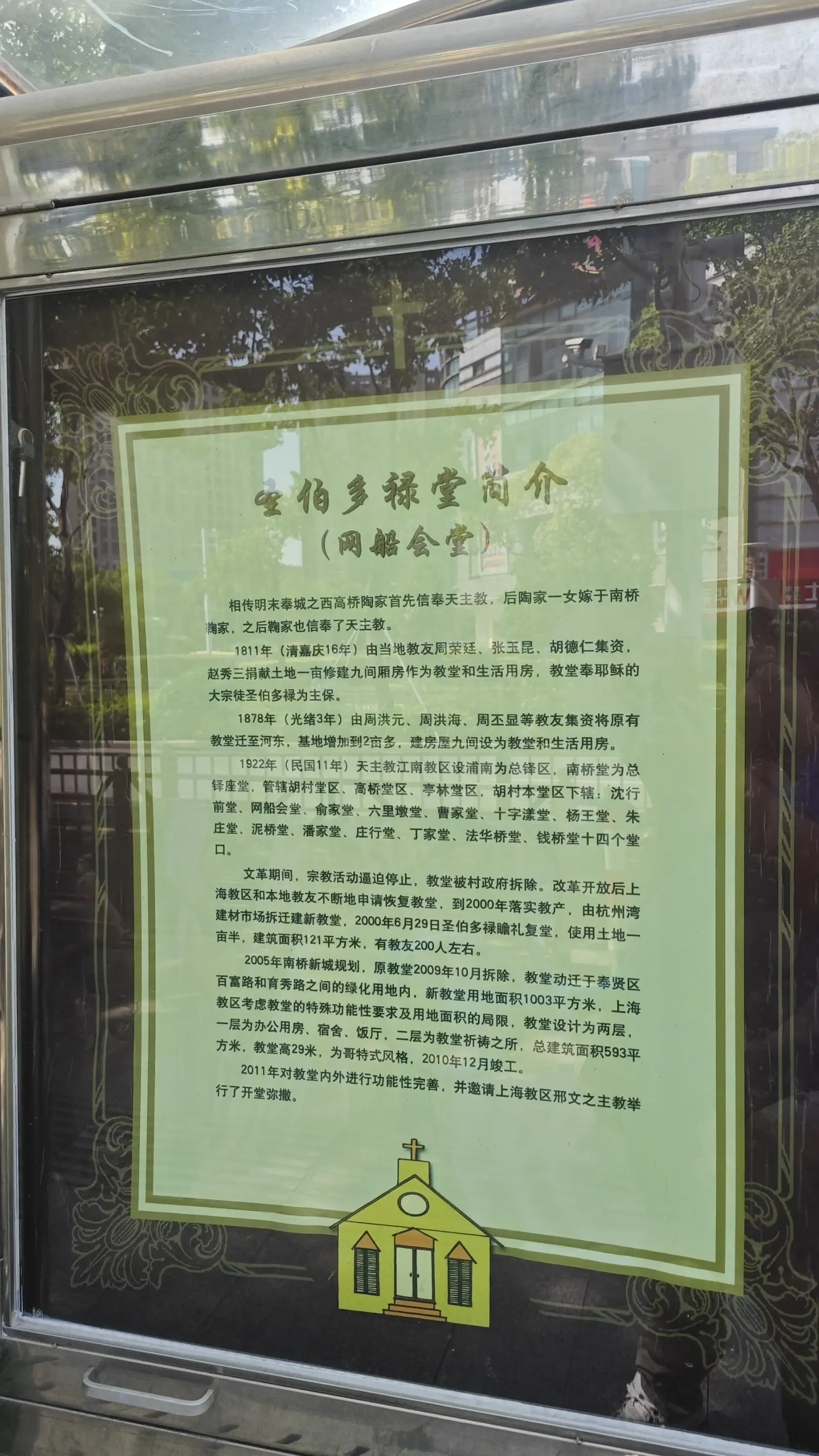
An introduction plaque to the church posted behind glass, in Chinese.
Photo: 中二halo君 · used with permission · Xiaohongshu · Bilibili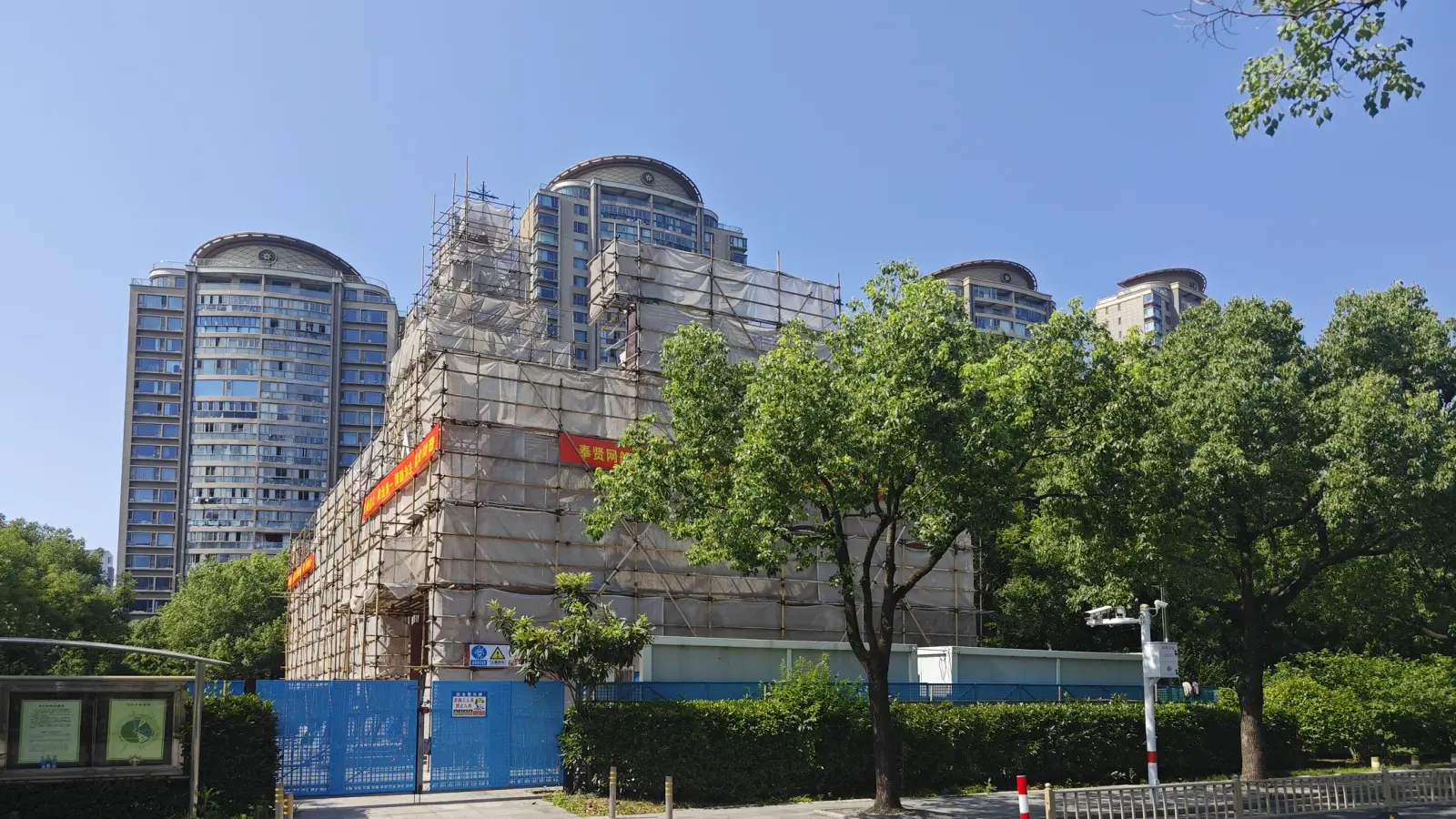
The church under restoration, wrapped in scaffolding and banners.
Photo: 中二halo君 · used with permission · Xiaohongshu · Bilibili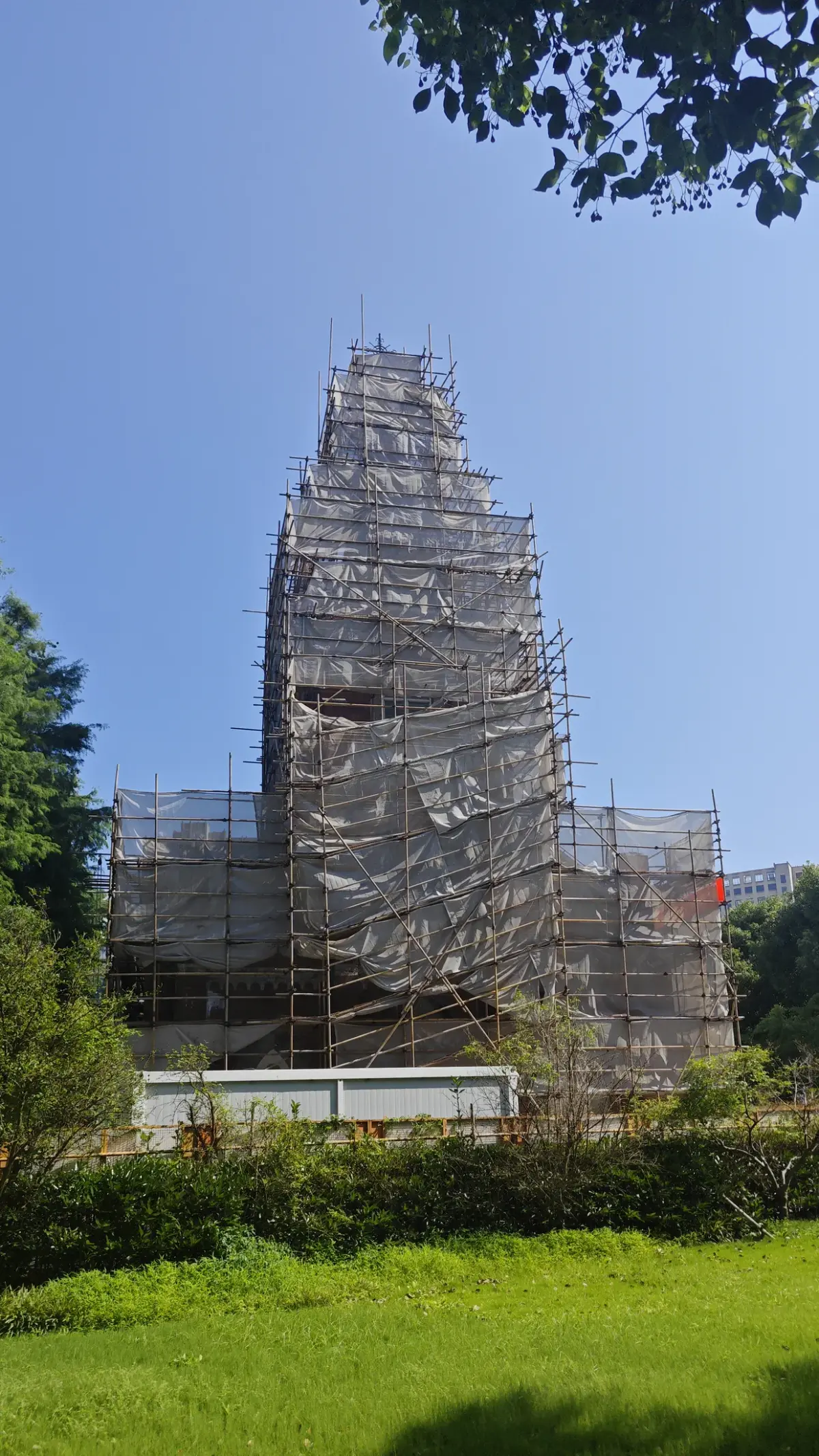
The tower under scaffolding, seen from a lawn.
Photo: 中二halo君 · used with permission · Xiaohongshu · BilibiliThe story
St Peter’s Church (圣伯多禄堂, Shèng Bóduōlù Táng), known locally as Wangchuanhui (网船会堂, Wǎngchuánhuì), is a small Gothic-style church in Nanqiao (南桥, Nánqiáo), Fengxian. Its introduction board runs from an 1811 village chapel to the present building, and shows how often it was moved.
How did Catholicism reach this district?
The board says the first believers were the Tao family of Gaoqiao, west of Fengcheng, in the late Ming. A Tao daughter married into a Nanqiao family, and the faith spread from there. In 1811 three local Catholics, Zhou Rongting, Zhang Yukun and Hu Deren, paid for a church with nine rooms on a mu of land given by Zhao Xiusan. St Peter, chief of the apostles, was made patron. In 1878 the church moved to the east bank of the river, on more than two mu.
What changed in the 1920s?
In 1922 the Punan deanery was set up at Nanqiao, and Wangchuanhui became one of the fourteen outstations of Hucun parish. The church stayed small, and the village government demolished it during the Cultural Revolution.
Two rebuildings in ten years
Diocese and parishioners kept applying for its return, and in 2000 a new church of 121 square metres on 1.5 mu opened on 29 June, St Peter’s feast, with about 200 parishioners. Nanqiao New City planning then forced its demolition in October 2009. The replacement stands on a small 1,003 square metre plot between Baifu and Yuxiu roads. Because the site was tight, the diocese made it two storeys: offices, dormitory and dining room below, worship space above. It is 29 metres tall in a Gothic style and was finished in December 2010. Bishop Xing Wenzhi led a dedication Mass in 2011.
What to look for
The building is compact and tall. Stand across the road to take in the 29-metre front, then notice how the ground floor serves as the parish’s living quarters. Read the introduction board for the full list of dates. Nothing here predates 2010.
Signs at the church, in full (1)
The wording of plaques and notices as photographed. Timetables and rules may have changed since.
St Peter’s Church (Wangchuanhui Church): An Introduction
圣伯多禄堂简介(网船会堂) · see the photo
Our translation of the Chinese
Introduction to St Peter's Church
(Wangchuanhui Church)
According to tradition, the Tao family in Gaoqiao, west of Fengcheng, were the first to adopt Catholicism in the late Ming period. A daughter of the Tao family later married into the [surname not yet legible] family in Nanqiao, after which that family also adopted Catholicism.
In 1811, the 16th year of the Jiaqing reign of the Qing dynasty, local Catholics Zhou Rongting, Zhang Yukun and Hu Deren raised funds, and Zhao Xiusan donated one mu of land, to build nine side rooms for use as a church and living quarters. The church took St Peter, the chief apostle of Jesus, as its patron.
In 1878, given on the board as the third year of the Guangxu reign, Zhou Hongyuan, Zhou Honghai, Zhou Pixian and other Catholics raised funds to move the existing church to the east side of the river. The site was enlarged to more than two mu, and nine rooms were built for use as a church and living quarters.
In 1922, the 11th year of the Republic, the Catholic Diocese of Jiangnan established Punan as a deanery, with Nanqiao Church as the dean's church, responsible for the Hucun, Gaoqiao and Tinglin parishes. Hucun Parish administered 14 churches: Shenhang Front Church, Wangchuanhui Church, Yujia Church, Liulidun Church, Caojia Church, Shiziyang Church, Yangwang Church, Zhuzhuang Church, Niqiao Church, Panjia Church, Zhuanghang Church, Dingjia Church, Fahuaqiao Church and Qianqiao Church.
During the Cultural Revolution, religious activities were forced to stop, and the village government demolished the church. After reform and opening up, the Diocese of Shanghai and local Catholics repeatedly applied for the church to be restored. In 2000, the church-property issue was resolved, and the Hangzhou Bay Building Materials Market arranged demolition and relocation and the construction of a new church. It reopened on 29 June 2000, the Feast of St Peter, on one and a half mu of land, with a building area of 121 square metres and approximately 200 Catholics.
Under the 2005 plan for Nanqiao New City, the existing church was demolished in October 2009, and the church was relocated to green-space land between Baifu Road and Yuxiu Road in Fengxian District. The new church occupies 1,003 square metres of land. Taking account of the church's particular functional requirements and the limited site area, the Diocese of Shanghai designed a two-storey building: offices, dormitories and a dining hall on the first floor, and the church's worship space on the second. The total building area is 593 square metres. The church is 29 metres high and Gothic in style. It was completed in December 2010.
In 2011, improvements were made to the interior and exterior to meet the church's practical needs, and Bishop Xing Wenzhi of the Diocese of Shanghai was invited to celebrate the opening Mass.
Chinese text
圣伯多禄堂简介
(网船会堂)
相传明末奉城之西高桥陶家首先信奉天主教,后陶家一女嫁于南桥[姓氏字迹待核]家,之后[姓氏字迹待核]家也信奉了天主教。
1811年(清嘉庆16年)由当地教友周荣廷、张玉昆、胡德仁集资,赵秀三捐献土地一亩修建九间厢房作为教堂和生活用房,教堂奉耶稣的大宗徒圣伯多禄为主保。
1878年(光绪3年)由周洪元、周洪海、周丕显等教友集资将原有教堂迁至河东,基地增加到2亩多,建房屋九间设为教堂和生活用房。
1922年(民国11年)天主教江南教区设浦南为总铎区,南桥堂为总铎座堂,管辖胡村堂区、高桥堂区、亭林堂区,胡村本堂区下辖:沈行前堂、网船会堂、俞家堂、六里墩堂、曹家堂、十字漾堂、杨王堂、朱庄堂、泥桥堂、潘家堂、庄行堂、丁家堂、法华桥堂、钱桥堂十四个堂口。
文革期间,宗教活动逼迫停止,教堂被村政府拆除。改革开放后上海教区和本地教友不断地申请恢复教堂,到2000年落实教产,由杭州湾建材市场拆迁建新教堂,2000年6月29日圣伯多禄瞻礼复堂,使用土地一亩半,建筑面积121平方米,有教友200人左右。
2005年南桥新城规划,原教堂2009年10月拆除,教堂动迁于奉贤区百富路和育秀路之间的绿化用地内,新教堂用地面积1003平方米,上海教区考虑教堂的特殊功能性要求及用地面积的局限,教堂设计为两层,一层为办公用房、宿舍、饭厅,二层为教堂祈祷之所,总建筑面积593平方米,教堂高29米,为哥特式风格,2010年12月竣工。
2011年对教堂内外进行功能性完善,并邀请上海教区邢文之主教举行了开堂弥撒。
How to visit
- Status
- Visitor access not yet confirmed
- Opening times and prices not yet confirmed; check before you go.
- Nearest metro
- Metro directions will be added after a site visit.Plan a metro journey here →
Chinese address — show this to a taxi driver
南桥镇百富路百秀路交叉口东北
Northeast of the junction of Baifu Road and Baixiu Road, Nanqiao Town, Fengxian District, Shanghai
Amap (高德地图) works best in mainland China; Apple Maps on iPhone. Both open in the app when it is installed.
The map position is approximate; the entrance has not been checked.
Nearby
Loading map…
No other places on the site are within a 20-minute walk yet.
Sources
- 1.on-site introduction board, St Peter's (Wangchuanhui) Church (photographed) — introduction boardfieldwork
- 2.Fengxian County Gazetteer, Catholicism (奉贤县志 · 第二节 天主教), Shanghai Local Chronicles Office — 第二节 天主教gazetteer