Church
St Teresa Catholic Church, Datian Road
大田路小德肋撒堂dà tián lù xiǎo dé lèi sā táng
A Romanesque and Gothic church of 1930-31 named for St Therese of Lisieux; schools and a free clinic stood beside it, and it reopened in 2020.
Directory and photographs supplied by 中二halo君. Photographs used with permission. · Xiaohongshu · Bilibili
- Built
- 1930–1931
- Architect
- Not recorded
- Style
- romanesque-revival, gothic-revival
- Heritage listing
- Jing'an District Cultural Relic Protection Point (静安区文物保护点) · district
- Status
- Visitor access not yet confirmed
- Then in
- International Settlement1899–1943Western District from 1899
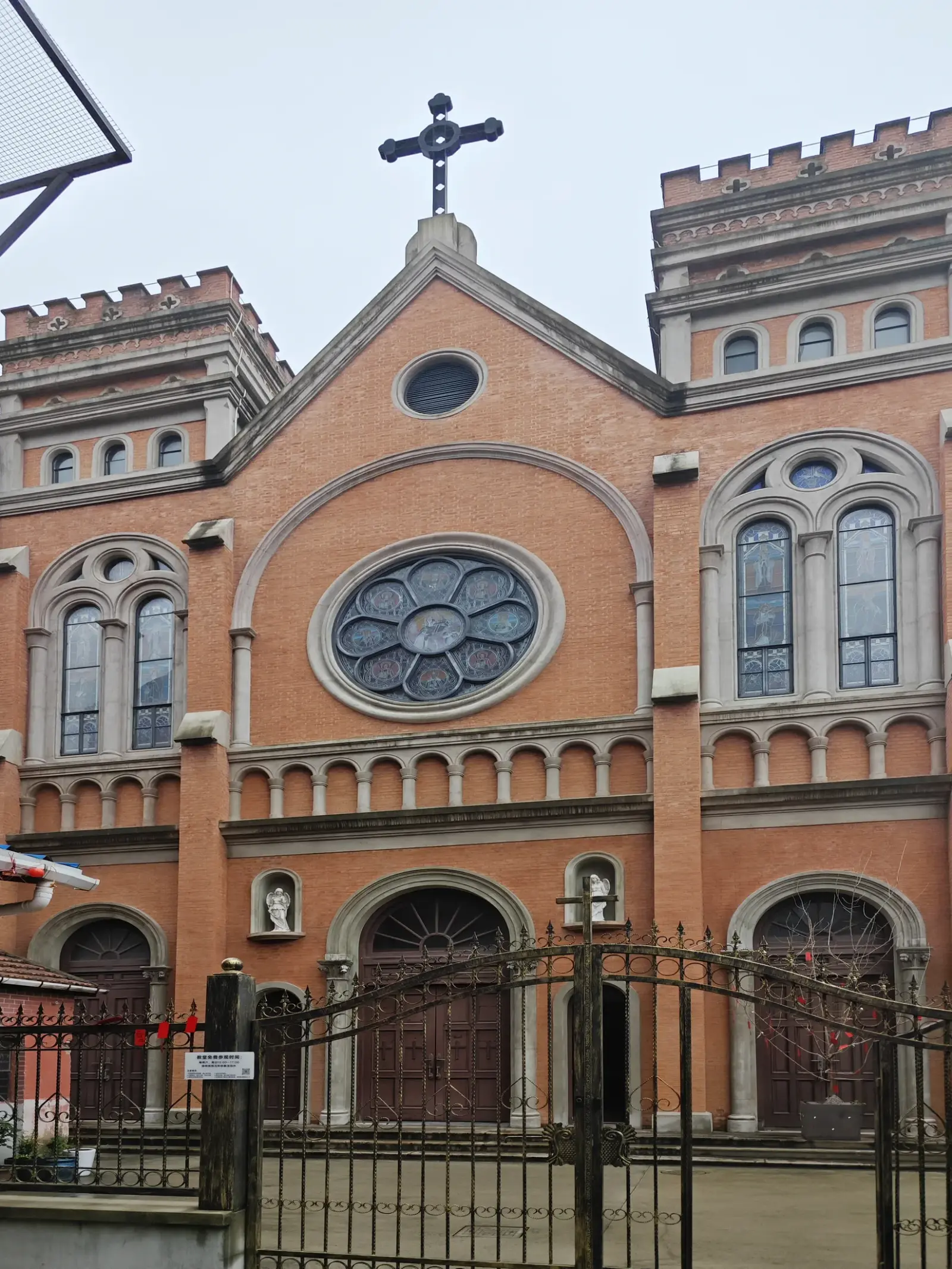
The terracotta-brick front of the church, with twin crenellated towers, a rose window and arched doors behind an iron gate.
Photo: 中二halo君 · used with permission · Xiaohongshu · BilibiliWhat you're looking at
- The tall nave, 19.6 metres high, with ribbed vaults and a dome above the altar
- Rose emblems on columns, floor tiles and lampshades, the symbol of St Therese
- Semicircular windows and Chinese-style bracket forms (斗拱) around them
- The English nameplate reading "Datian Road St.Teresa Catholic Church of Shanghai Diocese"
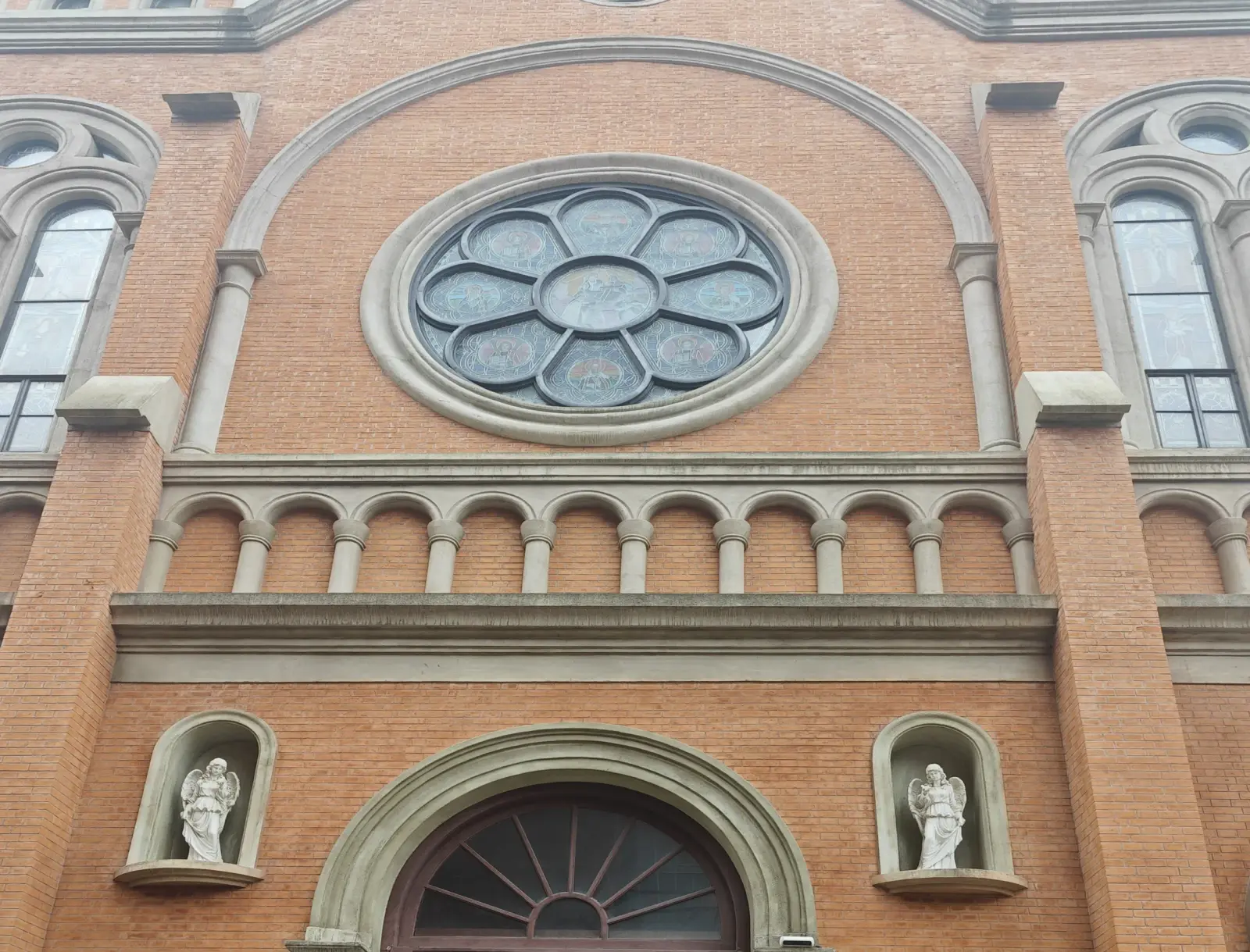
The rose window and arcaded band, with two angel statues in niches beside the central door.
Photo: 中二halo君 · used with permission · Xiaohongshu · Bilibili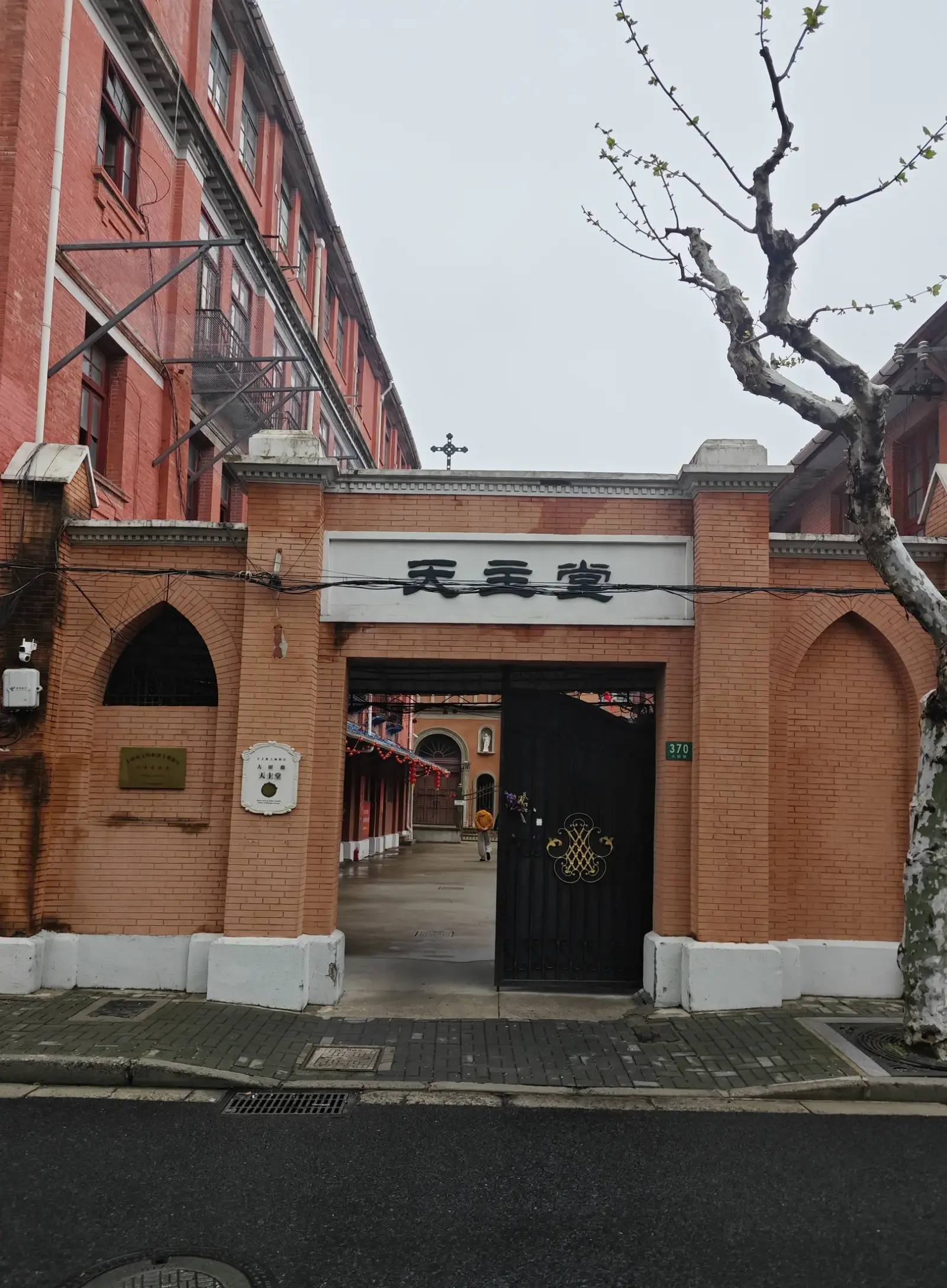
The brick gateway on the street, with the church name on a lintel above the entrance.
Photo: 中二halo君 · used with permission · Xiaohongshu · Bilibili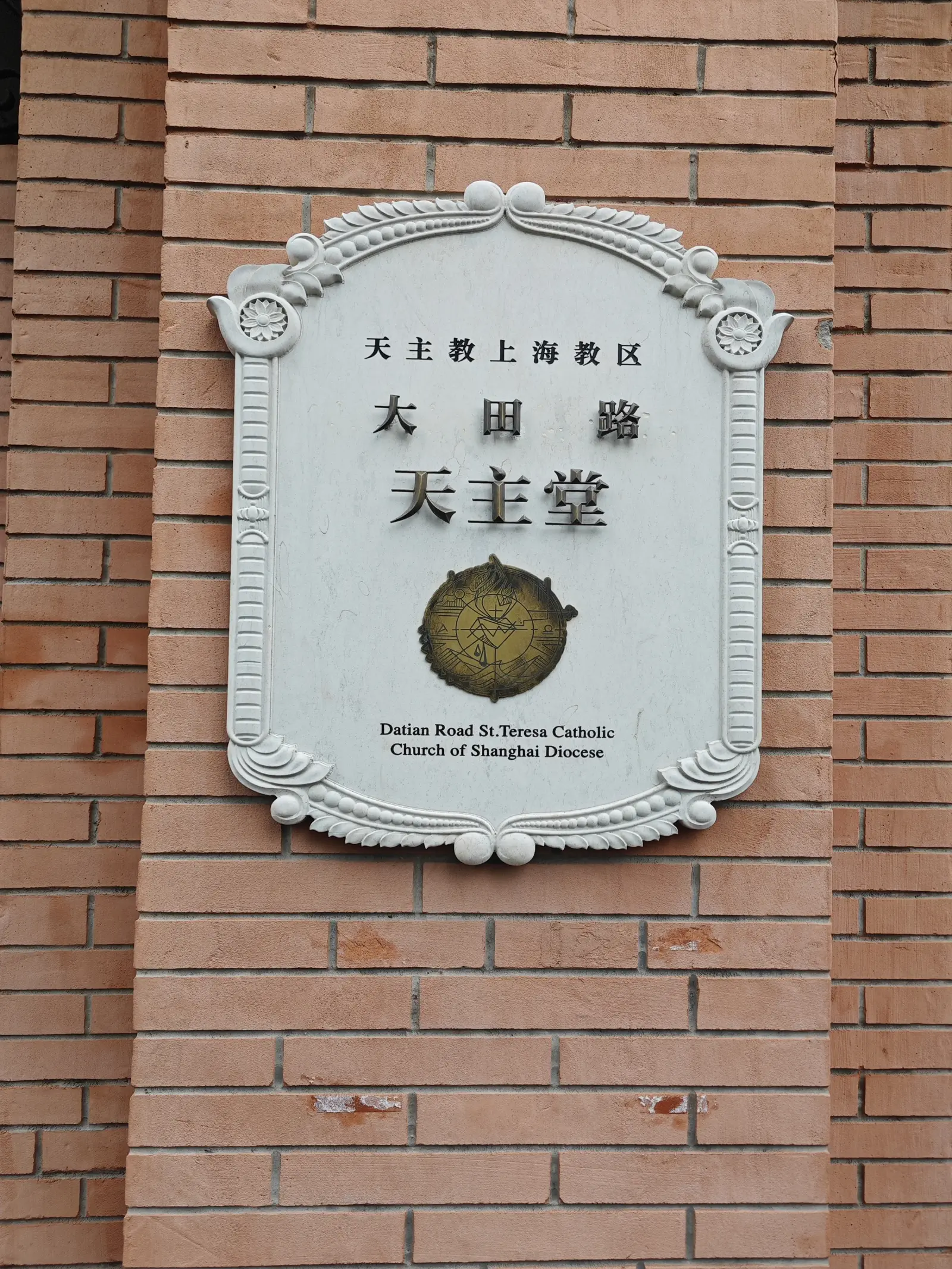
The stone name plate on the brick wall giving the church's name in Chinese and in English.
Photo: 中二halo君 · used with permission · Xiaohongshu · Bilibili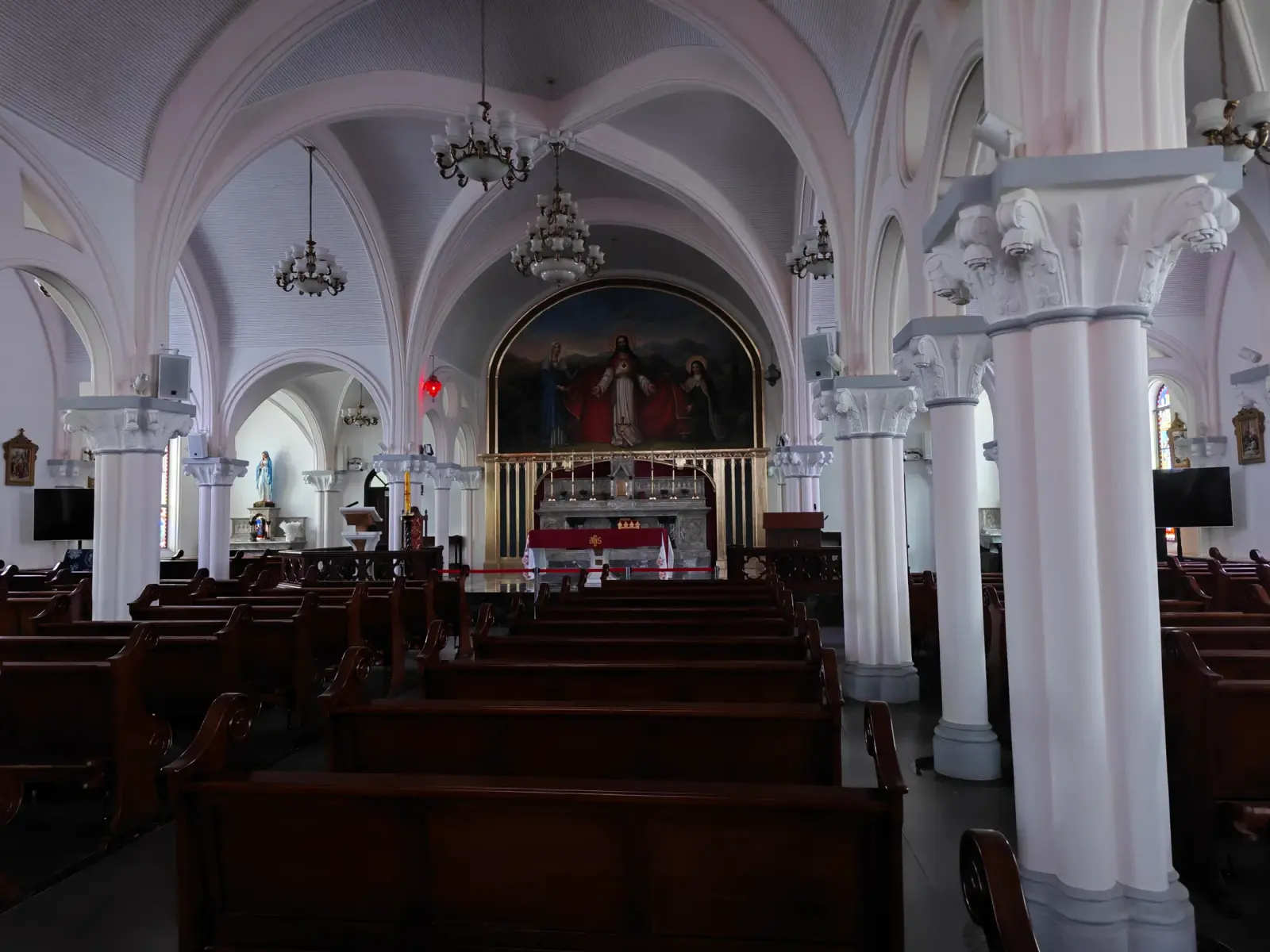
The nave, with white clustered columns, ribbed vaults, chandeliers and a painted altar scene.
Photo: 中二halo君 · used with permission · Xiaohongshu · Bilibili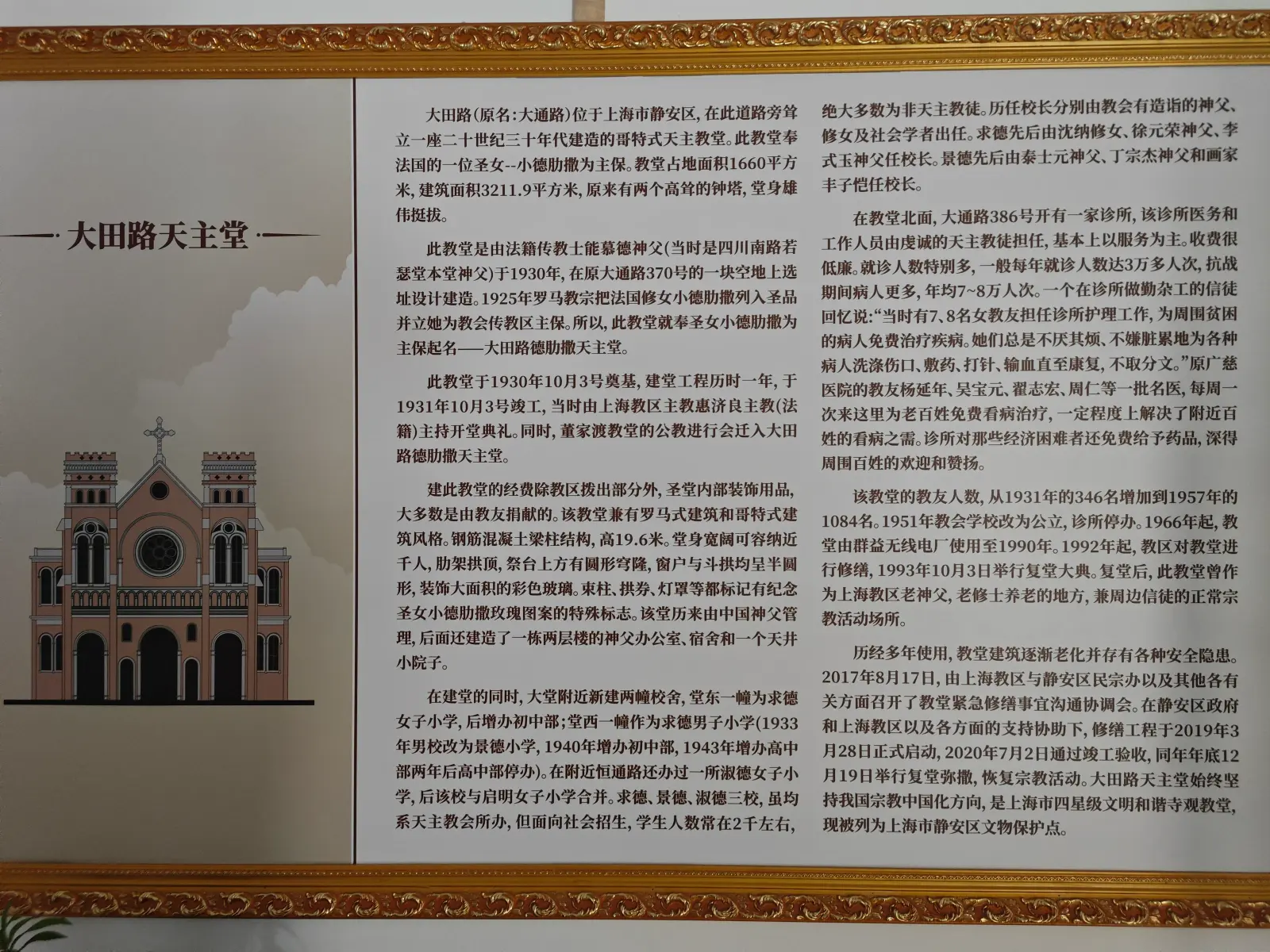
A Chinese-language history board with a sketch of the church front.
Photo: 中二halo君 · used with permission · Xiaohongshu · Bilibili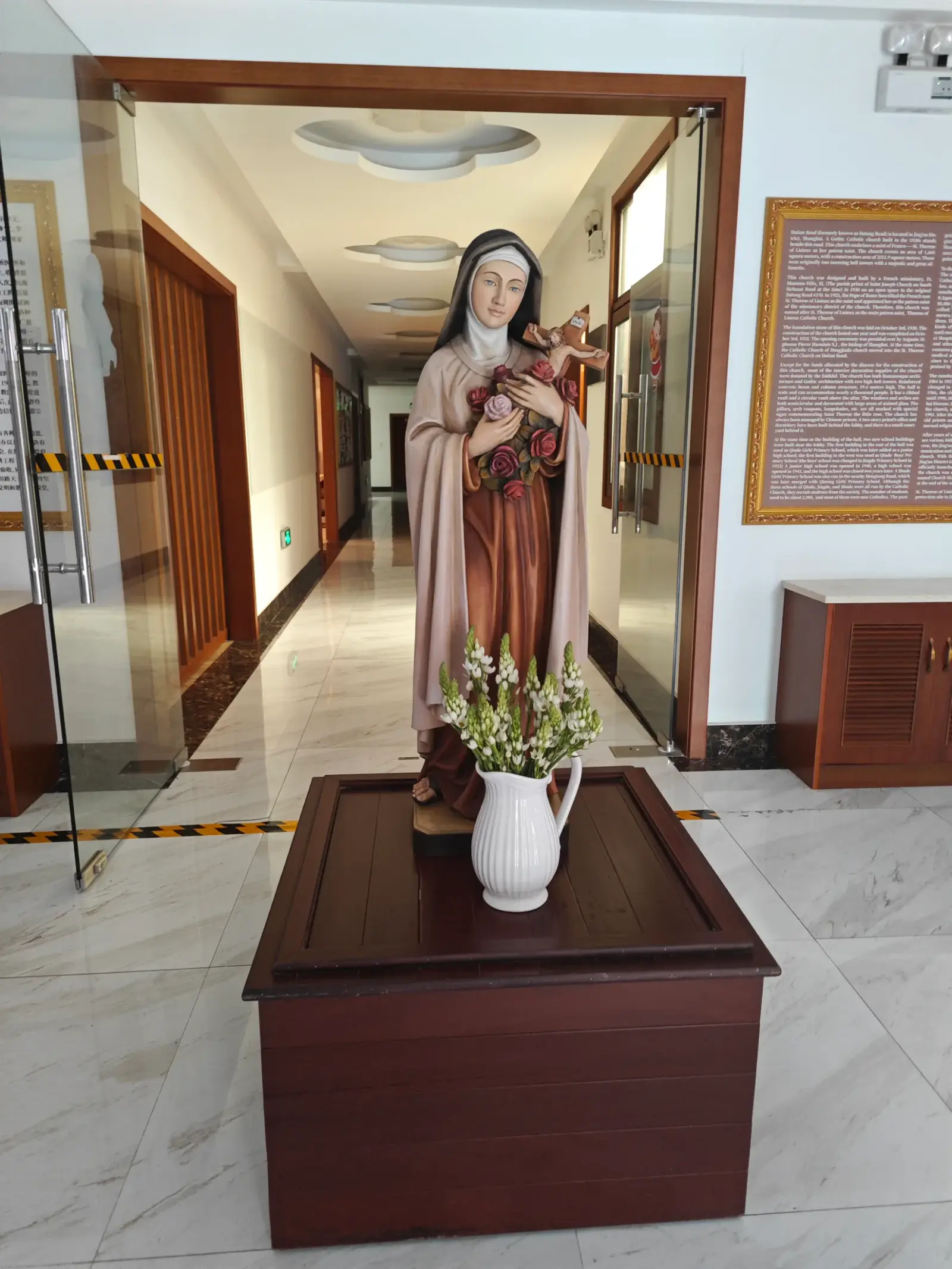
A statue of St Therese holding a crucifix and roses, in a corridor of the parish building.
Photo: 中二halo君 · used with permission · Xiaohongshu · BilibiliThe story
Datian Road St Teresa Church (大田路小德肋撒堂, Dàtián Lù Xiǎo Délèsā Táng), at 370 Datian Road in Jing’an District, is a Romanesque and Gothic church of 1930-31 dedicated to St Therese of Lisieux. It was repaired from 2019 and reopened with a Mass on 19 December 2020.
Why a church for St Therese?
St Therese of Lisieux was canonised in 1925. The Catholic leader Ma Xiangbo (马相伯, Mǎ Xiàngbó) translated her autobiography into Chinese as 《灵心小史》, and the Shanghai church urged its members to follow her example. According to the introduction posted at the church, the French missionary Fr Neng Mude (能慕德, Néng Mùdé), then pastor of St Joseph’s in Sichuan South Road, picked a vacant plot on what was then Datong Road, designed the church and built it. The foundation was laid on 3 October 1930 and the church finished on 3 October 1931. Both dates are her feast day. Bishop Hui Jiliang (惠济良) led the opening.
What does it look like?
The frame is reinforced concrete, 19.6 metres high, and the hall holds nearly a thousand people. It has ribbed vaults, a dome above the altar, semicircular windows and Chinese-style bracket forms, and a great deal of stained glass. Roses, the symbol of St Therese, appear on the columns, floor tiles and lampshades. The site is 1,660 square metres, with 3,211.9 square metres of floor space. The church originally had two high bell towers. About half the cost came from the diocese, and many furnishings were donated by parishioners.
A church with schools and a clinic
Two school buildings went up next to it, a girls’ school on the east and a boys’ school on the west, and a third school stood on Hengtong Road. Together the three taught about 2,000 pupils, most of them not Catholics. A clinic at 386 Datong Road, staffed by devout parishioners, charged very low fees; it averaged more than 30,000 visits a year, and 70,000 to 80,000 a year during the war. The introduction says doctors from Guangci Hospital came once a week to treat people free of charge.
From 1966 to today
The parish grew from 346 people in 1931 to 1,084 in 1957. The schools became public in 1951 and the clinic closed. From 1966 the Qunyi Radio Factory used the church until 1990; the Religion Gazetteer says the diocese regained it in 1991. After repairs from 1992 it reopened on 3 October 1993. For a time it served as a home for elderly priests and brothers. An emergency meeting on 17 August 2017 led to repairs starting on 28 March 2019; the work passed inspection on 2 July 2020, and the reopening Mass was held on 19 December 2020. The church is a Jing’an District cultural relic protection point.
What to look for
Inside, look up at the ribbed vaults and the dome above the altar, then for the roses carved or stamped on the columns, tiles and lampshades. Outside, find the semicircular windows and the bracket forms around them. The nameplate gives the English name as “Datian Road St.Teresa Catholic Church of Shanghai Diocese.”
Signs at the church, in full (2)
The wording of plaques and notices as photographed. Timetables and rules may have changed since.
Datian Road church name plaque
大田路天主堂门牌 · see the photo
English printed on the sign
Datian Road St.Teresa Catholic Church of Shanghai Diocese
Our translation of the Chinese
Catholic Diocese of Shanghai
Datian Road
Catholic Church
Chinese text
天主教上海教区
大田路
天主堂
Datian Road Catholic Church: An Introduction
大田路天主堂:简介 · see the photo
Our translation of the Chinese
Datian Road, formerly called Datong Road, is in Shanghai's Jing'an District. Beside it stands a Gothic Catholic church built in the 1930s. Its patron is the French saint Thérèse of Lisieux, known in Chinese as Little Thérèse. The church occupies a site of 1,660 square metres and has a gross floor area of 3,211.9 square metres. It originally had two soaring bell towers, and the church building was imposing and tall.
In 1930, the French missionary Father Neng Mude (能慕德), then parish priest of St Joseph's Church on South Sichuan Road, selected an empty plot at the former 370 Datong Road and designed and built this church. In 1925, the Pope in Rome canonised the French nun Thérèse of Lisieux and named her patron saint of the Church's mission territories. The church therefore took St Thérèse as its patron and was named Datian Road St Thérèse's Catholic Church.
The foundation stone was laid on 3 October 1930. Construction took one year and was completed on 3 October 1931. Bishop Hui Jiliang (惠济良), the French bishop of Shanghai, presided over the opening ceremony. At the same time, the Catholic Action organisation at Dongjiadu Church moved into Datian Road St Thérèse's Catholic Church.
The diocese provided part of the construction funding, while parishioners donated most of the items used to decorate the interior. The church combines Romanesque and Gothic architectural styles. It has a reinforced-concrete beam-and-column structure and is 19.6 metres high. Its spacious interior can accommodate nearly a thousand people. It has ribbed vaulting and a round dome above the altar; its windows and bracket sets are semicircular, with extensive stained-glass decoration. Clustered columns, arches and lampshades bear distinctive rose motifs commemorating St Thérèse. Chinese priests have always managed the church. Behind it, a two-storey building was also built to house priests' offices and accommodation, together with a small enclosed courtyard.
While the church was being built, two school buildings were constructed nearby. The one to the east housed Qiude Girls' Primary School, which later added a junior secondary section. The one to the west housed Qiude Boys' Primary School. In 1933, the boys' school was renamed Jingde Primary School; a junior secondary section was added in 1940 and a senior secondary section in 1943, though the senior section closed two years later. Shude Girls' Primary School was also established on nearby Hengtong Road and later merged with Qiming Girls' Primary School. Although Qiude, Jingde and Shude were all run by the Catholic Church, they admitted pupils from the general public. Their enrolment was often around two thousand, the great majority of whom were not Catholic. Their successive headteachers included accomplished priests and nuns from the Church as well as scholars from the wider community. Qiude's headteachers included, in succession, Sister Shen Na (沈纳), Father Xu Yuanrong (徐元荣) and Father Li Shiyu (李式玉). Jingde's included Father Qin Shiyuan (秦士元), Father Ding Zongjie (丁宗杰) and the painter Feng Zikai (丰子恺).
North of the church, at 386 Datong Road, there was a clinic staffed by devout Catholics. Its principal purpose was service, and its fees were very low. It treated a particularly large number of patients: generally more than 30,000 visits a year, rising to an annual average of 70,000–80,000 during the War of Resistance Against Japan. A Catholic who worked there as a general assistant recalled: “At that time, seven or eight Catholic women provided nursing care at the clinic, treating poor patients from the surrounding area free of charge. With endless patience, undeterred by dirt or exhaustion, they cleaned wounds, applied medicine, gave injections and performed blood transfusions for all kinds of patients until they recovered, without taking a penny.” A group of well-known Catholic doctors from the former Guangci Hospital, including Yang Yannian (杨延年), Wu Baoyuan (吴宝元), Zhai Zhihong (翟志宏) and Zhou Ren (周仁), came once a week to provide free consultations and treatment for ordinary people, helping to meet the medical needs of the surrounding neighbourhood. The clinic also gave medicines free of charge to those in financial difficulty, earning the welcome and praise of local residents.
The church's congregation increased from 346 in 1931 to 1,084 in 1957. In 1951, the Church's schools became public schools and the clinic closed. From 1966 until 1990, the church was used by the Qunyi Radio Factory. The diocese began repairing the church in 1992, and a grand reopening ceremony was held on 3 October 1993. After reopening, it served both as a retirement home for elderly priests and religious brothers of the Diocese of Shanghai and as a place for the normal religious activities of Catholics in the surrounding area.
After many years of use, the church building gradually aged and developed various safety hazards. On 17 August 2017, the Diocese of Shanghai, the Jing'an District Ethnic and Religious Affairs Office and other parties concerned held a meeting to communicate and coordinate arrangements for urgent repairs. With the support and assistance of the Jing'an District Government, the Diocese of Shanghai and other parties, restoration formally began on 28 March 2019 and passed its completion inspection on 2 July 2020. On 19 December that year, a reopening Mass was held and religious activities resumed. Datian Road Catholic Church has consistently adhered to the policy of adapting religions to the Chinese context. It is a Shanghai four-star “civilised and harmonious temple or church” and is now listed as a heritage protection site in Jing'an District, Shanghai.
Chinese text
大田路(原名:大通路)位于上海市静安区,在此道路旁耸立一座二十世纪三十年代建造的哥特式天主教堂。此教堂奉法国的一位圣女--小德肋撒为主保。教堂占地面积1660平方米,建筑面积3211.9平方米,原来有两个高耸的钟塔,堂身雄伟挺拔。
此教堂是由法籍传教士能慕德神父(当时是四川南路若瑟堂本堂神父)于1930年,在原大通路370号的一块空地上选址设计建造。1925年罗马教宗把法国修女小德肋撒列入圣品并立她为教会传教区主保。所以,此教堂就奉圣女小德肋撒为主保起名——大田路德肋撒天主堂。
此教堂于1930年10月3号奠基,建堂工程历时一年,于1931年10月3号竣工,当时由上海教区主教惠济良主教(法籍)主持开堂典礼。同时,董家渡教堂的公教进行会迁入大田路德肋撒天主堂。
建此教堂的经费除教区拨出部分外,圣堂内部装饰用品,大多数是由教友捐献的。该教堂兼有罗马式建筑和哥特式建筑风格。钢筋混凝土梁柱结构,高19.6米。堂身宽阔可容纳近千人,肋架拱顶,祭台上方有圆形穹隆,窗户与斗拱均呈半圆形,装饰大面积的彩色玻璃。束柱、拱券、灯罩等都标记有纪念圣女小德肋撒玫瑰图案的特殊标志。该堂历来由中国神父管理,后面还建造了一栋两层楼的神父办公室、宿舍和一个天井小院子。
在建堂的同时,大堂附近新建两幢校舍,堂东一幢为求德女子小学,后增办初中部;堂西一幢作为求德男子小学(1933年男校改为景德小学,1940年增办初中部,1943年增办高中部两年后高中部停办)。在附近恒通路还办过一所淑德女子小学,后该校与启明女子小学合并。求德、景德、淑德三校,虽均系天主教会所办,但面向社会招生,学生人数常在2千左右,绝大多数为非天主教徒。历任校长分别由教会有造诣的神父、修女及社会学者出任。求德先后由沈纳修女、徐元荣神父、李式玉神父任校长。景德先后由秦士元神父、丁宗杰神父和画家丰子恺任校长。
在教堂北面,大通路386号开有一家诊所,该诊所医务和工作人员由虔诚的天主教徒担任,基本上以服务为主。收费很低廉。就诊人数特别多,一般每年就诊人数达3万多人次,抗战期间病人更多,年均7~8万人次。一个在诊所做勤杂工的信徒回忆说:“当时有7、8名女教友担任诊所护理工作,为周围贫困的病人免费治疗疾病。她们总是不厌其烦、不嫌脏累地为各种病人洗涤伤口、敷药、打针、输血直至康复,不取分文。”原广慈医院的教友杨延年、吴宝元、翟志宏、周仁等一批名医,每周一次来这里为老百姓免费看病治疗,一定程度上解决了附近百姓的看病之需。诊所对那些经济困难者还免费给予药品,深得周围百姓的欢迎和赞扬。
该教堂的教友人数,从1931年的346名增加到1957年的1084名。1951年教会学校改为公立,诊所停办。1966年起,教堂由群益无线电厂使用至1990年。1992年起,教区对教堂进行修缮,1993年10月3日举行复堂大典。复堂后,此教堂曾作为上海教区老神父、老修士养老的地方,兼周边信徒的正常宗教活动场所。
历经多年使用,教堂建筑逐渐老化并存有各种安全隐患。2017年8月17日,由上海教区与静安区民宗办以及其他各有关方面召开了教堂紧急修缮事宜沟通协调会。在静安区政府和上海教区以及各方面的支持协助下,修缮工程于2019年3月28日正式启动,2020年7月2日通过竣工验收,同年年底12月19日举行复堂弥撒,恢复宗教活动。大田路天主堂始终坚持我国宗教中国化方向,是上海市四星级文明和谐寺观教堂,现被列为上海市静安区文物保护点。
How to visit
- Status
- Visitor access not yet confirmed
- Opening times and prices not yet confirmed; check before you go.
- Nearest metro
- Metro directions will be added after a site visit.Plan a metro journey here →
Chinese address — show this to a taxi driver
大田路370号
370 Datian Road, Jing'an District, Shanghai
Amap (高德地图) works best in mainland China; Apple Maps on iPhone. Both open in the app when it is installed.
The map position is approximate; the entrance has not been checked.
Nearby
Loading map…
Within a 10-minute walk
- Shanghai Natural History Museum上海自然博物馆4 min walk
Within a 20-minute walk
- West Nanjing Road Shopping District南京西路商圈13 min walk
- Sihang Warehouse四行仓库15 min walk
- Park Hotel国际饭店15 min walk
- Suhewan Commercial District苏河湾商圈15 min walk
- Ohel Rachel Synagogue拉结会堂16 min walk
Sources
- 1.Shanghai Religion Gazetteer, Catholicism, Open Churches (with table of other open churches) (上海宗教志 · 第四编天主教 · 第一节 开放教堂(附:其他开放教堂一览表)), Shanghai Local Chronicles Office — 十八、大田路小德肋撒堂gazetteer
- 2.Photographs of Shanghai churches and their signs, by 中二halo君 (上海教堂实拍照片(中二halo君)), 中二halo君, 中二halo君, 2026 — sign photographed at the churchfieldwork