Free walks · The Bund
The Bund, south to north: from the signal tower to Waibaidu Bridge
Thirteen stops along the Bund, from the 1907–08 signal tower to Broadway Mansions: banks, hotels, a clock that changed its tune and the oldest building.
Distance
2.2 km
Duration
64 min
Stops
13
Start → End
Gutzlaff Signal Tower (Yuyuan Garden (Lines 10, 14))→Broadway Mansions (Tiantong Road (Lines 10, 12))
We drafted this route from the map and have not yet walked it end to end. Distance and time are estimates and allow for stopping at each place, not for going inside.
Loading map…
Download GPXOpens in any map or fitness app. It holds the route and the numbered stops.
Stops
- 1
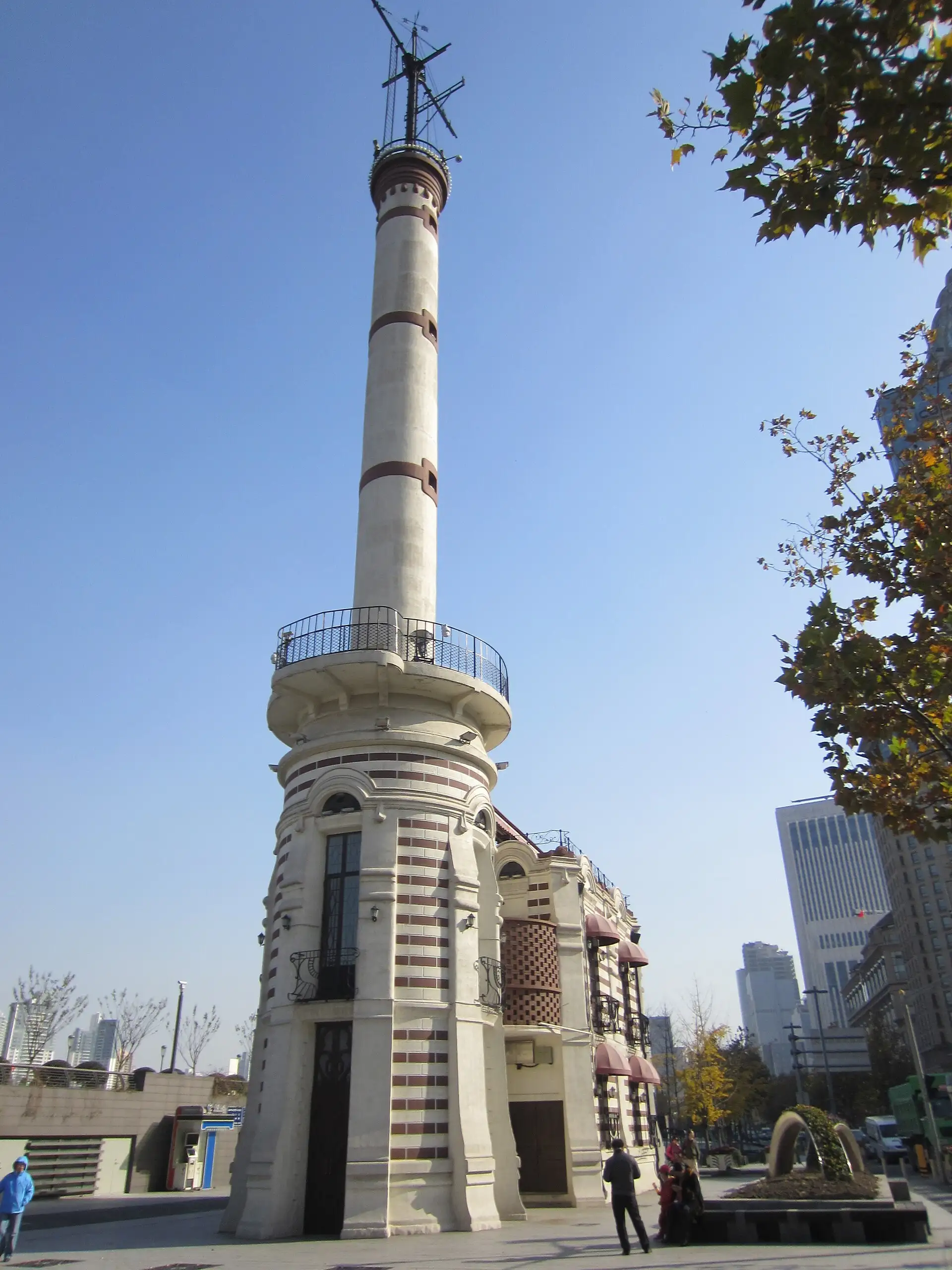
Photo: Another Believer · CC BY-SA 4.0 Gutzlaff Signal Tower
外滩信号台Wàitān Xìnhàotái
Start at the round concrete tower at the south end of the row. It was built in 1907–08 to signal weather and time to ships in the river: storm and wind flags went up at fixed hours, and a ball dropped from the mast at noon. In October 1993 the whole tower, 49.8 m tall, was moved 22.4 m toward the river in one piece to make room for a wider Zhongshan East Road. It reopened in October 2026 with a Bund history display on the ground floor and a café upstairs. From here, walk north on the inland pavement.
- 2
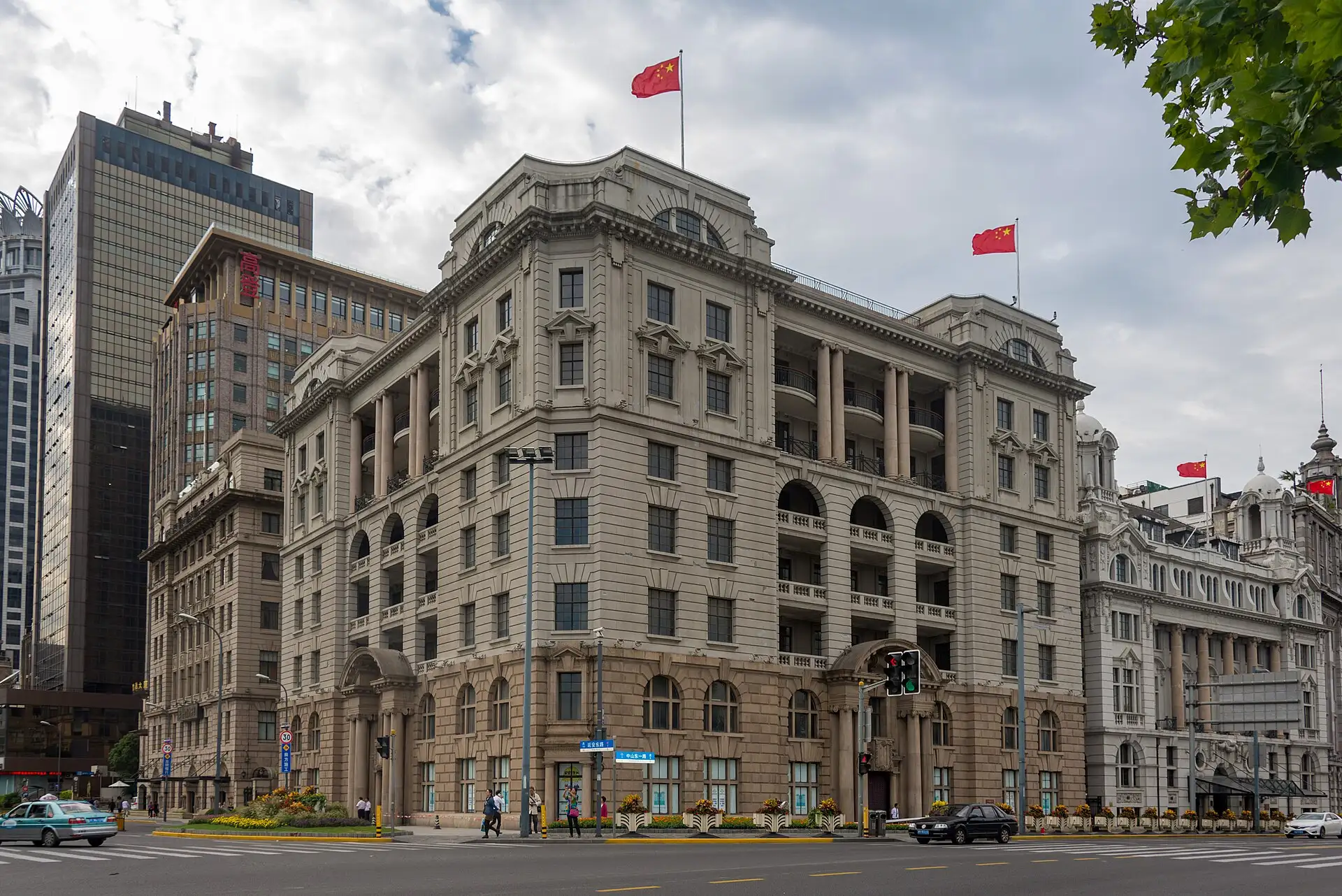
Photo: xiquinhosilva · CC BY 2.0 · Cropped to fit Asia Building
亚细亚大楼Yàxìyà Dàlóu
Bund No. 1 was completed in 1916 as the McBain Building and took its usual name from the Asiatic Petroleum Company, a Shell subsidiary, which moved in the next year. It was the tallest building on the Bund when it opened, which, with its address, earned it the nickname 'the first building on the Bund'. Look for the four Ionic columns under a carved arch at the river entrance, and the concave bay that rounds off the corner with East Yan'an Road. The second and third floors have held the main galleries of the Shanghai Jiushi Art Museum since 2026.
- 3
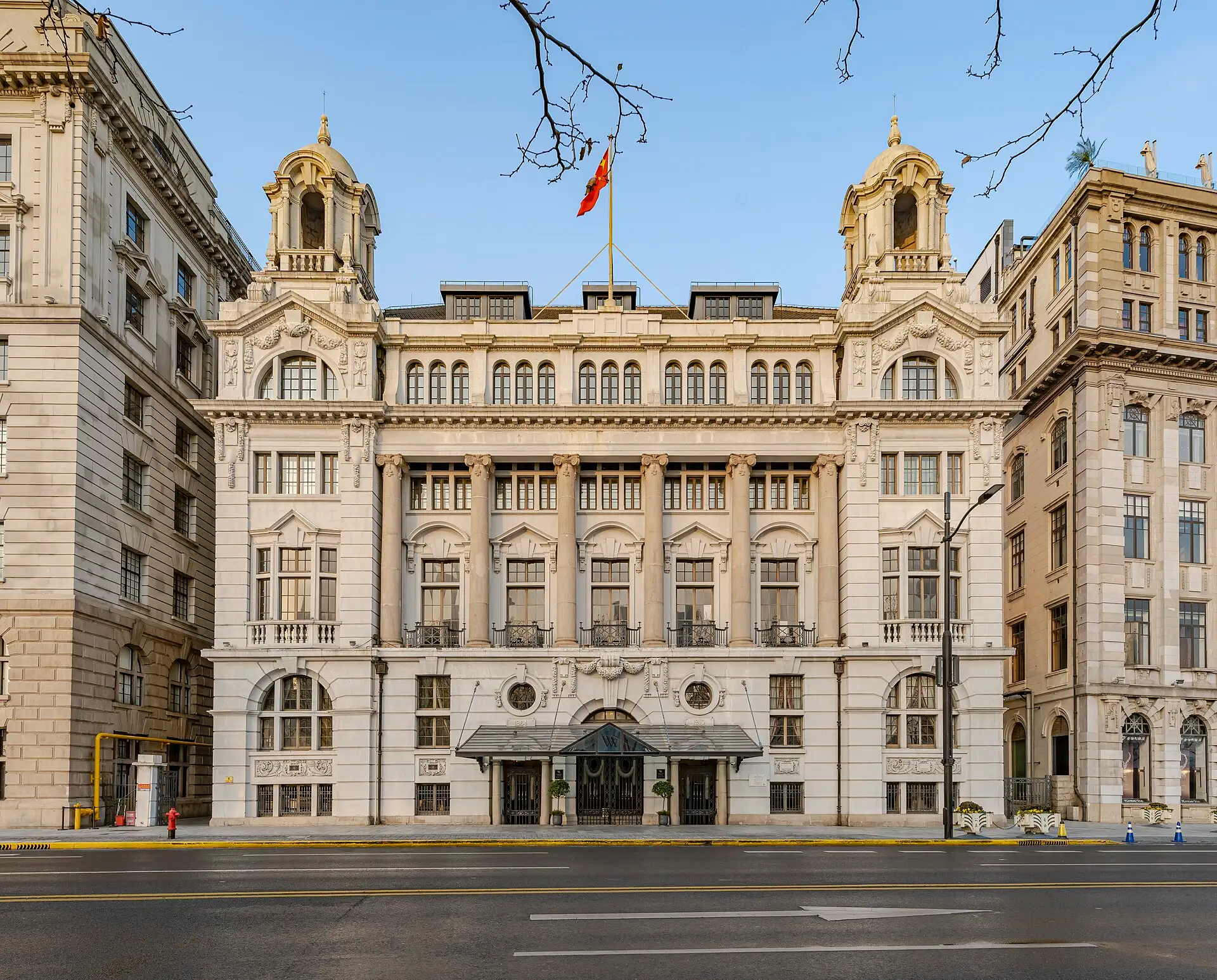
Photo: ScareCriterion12 Shanghai Club Building
上海总会大楼Shànghǎi Zǒnghuì Dàlóu
The British Shanghai Club moved into this building around 1910; sources differ on whether it opened in 1910 or 1911. Its ground-floor bar counter, more than 30 m long, was described as the longest in the world. In 1909 the club had 1,300 members, three-quarters of them British. After 1949 the building became a seamen's club and then the Dongfeng Hotel, where Shanghai's first KFC opened in 1989. It is now the Waldorf Astoria, with the Long Bar restored. Outside, count the six giant Ionic columns and the two turrets on the roof.
- 4
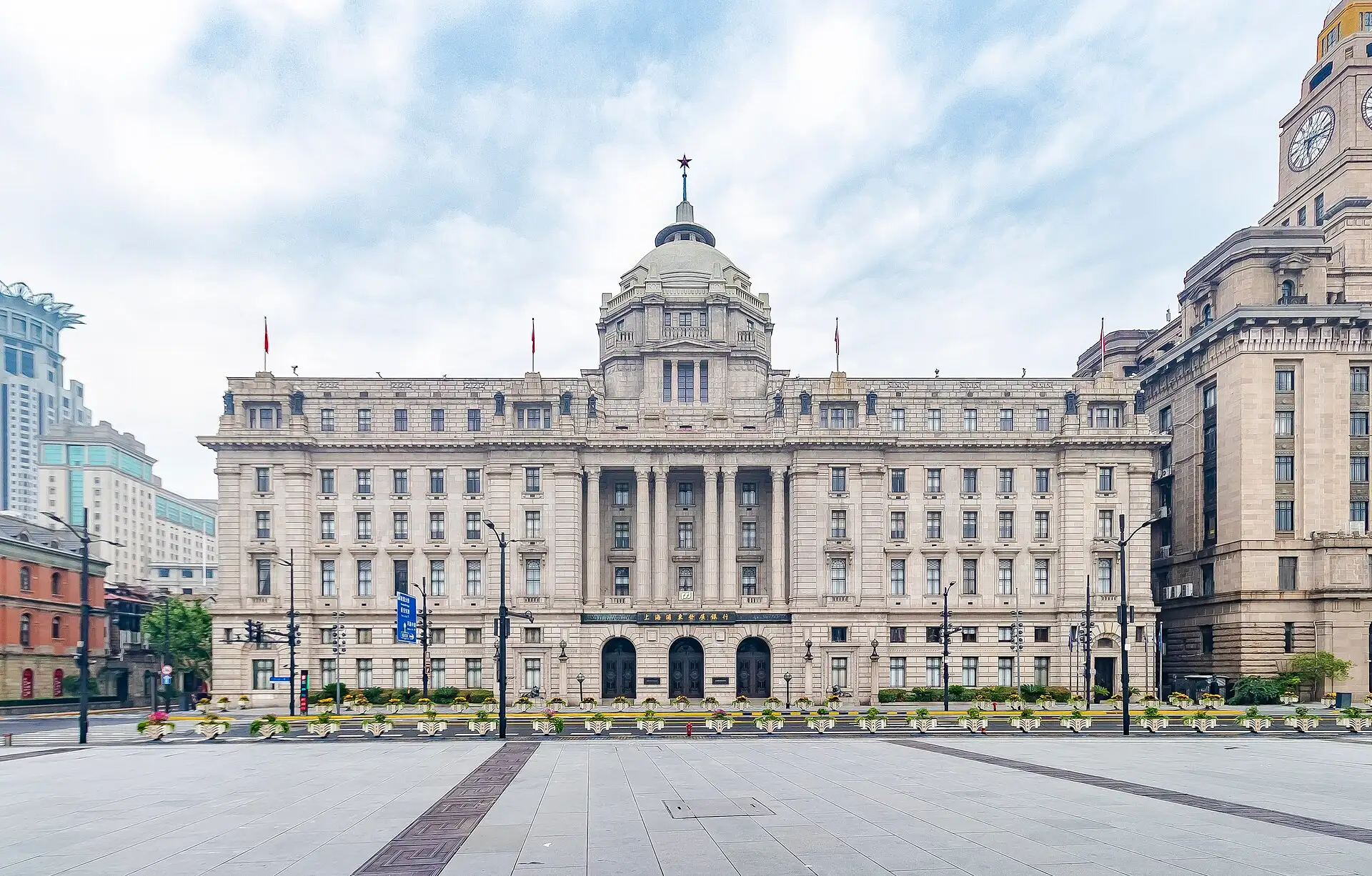
Photo: ScareCriterion12 · CC BY-SA 4.0 · Cropped to fit HSBC Building
上海浦东发展银行大楼Shànghǎi Pǔdōng Fāzhǎn Yínháng Dàlóu
The widest frontage on the Bund, covering Nos. 10 to 12. HSBC's Shanghai manager briefed the architects Palmer & Turner in 1919 to spare no expense and dominate the Bund; the building opened on 23 June 1923. The bronze lions at the door are replicas made around 1997; the originals, Stephen and Stitt, are in the Shanghai History Museum. Inside is an octagonal hall whose mosaic dome was painted over in 1956 and found again in 1997. The building is now SPD Bank, which has offered short booked lunchtime visits, entered from 36 Fuzhou Road.
- 5
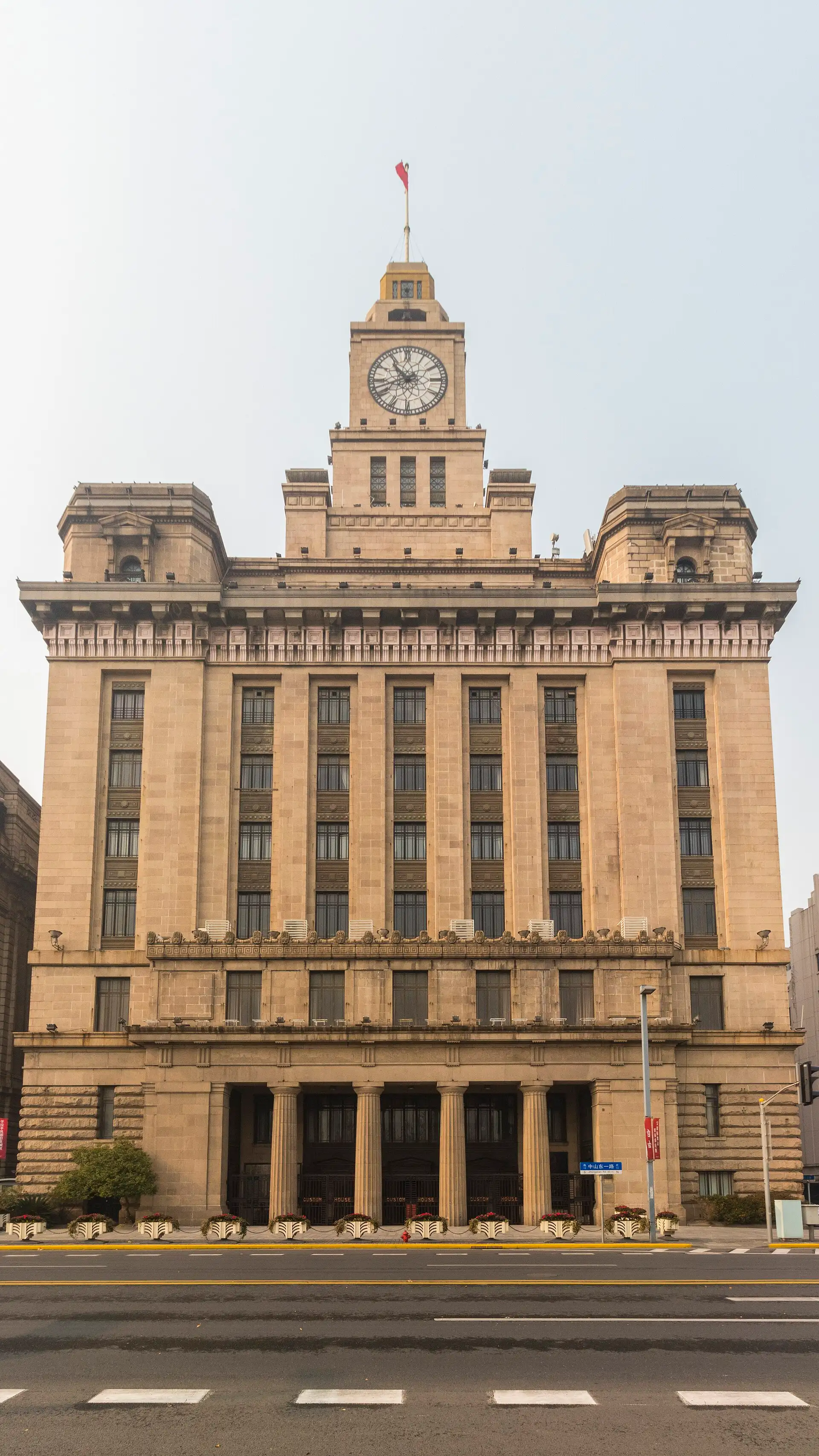
Photo: ScareCriterion12 · CC BY-SA 4.0 Customs House
上海海关大楼Shànghǎi Hǎiguān Dàlóu
Next door, the clock tower was the highest point on the Bund when the Customs House opened in December 1927. The clock, made by J. B. Joyce & Co. of Whitchurch in England, first struck on New Year's Day 1928. Its quarter-hour tune has followed politics: Westminster chimes at first, The East Is Red from 1966, Westminster again from 1986, only the hour from mid-1997, and The East Is Red once more since 2003, now played from a recording. The hour is still struck on a real bell. Shanghai Customs still works in the building, so you see it from the street.
- 6
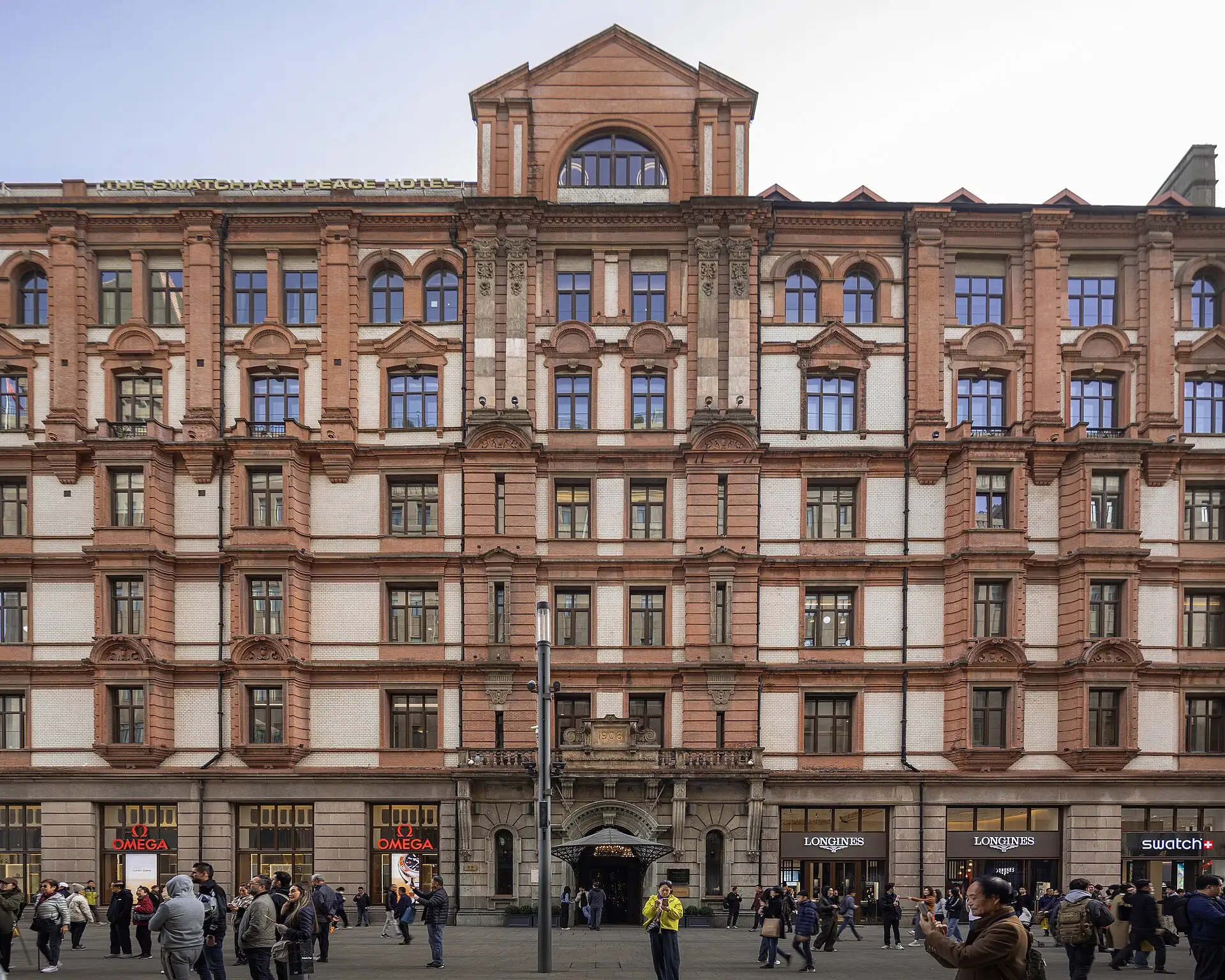
Photo: Supanut Arunoprayote · CC BY 4.0 · Cropped to fit Palace Hotel (Swatch Art Peace Hotel)
汇中饭店大楼Huìzhōng Fàndiàn Dàlóu
Walk on to the south corner of Nanjing Road East. The Palace Hotel opened in 1908; the '1906' over its Nanjing Road door is the date of the drawings. Its two Otis lifts are described as the first passenger lifts in Shanghai. From 1 to 26 February 1909 it hosted the International Opium Commission, the first international meeting on narcotics control, with delegates from 13 countries; a bronze plaque unveiled in 1996 marks it. The roof pavilions burned in 1914, which is why the roofline is flat. The building is now the Swatch Art Peace Hotel.
- 7
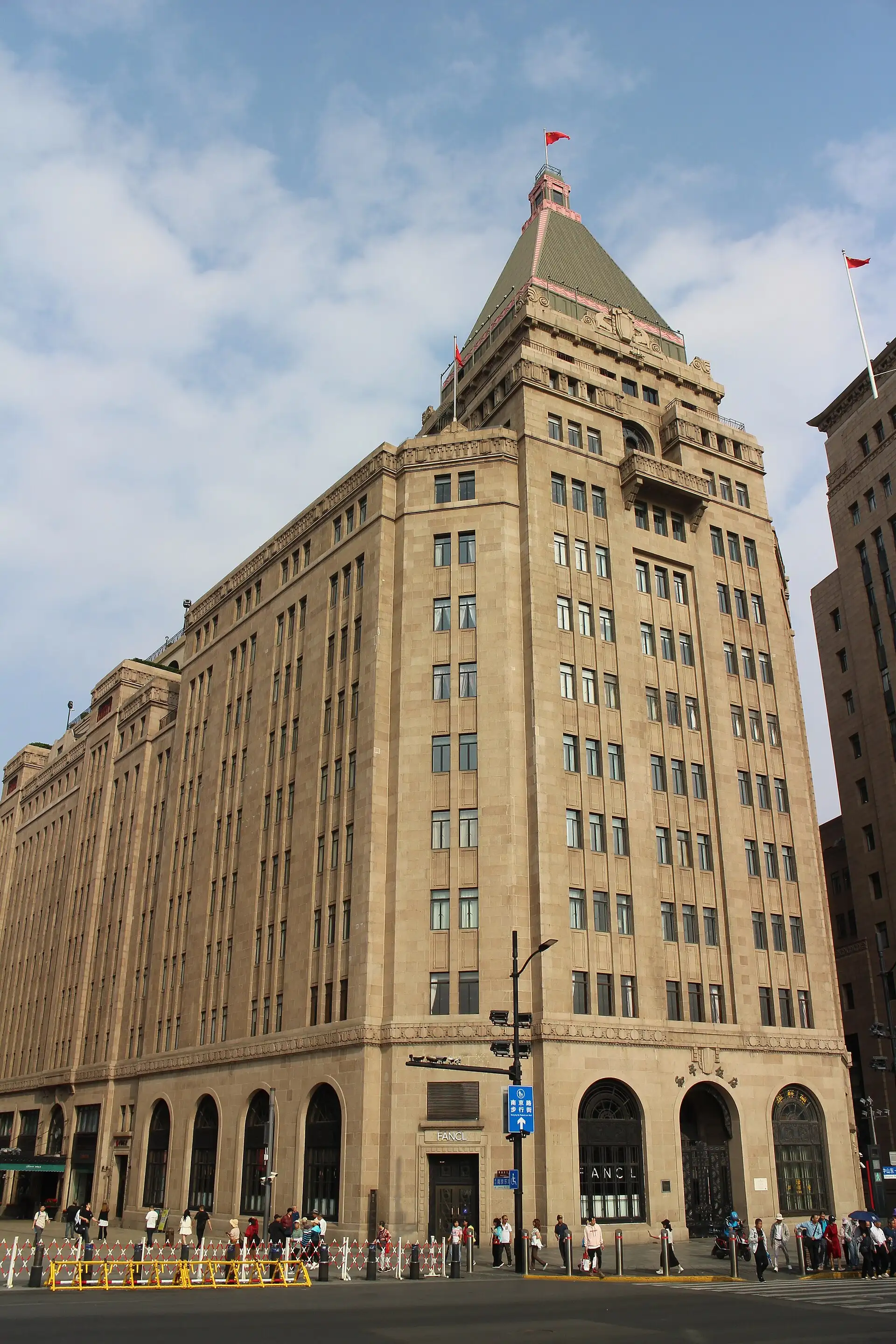
Photo: Suicasmo Sassoon House (Fairmont Peace Hotel)
沙逊大厦Shāxùn Dàshà
Across Nanjing Road stands Victor Sassoon's tower, completed in 1929, with its 19-metre pyramid roof of copper painted dark green. The Cathay Hotel took floors five to nine and Sassoon lived at the top. On 14 August 1937, the day after fighting broke out in Shanghai, two bombs from Chinese aircraft fell at this junction, one on the Palace Hotel's roof and one in the road in front of the Cathay; 729 people were killed. The hotel reopened as the Peace Hotel in 1956. Its entrance is on Nanjing Road, and a history museum is on the ground floor.
- 8
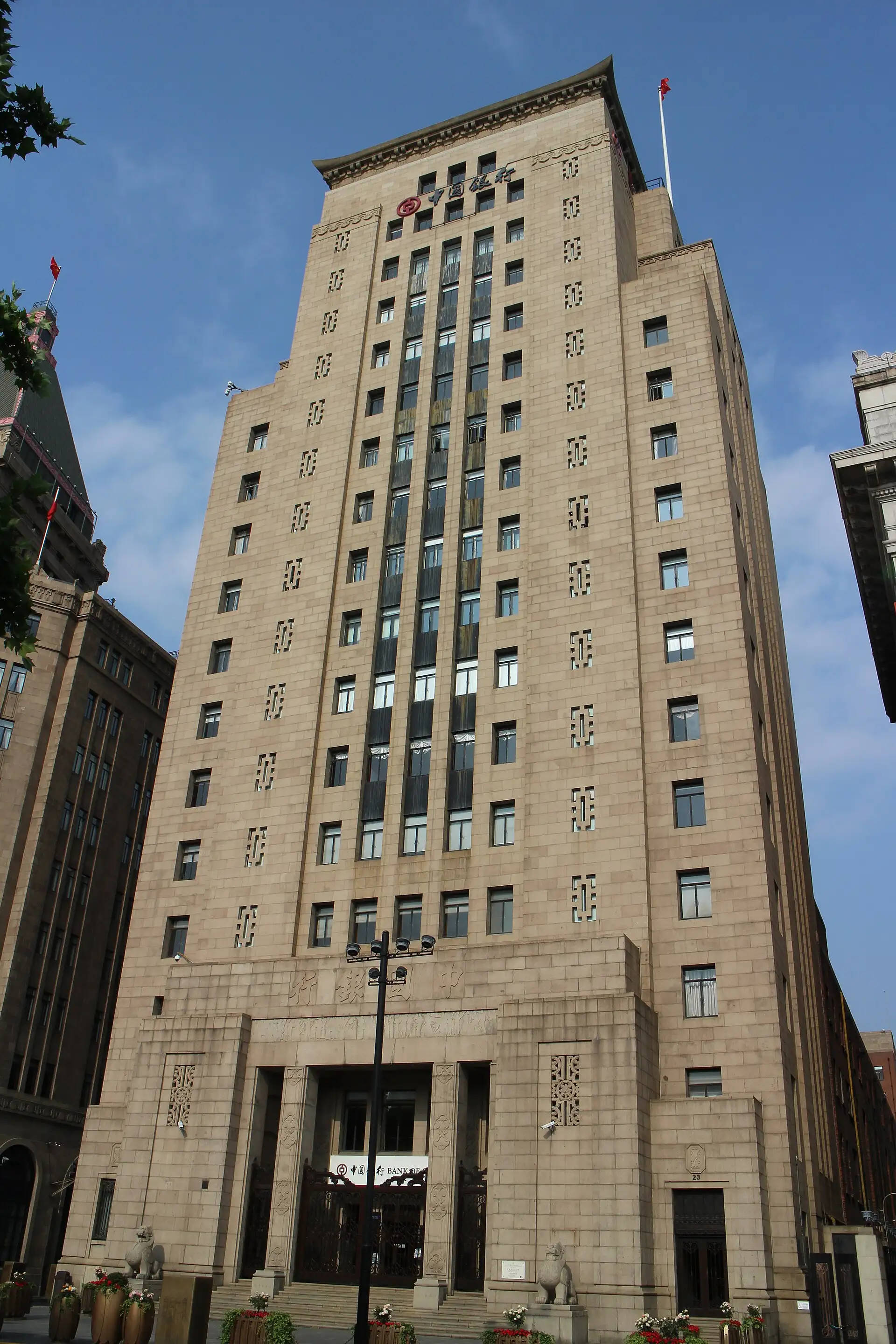
Photo: Suicasmo Bank of China Building
中国银行大楼Zhōngguó Yínháng Dàlóu
One of the few buildings on the row in a Chinese style. Its roof is a low pyramid of blue glazed tiles over stone dougong brackets, with Chinese patterns in the railings and grilles. It was designed by Luke Him Sau (陆谦受, Lù Qiānshòu) of the bank's own building department, with Palmer & Turner as consultants, and topped out in 1937 at about 70 m, a little lower than Sassoon House next door. Why it was not built taller is disputed: the city gazetteer blames Victor Sassoon and the council, while a 2017 Shanghai Banking Museum study points to money and height rules.
- 9
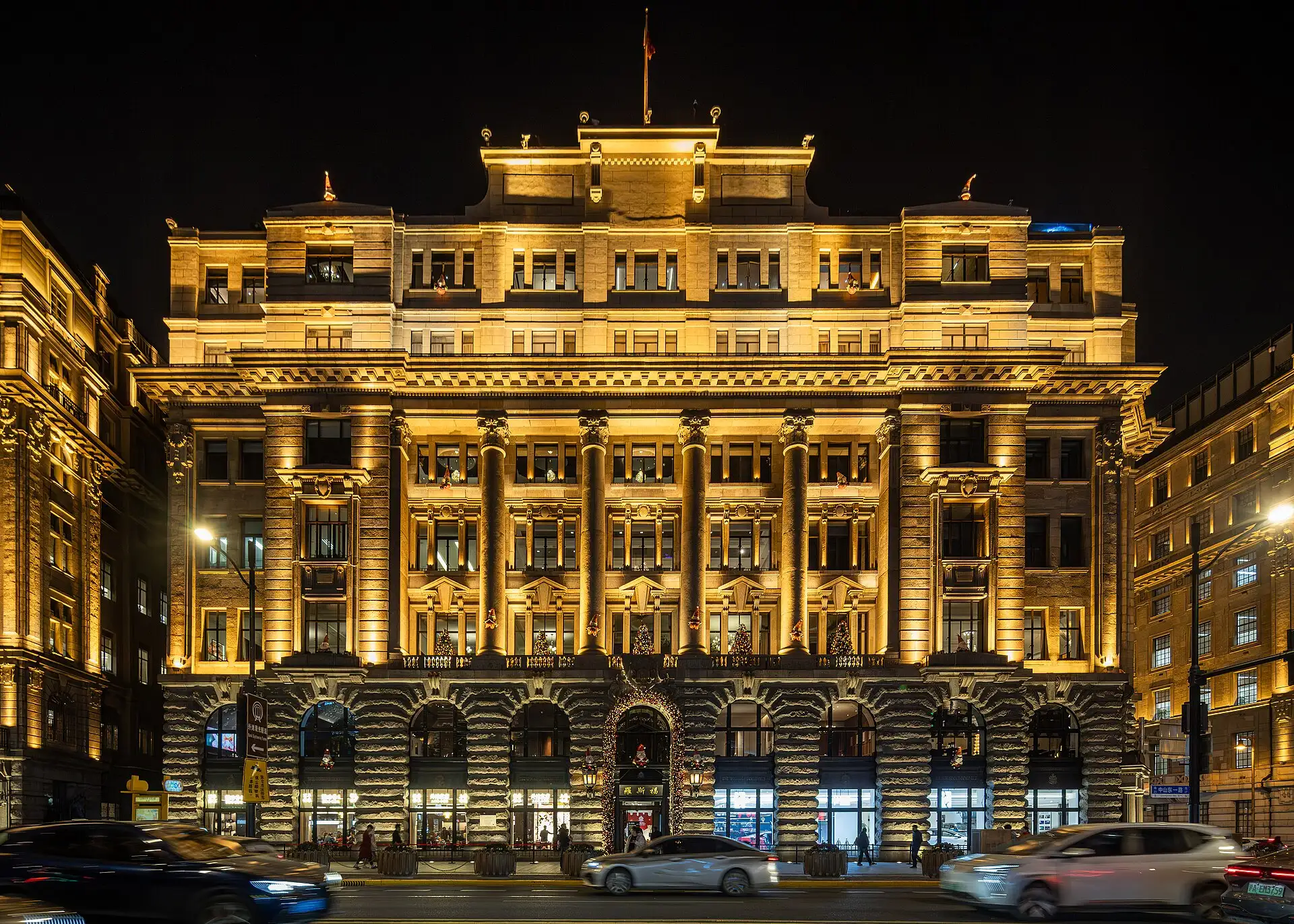
Photo: Supanut Arunoprayote · CC BY 4.0 · Cropped to fit Jardine Matheson Building
怡和洋行大楼Yíhé Yángháng Dàlóu
Jardine, Matheson & Co., among the first foreign firms in Shanghai, held this lot at No. 27 from 1845. The present head office was finished in November 1922: granite throughout, rough-cut on the lower floors, with four Corinthian columns across the middle and a carved ram's head at the centre of the second floor. Look at the top: the upper floors were added later, most sources say in 1983, and sit above the original cornice. From 1955 the building housed the Shanghai Foreign Trade Bureau; today it holds shops, restaurants and offices.
- 10
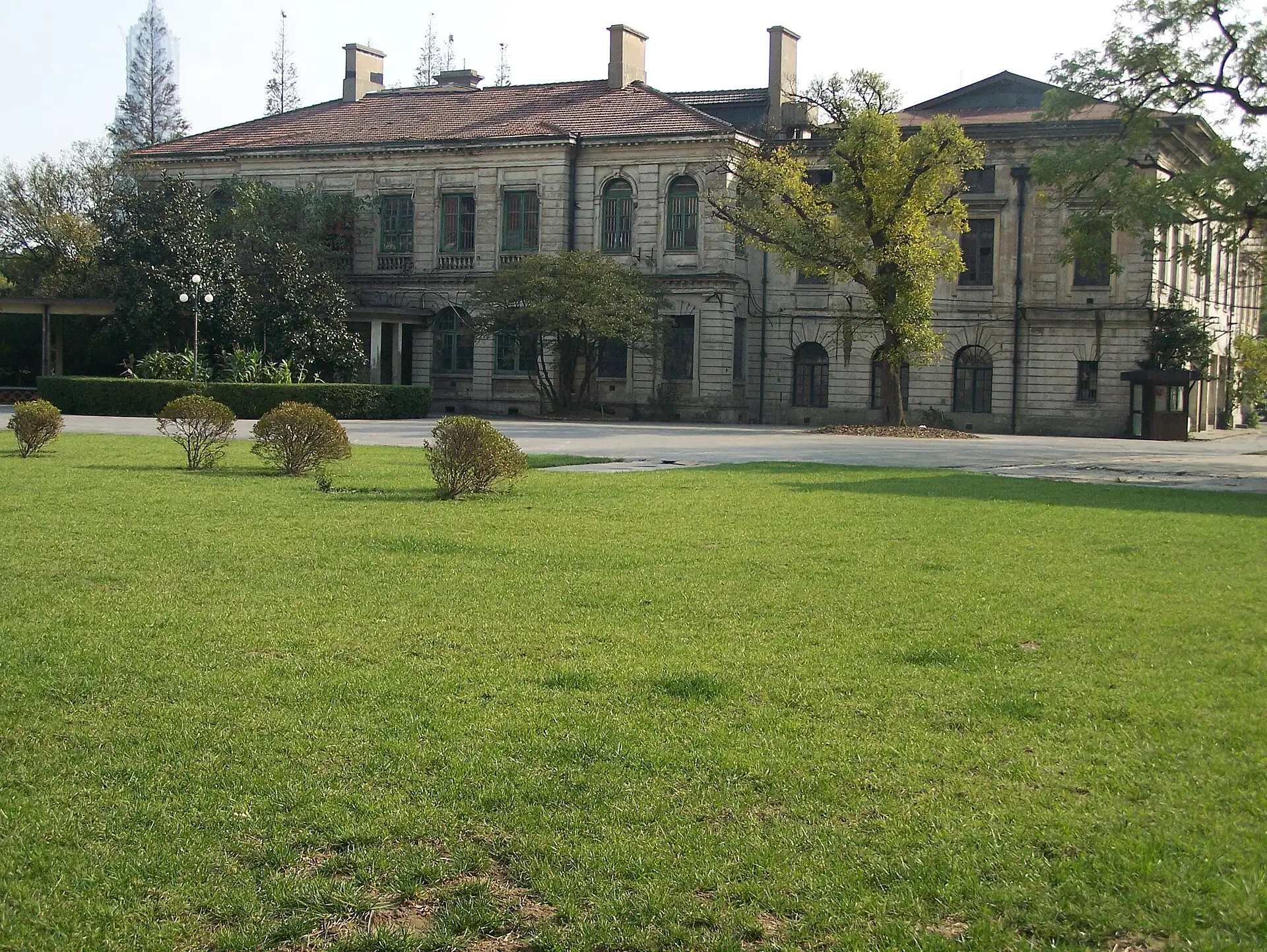
Photo: Jason Zou Former British Consulate-General
原英国驻沪总领事馆Yuán Yīngguó Zhù Hù Zǒnglǐngshìguǎn
At the north end, set back behind a lawn, is the oldest surviving Western-style building on the Bund. The British consulate moved onto this plot in 1849; this two-storey block replaced one destroyed by fire in 1870 and was finished in 1873. Note the five arches along the ground floor, the verandah above them, and the roof of small grey Chinese tiles. The consulate-general moved to Xuhui District in 1985. Since 2010 the compound has been Bund Origin No. 1, used for exhibitions, with some rooms open at set times.
- 11
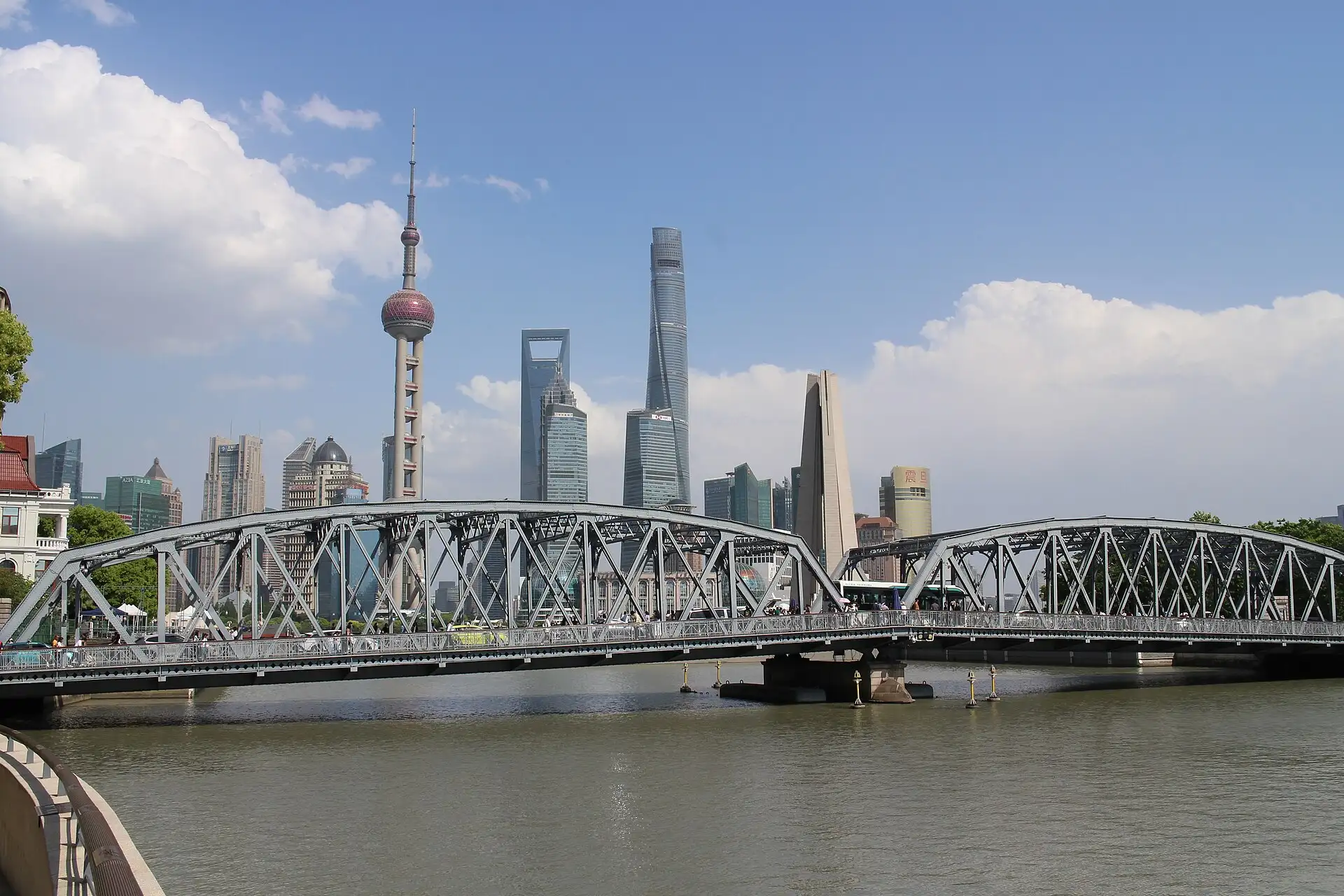
Photo: Suicasmo Waibaidu Bridge
外白渡桥Wàibáidù Qiáo
Cross the mouth of Suzhou Creek on the first steel bridge over the creek, completed on 29 December 1907. Its Chinese name records a grievance. The earlier wooden toll bridge charged Chinese pedestrians while foreign residents crossed free, and people used free ferries nearby instead. When the council bought the bridge in 1872 and ended the toll, the new crossing became 外白渡, 'the outer free crossing'. In 2008 the two spans were floated away for repair; they came back in 2009 with some 63,000 new rivets.
- 12
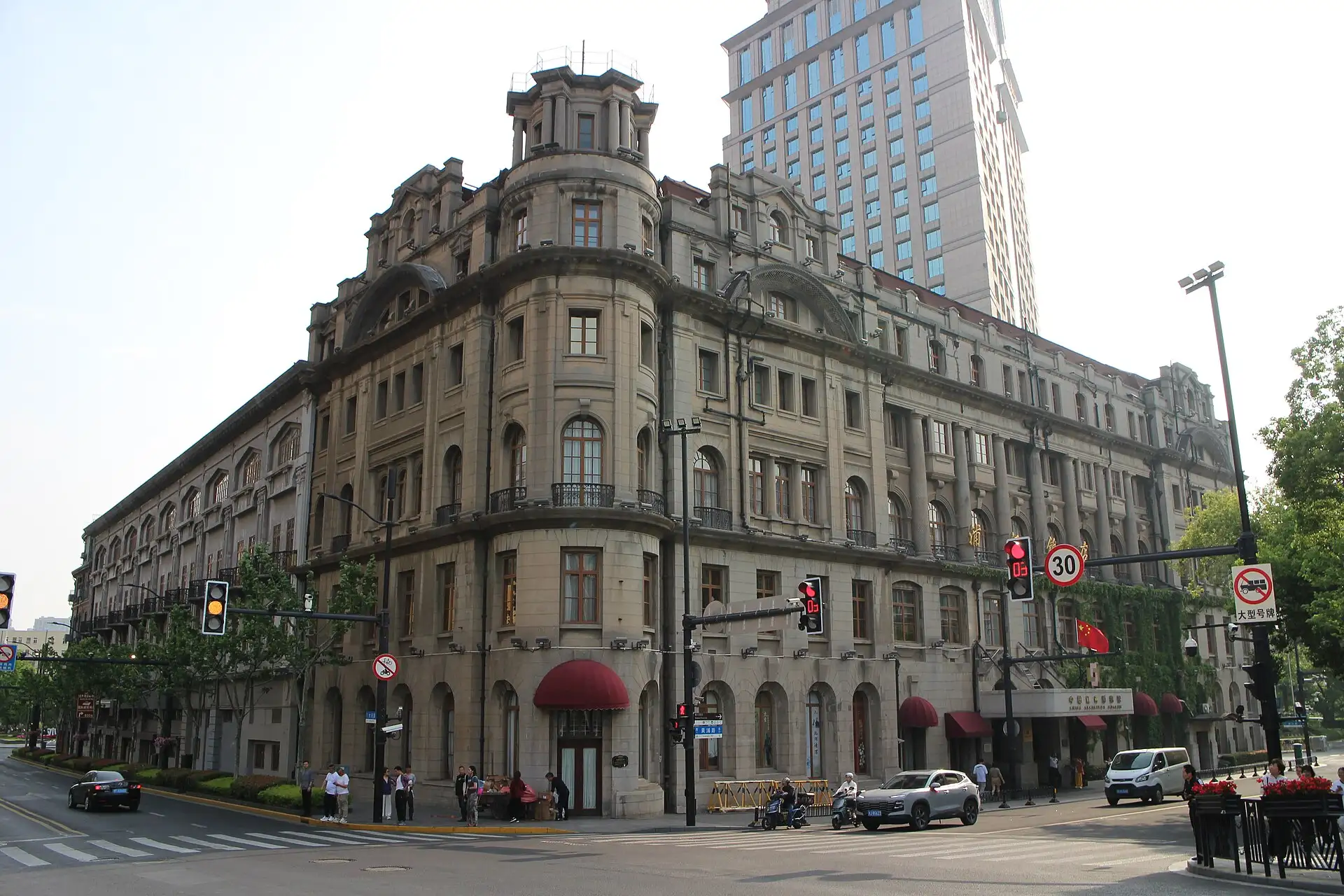
Photo: Suicasmo Astor House Hotel
浦江饭店Pǔjiāng Fàndiàn
On the north bank, to the right of the bridge, the Astor House began in 1846 as Richards' Hotel, the first Western-run hotel in Shanghai, and moved to this side of the creek in 1858 (some accounts say 1857). Einstein stayed in 1922 and Charlie Chaplin in 1931 and 1936. The present building dates from the rebuilding after the new steel bridge took part of the hotel's land in 1906. On 19 December 1990 the Shanghai Stock Exchange opened in its ballroom, and the building is now the China Securities Museum.
- 13
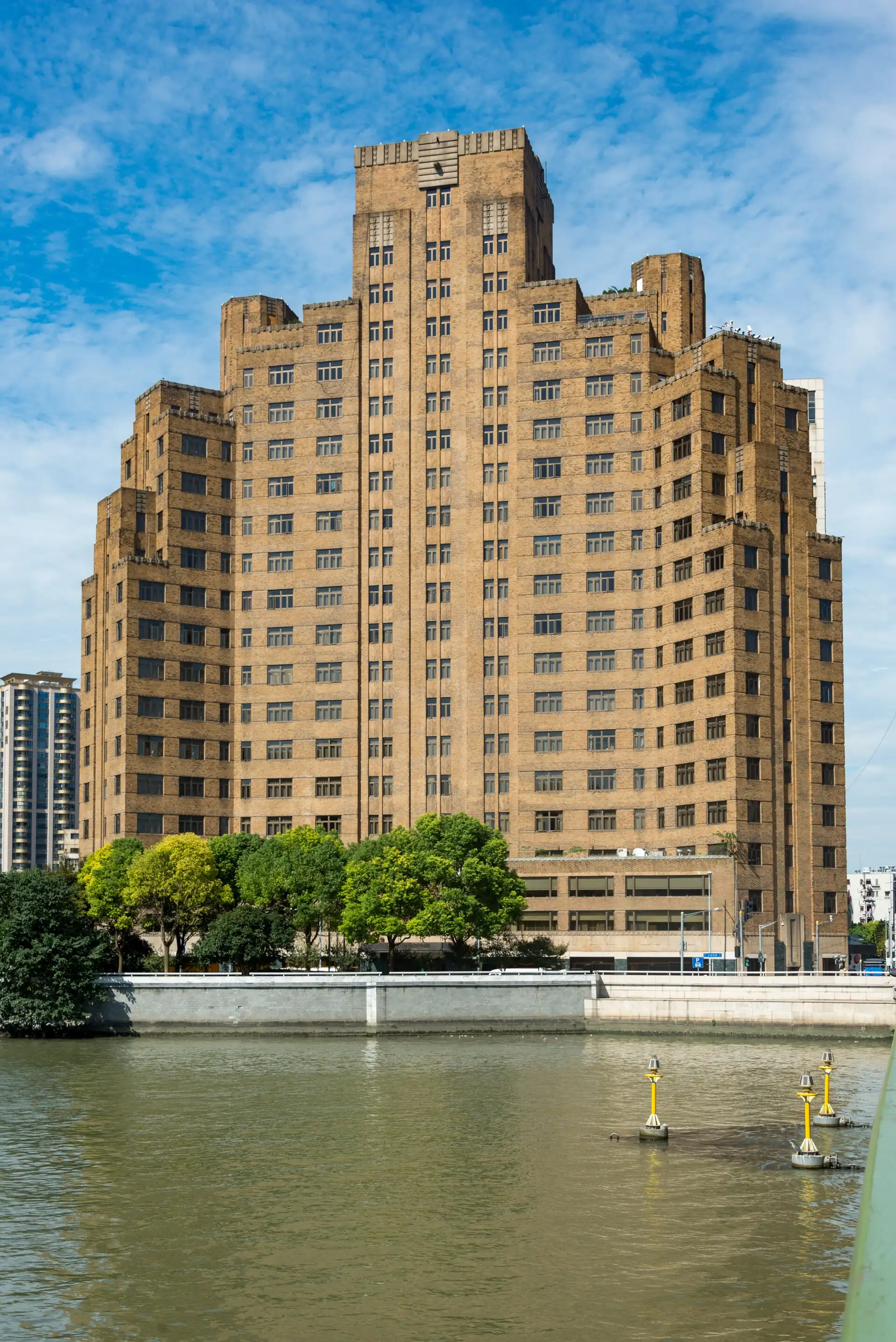
Photo: xiquinhosilva · CC BY 2.0 Broadway Mansions
上海大厦Shànghǎi Dàshà
Finish at the brown-brick tower at the bridgehead, completed in 1934 as a hotel and flats for foreigners. Its steel came from Dorman Long in Britain, and it steps back floor by floor from the eleventh storey, which gives it its mountain-like outline. It was renamed Shanghai Mansions in 1951. Before the Pudong towers were built, this was where visitors came to look over the city: Zhou Enlai brought foreign leaders up to the 18th-floor terrace. Tiantong Road is the nearest metro station.


Practical tips
Which way to walk. This route goes south to north on the inland pavement, where you are close enough to read doorways and carvings. Come back along the raised riverside promenade, opposite, to see the whole row at once with Pudong behind you. Going the other way works just as well: start at Broadway Mansions and finish near Yu Garden and the old city walk.
When to go. Late afternoon, so you finish at dusk when the facades and the Pudong towers are lit. On national holidays the Bund is very crowded and police may control the crowds; the Bund visitor’s guide has more on timing, the lights and which buildings let you in.
Going inside. Most of the row is banks and offices, seen from the street. The places that let visitors in are mainly hotels, bars and exhibition spaces: the Peace Hotel, the Waldorf Astoria’s Long Bar, the Asia Building’s art museum, the signal tower’s display and the China Securities Museum in the Astor House. Opening times are on each place page where an official source gives them. Carry your passport; museums may ask for it.
Read more. How to read the Bund explains why the row looks the way it does; Behind the Bund covers the streets behind it, and The river and the Bund the waterfront itself.