People · Firm
David Sassoon & Co.
老沙逊洋行Lǎo Shāxùn Yángháng · est. 1832
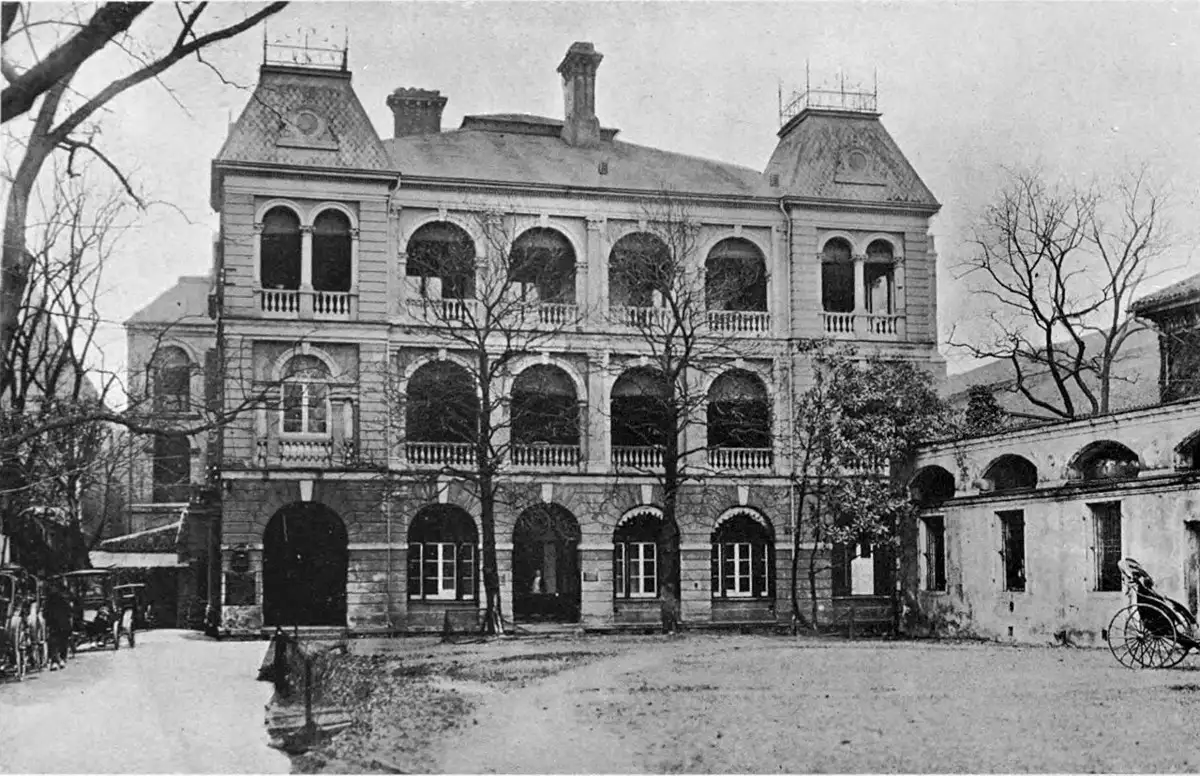
Bombay trading house founded in 1832 by David Sassoon; opened in Shanghai in 1845 and was known as Old Sassoon after the family firm split.
- Founded
- 1832
- Known as
- trading house, opium merchants, cotton and textile owners, bankers
- Also written
- David Sassoon, Sons & Co. · Sassoon, Sons & Co. · Old Sassoon · 沙逊洋行
- Part of
- The Sassoon family沙逊家族
Why Shanghai knows the name
David Sassoon & Co. was the first Sassoon house, founded in Bombay in 1832 and known in Chinese as 老沙逊洋行 (Lǎo Shāxùn Yángháng), “Old Sassoon”. It opened in Shanghai in 1845 and traded there in opium, cotton and textiles for the rest of the century. After a family quarrel produced a second firm, E. D. Sassoon & Co. or “New Sassoon”, the older house slowly lost ground to it.
How did a Baghdad treasurer start a trading house in Bombay?
David Sassoon, born in Baghdad in 1792, had served as the city’s treasurer between 1817 and 1829. He left for Bombay with his family; the sources give 1830 or 1832 for the move, and 1832 for the firm itself. It began as a counting house at 9 Tamarind Street, working in banking and property before trade.
The firm grew through its sons. Abdallah, later Sir Albert Sassoon, became a partner in 1852 and Elias David Sassoon joined soon after. After David’s death on 7 November 1864, Albert took charge. That succession is the root of the quarrel that split the family.
How did the firm get into China?
China opened to foreign trade after the Treaty of Nanking in 1842. The firm moved early. Betta places the Hong Kong office in 1843 and the Shanghai office in 1845, and says the Shanghai office stayed the main focus of its China operations for the following century. Wikipedia lists further branches in Canton and Hankow, and in Japan at Kobe, Nagasaki and Yokohama. An office on the Shanghai Bund was in use by 1845, according to a book cited there.
Opium and cotton were the staples. In the 1860s the firm began to dominate the trade between India and China, partly by buying the opium crop before it was harvested and so undercutting British houses. It ran its own opium clippers. Dent & Co., one of its rivals, went bankrupt in 1867, and Jardine Matheson ceased to matter as an opium dealer in the early 1870s. Wikipedia says the Sassoon firm handled around 70 per cent of the Indian opium traded by then, but that figure has no source in the article, and no other source read for this entry repeats it.
Banking followed trade. The firm was among the merchant houses that founded the Hongkong and Shanghai Banking Corporation in 1865, helped set up the Anglo-California Bank in 1873 and was the principal funder of the Imperial Bank of Persia in 1889.
What happened to the Shanghai staff and clients?
The Shanghai office drew its clerks and managers from Baghdad and India. In 1906, 22 of the 42 Baghdadis employed by the city’s Baghdadi Jewish firms worked for Sassoon firms. Silas Hardoon’s career shows the link: the Shanghai gazetteer says the Sassoon firm sent him to Shanghai in 1873, and that in the late nineteenth century he and the older firm jointly ran the opium exchange, the 洋药公所. In 1886 he moved to the property department of the New Sassoon firm. English Wikipedia dates his arrival earlier, to 1868.
Why did the family split, and who won?
Wikipedia, citing Stanley Jackson, says Elias David Sassoon left the family firm in 1867, three years after his father’s death, after quarrels with his brothers and set up E. D. Sassoon & Co. in Bombay and Shanghai. Sixth Tone and a Chinese firm dictionary date the new firm to 1872. The Chinese names for the two houses, 老沙逊 and 新沙逊, come from that division.
Measured by capital, the new firm won. In the Edwardian years it stood at £1.25–1.5 million against about £0.5 million for the old one. Sixth Tone says that by the end of the nineteenth century New Sassoon had gradually displaced Old Sassoon in Shanghai.
How did the old firm change after the split?
In 1872 the head office moved from Bombay to 12 Leadenhall Street in London, to be nearer capital and information. In Bombay the firm turned to industry: the Sassoon Spinning and Weaving Company was founded in 1874 and eventually ran seven cotton mills, Sassoon Docks opened in 1875 and a silk mill followed in 1883. In 1901 it became a joint-stock company with £500,000 of capital, giving shares to non-family managers for the first time. After Sir Edward Sassoon’s death in 1912, Frederick David Sassoon dominated it until his death in 1917, and David Gubbay chaired it until he died. By 1939 Sir Philip Sassoon was chairman in name only.
What did the firm mean for the Settlement?
Its partners sat in the Settlement’s government. Until 1904 the Baghdadi Jewish members of the Shanghai Municipal Council were partners in Sassoon firms, and between 1869 and 1921 Baghdadis elected a councillor almost every year to the British quota of six seats. Betta draws the conclusion that the Sassoons had a direct hand in the affairs of the International Settlement. The family also underwrote the community’s institutions: it sponsored the Beth El synagogue founded in 1887, and a visitor in 1888 reported that without the Sassoon family’s liberality the congregation, then 30 to 40 members, would not have continued.
The scale of the later Shanghai business gives a measure of what the older house had left behind. Sixth Tone, citing the historian Tang Peiji, puts the New Sassoon firm’s Shanghai real estate at 13.3 million taels in 1921, from a start in which Elias paid 80,000 taels for a Bund plot in 1877. Nothing comparable is recorded for Old Sassoon in the sources used here, which is itself a sign of how the two firms diverged.
What the sources disagree on
- Founding: the firm is dated to 1832 in Bombay; the Chinese firm dictionary describes a Shanghai-based “Sassoon, Sons & Co.” founded in 1832, which the other sources do not support.
- Hong Kong and Shanghai offices: Hong Kong 1843 or 1844; Shanghai 1845.
- Split of the family firms: 1867 or 1872.
- Opium share: about 70 per cent (unsourced), against the family fleet carrying about one-fifth of China’s imports (a different measure; see the family entry).
How did it end?
After the Second World War the firm was a shadow of what it had been, in the words of Joseph Sassoon’s history as quoted by Wikipedia. It was sold in 1982 for about £2 million to the London stockbroker Rowe Rudd and later passed to UBS. In Shanghai the older house had lost its role long before: Betta says that by the late 1920s the significance of the Sassoon firms in the city had diminished, and the property boom of the 1930s belonged to New Sassoon.
What to look for
There is no building in Shanghai that belonged to Old Sassoon alone, and its Bund office of the 1840s is gone. The family’s presence is easier to see through its later firm: the Bund tower of 1929, Sassoon House, belonged to New Sassoon. The two names survive mostly in the Chinese phrase 老沙逊洋行 and in the archives.
What Shanghai says, and what the record shows
Popular stories, told in our words, checked against the sources listed below.
- Not what the record shows
The story: Old Sassoon and New Sassoon were two separate families.
The record: They were two firms of one family. Elias David Sassoon, a son of the founder, left David Sassoon & Co. after quarrels with his brothers and founded E. D. Sassoon & Co. A Chinese firm dictionary says the name 'Old Sassoon' arose only after the new firm appeared.1,3
- Unproven
The story: David Sassoon & Co. controlled about 70 per cent of the opium trade to China.
The record: The figure appears in Wikipedia for the early 1870s but with no source attached to it, and the same article attributes the Jardine Matheson and Dent data to book pages that do not carry the 70 per cent. No source I read gives chest counts for the firm.1
Timeline
- 1832Founded in Bombay as a counting house on Tamarind Street1
- 1843Hong Kong office, by one count1
- 1845Shanghai office opens1
- 1852Abdallah (later Sir Albert) Sassoon becomes partner; Elias David Sassoon joins soon after1
- 1865Part of the merchant consortium that founds the Hongkong and Shanghai Bank1
- 1867Elias David Sassoon leaves to found E. D. Sassoon & Co. (1872 in some accounts)1,3
- 1872Head office moved from Bombay to London1
- 1874Sassoon Spinning and Weaving Company founded in Bombay1
- 1901Becomes a joint-stock company with £500,000 capital1
- 1982Sold for about £2 million to the London stockbroker Rowe Rudd1
Connections
- Dent & Co.宝顺洋行Dent & Co. went bankrupt in 1867, a year the Sassoons were gaining opium business
- E. D. Sassoon & Co.新沙逊洋行Rival firm founded by Elias David Sassoon after a family quarrel
- Elias David Sassoon以利亚·大卫·沙逊Elias David Sassoon worked in the firm before leaving to found E. D. Sassoon & Co.
- Jardine, Matheson & Co.怡和洋行Jardine Matheson stopped being a major opium dealer by the early 1870s
 Silas Aaron Hardoon哈同Silas Hardoon was sent to Shanghai by the Sassoon firm in 1873
 The Sassoon family沙逊家族The family firm founded by David Sassoon
Stories
Sources
- 1.David Sassoon & Co. (English Wikipedia; cites Jackson 1989, Stansky 2003, Chapman 2006, J. Sassoon 2022) (David Sassoon & Co.), Wikipedia — Founding, citing Stansky 2003, p. 5; Branch list; Founding, citing Jackson 1989, pp. 19 and 30; Opium trade; Banking; 1867 split; citing Chapman 2006 p. 131; Cotton and infrastructure; citing Jones 2007 p. 51, Seth 2019 p. 50; Cotton and infrastructure; citing Jones 2007 p. 51; Corporate changes and leadership; citing Emden 1938 p. 381, Jackson 1989 pp. 119 and 219; Later declinewikipedia
- 2.David Sassoon (treasurer) (English Wikipedia; cites Jackson 1989, Kaufman 2020) (David Sassoon (treasurer)), Wikipedia — Bombay section, citing Jackson pp. 17–19; China branches; Family splitwikipedia
- 3.Dictionary of Foreign Firms in China, entry Old Sassoon / New Sassoon (as transcribed in the MAD Space database; seen only as a search-result snippet) (外国在华商行辞典 条目:老沙逊/新沙逊(MAD Space 广告商数据库转录)), MAD Space database, citing 四川人民出版社 1995, 1995 — entry text, as seen in a search snippetwebsite
- 4.From Orientals to Imagined Britons: Baghdadi Jews in Shanghai (From Orientals to Imagined Britons: Baghdadi Jews in Shanghai), Chiara Betta, Modern Asian Studies 37(4), Cambridge University Press (text read at jewsofchina.org), 2003 — section on the Sassoon firms; sections on the 1906 directory and the late 1920s; sections on the Municipal Council and Beth Elarticle
- 5.E. D. Sassoon & Co. (English Wikipedia; cites Jackson 1989, Chapman 2006, Thampi 2017) (E. D. Sassoon & Co.), Wikipedia — opening sectionwikipedia
- 6.From Baghdad to the Bund: The Family That Built Shanghai (From Baghdad to the Bund: The Family That Built Shanghai), Huang Wei (translated by David Ball), Sixth Tone, 2022 — section on Old and New Sassoon; section on Elias and early real estatearticle
- 7.Shanghai Concessions Gazetteer, part 6 People, ch. 1 Biographies: Silas Aaron Hardoon (1846–1931) (上海租界志·第六篇 人物·第一章 人物传略·哈同(Silas Aaron Hardon 1846~1931年)), 上海市档案馆(编), 上海社会科学院出版社;上海市地方志办公室数字方志(在线), 2001 — life of Silas Aaron Hardoon, first paragraphgazetteer
- 8.Silas Aaron Hardoon (English Wikipedia; seen only as a search-result summary) (Silas Aaron Hardoon), Wikipedia — career sectionwikipedia