Building · in The Bund
Former Navy YMCA Building
海青大楼Hǎiqīng Dàlóu
The 1923 Navy YMCA at Sichuan and Hong Kong Roads: a pool, gym and beds for sailors of every navy, later a sports hall and now a hotel.
- Built
- 1923
- Heritage listing
- Shanghai Outstanding Historical Building (上海市优秀历史建筑) · municipal · 5th batch
- Status
- Exterior only
- Then in
- British Settlement1848–1863International Settlement1863–1943Central District from 1899Close to a boundary drawn along today's streets; it may have fallen on either side.
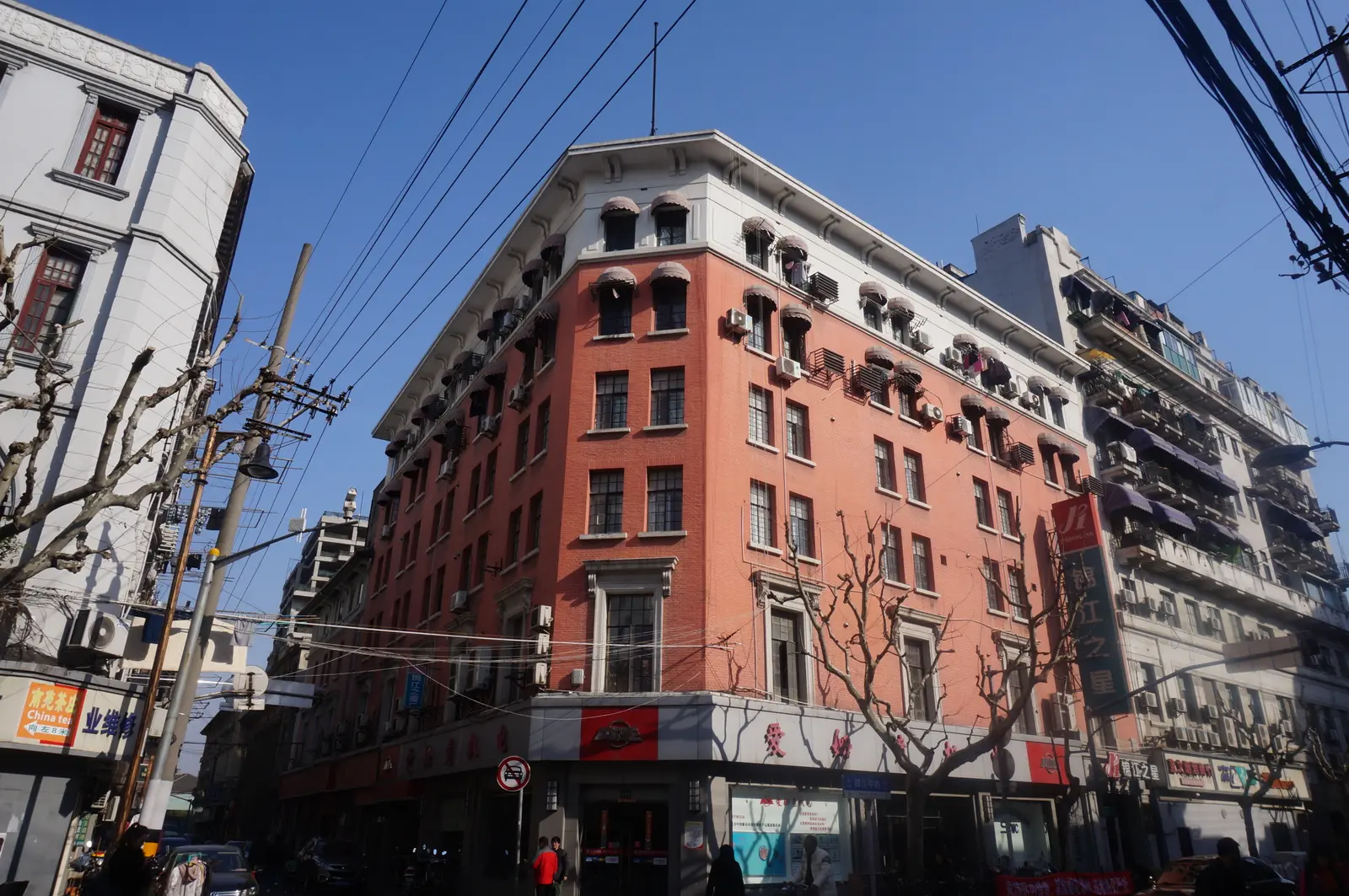
The former Navy YMCA at the corner of Sichuan Road Middle and Hong Kong Road in February 2016, with a Jinjiang Inn sign on the Hong Kong Road side.
Photo: Livelikerw · CC BY-SA 4.0
What you're looking at
- Two long red-brick fronts, on Sichuan Road and Hong Kong Road, meeting in a corner towards the junction: the bedrooms ran along these fronts.
- The white top floor and bracketed cornice, above five storeys of brick.
- Shopfronts along the ground floor: the YMCA let its street frontage as shops from the start.
The story
On the corner of Sichuan Road Middle and Hong Kong Road, a few blocks behind the Bund, stands the six-storey building that the YMCA opened in 1923 for American sailors on shore leave. Shanghai calls it the Haiqing Building (海青大楼, Hǎiqīng Dàlóu), after the Chinese name of the Navy YMCA, 海军青年会 (Hǎijūn Qīngniánhuì). Over the following decades it took in sailors from every navy in the river, then refugees, Japanese occupiers and Shanghai’s young athletes. Today it is a Jinjiang Inn hotel.
Why the YMCA built it
US warships called at Shanghai all the time in the 1920s. Their crews were poorly treated and little respected, and on shore leave many spent their time drinking and in brothels. The Army and Navy YMCA had worked with American servicemen since 1898. After the First World War its National War Work Council had money left over from its wartime appeals, and it decided to spend some of it on clubs for Navy men. Shanghai was given US$300,000. The idea was simple: give sailors somewhere clean and cheap to sleep, eat and play, and they would spend less of their leave in the bars.
The YMCA already had a Shanghai branch for the fleet, working since 1912 out of small rented rooms on Broadway, Seward Road, Nanking Road and Avenue Edward VII. For the new building its International Committee bought two adjoining lots at the corner of Hong Kong Road and Sichuan Road, registering the title deeds in July 1920. The YMCA’s own Building Bureau drew the plans, under the American architect Arthur Q. Adamson, who oversaw the design of YMCA buildings across China.
The foundation stone went down on 8 May 1922, in front of some 150 guests including the US consul general, Edwin Cunningham. Inside it the YMCA sealed a time capsule: photographs of the building site, US Navy regulations, a Bible, a sailor’s will, a Mother’s Day letterhead, and Shanghai newspapers and coins of the day.
Opening day
The building was finished in May 1923, and sailors were using it by June. The formal opening came on the morning of 10 October 1923. Nearly 200 men from the American warships attended, a detail of sailors raised the US flag, and the commander of the US Asiatic Fleet, Admiral Edwin Anderson, spoke. President Calvin Coolidge sent a telegram of congratulations.
Inside the “home away from home”
The plot is an L shape, made of the two lots, with about 25 metres of frontage on Sichuan Road and 58 metres on Hong Kong Road. Behind the brick front is a reinforced-concrete frame on piles, built with central heating and a fire system. The building faces west onto Sichuan Road.
Each floor had its own job:
- Ground floor. The entrance on Sichuan Road opened into a cramped vestibule that led only to the lifts. The rest of the street frontage was let as shops, which paid a good share of the YMCA’s bills. Behind them were an indoor swimming pool 18.3 metres long, lined in green and white mosaic and heated in winter, with showers and lockers beside it; a boxing room with wrestling mats and punch bags; a barber; and a bridge room.
- First floor. Sailors checked in at the front desk. Beyond it was a lounge hung with navy-blue curtains, with leather-covered hardwood benches, writing desks, a piano and a gramophone. Off the lounge were a reading room with the latest papers from home, a small shop for sweets and toiletries, a billiard room with three American tables and one English table, and a corner for chess. The gymnasium took basketball and volleyball games, and with a little rearranging became a 450-seat hall for films, concerts, parties and lectures. A stair ran from it straight down to the pool.
- Second floor. A restaurant seated 75. It was open to anyone, and Shanghai businessmen came for lunch because the food was good and the prices fair. One wall was oak-panelled and covered with YMCA photographs of landscapes and sailors’ get-togethers, which the men would stand and study. A soda fountain seated another 50.
- Second to fifth floors. Bedrooms, about 30 to a floor, ran along the two street fronts in a V towards the corner. Sailors could choose a single room, a room for two to four, or the cheapest option, a bunk in a dormitory. Most rooms were 8 to 11 square metres. The top floor was kept for long-term residents. Every floor shared its washrooms.
The 1930s paperwork in the gallery below shows the place at work: a green flyer promising it was open “24 hours a day & 7 days a week”, a soda-fountain receipt for three malted milks, and a US Navy “patrol chit” for one breakfast, written out in 1937 for a sailor off the cruiser USS Augusta.
A club for every navy
The beds filled almost at once, and before long people were complaining that the building was too small. It was never only for Americans. In the first ten days of March 1925 the desk counted 1,221 Italian visitors, 1,212 American, 1,040 British and 245 French, and put up 398 sailors for the night, 260 of them British. Shanghai residents came mostly for the restaurant.
The YMCA was a Christian organisation, and the building offered Bible classes and a Sunday evening song service. But most of what went on inside was sport, food and entertainment.
War and after
In March 1927, as the National Revolutionary Army closed in on Shanghai, the building opened its doors to people fleeing the fighting. Women slept on camp beds in the gymnasium and men in the dormitories upstairs.
From 1937, with war in and around Shanghai, fewer American warships came and the club grew quiet. After the Pacific War began in 1941, Japan took over the building. It filled with servicemen again after 1945.
In May 1949 the Navy YMCA staff left Shanghai. The national YMCA and the Shanghai YMCA took over the building as the Shanghai YMCA’s Second Branch and put its sports rooms to use. They ran classes in ball games, swimming, weightlifting, boxing and martial arts, with more than 12,300 enrolments a year, and over 110,000 people a year came to watch its matches.
In July 1959 the city’s housing administration took the building over. The gymnasium and pool became the Sichuan Road Gymnasium (四川路体育馆) of the Huangpu District youth sports school, the Shanghai Youth Palace opened a branch upstairs, and the ground floor stayed as shops. Later the building was turned over to commercial use and became a Jinjiang Inn hotel. It is listed as a Shanghai Outstanding Historical Building.
The map they handed out
In about 1933 the Navy YMCA printed a folding map of Shanghai for sailors, with its building on the cover under the slogan “The red triangle points the way”. The copy shown in the gallery was photographed by hys, who found it in a second-hand bookshop in Hong Kong.
The back cover lists what was free and what cost a little. Free: a heated lobby, safe keeping for money, reading and writing rooms, a radio, games, a gymnasium, a roof garden and “splash parties” in the pool. For a small fee: the restaurant and soda fountain, dormitory beds, lockers, a barber, billiards, laundry and pressing, photo developing and American Express money exchange. “Our doors are never locked,” the cover promises. The Shanghai branch was one of five in China, with others at Hankou, Tianjin, Beijing and Yantai, and the YMCA’s national headquarters in New York sent some 32,000 US dollars a year for the China work.
The map inside was sponsored by Socony Motor Gasoline, whose slogan runs round the border; red dots mark its petrol pumps. Red lines trace the boundaries of the International Settlement and the French Concession, with the “Chinese City” marked to the south. The red YMCA triangle is drawn at the Bund end of Suzhou Creek, and anchors in the river mark where British, French, US and Japanese warships moored.
An index lists the places a man on shore leave might need: consulates, banks, churches, clubs, hotels, parks and theatres, from the Cathay Theatre to the Great World and the Metropole Hotel. Many addresses use the old street names, such as Bubbling Well Road for today’s Nanjing Road West.
The back of the sheet is part guidebook, part advertising. Panels give the time in other ports when it is noon in Shanghai, rickshaw fares (10 cents for a mile, 50 cents for an hour), taxi rates, postage and a note on “Chinese money”. Around them are advertisements for Sincere department store on Nanking Road, the Sun Ya Cantonese restaurant, the Ford Hire taxi service, and a sports shop in the YMCA building itself that also sold DeVry movie cameras. An information panel puts the city at about 49,000 foreigners and over two million Chinese, and calls it “A Miniature League of Nations”.
The sheet carries no date, but two clues narrow it down. The money panel quotes the exchange rate on 1 April 1933: $4.72 Chinese dollars to one US dollar. And the hotel list leaves out the Park Hotel, which opened on 1 December 1934. So the map was most likely printed between spring 1933 and late 1934.
How to see it
The building stands at the corner of Sichuan Road Middle and Hong Kong Road, a few minutes’ walk from the Bund. It works as a hotel, so most visitors will see it from the street. Stand on the opposite corner to take in the two long brick fronts meeting at the junction, with the top floor and cornice picked out in white. Just south along the same road, the former Chinese YMCA on Sichuan Road makes a natural pair: the YMCA built for Shanghai’s Chinese members, and the one built for foreign sailors.
From the archive
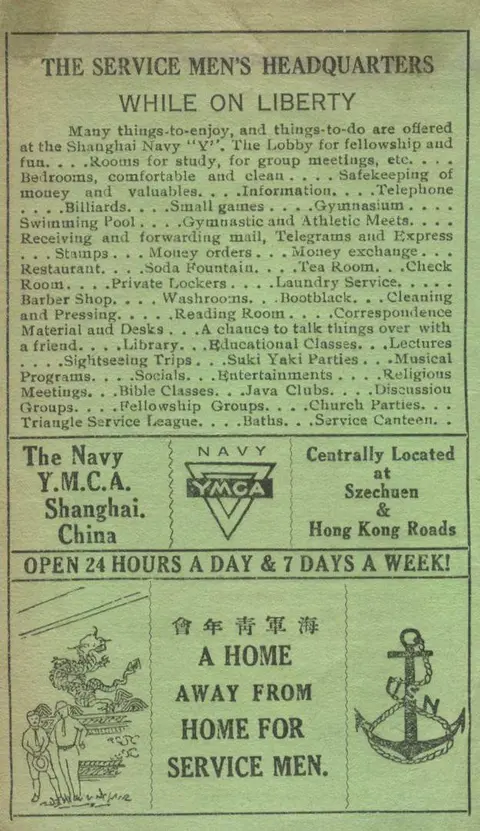
A Navy YMCA flyer from the 1930s, "The service men's headquarters while on liberty", listing what the building offered and promising it was open 24 hours a day, 7 days a week.
Navy Y.M.C.A. flyer, public domain, via Wikimedia Commons
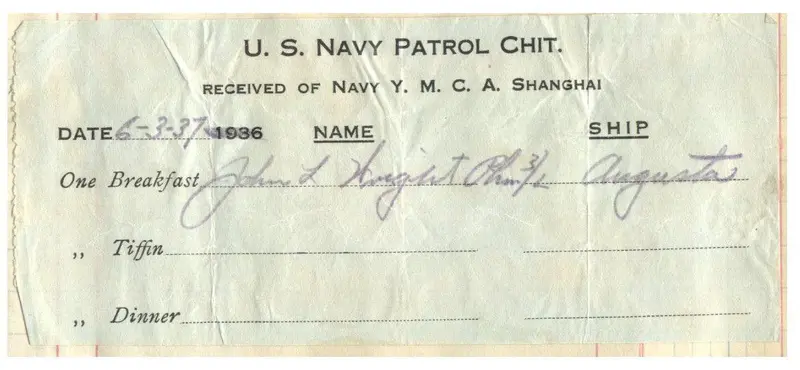
A US Navy Patrol Chit for one breakfast, "received of Navy Y.M.C.A. Shanghai", filled in by hand in 1937 for a sailor from the cruiser USS Augusta.
Navy Y.M.C.A. chit, public domain, via Wikimedia Commons
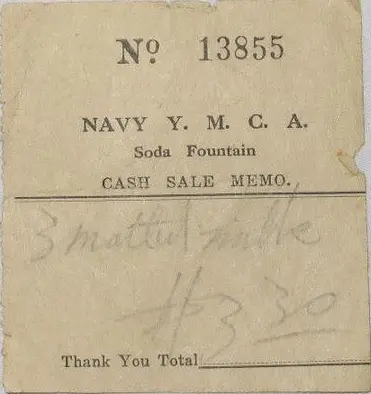
A cash sale memo from the Navy YMCA soda fountain, written out for three malted milks.
Navy Y.M.C.A. receipt, public domain, via Wikimedia Commons
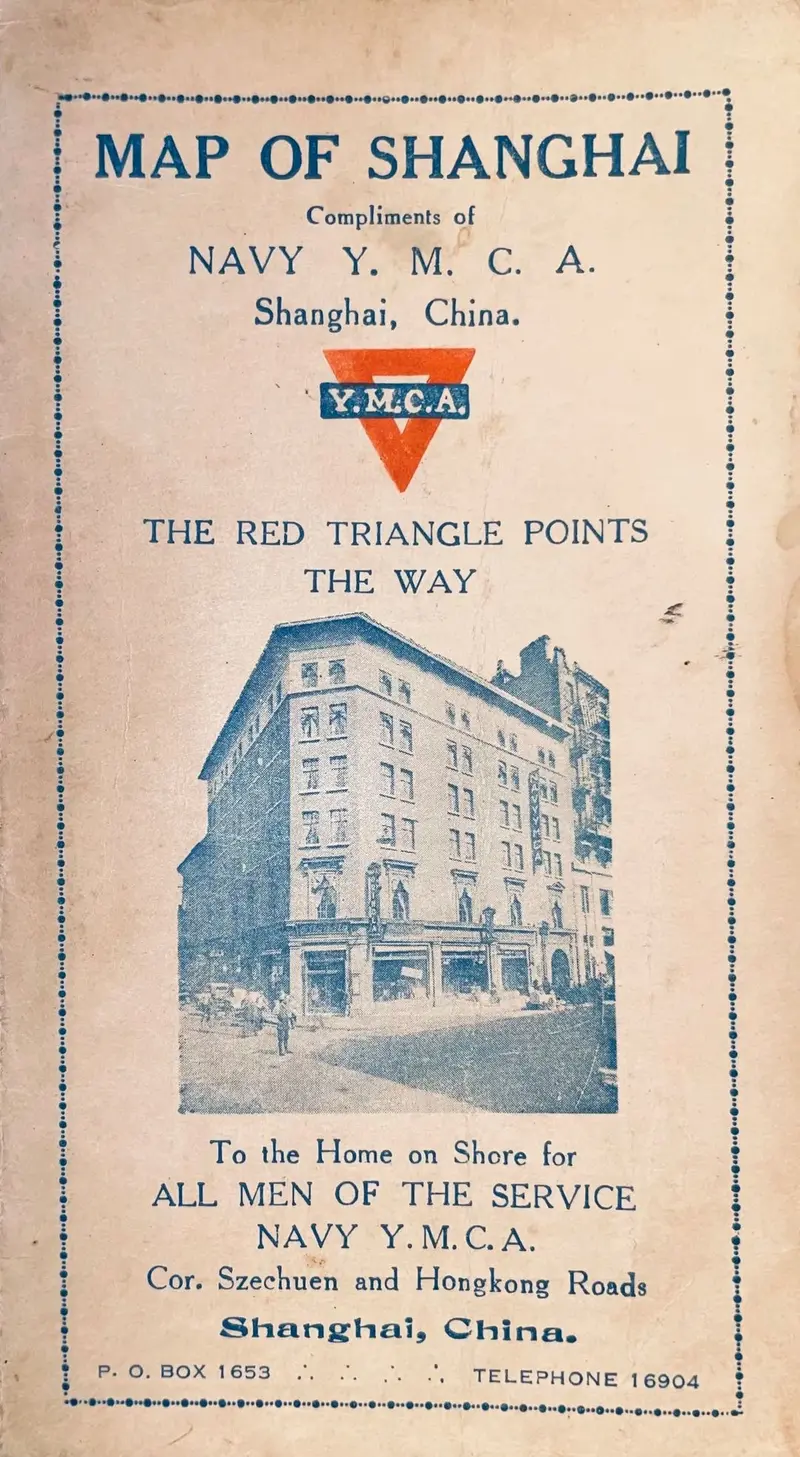
Cover of the Navy YMCA's folding map of Shanghai, probably printed in 1933 or 1934, with the building at Sichuan and Hong Kong Roads and the line "The red triangle points the way".
Photo: hys · used with permission · Xiaohongshu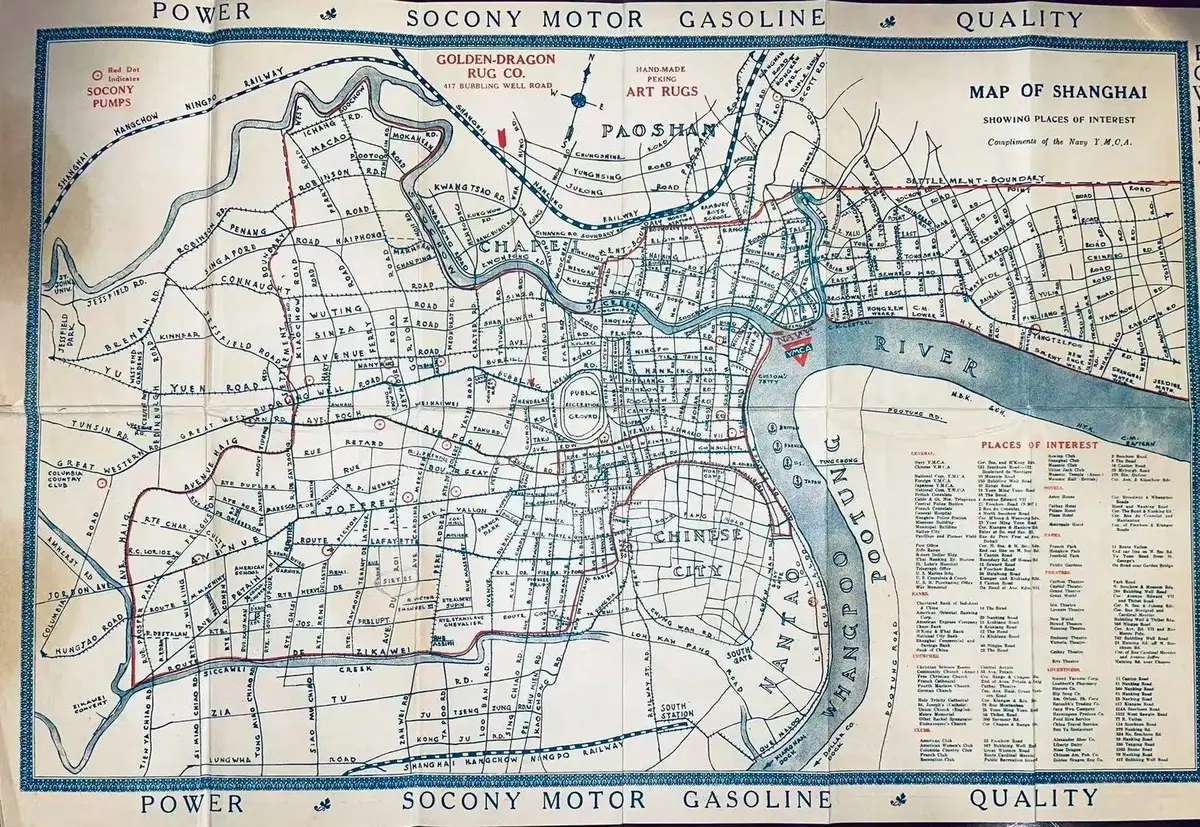
The hand-drawn map inside, sponsored by Socony motor gasoline: red dots mark Socony pumps, red lines the boundaries of the International Settlement and the French Concession, and the red YMCA triangle sits just inland from the Bund at Suzhou Creek.
Photo: hys · used with permission · Xiaohongshu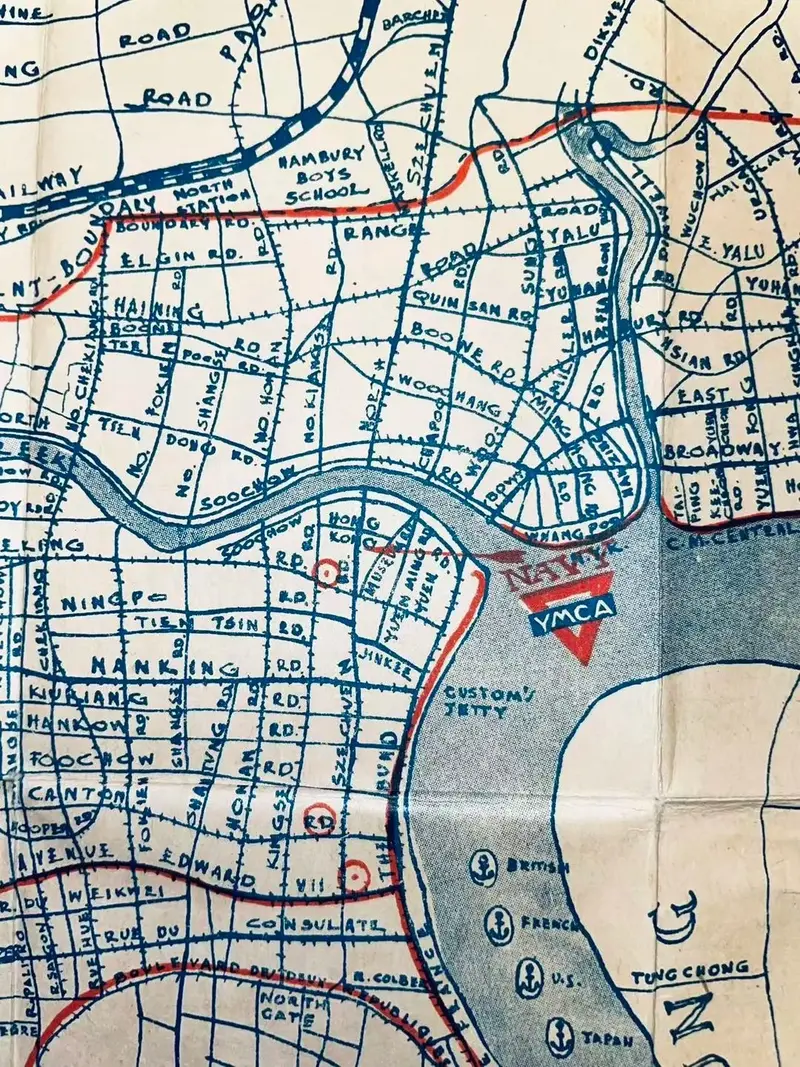
Detail of the map around the Bund: the Navy YMCA triangle between Hong Kong Road and the river, the Customs Jetty, and anchors marking the British, French, US and Japanese naval moorings.
Photo: hys · used with permission · Xiaohongshu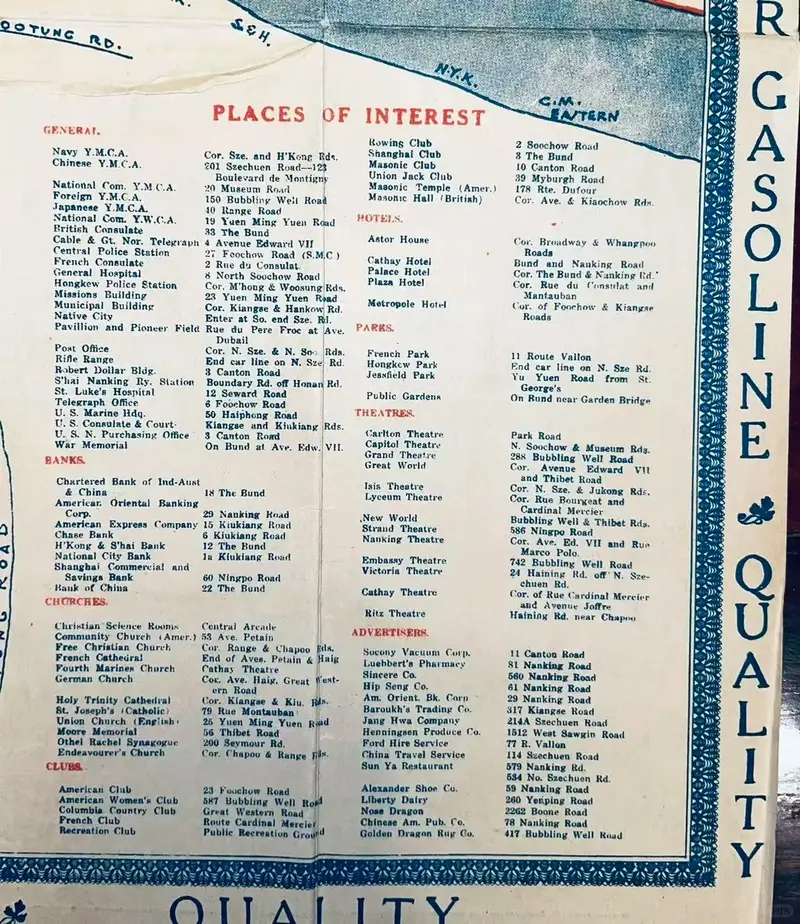
The map's index of places of interest, grouped as general, banks, churches, clubs, hotels, parks, theatres and advertisers, with old street addresses.
Photo: hys · used with permission · Xiaohongshu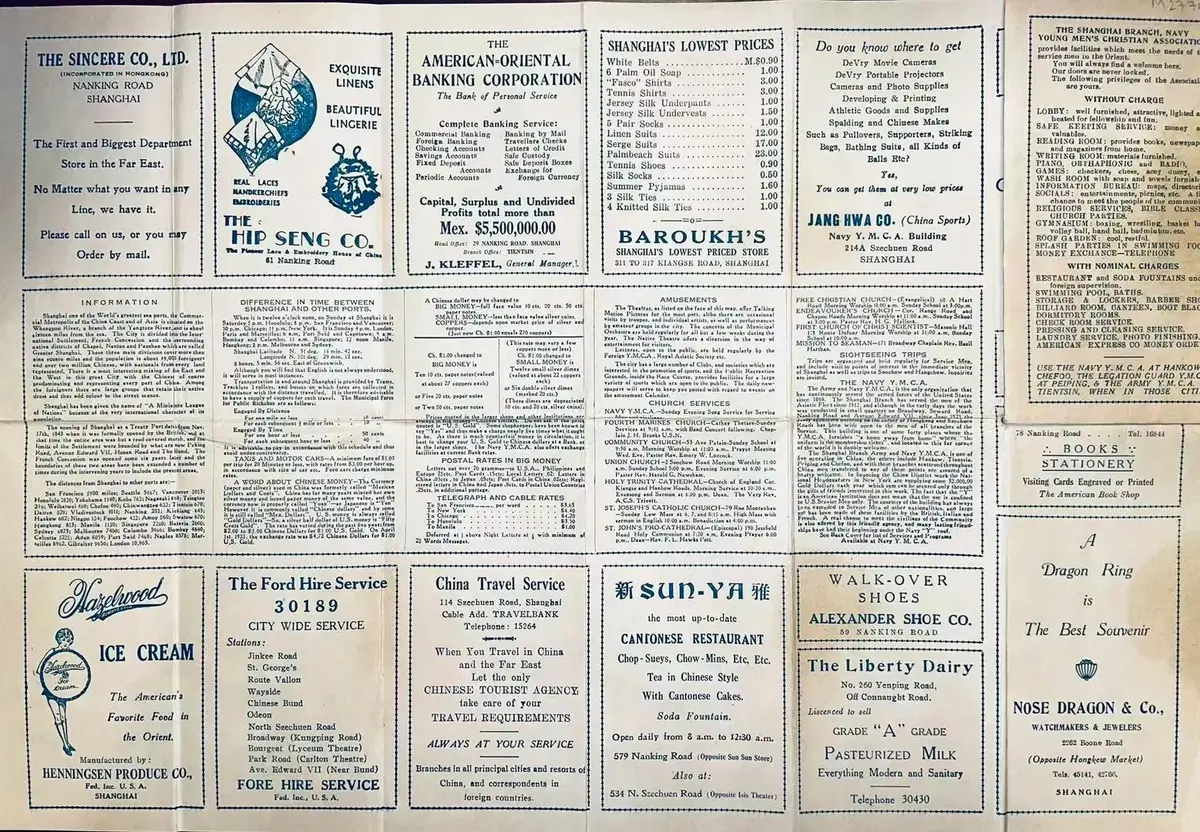
The back of the sheet: advertisements for Sincere department store, the Sun Ya Cantonese restaurant, the Ford Hire taxi service and others, around panels of advice on time, money, rickshaw fares, postage, church services and the YMCA's own services.
Photo: hys · used with permission · Xiaohongshu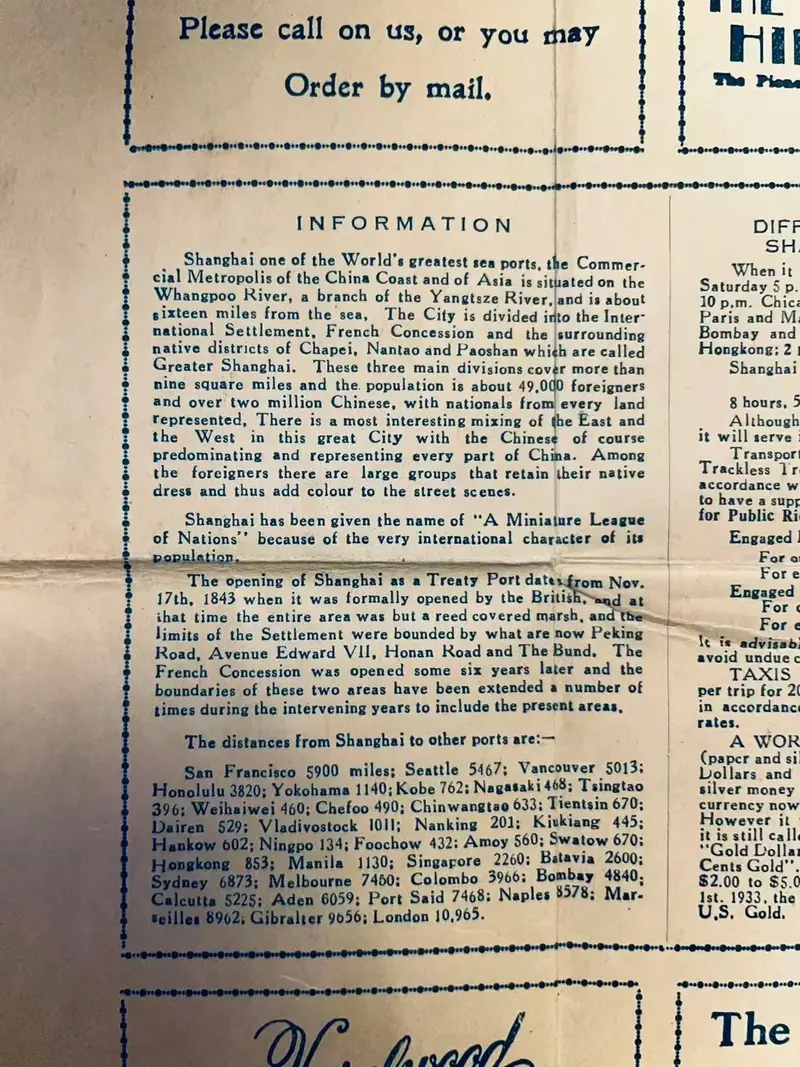
The brochure's Information panel, which calls Shanghai "A Miniature League of Nations" and gives sailing distances from Shanghai to ports from Ningbo to London.
Photo: hys · used with permission · XiaohongshuHow to visit
- Status
- Exterior only
- Opening times and prices not yet confirmed; check before you go.
- Nearest metro
- Tiantong Road天潼路Line 10Line 12Exit 3· 8 min walkPlan a metro journey here →
Chinese address — show this to a taxi driver
上海市黄浦区四川中路630号(香港路85号)
630 Sichuan Road Middle (85 Hong Kong Road), Huangpu District
How to search this address in AmapAmap (高德地图) works best in mainland China; Apple Maps on iPhone. Both open in the app when it is installed.
Nearby
Loading map…
Within a 10-minute walk
- Shanghai Bankers' Association Building上海银行公会大楼2 min walk
- Former Chinese YMCA Building, Sichuan Road四川中路基督教青年会旧址2 min walk
- Y.M.C.A. Building (Huqiu Apartments)青年协会大楼(虎丘公寓)2 min walk
- Christian Literature Society Building广学会大楼3 min walk
- Yee Tsoong Tobacco Co. Building颐中大楼3 min walk
- Capitol Building光陆大楼3 min walk
Sources
- 1.Shanghai outstanding historic buildings, fifth batch list (第五批历保建筑清单), 上海市房屋管理局, 上海市房屋管理局, 2020 — Huangpu District rows 5A007 and 5A075; row 5A007, current name 锦江之星official-list
- 2.Navy YMCA folding map of Shanghai with visitor information (c. 1933–1934), photographed by hys (Map of Shanghai, compliments of Navy Y.M.C.A., Shanghai, China), Navy Y.M.C.A., Shanghai, Navy Y.M.C.A., Shanghai (map sponsored by Socony Motor Gasoline); copy photographed by hys and shared on Xiaohongshu, 1933 — back, panel "The Navy Y.M.C.A."; back, panel "The Navy Y.M.C.A." and back cover; back cover, "The Shanghai Branch, Navy Young Men's Christian Association"; front cover; back, panels "Sightseeing trips" and "Church services"; map side; back, panels "Information" and "Difference in time"; back, "A word about Chinese money"; map side, places of interest; back, advertisementsarchive
- 3.Pengpai News report on Cathay Theatre closing for upgrades, 25 Aug 2022 (国泰电影院:上海最早的24小时影院之一(澎湃新闻,2022-08-25,钱雪儿)), 钱雪儿, 澎湃新闻 (The Paper), 2022 — Cathay Theatre openingarticle
- 4.Park Hotel, under Jinjiang International Group, carries on its history (锦江国际集团旗下国际饭店传承历史底蕴), 上海市国有资产监督管理委员会, 2023 — Park Hotel openingwebsite
- 5.Chinese Wikipedia: Haiqing Building (Shanghai Navy YMCA), revision 94593811 (海青大楼), Wikimedia Foundation, 2026 — 筹备和兴建过程 (citing 王方 2011, p. 107; 钱宗灏、林维航 2004, p. 638); 筹备和兴建过程 (citing Todnem 1974, p. 39; Denison 2017, p. 110); 筹备和兴建过程 (citing 王方 2011, p. 107); 落成启用后 (citing 钱宗灏、林维航 2004, p. 636; 王方 2011, pp. 107–108); 落成启用后 (citing 王方 2011, p. 111; 钱宗灏、林维航 2004, pp. 637–638); 落成启用后 (citing Grace Service, Golden Inches, 1991, p. 306); 落成启用后 (citing 钱宗灏、林维航 2004, p. 638); 落成启用后 (citing 钱宗灏、林维航 2004, p. 638; 《体坛先锋》 1990, p. 187); 落成启用后 (citing 《黄浦区志》 1996, p. 1304; 《上海大辞典》 2007, p. 737); 整体建筑设计 (citing 钱宗灏、林维航 2004, p. 636; 王方 2011, pp. 108, 231; 《黄浦区地名志》 1989, p. 94); 内部设施·一楼 (citing 王方 2011, pp. 108–109; 钱宗灏、林维航 2004, p. 637); 内部设施·二楼 (citing 钱宗灏、林维航 2004, pp. 636–637; 王方 2011, pp. 109–110); 餐饮和会议设施 (citing 钱宗灏、林维航 2004, p. 637); 住宿空间 (citing 钱宗灏、林维航 2004, p. 637; 王方 2011, p. 110)wikipedia
- 6.Navy YMCA Shanghai flyer, 1930s (scan on Wikimedia Commons) (The Service Men's Headquarters while on Liberty (Navy Y.M.C.A. Shanghai flyer)), Navy Y.M.C.A., Shanghai, Wikimedia Commons — frontarchive
- 7.US Navy patrol meal chit from the Shanghai Navy YMCA, 1937 (scan on Wikimedia Commons) (U.S. Navy Patrol Chit, received of Navy Y.M.C.A. Shanghai), Navy Y.M.C.A., Shanghai, Wikimedia Commons, 1937 — chitarchive