Building · in North Bund and Hongkou
Henry Lester Institute of Technical Education (former)
雷士德工学院旧址Léishìdé Gōngxuéyuàn Jiùzhǐ
A 1934 Gothic Revival and Art Deco college building in Hongkou, funded by Henry Lester's will, later a seamen's hospital and now a design institute.
- Built
- 1934
- Architect
- Lester, Johnson & Morriss
- Style
- gothic-revival, art-deco
- Heritage listing
- Shanghai Outstanding Historical Building (上海市优秀历史建筑), per Chinese Wikipedia; the gazetteer calls it an outstanding modern building without giving the batch · municipal · 2nd batch · 1994
- Status
- Exterior only
- Then in
- American Settlement1848–1863International Settlement1863–1943Eastern District from 1899
What you're looking at
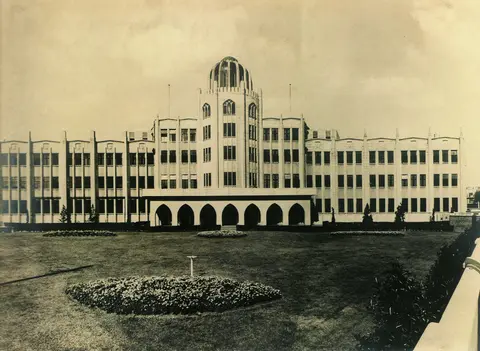
- A domed central tower with arched windows, with wings that step down in height on either side.
- Crenellated tops to the wing walls.
- A front arcade of pointed arches, described in the gazetteer with a balcony above.
- Window and fitting details based on drawing and science instruments, such as scales, set squares and gears.
The story
The Henry Lester Institute of Technical Education (雷士德工学院, Léishìdé Gōngxuéyuàn) is a large school building of 1934 at 505 Changzhi Road in Hongkou. It was paid for by the estate of the British property developer Henry Lester (雷士德), and since 2022 it has housed a design institute after a restoration.
A college funded by a will
Lester died in Shanghai in 1926. His will provided for an engineering college, intended mainly for Chinese students and excluding religious instruction. The Lester Trust built the college with an affiliated middle school in 1934.
Tools worked into the architecture
The design is credited to Bothwell (鲍斯惠尔) of Lester, Johnson & Morriss, the practice Lester had founded. Its reinforced-concrete structure combines Gothic Revival and Art Deco features: a domed central tower rises between wings that step down in height, with pointed arches along the front.
The decoration refers to the subjects taught inside. Window and fitting details use scales, set squares, gears, compasses and beakers, giving the building an identity more specific than its architectural style alone.
College, hospital and design institute
Teaching began in 1934. About 450 candidates sat the first entrance examinations, and some 2,000 people applied for the 639 places in the evening classes. The first engineering diplomas were awarded in June 1937. The college kept teaching through the war, and its first principal, Bertram Lillie, was killed in a road accident in April 1939. Japanese authorities seized the school in December 1942 and renamed it the East Asia Industrial College. After the war, the buildings served maritime colleges before becoming a seamen’s sanatorium in 1953 and the Shanghai Seamen’s Hospital in 1955.
Restoration began in 2021, and the heritage bureau records a reopening in November 2022. The third-floor drawing classroom retains its saw-tooth skylight. Craftspeople also rebuilt the glazed tiles of seven fireplaces whose originals had come from England in 1934.
The building now houses the Shanghai Innovation and Design Research Institute. Public outreach was part of its announced programme, but regular visiting hours have not been confirmed. View the exterior from the street unless an event or authorised visit is available.
From the archive

How to visit
- Status
- Exterior only
- Opening times and prices not yet confirmed; check before you go.
- Nearest metro
- International Cruise Terminal国际客运中心Line 12· 3 min walkPlan a metro journey here →
Chinese address — show this to a taxi driver
上海市虹口区东长治路505号
505 East Changzhi Road, Hongkou District
How to search this address in AmapAmap (高德地图) works best in mainland China; Apple Maps on iPhone. Both open in the app when it is installed.
Nearby
Loading map…
Within a 10-minute walk
- Sacred Heart Church (Hongkou)虹口耶稣圣心堂10 min walk
Within a 20-minute walk
- 1933 Old Millfun1933老场坊12 min walk
- North Bund Shopping District北外滩商业中心14 min walk
- Jingling Church景灵堂16 min walk
- Astor House Hotel浦江饭店16 min walk
- Broadway Mansions上海大厦17 min walk
People
- Henry Lester雷士德surveyor, property developer, philanthropist(funded)
- Lester, Johnson & Morriss德和洋行architect
Sources
- 1.Shanghai Famous Buildings Gazetteer: the Lester Institute of Technical Education building (Shanghai Seamen's Hospital) (上海名建筑志·著名的土木工程师的摇篮:雷士德工学院楼(上海海员医院)), 上海市地方志办公室, 上海通(上海市地方志办公室数字方志) — 上海名建筑志, entry 雷士德工学院楼(上海海员医院), first paragraph; paragraphs 10-12; paragraph 10; paragraph 13; paragraphs 11 and 13; paragraphs 12 and 14; paragraph 14; paragraph 12gazetteer
- 2.Lester Institute of Technical Education (Chinese Wikipedia) (雷士德工学院), Wikimedia Foundation — 雷士德工学院旧址 entry, address line; 建成年份 line; 设计者 line; 历史沿革; 现状 linewikipedia
- 3.Report on the restoration of the Lester Institute of Technical Education (Jiemian) (雷士德工学院修缮 (界面新闻)), 界面新闻, 2022 — article text on the will and the institute; restoration and current use; features and restoration paragraphsarticle
- 4.Another historic building to open to the public: the Lester Institute returns next year (background on Henry Lester and his firm) (上海又添一座开放的历史建筑 雷士德医学院明年“回归”), 上海市文化和旅游局 (reprinting 上观新闻, 2023-06-16), 2023 — section 雷士德工学院article
- 5.Lester, Henry 1840 - 1926 (Lester, Henry 1840 - 1926 (Biographical Dictionary of British and Irish Architects 1800-1950)), AHRnet (Art History Research Net) — selected projects, Technical Institute, 505 Changzhi Road (1934)website
- 6.Hongkou District Gazetteer: notable modern buildings (Lester Institute of Technical Education entry) (虹口区志·第三节 优秀近代建筑(雷士德工学院)), 上海市虹口区志编纂委员会, 上海市地方志办公室(上海通), 1999 — 第三节 优秀近代建筑, item 5gazetteer
- 7.The Municipal Gazette of the Shanghai Municipal Council, 1908–1942 (The Municipal Gazette: Being the Official Organ of the Shanghai Municipal Council, vol. 1 (1908) to vol. 34 (1942)), Shanghai Municipal Council, Shanghai Municipal Council (digitised run on the Internet Archive), 1908 — vol. 28 (1935), 27 June 1935, p. 304 (report for 1934); vol. 31 (1938), report for 1937; vol. 27 (1934), 27 June 1934, pp. 335–336; vol. 32 (1939), Lester Trustees' report for 1938archive
- 8.Hansard, House of Commons written answers, 1 May 1939: death of Mr Bertram Lillie (China and Japan (House of Commons written answers, 1 May 1939, vol. 346 c1510W)), UK Parliament, Hansard (historic Hansard), 1939 — written answer, 1 May 1939, vol. 346 c1510Warchive