Building · in The Bund
Somekh Building
哈密大楼Hāmì Dàlóu
A nine-storey 1927 block on Yuanmingyuan Road by Moorhead, Halse & Robinson, best known as a home of the newspaper Wenhui Bao.
- Built
- 1927
- Architect
- Moorhead & Halse
- Style
- neoclassical, eclectic
- Status
- Exterior only
- Then in
- British Settlement1848–1863International Settlement1863–1943Central District from 1899
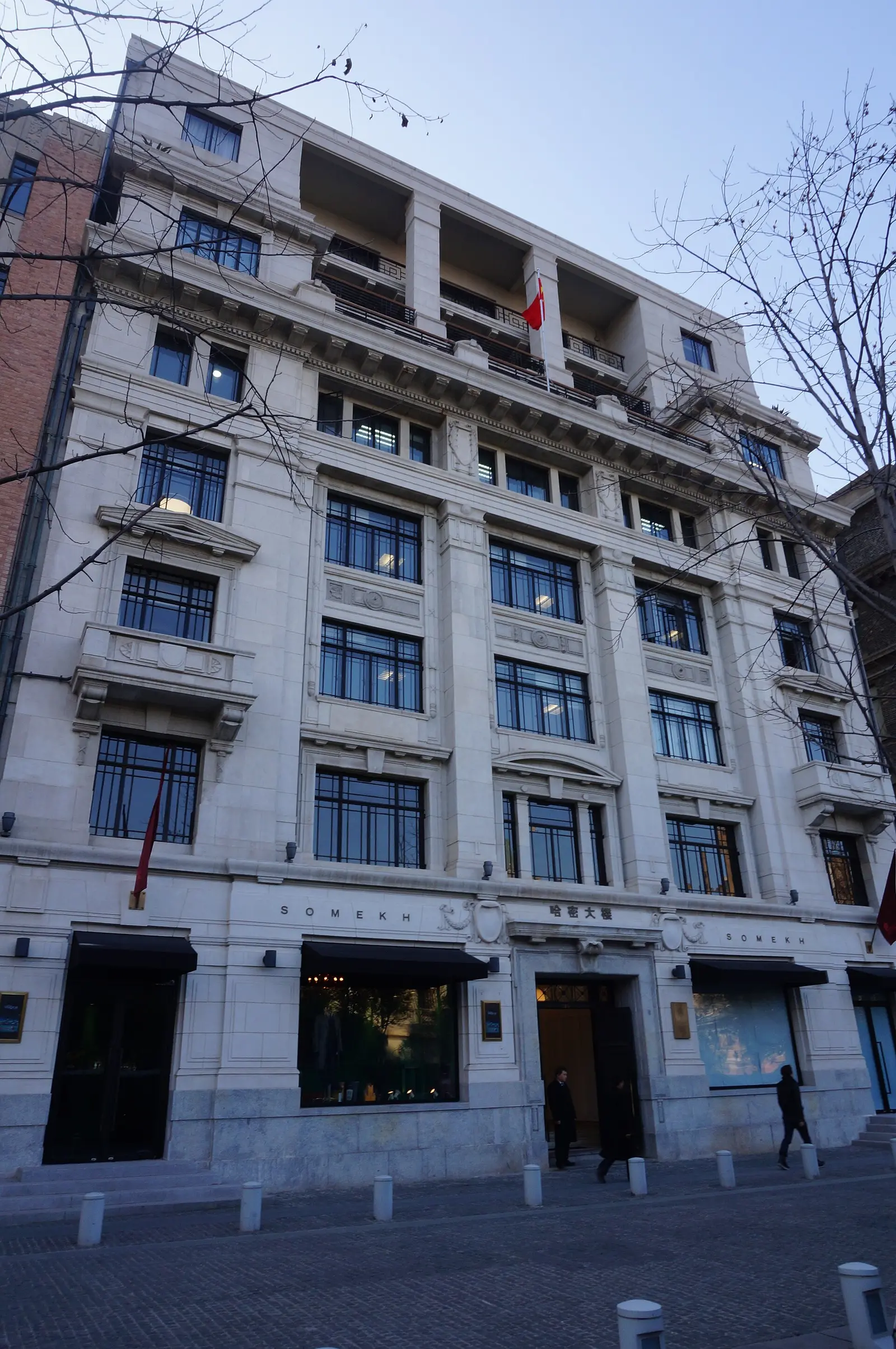
The building on Yuanmingyuan Road, 2014.
Photo: Livelikerw, CC BY-SA 3.0, via Wikimedia Commons (resized) · CC BY-SA 3.0
What you're looking at
- The granite base on the north and east facades.
- The three-part division of the facade, with pale render above the base.
- The finely made entrance doors and balconies.
- The upper floors, which were added after 1927.
The story
The Somekh Building (哈密大楼, Hāmì Dàlóu) at 149 Yuanmingyuan Road is a nine-storey office block of 1927 designed by the Shanghai firm Moorhead, Halse & Robinson. It is best known as a long-term home of the newspaper Wenhui Bao (文汇报).
A British firm’s design
Robert Moorhead, an engineer, and Sidney Joseph Halse, an architect, formed their partnership in Shanghai in 1907. By the time of this building it was Moorhead, Halse & Robinson (新马海洋行). The firm also designed the Asia Building at 1 Zhongshan East Road, among other Shanghai landmarks.
Reading the facade
The facade is neoclassical with some eclectic touches. It is divided into three horizontal parts. On the north and east faces, which are the main fronts, the base is granite. Elsewhere the walls are pale imitation-stone render mixed with fine gravel and sand. Look at the entrance doors and balconies, which are carefully made.
The first seven floors form the original reinforced-concrete frame, and the top two were added later. Many steel windows on floors two to six are original.
A newspaper’s home
The building was first known as the Somekh Building (沙咪大楼). Early tenants included the Shanghai branch of the Central News Agency and trading firms, among them Somekh & Co. (沙咪洋行). After 1949 the Xinhua News Agency’s East China and Shanghai branches took offices here, along with commercial and technology companies.
The best-known tenant was Wenhui Bao. The paper was founded in Shanghai in January 1938 and was suspended in May 1939 because of its anti-Japanese reporting. After the war it started with a trial edition from rented space, then moved into this building in September 1946. In May 1947 it was ordered closed; some of its staff went to Hong Kong and began a Hong Kong edition. The Shanghai paper reopened in June 1949. In 1956 it moved to Beijing for a few months, then came back to this building in October.
As the paper grew, it spread across three blocks. The rear printing works, on Huqiu Road, was demolished in 1985, and a 22-storey news building put up nearby in 1989 was cleared in the Rockbund redevelopment.
Today
The building has been renovated as an office building within Rockbund. It was closed to the public in 2014, so plan to see the exterior from the street, next to the YWCA Building. More about the buildings along this lane is on the Yuanmingyuan Road page.
How to visit
- Status
- Exterior only
- Opening times and prices not yet confirmed; check before you go.
- Nearest metro
- East Nanjing Road南京東路Line 2Line 10Exit 6· 11 min walkPlan a metro journey here →
Chinese address — show this to a taxi driver
上海市黄浦区圆明园路149号
149 Yuanmingyuan Road, Huangpu District
How to search this address in AmapAmap (高德地图) works best in mainland China; Apple Maps on iPhone. Both open in the app when it is installed.
Nearby
Loading map…
Within a 10-minute walk
- YWCA Building女青年会大楼1 min walk
- Associate Mission Building协进大楼1 min walk
- Yuanmingyuan Apartments圆明园公寓2 min walk
- Yuanmingyuan Road圆明园路2 min walk
- Former British Consulate-General原英国驻沪总领事馆2 min walk
- Rockbund Art Museum上海外滩美术馆2 min walk
People
- Moorhead & Halse马海洋行architect
Sources
- 1.White mansion one of homes for patriotic newspaper beacon (Somekh Mansion) (哈密大楼——爱国新闻媒体的摇篮), Shanghai Municipal Government Information Office (touch.shio.gov.cn), 2014 — Architects and year; Architects; Floors; History of Wenhui Daily; Current usewebsite
- 2.A short history of the Somekh Building (哈密大楼小史钩沉), 陶敏, 政协联线 / 政协头条, 2021 — Construction and design; Original use and tenants; Wenhui Baoarticle
- 3.The Bund (Waitanyuan and the Bund buildings) (外滩·源), 杨嘉祐, 上海人民出版社, 2012 — p. 37, 哈密大楼; p. 37; p. 39; pp. 39–40; p. 40; pp. 37–38; p. 38book