Building · in The Bund
Associate Mission Building
协进大楼Xiéjìn Dàlóu
A 1923–24 office block on Yuanmingyuan Road for the National Christian Council and mission societies, with a granite entrance porch.
- Built
- 1923–1924
- Style
- eclectic
- Heritage listing
- Shanghai Outstanding Historical Building · municipal · 5th batch
- Status
- Exterior only
- Then in
- British Settlement1848–1863International Settlement1863–1943Central District from 1899
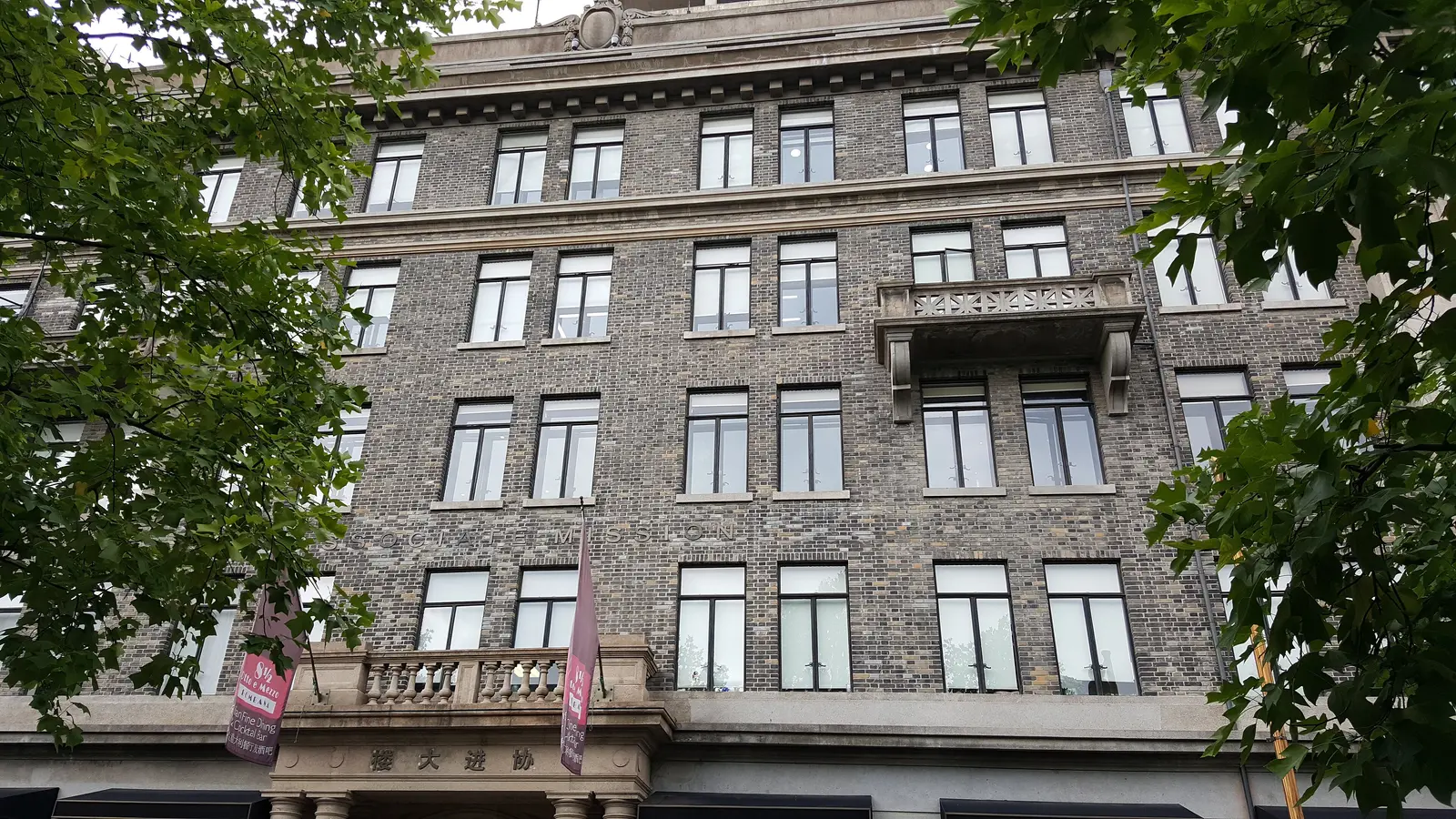
The building on Yuanmingyuan Road, 2017.
Photo: Antigng, CC BY-SA 4.0, via Wikimedia Commons (resized) · CC BY-SA 4.0
What you're looking at
- The granite porch with two pairs of columns and a round-arched doorway.
- The balustraded balcony above the entrance.
- Clear brick walls divided by bands of pale render.
- Ionic capitals over the side entrances.
The story
The Associate Mission Building (协进大楼, Xiéjìn Dàlóu) at 169 Yuanmingyuan Road is a six-storey office block built in 1923–24 for the National Christian Council of China and other Protestant mission bodies. Walk up to its granite entrance porch: the columns and the balcony above them are the most formal detail on this part of the street.
Offices for a new national body
The National Christian Council (中华全国基督教协进会) was formed in 1922 to link churches and mission societies across China. It first worked from Kunshan Garden, then moved into this purpose-built block. The foundation stone was laid in May 1923 and the building was finished in 1924. The Presbyterian Board contributed land it owned on Peking Road, and a Rockefeller fund offered US$100,000 towards the cost.
The Council took the third floor. The Mission Architects Bureau (会差建筑绘图事务所), which designed the building, took the fourth. Other floors went to mission organisations, among them the Associated Mission Treasurers, the London Missionary Society and the American Baptist Society, and to Bible societies and a medical missionary association with its journal. From the 1920s to the 1940s, more than thirty religious organisations kept offices on Yuanmingyuan Road, and most of them were here.
What you see now
The frame is reinforced concrete. A granite plinth runs round the base. Above it, clear brick walls are divided by bands of imitation-stone render into a strong grid of verticals and horizontals. The style is eclectic: the porch borrows from Renaissance design, with free-standing granite columns, an arched door and a balustraded balcony, while the side entrances have Ionic capitals.
Many of the original metal windows on the second to fifth floors have survived. Behind the front block, a larger seven-storey concrete building once faced Huqiu Road and was used as offices or a warehouse.
In Rockbund today
The building was kept and renovated as part of the Rockbund redevelopment, around 2006. For some years its top floor held an Italian restaurant. Plan to see it from the street.
It stands along the same street as the YWCA Building, and the whole group of restored buildings is described on the Yuanmingyuan Road page. The Rockbund Art Museum is a short walk away on Huqiu Road.
How to visit
- Status
- Exterior only
- Opening times and prices not yet confirmed; check before you go.
- Nearest metro
- Tiantong Road天潼路Line 10Line 12Exit 3· 11 min walkPlan a metro journey here →
Chinese address — show this to a taxi driver
上海市黄浦区圆明园路169号
169 Yuanmingyuan Road, Huangpu District
How to search this address in AmapAmap (高德地图) works best in mainland China; Apple Maps on iPhone. Both open in the app when it is installed.
Nearby
Loading map…
Within a 10-minute walk
- Somekh Building哈密大楼1 min walk
- YWCA Building女青年会大楼1 min walk
- Former British Consulate-General原英国驻沪总领事馆2 min walk
- True Light Building真光大楼2 min walk
- Christian Literature Society Building广学会大楼2 min walk
- Yuanmingyuan Apartments圆明园公寓2 min walk
Stories
Sources
- 1.Shanghai outstanding historic buildings, fifth batch list (第五批历保建筑清单), 上海市房屋管理局, 上海市房屋管理局, 2020 — 黄浦区, 5A045official-list
- 2.The Missions Building on Yuanmingyuan Road (Bund II series) (圆明园路上的传教楼), Shanghai Municipal Government Information Office (touch.shio.gov.cn), 2014 — Architect and tenants; Timeline; Early tenants; Funding; Religious context; Later usewebsite
- 3.The Bund (Waitanyuan and the Bund buildings) (外滩·源), 杨嘉祐, 上海人民出版社, 2012 — pp. 34–35, 协进大楼; pp. 33–35; p. 34; pp. 35–36; p. 36; p. 35; p. 33book
- 4.Decoding the Rockbund buildings, part 2 (解码外滩源建筑(续)), 赵金华, 周到 / 申活家, 2023 — 协进大楼article