Park · in The Bund
Huangpu Park
黄浦公园Huángpǔ Gōngyuán
The former Public Garden at the Suzhou Creek mouth, reshaped by road widening, changing admission rules and a modern memorial landscape.
- Built
- 1868
- Status
- Open to visitors
- Then in
- Chinese territory throughout; outside the foreign settlements
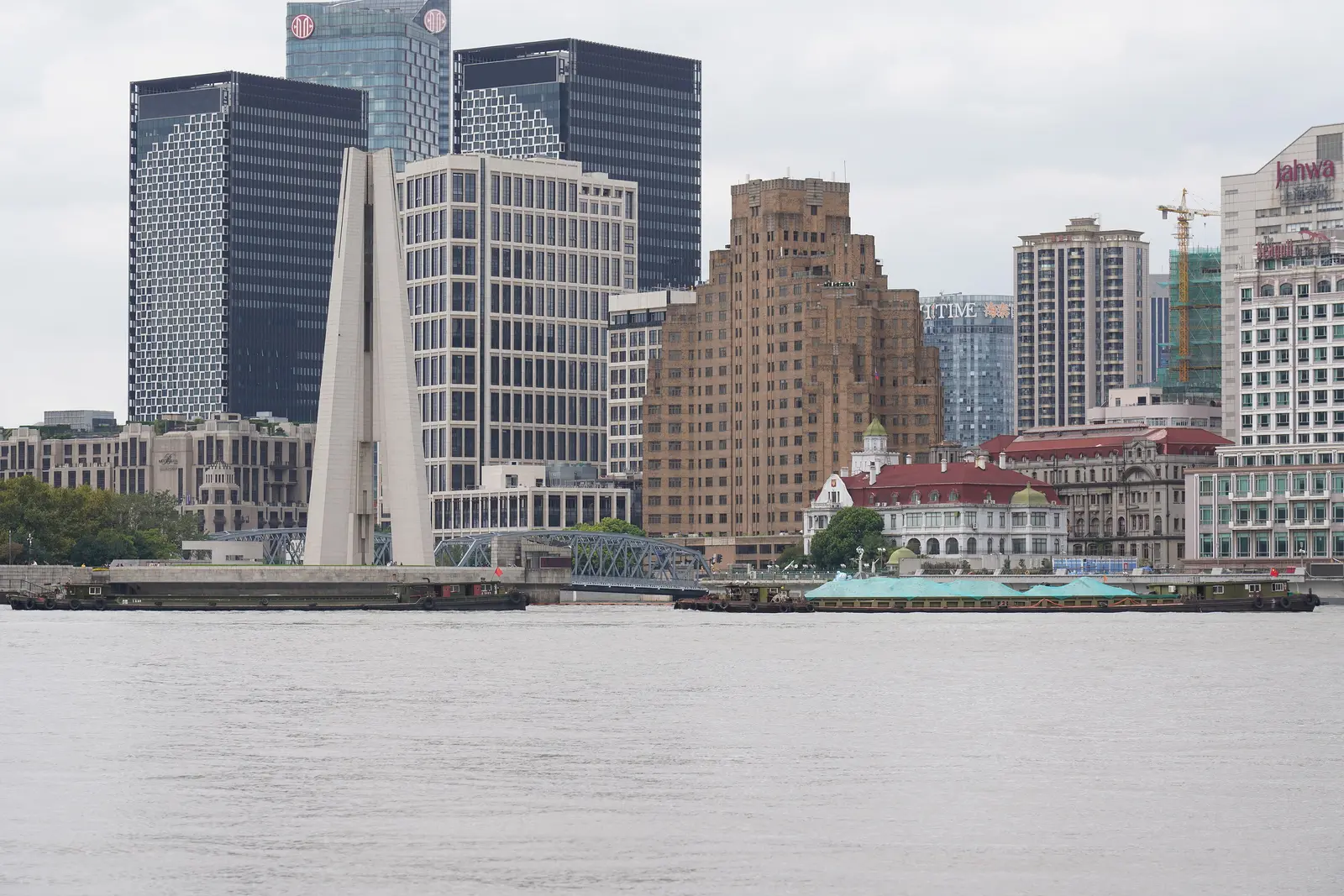
The park and its monument at the mouth of Suzhou Creek, seen across the Huangpu, 2019.
Photo: Ding Kezhong, CC BY-SA 4.0, via Wikimedia Commons (resized) · CC BY-SA 4.0
What you're looking at
- The meeting of Suzhou Creek and the Huangpu River beside the park.
- The memorial tower, reliefs and plaza added during the 1990s rebuilding.
- Mature trees and green areas retained within the redesigned park.
The story
Huangpu Park (黄浦公园, Huángpǔ Gōngyuán) occupies the meeting point of Suzhou Creek and the Huangpu River at the north end of the Bund. The memorial tower and plaza belong to a modern redesign of a much older garden. The site opened as the Public Garden in 1868, but its boundaries, buildings and admission rules have all changed.
A garden on reclaimed ground
The first garden was laid out on the consular mud-flat, land set aside for the recreation of the foreign community. Its position at the creek mouth made its edges subject to the same works that reshaped the Bund. In 1904 the Municipal Council planned to take a strip from its western side to widen the road, while extending the garden through reclamation by the creek. The widening was completed the following year.
Today’s paths and river edge therefore do not trace an untouched nineteenth-century garden. When comparing an old photograph with this view, look first for the rivers and bridge, then allow for the shifting shoreline and roadway.
Who could enter
The word “public” did not mean equal access. Most Chinese residents were excluded, although some received discretionary admission tickets. Chinese merchants petitioned against the policy. On 1 June 1928, the garden opened to Chinese visitors on the same terms as foreigners, a change recorded in the Municipal Council’s own annual report.
The longer story, including the petitions and the evidence behind the much-repeated sign about Chinese people and dogs, is told in The Public Garden and Who Could Enter. Here, the contrast between an accessible park and its former rules is part of the site’s history.
The landscape now
The garden was also a venue for the Town Band. A new bandstand was erected in 1889, but the concert structure did not survive the park’s later military use and rebuilding. It should not be confused with the memorial tower or another pavilion now on the grounds.
The name Huangpu Park dates from January 1946. A redesign begun in 1991 organised the landscape around the Monument to the People’s Heroes, its sculptures and plaza, while retaining mature trees and green areas. The tower was completed in 1994. These commemorative features, together with the Bund History Museum, are parts of the park with their own histories. They are not remnants of the original garden. The outdoor grounds and the museum also require separate visit planning; museum access has not been checked on site.
How to visit
- Status
- Open to visitors
- Opening times and prices not yet confirmed; check before you go.
- Nearest metro
- East Nanjing Road南京東路Line 2Line 10Exit 2· 14 min walkPlan a metro journey here →
Chinese address — show this to a taxi driver
上海市黄浦区中山东一路479号
479 Zhongshan Road East No. 1, Huangpu District
How to search this address in AmapAmap (高德地图) works best in mainland China; Apple Maps on iPhone. Both open in the app when it is installed.
Nearby
Loading map…
Within a 10-minute walk
- Shanghai Monument to the People's Heroes上海市人民英雄纪念塔2 min walk
- Suzhou Creek苏州河3 min walk
- Glen Line Building格林邮船大楼3 min walk
- Banque de l'Indochine Building东方汇理银行大楼3 min walk
- Waibaidu Bridge外白渡桥3 min walk
- Jardine Matheson Building怡和洋行大楼3 min walk
Stories
Sources
- 1.Huangpu Park — Shanghai revolutionary heritage resource register (黄浦公园), 上海红色文化资源网(复旦大学、中共上海市委党史研究室), 2020 — opening location description; opening description and paragraph beginning 1994年website
- 2.Shanghai Municipal Council annual report for 1881 (Shanghai Municipal Council: Report for the Year 1881 and Budget for the Year 1882), Shanghai Municipal Council, Shanghai Municipal Council (digitised copy on the Internet Archive), 1882 — Public Garden, letter of 25 April 1881 quoting Winchester's letter of 20 June 1868archive
- 3.A Short History of Shanghai (A Short History of Shanghai: Being an Account of the Growth and Development of the International Settlement), F. L. Hawks Pott, Kelly & Walsh, Shanghai (digitised copy on the Internet Archive), 1928 — p. 77book
- 4.Shanghai Municipal Council annual report for 1904 (Shanghai Municipal Council: Report for the Year 1904 and Budget for the Year 1905), Shanghai Municipal Council, Shanghai Municipal Council (digitised copy on the Internet Archive), 1905 — Works, Central District: The Bund; also registered in how-to-read-the-bund f10archive
- 5.Shanghai Municipal Council annual report for 1905 (Shanghai Municipal Council: Report for the Year 1905 and Budget for the Year 1906), Shanghai Municipal Council, Shanghai Municipal Council (digitised copy on the Internet Archive), 1906 — Works summaryarchive
- 6.Shanghai Municipal Council annual report for 1889 (Shanghai Municipal Council: Report for the Year 1889 and Budget for the Year 1890), Shanghai Municipal Council, Kelly & Walsh, Shanghai (digitised copy on the Internet Archive), 1890 — Garden Committee report, pp. 223–224; Admission of Chinese to Public Garden, pp. 226–230; Garden Committee, pp. 223–224; Town Band, p. 232archive
- 7.Shanghai Municipal Council annual report for 1928 (Shanghai Municipal Council: Report for the Year 1928 and Budget for the Year 1929), Shanghai Municipal Council, Shanghai Municipal Council (digitised copy on the Internet Archive), 1929 — Admission of Chinese to Public Parks, pp. 70–73; Public Garden (The Bund Garden), p. 276; original OCR rechecked 6 November 2026archive
- 8.Huangpu Park — Huangpu District Archives history column (【档案长廊】黄浦公园), 黄浦区档案馆, 上海市黄浦区有线电视中心, 2014 — paragraphs beginning 公园初建时 and 1949年后; opening paragraph and paragraph beginning 1991年article
- 9.Huangpu District's guide to parks open around the clock, July 2024 (夏夜遛弯,不妨到黄浦这几个24小时开放公园逛逛→), 上海黄浦, 上海黄浦官方账号(上观新闻), 2024 — 黄浦公园 section and article heading; publisher attribution at footarticle