Stories
Lijiachang: how a reed bank at the creek mouth became the British consulate
How a half-flooded plot at the mouth of Suzhou Creek, bought from about thirty holders, became the British consulate and the northern anchor of the Bund.
Timeline
Click a year on the axis to read what happened and set the map to that period.
Government1 of 20
Treaty of Nanking opens Shanghai
《南京条约》开放上海
The treaty that ended the First Opium War opened Shanghai, with four other ports, to British trade and residence.
Government2 of 20
The port is declared open
上海正式开埠
George Balfour, the first British consul, arrived on 8 November 1843 and declared the port open in the same month; the gazetteer gives 17 November, Pott 14 November.
Boundary3 of 20
Land Regulations set aside 830 mu
《土地章程》划定约830亩
Daotai Gong Mujiu published the Land Regulations agreed with Balfour, reserving about 830 mu between the Yangjingbang, Lijiachang and the river for British merchants, with no western limit and no Chinese residents.
Boundary4 of 20
Barrier Road closes the rectangle, 1,080 mu
界路划定西界,1,080亩
The western boundary was fixed at a new road, Barrier Road, today's Henan Road Central, and the settlement measured 1,080 mu.
Boundary5 of 20
Americans settle in Hongkou
美国人在虹口落脚
Bishop Boone's mission had rented land across Suzhou Creek; the daotai agreed that Hongkou could serve as an American settlement, with no boundary fixed.
Boundary6 of 20
Extension to Suzhou Creek and the Defence Creek, 2,820 mu
扩至苏州河与泥城浜,2,820亩
After the Qingpu incident, consul Alcock pressed for more ground and daotai Lin Gui extended the settlement north to Suzhou Creek and west to the Zhoujing creek, today's Xizang Road.
Boundary7 of 20
The French Concession, 986 mu
法租界设立,986亩
Daotai Lin Gui and consul Montigny exchanged letters creating a French concession between the Yangjingbang, the city moat, the river and the Guandi temple at Zhujia bridge.
People8 of 20
The Small Swords take the walled city
小刀会占领县城
Chinese families fled into the settlements and the rule of separate residence collapsed; the settlement's population passed 20,000 that year.
Government9 of 20
The Municipal Council is elected
工部局成立
The land renters, under the British, American and French consuls, adopted revised Land Regulations and elected a Municipal Council with power to levy rates and hire police.
Government10 of 20
The French set up their own council
法租界公董局成立
Consul Edan created a municipal council for the French Concession by consular order, whose decisions needed his approval; the two foreign towns were governed separately from then on.
Boundary11 of 20
British and American settlements unite
英美租界合并
The two settlements north of the Yangjingbang were united under one council; from 1899 the merged area was called the International Settlement.
Boundary12 of 20
Forty boundary stones in Hongkou
虹口界石四十块
The American section's line, proposed by consul Seward in 1863, was finally surveyed and marked with forty stones on 10–11 June 1893; the settlement then measured 10,676 mu.
Boundary13 of 20
The great extension, 33,503 mu
公共租界大扩张,33,503亩
The daotai's proclamation extended the settlement east to Zhoujiazui, west to Jing'an Temple and north to the county line, more than tripling its area.
Boundary14 of 20
French Concession extends west, 2,135 mu
法租界第一次扩张,2,135亩
The extension agreed in June 1899 and proclaimed in January 1900 took the concession west to Gujiazhai, today's Chongqing Road.
Boundary15 of 20
French Concession reaches Xujiahui, 15,150 mu
法租界扩至徐家汇,15,150亩
The Yuan Shikai government gave the French council police and taxation powers over its outside roads; the concession became fifteen times its original size and kept this shape to 1943.
People16 of 20
May Thirtieth
五卅惨案
Police of the Louza station fired on demonstrators on Nanking Road; the strike and boycott that followed changed the settlement's politics.
Government17 of 20
Chinese members join the Council; the parks open
华董入局,公园开放
Three Chinese councillors took their seats in April 1928 and the Council's parks opened to Chinese residents from 1 June; the number of Chinese seats rose to five in 1930.
The end18 of 20
Japanese troops enter the Settlement
日军进占公共租界
On the morning of 8 December 1941 Japanese troops crossed the Suzhou Creek bridges; the French Concession, under Vichy, was not occupied.
The end19 of 20
The settlements are handed over
租界交还
Britain and the United States gave up extraterritoriality by treaty on 11 January 1943; the Wang Jingwei government took over the French Concession on 30 July and the International Settlement on 1 August 1943.
The end20 of 20
The Sino-French treaty closes the account
中法条约完成交还
The treaty of 28 February 1946 completed the legal return of the French Concession after the war, and the former settlements became districts of the city.
Loading map…
Boundaries in 1846
- Chinese walled city上海县城(老城厢)1553–1914
- British Settlement, 1845英租界(1845)1845-11-29–1848-11-27 · 1,080 mu
Boundaries in 1849
- Chinese walled city上海县城(老城厢)1553–1914
- British Settlement, 1848英租界(1848 扩展)1848-11-27–1863-09-21 · 2,820 mu
- American Settlement (Hongkou)美租界(虹口)1848–1863-09-21 · 7,856 mu · approximate line
- French Concession, 1849法租界(1849)1849-04-06–1900-01-27 · 986 mu
Boundaries in 1863
- Chinese walled city上海县城(老城厢)1553–1914
- French Concession, 1849法租界(1849)1849-04-06–1900-01-27 · 986 mu
- French riverside strip, 1861法租界小东门外扩展(1861)1861-10-30–1943-07-30 · 37 mu · approximate line
- International Settlement, 1863英美租界 / 公共租界(1863)1863-09-21–1899-05-08 · 10,676 mu · approximate line
Boundaries in 1900
- Chinese walled city上海县城(老城厢)1553–1914
- French riverside strip, 1861法租界小东门外扩展(1861)1861-10-30–1943-07-30 · 37 mu · approximate line
- International Settlement, 1899公共租界(1899 扩展)1899-05-08–1943-08-01 · 33,503 mu
- French Concession, 1900法租界(1900 扩展)1900-01-27–1914-09-14 · 2,135 mu
Boundaries in 1914
- Chinese walled city上海县城(老城厢)1553–1914
- French riverside strip, 1861法租界小东门外扩展(1861)1861-10-30–1943-07-30 · 37 mu · approximate line
- International Settlement, 1899公共租界(1899 扩展)1899-05-08–1943-08-01 · 33,503 mu
- French Concession, 1914法租界(1914 扩展)1914-09-14–1943-07-30 · 15,150 mu
Boundary lines follow today’s streets where the old creeks and roads ran; dashed lines are inferred. Expect errors of a street or two, not more.
Dotted lines from 1900: the Central, Northern, Eastern and Western districts of the International Settlement, as the Council used them; it never printed a definition, so the lines follow Suzhou Creek, Xizang Road and Hongkou Creek as its usage implies.
The Bund now begins at a lawn. North of the Peace Hotel and the banks, the riverfront row stops at a low two-storey building with a five-arched arcade, set back behind grass. This is the former British consulate, and the open space in front of it is the oldest planned piece of the waterfront. It did not start as a garden. It began as a half-flooded enclosure that lay outside the first settlement, bought from about thirty holders by a consul who had been told not to buy it.
Waitanyuan (外滩源, wàitān yuán), “the source of the Bund”, is a modern name. The ground it describes is the oldest part of the British settlement’s story, and the shape of the district today still follows the lines drawn round that purchase in the 1840s.
Outside the line
When Shanghai opened to foreign trade in 1843, the British “location” north of the walled city had no fixed outline. The Land Regulations that the daotai Gong Mujiu (宫慕久, Gōng Mùjiǔ) agreed with the British consul George Balfour in November 1845 set its southern edge at the Yangjingbang creek and its northern edge at the line of today’s Beijing East Road.
North of that line, between the road and the mouth of Suzhou Creek, the ground was low. Part of it belonged to the Chinese government, which had docks there. Most of the rest was the Li Chia Chang, the Li family enclosure, known in Chinese as Lijiachang (李家厂, Lǐjiāchǎng). For a while this whole corner was treated as outside the settlement.
It was also a military site. When the British squadron came up the Huangpu towards the county town on 19 June 1842, a Qing battery here opened fire on it. The position commanded the straight reach of river up to the city. The battery stood on what later became the consulate lawn.
A consul buys what he was told to rent
Balfour opened the consulate in 1843 in a rented house inside the walled city. London’s policy was to rent consulates, not to buy or build them, and a house in the city kept the consul close to the daotai. It also kept him far from the merchants, whose godowns were going up along the river north of the city. As shipping grew and sailors came ashore in larger numbers, a city prison was no longer adequate. Balfour started looking for land beside the settlement.
On 28 April 1846 he reported what he had found. The Li family enclosure was about 100 mu, perhaps half of it under water at high tide, and he had arranged to “rent” it at the current rate. Land and the Chinese buildings on it would cost about 17,000 dollars. Sir John Davis, the British plenipotentiary in Hong Kong, replied that this was directly against instructions and that he could not advance the money. Balfour paid nearly 4,000 dollars out of his own pocket, left a merchant at Dent & Co. to act for him, and went home.
His successor, Rutherford Alcock, took up the case. Over objections from the Foreign Secretary, Lord Aberdeen, he persuaded Davis; Davis persuaded Lord Palmerston, the next Foreign Secretary; and Palmerston persuaded the Treasury.
Thirty holders and a swap
Buying the site meant dealing with many owners. A Dr Hale had already bought one portion. The strip along the north, by the creek, was Chinese government land. The remainder was divided among small holders, and some of them would not sell until officials had, in the British account’s words, spoken “persuasively”. In all, about thirty separate people had interests in the plots.
The government’s share was not sold but exchanged for other land. With it came the docks and the old battery. When the deal was done the British Government held 126.9 mu, roughly eight and a half hectares, at a cost of 17,708,420 copper cash for land and buildings. The land alone worked out at 52,171 cash a mu, about 30 taels.
The legal form explains why Balfour kept putting “rent” in quotation marks. Foreigners did not buy land outright in early Shanghai. They took a perpetual lease from the Chinese holder, paid a lump sum up front and then an annual rent. Balfour and the daotai had fixed that rent at 1,500 copper cash a mu a year, a little above the land tax of about 1,300 cash that the holder still owed the state, so the rent covered the tax. Chinese owners preferred a high annual rent with a deposit, called ya-tsoo (押租, yāzū), equal to a year’s rent. When a foreigner wanted the rent lowered, the deposit went up instead. Houses standing on the land were bought outright. The consulate paid the standard 1,500 cash a mu like everyone else. The deeds also allowed the sellers to take the land back if the British Government ever wanted to return it. They gave the sellers no right to demand it back.
The compound in 1849
The consular offices moved onto the site on 21 July 1849. The property then ran from the open Huangpu on the east to a ditch on the west, on the line of what later became Museum Road, now Huqiu Road. Suzhou Creek lay to the north, and a wide road on the south divided it from the Jardine, Matheson & Co. premises. There was no park between the consulate and the river yet: the water came up to the foreshore.
The consul’s house was built under Alcock, with George Cleverly, the surveyor-general of Hong Kong, directing the work. A small gaol followed in the south-west corner. Alcock was not impressed with the support he got from London. He complained that this was the fifth consular building he had been made to fit out in eight years. On another occasion a consul was refused a punkah, a ceiling fan worked by a servant pulling a cord, for his office.
Selling half the garden
The compound did not stay that size. In 1862 the consul Harry Parkes sold roughly half the grounds at public auction, in nine lots, without telling London. About eight acres were kept. By 1904 a visitors’ guide gave the consulate-general’s grounds as 43 mu, about a third of the 1849 purchase.
The next two stories in this series follow the streets that filled in west of the consulate, Museum Road and Yuanmingyuan Road, with their theatre, museum, clubs and mission offices.
Courts, fire and the 1873 building
The consulate was also a court. A Supreme Court for China was set up in Shanghai in 1865 to try British subjects, and a courtroom was added to the west side of the consul’s house; it was finished in 1869. On 23 December 1870 fire destroyed the combined consulate and court building, and most of the consulate’s records burned with it. A new consul’s residence, nearly finished at the time, escaped and was occupied the following year.
Robert Boyce of the Office of Works rebuilt the offices and court on the old foundations, which was the cheapest option. His building, completed in 1873, is the one you see: a two-storey block with a five-arched arcade below and a verandah above.
By 1904 it was a busy government office. The police court and shipping offices were on the ground floor, the consular and land offices upstairs, and the Supreme Court at the back, facing Yuanmingyuan Road.
On the lawn the consul Walter Medhurst laid a stone in April 1873 recording the site’s latitude and longitude, and guidebooks pointed visitors to it.
A river turned into a park and a bridge
Two changes in the 1850s and 1860s cut the consulate off from open water. In October 1856 Wills’ Bridge, a wooden toll bridge, opened across the creek mouth. The daotai declared it a foreign structure built with official sanction. Chinese pedestrians who used it instead of the ferry paid one cash each. Foreign firms paid annual fees for their staff, and the British Consulate paid five pounds a year.
East of the consulate the foreshore was built up. In 1866 the Municipal Council voted money for a garden there, and it was raised with mud dredged out of the Yangjingbang. The Public Garden, now Huangpu Park, was handed over to a management committee on 8 August 1868. The consulate’s lawn now looked onto a park rather than the river.
The park was for foreigners only, and the exclusion was argued over for sixty years. In 1881 nine Chinese residents, among them the clergyman and educator Yan Yongjing (颜永京) and the comprador Tang Maozhi (唐茂枝), wrote to the Municipal Council after police turned some of them away at the gate; the Council first promised to admit “respectable, well-dressed” Chinese, then went back on it. In 1889 the daotai Gong Zhaoyuan (龚照瑗) wrote to the British consul-general, pointing out that the garden stood on Chinese land. The Council then issued passes for a few Chinese visitors, each valid for a week; 183 were issued that year. The ratepayers finally voted in April 1928 to admit Chinese, and from 1 June 1928 anyone could enter with a ticket.
The government land at the northern end of the old purchase, along the creek bank, later became the site of the Union Church.
After 1941
Japanese forces closed the consulate after the Pacific War broke out in December 1941; it reopened on 10 September 1945. After 1954 a smaller British office worked from the old compound, and the riverfront building later passed to Shanghai municipal offices.
When the area was redeveloped in the 2000s, the name for the new district came out of a meeting organised by the New Huangpu group, the developer then in charge of the project. Someone suggested wàitān fēngqíng, “Bund ambience”. The historian Li Tiangang (李天纲) thought that sounded like a property advertisement. Cities like Ningbo and Qingdao already had “little Bunds”, and Shanghai had a South Bund and a North Bund. He proposed “the original Bund”, and the group settled on wàitān yuán, the source of the Bund. The restored consulate reopened in 2010 as Bund Origin No. 1 (外滩源壹号).
What to look at
The building you see is Boyce’s 1873 block, standing on the foundations of its predecessors. Inside, the restorers kept what they could of the original brown floor tiles in the ground-floor corridor. The west side is 1873 tile; the east side is new tile made to match, and the difference shows in the sheen.
From the lawn, the original outline of the purchase is easy to trace. The creek and Waibaidu Bridge are the northern edge. Huqiu Road, two blocks west, runs along the line of the ditch that was the western boundary in 1849. Beijing East Road, a short walk south, is the line where the first settlement stopped and the Li family’s enclosure began.
Places mentioned
Tap a name in the text, or “map” in this list, to see where it is; names with their own page link to it.
- 01Former British Consulate原英国驻沪领事馆(外滩源壹号)mapThe 1873 office and court building on the 1849 consular site; the lawn in front faces the Huangpu.
- 02Beijing East Road (the first northern boundary)北京东路Then Peking Road. The 1845 settlement stopped here; the Li family enclosure lay to the north.approximate position
- 03Huqiu Road (the old western ditch)虎丘路A ditch on this line formed the western edge of the consular land in 1849; it later became Museum Road.approximate position
- 04Union Church新天安堂mapBuilt on the northern part of the site, the strip that had been Chinese government land.
- 05Huangpu Park (the Public Garden)黄浦公园mapFilled in from the foreshore in the late 1860s and opened in 1868; in 1849 the consulate looked straight onto open river.
- 06Waibaidu Bridge (site of Wills' Bridge)外白渡桥mapThe first bridge over the creek mouth, a wooden toll bridge, opened in October 1856.
Places in this story
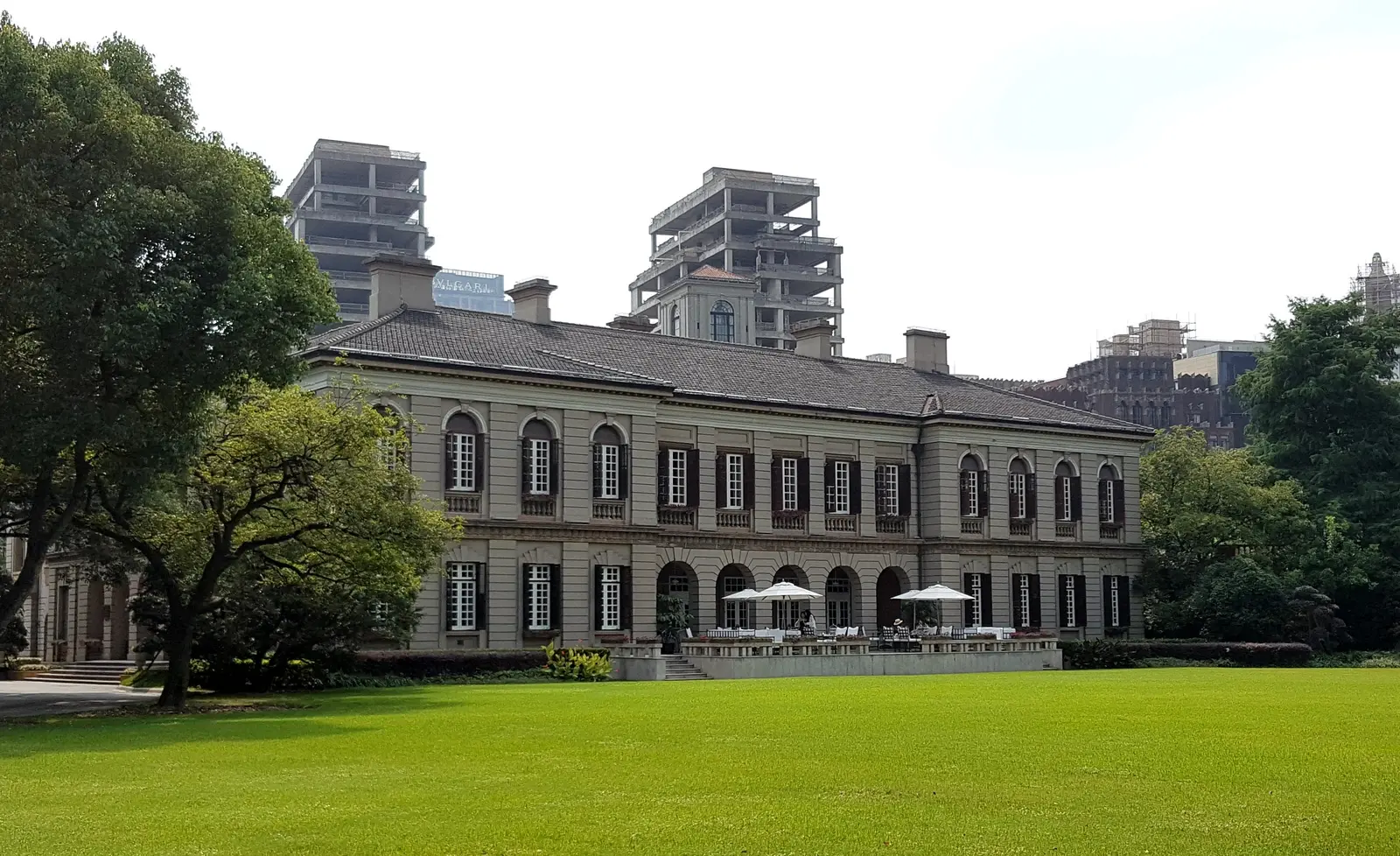

Building· 1872–1873
Former British Consulate-General
原英国驻沪总领事馆Yuán Yīngguó Zhù Hù Zǒnglǐngshìguǎn
The Bund's oldest surviving Western-style building: the British consulate rebuilt in 1872-73 after a fire, now an exhibition venue (Bund Origin No. 1).
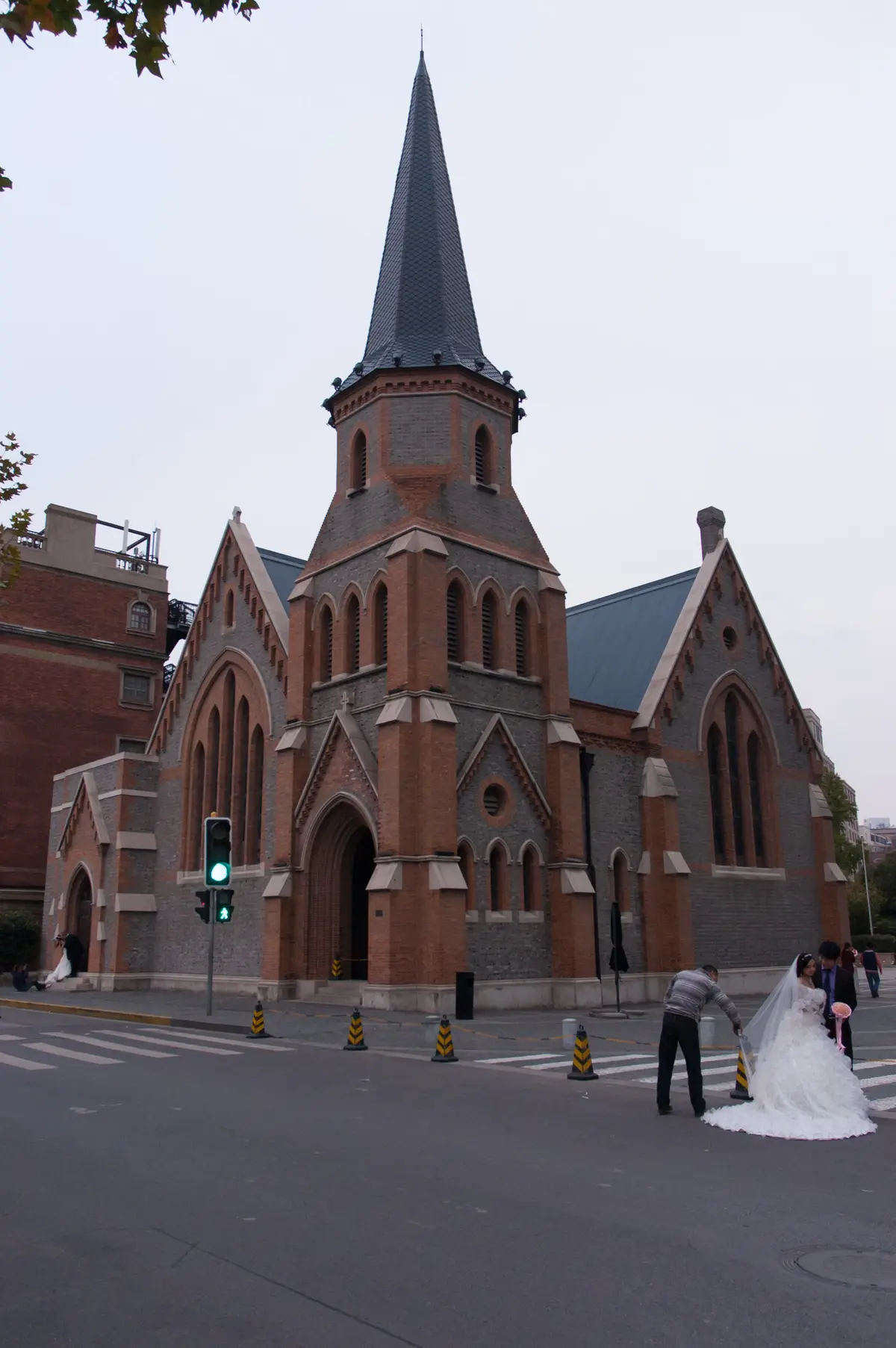

Protestant church· 1885–1886
Union Church
新天安堂xīn tiān ān táng
The British and American Union Church on Suzhou Creek, founded in 1886 for foreign residents and rebuilt after a 2007 fire.
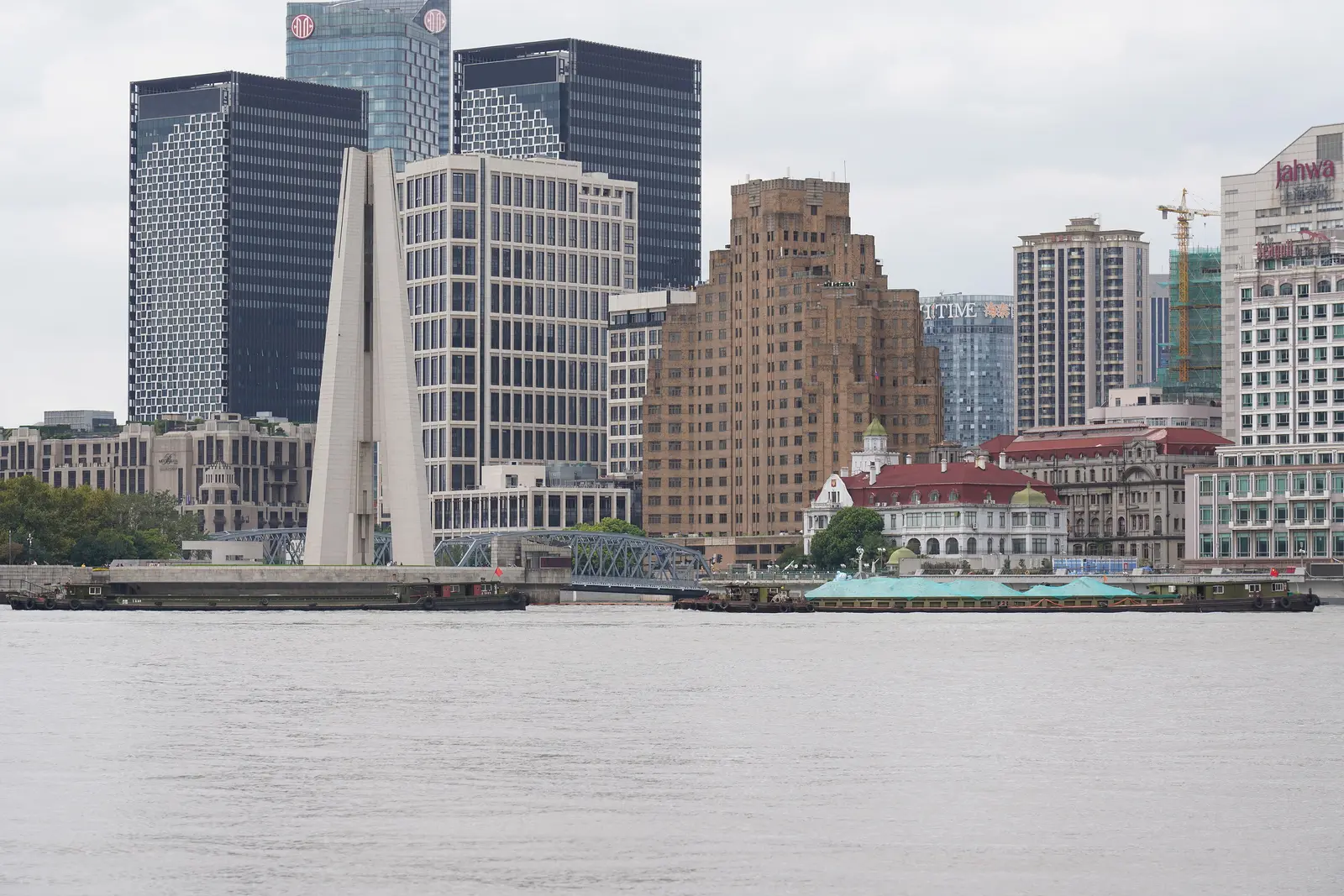

Park· 1868
Huangpu Park
黄浦公园Huángpǔ Gōngyuán
The former Public Garden at the Suzhou Creek mouth, reshaped by road widening, changing admission rules and a modern memorial landscape.
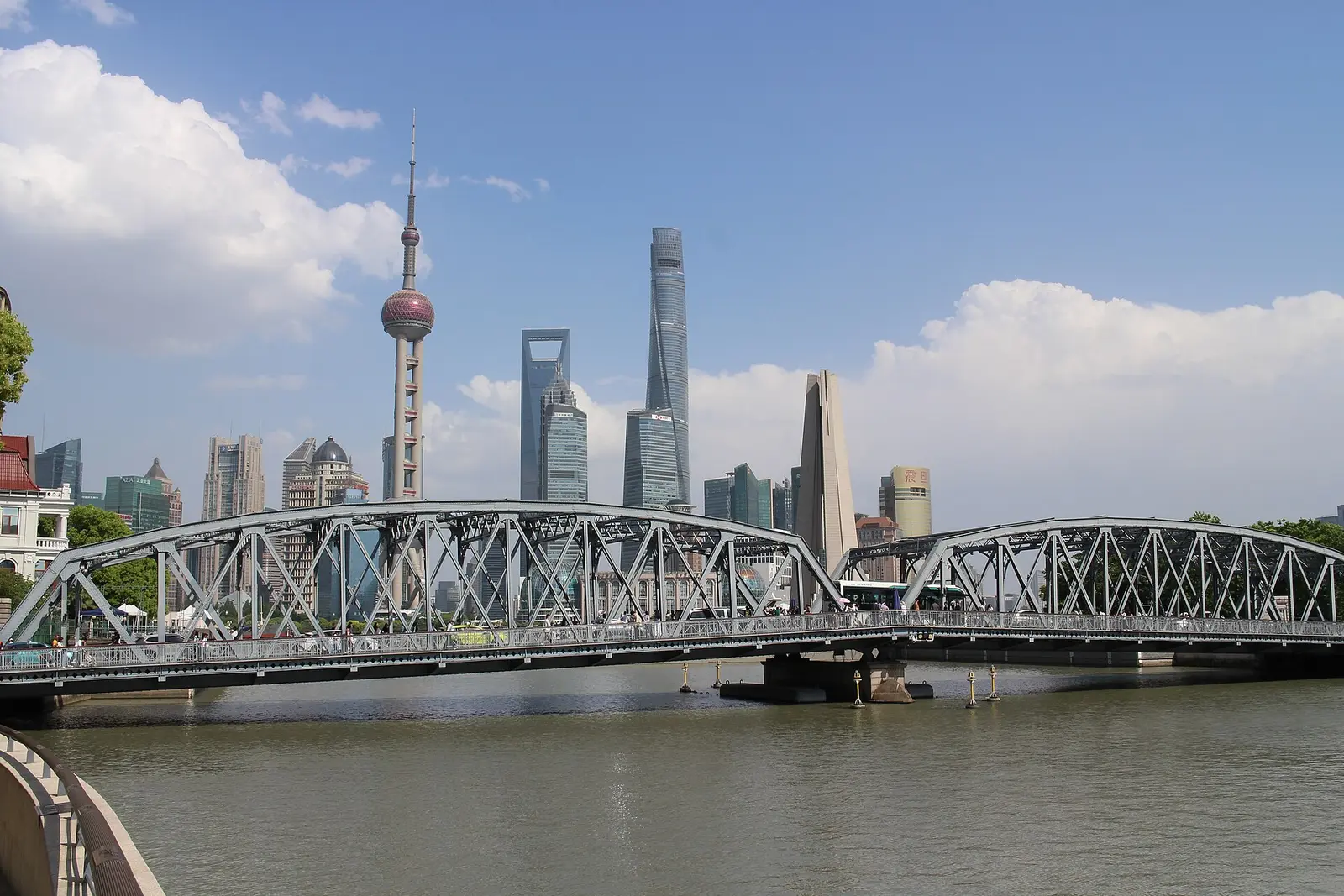

Bridge· 1906–1907
Waibaidu Bridge
外白渡桥Wàibáidù Qiáo
Riveted steel truss bridge of 1907 over the mouth of Suzhou Creek, the first steel bridge on the creek; its name recalls a toll-free crossing of the 1870s.
People in this story
Sources
- 1.The History of Shanghai (Lanning & Couling) (The History of Shanghai, Part I), G. Lanning; S. Couling, Kelly & Walsh, Shanghai, for the Shanghai Municipal Council (digitised copy on the Internet Archive), 1921 — Vol. I, p. 277; Vol. I, pp. 269–270, 280; Vol. I, pp. 278–280; Vol. I, p. 280; Vol. I, pp. 280–281; Vol. I, pp. 279–280, quoting Balfour's report; Vol. I, p. 281; Vol. I, pp. 448–449book
- 2.Shanghai – before 1925 (British consular compound history) (Shanghai – before 1925), Room for Diplomacy — Compound, 1843–73website
- 3.Darwent, Shanghai: A Handbook for Travellers and Residents (1904) (Shanghai: A Handbook for Travellers and Residents to the Chief Objects of Interest in and around the Foreign Settlements and Native City), C. E. Darwent, Kelly & Walsh, Shanghai (digitised copy on the Internet Archive), 1904 — The Bund: British Consulate, pp. 2–4; The Bund: British Consulate, p. 3; The Bund: British Consulate, p. 4; The Bund: Public Gardens, p. 2book
- 4.Mapping reality and virtuality: the Shanghai Bund settlements, 1845–1860 (Mapping Reality and Virtuality: Paintings, Maps and Hydrographical Surveying about British and American Settlements of the Shanghai Bund, 1845–1860), Kam Wing Fung, Abstracts of the International Cartographic Association, vol. 1, p. 85, 2019 — abstractarticle
- 5.Shanghai Famous Buildings Gazetteer: the British Consulate building (node 108935; read from a Wayback snapshot of the legacy page userobject1ai108935) (上海名建筑志 · 欧美风情的沪滨广厦 · 中英外交的历史见证:典雅秀美的英国领事馆楼), 上海市地方志办公室, 2009 — 英国领事馆楼gazetteer
- 6.How many secrets does the Bund still hide? (on the naming and buildings of Waitanyuan) (上海外滩还藏着多少秘密:孙中山的教名?胡蝶的婚礼?), 于淑娟, 澎湃新闻, 2014 — paras on 外滩源 namearticle
- 7.Waitanyuan: the dignity and awkwardness of going upmarket (外滩源:“高大上”的体面与尴尬), 什雅, 上观新闻(上海观察), 2014 — first sectionarticle
- 8.Chinese Wikipedia (article given in each fact's locator) (中文维基百科), Wikimedia Foundation — 原英国驻上海总领事馆wikipedia
- 9.English Wikipedia (article given in each fact's locator) (English Wikipedia), Wikimedia Foundation — Former Consulate-General of the United Kingdom, Shanghaiwikipedia
- 10.Shanghai Concessions Gazetteer: management of parks (上海租界志 · 第五篇管理 · 第三章文化管理 · 第二节 公园管理), 上海市档案馆(编), 上海社会科学院出版社;上海市地方志办公室数字方志(在线), 2001 — 第二节 公园管理, paras on 1878–1881; 第二节 公园管理, paras on 1889 and 1928gazetteer