Stories
Mission Row: the Christian offices of Yuanmingyuan Road
Between the wars more than thirty Protestant organisations had offices on Yuanmingyuan Road, several of them led by Chinese Christians.
Loading map…
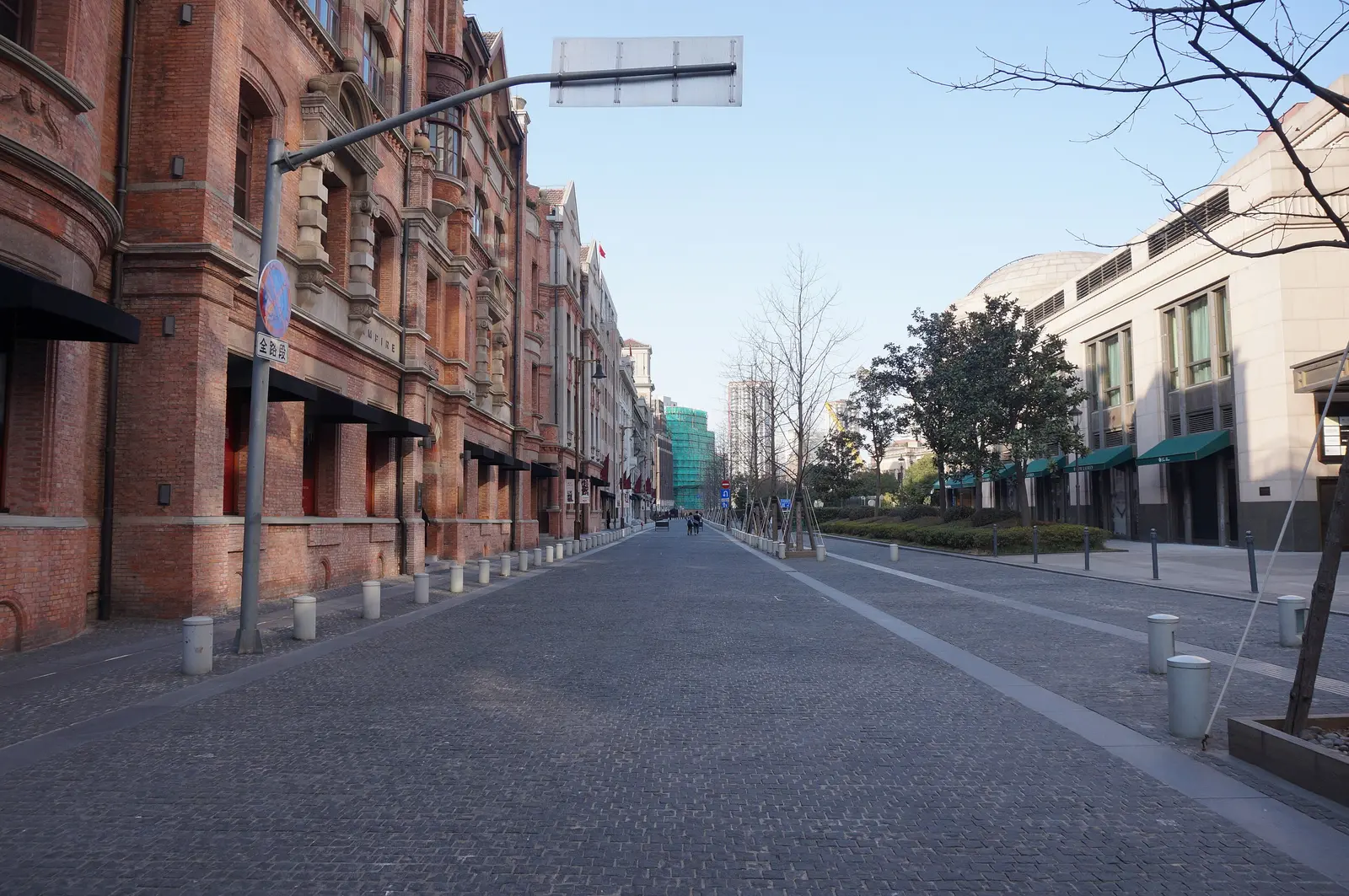
Yuanmingyuan Road (圆明园路, Yuánmíngyuán Lù) is a quiet street of stone and brick office buildings, one block back from the Bund. Between the wars it was the headquarters street of Protestant China. More than thirty religious organisations kept offices here: a national council of churches, Bible societies, mission treasurers, a medical missionary association, two publishers, and the national YWCA. Most of the buildings they put up still stand.
The interesting part is who ran them. In the 1920s leadership of several of these bodies passed from foreign missionaries to Chinese Christians, and the street’s buildings date from exactly that change.
Why this street
The street runs along the back of the British consulate’s land, told in part one of this series, and mission printing was already established nearby. In 1904 the American Presbyterian Mission Press stood at 18 Peking Road, printing a great quantity of literature for Chinese readers every year.
That Presbyterian property became the seed of the street’s biggest building. When the missions decided in the early 1920s to build a shared headquarters, the Presbyterian Board gave its Peking Road site, which was sold to pay for a plot on Yuanmingyuan Road. Most of the money came from an American Presbyterian, Dr Fred J. Tooker, who had worked with the mission in Hunan, and his sisters: US$150,000 given in memory of their father. The trustees of a Rockefeller family fund offered another US$100,000. The building was known at first simply as the Missions Building (教会大厦), and its address was 23 Yuanmingyuan Road; the street was renumbered later, which is why it is 169 today.
The Missions Building
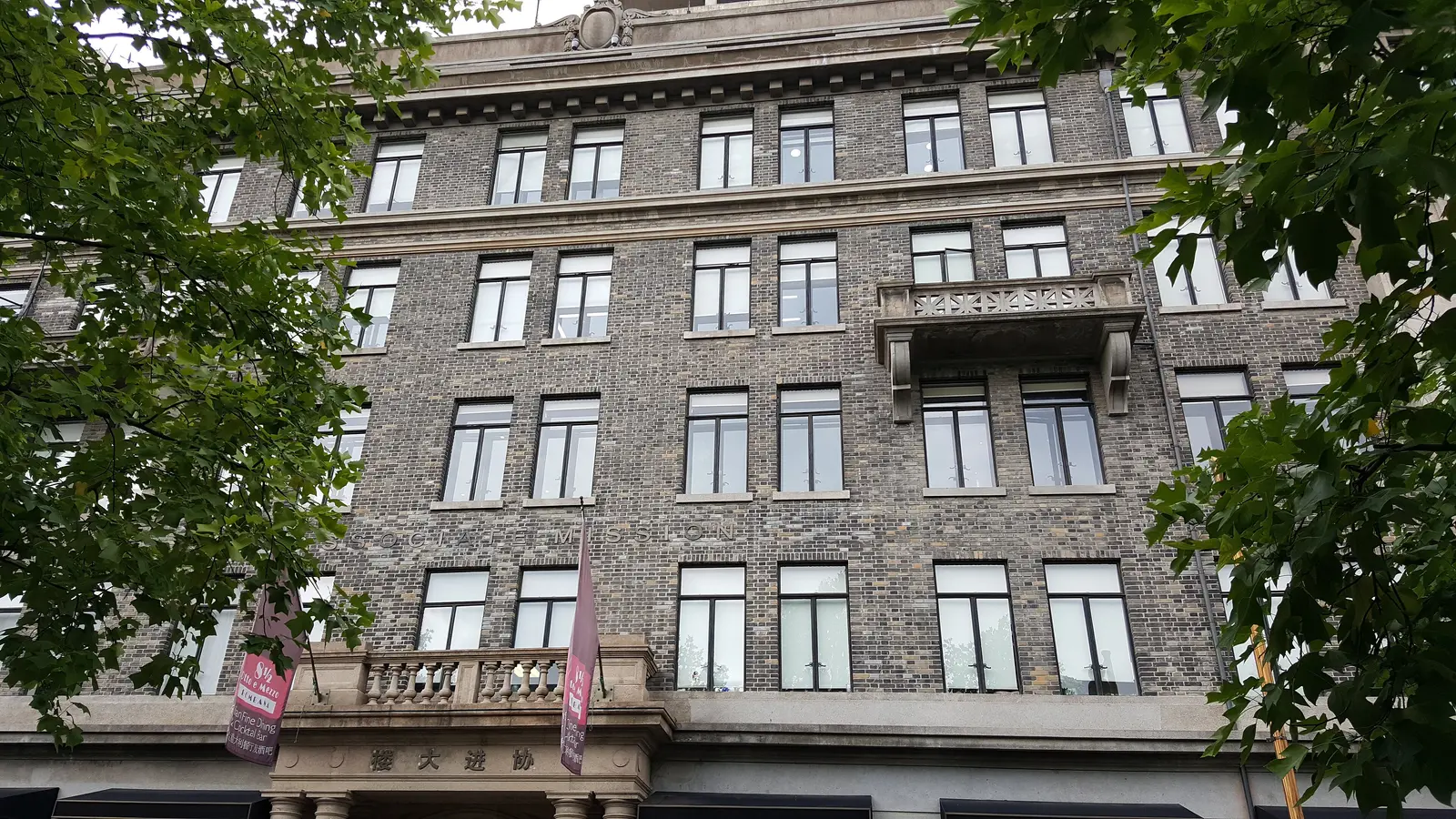
The foundation stone of the Missions Building at 169 Yuanmingyuan Road was laid in May 1923, and it was finished the next year. Its architects, the Mission Architects Bureau, moved into the fourth floor themselves. The front has a granite porch with two pairs of columns, and the walls above are grey brick divided by bands of imitation stone: six storeys of offices.
The tenants show how the Protestant enterprise in China was organised. The National Christian Council, founded in 1922, had the third floor, with a committee room for a hundred people and exhibition rooms. The London Missionary Society, the American Baptists and the Associated Mission Treasurers, who handled money for several missions, had offices. So did the British and Foreign Bible Society and the China Medical Missionary Association. Commercial firms rented space too: trading houses, shipping companies, and a timber merchant, Kow Kee, that moved in from a neighbouring building in 1935 and supplied the woodwork for the Park Hotel. When its Chinese manager, Y. L. Chang, died suddenly in 1936, the English-language papers printed his obituary.
Chinese leaders at the council
The National Christian Council was the clearest sign of the change. Its first general secretary was Cheng Jingyi (诚静怡, Chéng Jìngyí), who had served as secretary of the missionary continuation committee formed after the American organiser John R. Mott’s visit in 1913. Cheng ran the council from its founding in 1922 until ill health forced him to resign in 1933. He held that the future of the church in China depended on Chinese leadership, and he put that into practice. He founded the China for Christ movement in 1919, and in 1927 he became the first moderator of the Church of Christ in China, a union of sixteen Protestant denominations. He died in Shanghai in 1939.
The council’s first chairman, from 1922 to 1928, was David Z. T. Yui (余日章, Yú Rìzhāng), who was at the same time general secretary of the YMCA of China. Yui’s slogan was “saving the nation through character”. He died in January 1936.
The council was a federation. Its members were sixteen denominations and six national bodies, among them the Christian Literature Society, the Bible society and the national committees of the YMCA and the YWCA. Its own work ran from evangelism and rural churches to literacy, anti-opium and anti-prostitution campaigns. Its main cause was a Chinese church that would pay for, govern and spread itself. In practice, the money and much of the real control still lay with the foreign missions. When the Pacific War began in December 1941 it moved inland to Chengdu.
Cheng had another office nearby. The Chinese Home Missionary Society, founded by Chinese Christians in 1918 to send Chinese missionaries to Yunnan, elected him its first president in 1920 and kept its headquarters at 23 Yuanmingyuan Road. It had 2,500 members in eighteen provinces and overseas.
The national YWCA
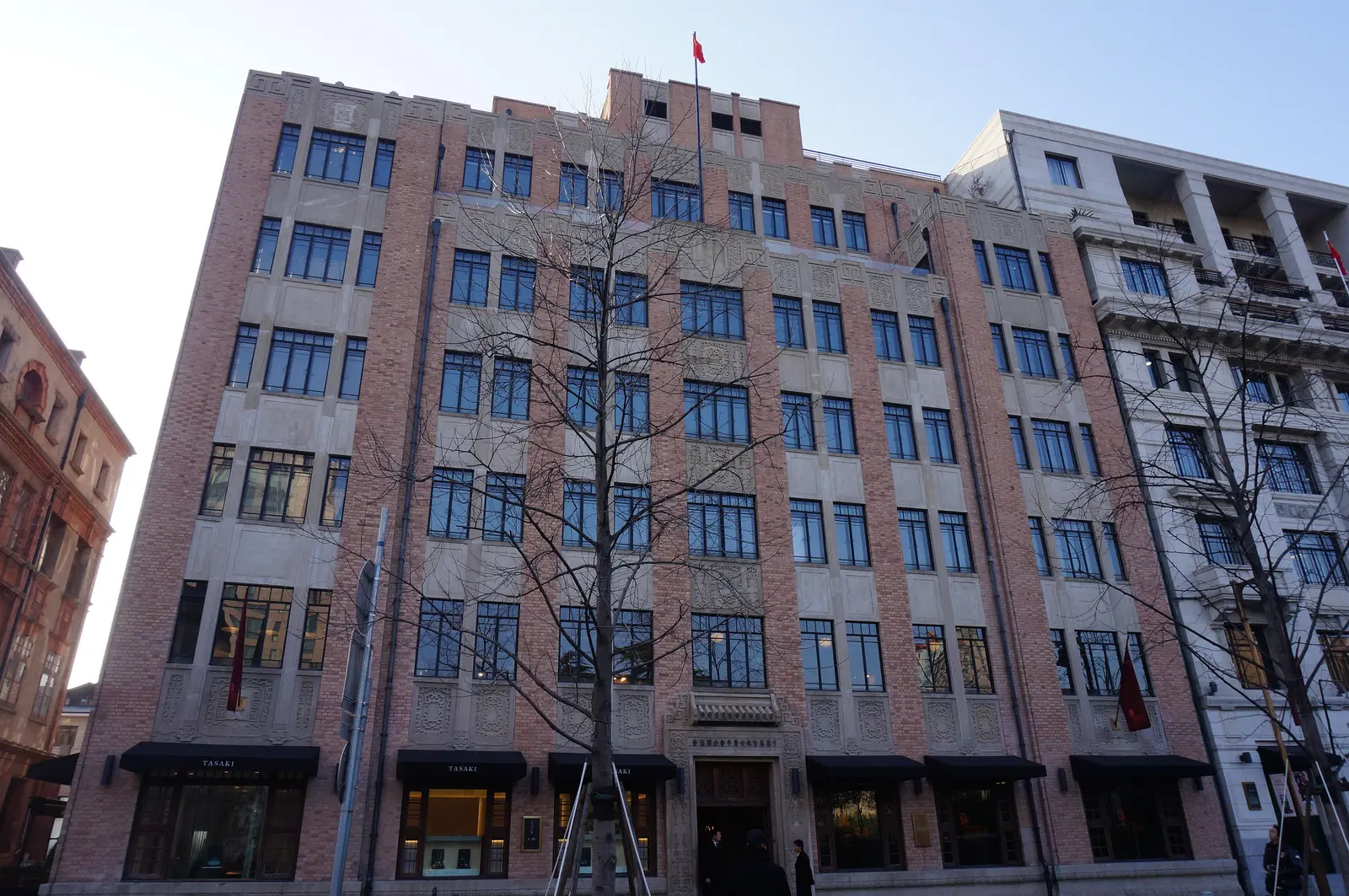
A short walk south is the street’s most decorated building. The national YWCA building at 133 Yuanmingyuan Road was completed on 28 February 1932 to designs by Li Jinpei (李锦沛, Lǐ Jǐnpèi), known in English as Poy Gum Lee. It is an Art Deco office block with strong vertical lines and stepped-back upper floors. The ornament is Chinese: lotus petals carved at the base, key-pattern panels under the windows and Chinese motifs around the entrance.
The woman who led the YWCA when it moved in was Ding Shujing (丁淑静, Dīng Shūjìng). She was born in 1890 in Linqing in Shandong, went to North China Union College in 1907 and in 1911 was among the first women to graduate from a Chinese college. She joined the Beijing YWCA staff in 1914, and by the end of 1925 she was in Shanghai as the first Chinese head of the national association. She also sat on the boards of Jinling College, Yanjing University and McTyeire School, and served on the National Christian Council.
The YWCA used the upper floors of its building for offices and club rooms. In 1936 the building held an exhibition of modern Chinese painting, and Charlie Chaplin, visiting Shanghai, came to see it. That year the World YWCA invited Ding to become Asia’s permanent representative on its World Council. Before she could decide, she was taken suddenly to hospital and died in Shanghai on 27 July 1936, aged 46.
The YWCA’s best-known work went on far from Yuanmingyuan Road. From 1930 its industrial work was led by Deng Yuzhi (邓裕志, Dèng Yùzhì), known as Cora Deng. She had joined the Shanghai YWCA in 1921 and studied at the London School of Economics. Her night schools for women factory workers in Shanghai’s industrial districts taught reading with the educator James Yen’s thousand-character method. The YWCA also campaigned for a weekly rest day, shorter than thirteen-hour shifts, guards on machinery and a minimum working age for children.
Two publishers, one architect
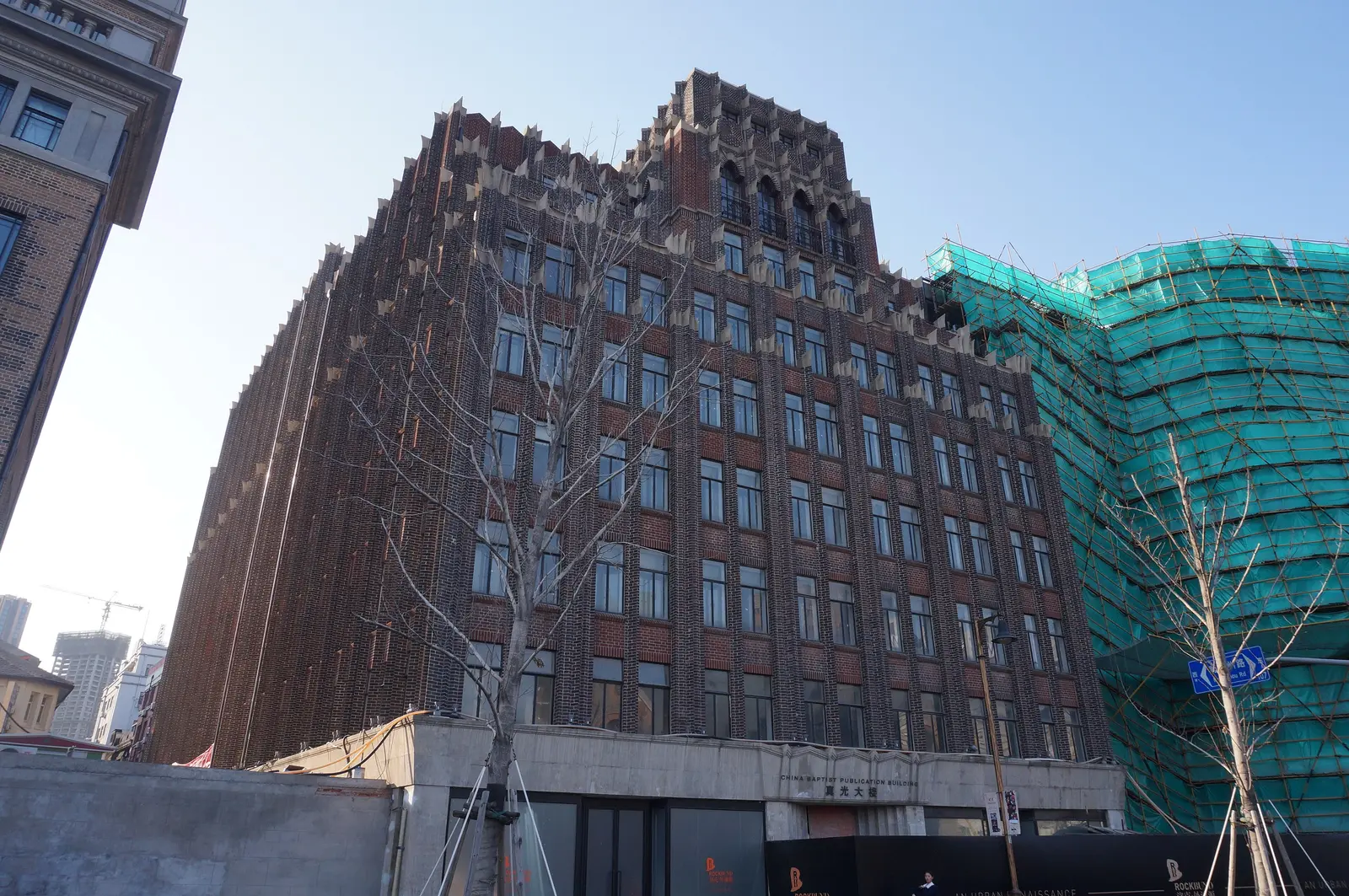
At the north end of the street, two dark-brick towers built at the same time by the same architect stand back to back. László Hudec designed both from 1930 to 1932. The one on Yuanmingyuan Road, no. 209, was for the China Baptist Publication Society and was built by a Chinese contractor, the Qiaxing Construction Company (洽兴营造厂). The other, round the corner at 128 Huqiu Road, was for the Christian Literature Society, on the site of the old Lyceum Theatre. Hudec kept his own office on the Baptist building’s upper floors until he left China in 1947.
The Baptist building took its later name, the True Light Building, from the Baptist monthly True Light (真光, Zhēnguāng). It had been published since 1902 and at its peak sold up to 50,000 copies. The press printed New Testaments and hymnals, and in its early years books on science and public affairs too. Soon after the building opened, the Baptist-founded University of Shanghai (沪江大学) bought the second floor for a downtown school of commerce. After war came to Shanghai in 1937, the whole university moved its staff and students into this branch and taught in half-day shifts.
The Christian Literature Society (广学会, Guǎngxuéhuì) was the older of the two publishers. Its magazine Wanguo Gongbao (万国公报) went back to 1868, and the Baptist missionary Timothy Richard had led the society from 1891 to 1916. In those years it published mainly on Western history, science, law and politics rather than religion, and it aimed at officials and scholars. When the Guangxu emperor collected books on Western learning before the reforms of 1898, 89 of the 129 he bought were the society’s.
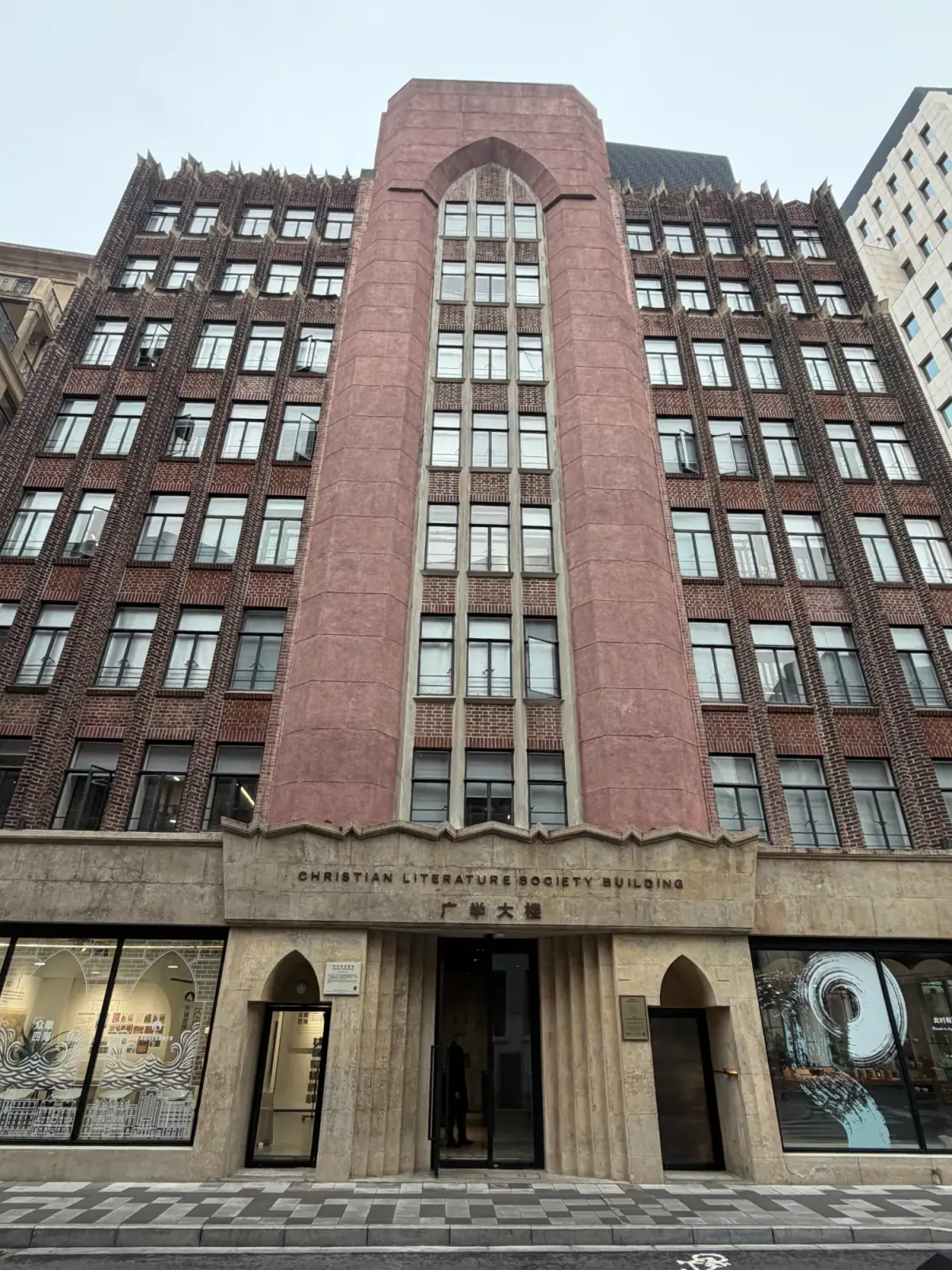
Its nine-storey tower on Museum Road was finished in 1932 and cost 350,000 taels, with materials and fittings imported. By then the society had changed direction: in 1927 it decided to concentrate on devotional books for Christian readers, and even church schools were using its textbooks less. For fifty-three years every general secretary was a Westerner. The first Chinese general secretary, Zhu Lide (朱立德), took over in 1939, and Hu Zuyin (胡祖荫) followed him in 1946. During the war part of the staff moved inland, returning to Shanghai in 1946.
How it ended
Mission Row lasted about a generation. The Christian Literature Society’s foreign staff left in 1949. In 1956 the Christian Literature Society, the Baptist publishing house and two other Protestant publishers were merged into a single Christian publishing house. From 1957 the buildings were managed by the city housing authorities. The two Hudec towers became offices for state import and export companies; the Missions Building was shared between Chinese Christian bodies and a state transport company.
Walking the street
Start at the south end of Yuanmingyuan Road, at Beijing East Road. The YWCA at no. 133 is the one with Chinese ornament; look at the base and the entrance. Further north, the Missions Building at no. 169 is recognisable by its granite porch. At the north end, the True Light Building at no. 209 is joined at the back to the Christian Literature Society Building, whose front is on Huqiu Road. Walk round the block to see the two towers as a pair. The next story follows how these buildings were emptied, restored and reopened as Rockbund.
Places mentioned
Tap a name in the text, or “map” in this list, to see where it is; names with their own page link to it.
- 01Missions Building (169 Yuanmingyuan Road)协进大楼mapHome of the National Christian Council and many mission offices, completed in 1924.
- 02National YWCA Building (133 Yuanmingyuan Road)女青年会大楼mapHeadquarters of the YWCA of China, completed in 1932 to designs by Poy Gum Lee (Li Jinpei).
- 03Christian Literature Society Building (128 Huqiu Road)广学大楼mapHudec's tower for the Christian Literature Society, on the old Lyceum site.
- 04True Light Building (209 Yuanmingyuan Road)真光大楼mapThe China Baptist Publication Society's building, joined to the Christian Literature Society tower.
- 05Yuanmingyuan Road圆明园路mapThe street, between South Suzhou Road and Dianchi Road.
- 06Beijing East Road near Yuanmingyuan Road (old Presbyterian property)北京东路In 1904 the American Presbyterian Mission Press was at 18 Peking Road; the board later traded the property towards the Missions Building site. Position approximate.approximate position
Places in this story

Building· 1923–1924
Associate Mission Building
协进大楼Xiéjìn Dàlóu
A 1923–24 office block on Yuanmingyuan Road for the National Christian Council and mission societies, with a granite entrance porch.

Building
YWCA Building
女青年会大楼Nǚ Qīngniánhuì Dàlóu
An Art Deco home for the national YWCA on Yuanmingyuan Road, with Chinese carved details and upper floors that step back.
Building· 1930–1932
Christian Literature Society Building
广学会大楼Guǎngxuéhuì Dàlóu
A nine-storey Art Deco tower by László Hudec, built in 1930–32 for the Christian Literature Society, a Chinese-language publisher.

Building· 1930–1932
True Light Building
真光大楼Zhēnguāng Dàlóu
A stepped, dark-brick Art Deco office block by László Hudec for the Baptist publishing house, whose magazine True Light gave it its name.

Street
Yuanmingyuan Road
圆明园路Yuánmíngyuán Lù
A street through Waitanyuan, from Dianchi Road to Suzhou Creek, with former offices, apartments and the YWCA Building.
People in this story
- László Hudec邬达克
Sources
- 1.Darwent, Shanghai: A Handbook for Travellers and Residents (1904) (Shanghai: A Handbook for Travellers and Residents to the Chief Objects of Interest in and around the Foreign Settlements and Native City), C. E. Darwent, Kelly & Walsh, Shanghai (digitised copy on the Internet Archive), 1904 — The Bund, p. 26book
- 2.The Missions Building on Yuanmingyuan Road (圆明园路上的传教楼 (The Missions Building symbolized Christian influence in China)), 上海市人民政府新闻办公室(感知上海·今日上海), 2014 — funding paragraphs; tenants; building paragraph; tenants; people; later useswebsite
- 3.The Missions Building on Yuanmingyuan Road (Bund II series) (圆明园路上的传教楼), Shanghai Municipal Government Information Office (touch.shio.gov.cn), 2014 — Funding; Religious context; Timeline; Architect and tenantswebsite
- 4.The Bund (Waitanyuan and the Bund buildings) (外滩·源), 杨嘉祐, 上海人民出版社, 2012 — p. 34; pp. 24–27, 61–63; pp. 24–27; pp. 61–63; pp. 24–27, 63; pp. 35–36book
- 5.Cheng Jingyi (Biographical Dictionary of Chinese Christianity) (Cheng Jingyi), Biographical Dictionary of Chinese Christianity — biography, paras 3–6article
- 6.Yu Rizhang / David Z. T. Yui (Biographical Dictionary of Chinese Christianity) (Yu Rizhang), Biographical Dictionary of Chinese Christianity — biographyarticle
- 7.Ding Shujing (Biographical Dictionary of Chinese Christianity) (Ding Shujing), Carol Lee Hamrin, Biographical Dictionary of Chinese Christianity — biographyarticle
- 8.Archives Corridor: the YWCA Building (【档案长廊】女青年会大楼), 黄浦区档案馆, 上海市黄浦区有线电视中心, 2014 — Construction; Architecture paragraphs; Association offices; 1936 exhibitionarchive
- 9.An art walk along Suzhou Creek (掠影·艺游苏州河), 上海市文旅推广网, 2024 — 女青年会大楼website
- 10.Deng Yuzhi (Cora Deng) (Women in World History, via Encyclopedia.com) (Deng Yuzhi (b. 1900)), Gale / Encyclopedia.com — biographyarticle
- 11.László Hudec (Chinese edition, with an incomplete catalogue of works) (邬达克), 卢卡·彭切里尼(Luca Poncellini)、尤利娅·切伊迪(Júlia Csejdy)著;华霞虹、乔争月译, 同济大学出版社, 2013 — Catalogue of works, 1930–1932; Catalogue of worksbook
- 12.Zhenguang and Guangxue Buildings (Chinese Wikipedia; cites Shanghai Construction Chronicle 1997 and North-China Daily News, 1930) (真光广学大楼), Wikimedia Foundation — Architect, builder and tenants; Tenantswikipedia
- 13.Timothy Richard (Timothy Richard (Biographical Dictionary of Chinese Christianity)), Biographical Dictionary of Chinese Christianity — Timothy Richardarticle
- 14.Shanghai Religion Gazetteer: other national Protestant bodies in Shanghai (National Christian Council and others) (上海宗教志 · 第五编基督教 · 第二章团体 · 第六节 其他在沪全国性团体), 上海市地方志办公室(上海方志数据库) — 一、中华全国基督教协进会; 十一、其他全国性合作团体gazetteer
- 15.Shanghai Religion Gazetteer: Protestant publishing (Christian Literature Society and others) (上海宗教志 · 第五编基督教 · 第三章教育和出版 · 第四节 出版), 上海市地方志办公室(上海方志数据库) — 五、广学会gazetteer