People · scholar-official, translator, agronomist, astronomer
Xu Guangqi
徐光启Xú Guāngqǐ · 1562–1633
Ming official from Shanghai (1562–1633) who translated Euclid with Matteo Ricci and reformed the calendar; his grave gave Xujiahui its name.
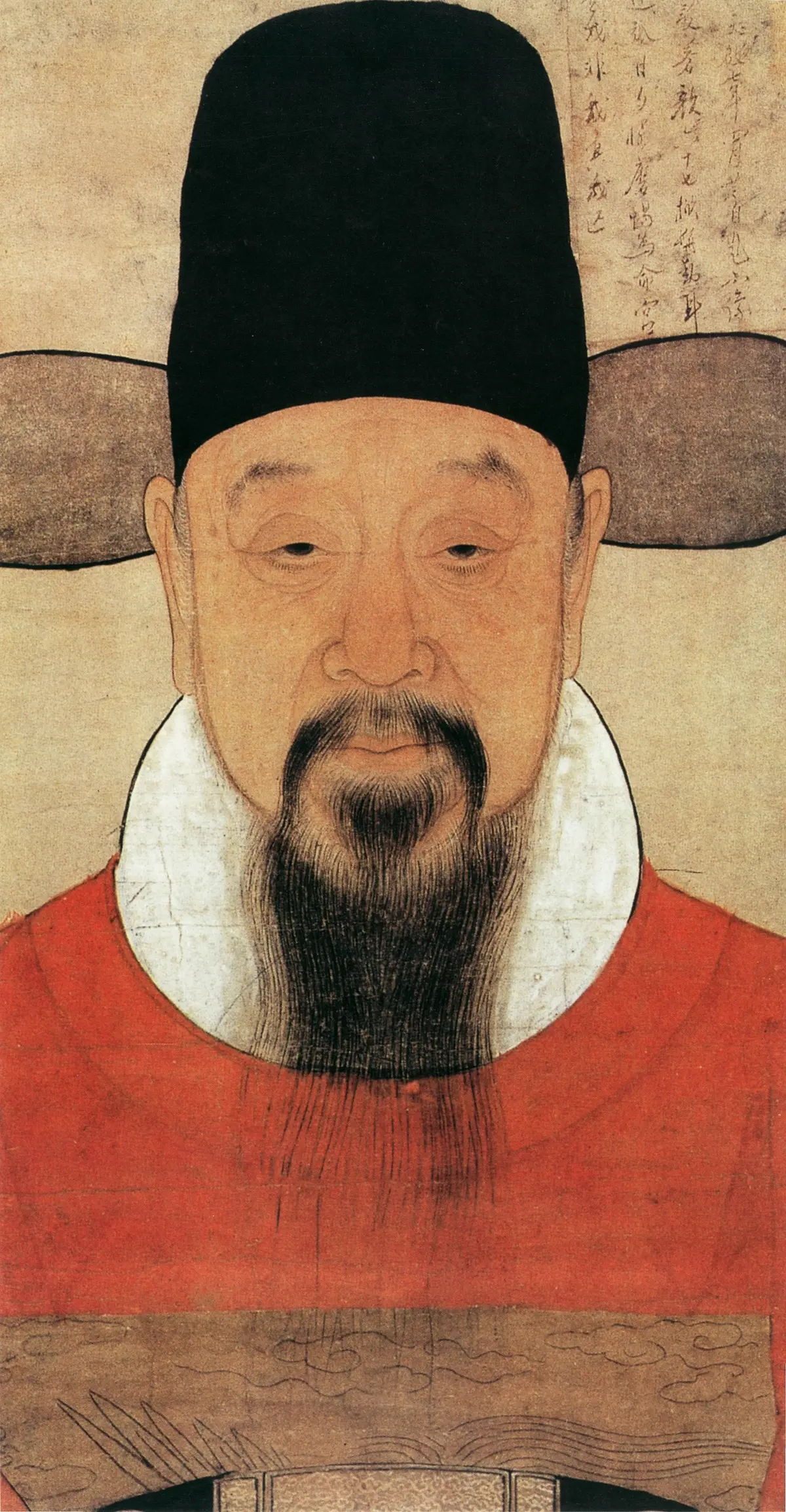
- Born
- 1562
- Died
- 1633
- Known as
- scholar-official, translator, agronomist, astronomer
- Also written
- Paul Xu · Zixian · Xu Wending · 徐光啓 · 子先 · 徐文定
Loading map…
Xu Guangqi (徐光启, Xú Guāngqǐ) is the Shanghai man behind two names on today’s map: Xujiahui, the Xu family’s settlement, which grew up round his grave, and Guangqi Park, where that grave still is. In his own time he was a Ming official from a family of farmers and weavers. He became a Catholic, translated the first books of Euclid with the Jesuit Matteo Ricci, wrote about farming, and in his last years ran the reform of the imperial calendar. He was born in the walled town on 24 April 1562 and died in Beijing on 8 November 1633.
For his whole life told in order, read the three-part series Xu Guangqi’s Shanghai. This page follows the work he is remembered for, using what the Memorial Hall in Guangqi Park puts on display.
The paper pulled from the reject pile
Xu sat the provincial examination for the first time in 1582 and failed. He kept failing, and supported himself by teaching. In 1597 the chief examiner, the scholar Jiao Hong, went through the papers already turned down, found Xu’s, and placed it first. Seven years later Xu passed the highest examination and entered the Hanlin Academy, the emperor’s college of scholars.
In between, the course of his life had changed. He met Matteo Ricci in Nanjing in 1600 and was baptised there in 1603 under the name Paul. In Beijing he went on studying with Ricci, and the two of them took on a book that no one had yet put into Chinese.
Euclid, from Rome to Beijing
Ricci had learned his mathematics in Rome from Christopher Clavius, the Jesuit who led the work on the Gregorian calendar and who had published his own annotated Latin edition of Euclid’s Elements. That edition is the text Ricci and Xu translated. The Memorial Hall’s displays say Xu went back over the meaning again and again and rewrote the Chinese three times. The first six books, the plane geometry, were printed in 1607 as Jihe yuanben (幾何原本). In his preface Xu recalled Ricci telling him that none of the other Western books could be discussed until this one was translated.
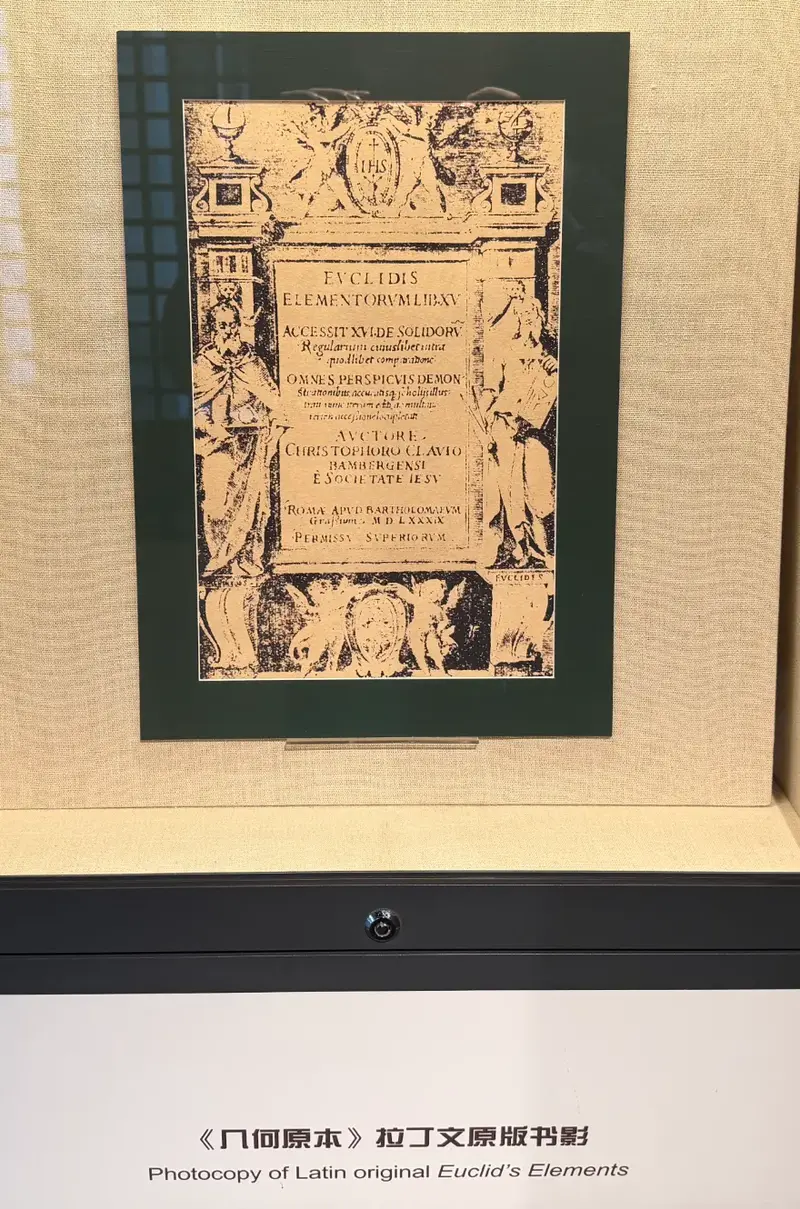
Title page of Christopher Clavius's Latin Euclid, Rome 1589. Ricci, Clavius's former pupil, translated Clavius's text with Xu. A facsimile in the Xu Guangqi Memorial Hall.
Photo: the site owner, Shanghai Story MapThey had to make up a vocabulary as they went. The book opens with a sentence that sets out its method: all geometry begins from a point; draw the point out and it becomes a line, spread the line out and it becomes a surface, stack surfaces and they become a solid. The definitions are short: “㸃者無分”, a point has no parts; “線有長無廣”, a line has length but no breadth. For the letters on the diagrams the translators did not keep Clavius’s A, B, C. They swapped in the ten heavenly stems, 甲, 乙, 丙, 丁, letter for letter in the same order, so that the equilateral triangle Clavius builds on the line AB is built in Chinese on the line 甲乙.
The figure below plays three of these pages line by line, in Clavius’s Latin and Xu’s Chinese: the opening definitions, the first proposition, and the forty-seventh, the theorem of the right-angled triangle that Chinese mathematics already knew as the gougu rule.
Euclid's Elements · 幾何原本 · 1607
Watch the geometry Xu and Ricci put into Chinese
Book 1, opening definitions
Euclides … initio facto à definitionibus, quarum prima punctum explicat. Clavius, 1589, p. 28
凡論幾何,先從一㸃始。
All talk of geometry begins from a point.
Punctum est, cuius pars nulla est. Clavius, 1589, p. 27, def. 1
㸃者無分
A point has no parts.
Mathematici … imaginantur punctum … e loco in locum moueri. Clavius, 1589, p. 29
自㸃引之為線
Draw a point out and it becomes a line.
Linea vero, longitudo latitudinis expers. Clavius, 1589, p. 28, def. 2
線有長無廣
A line has length but no breadth.
Intelligamus lineam aliquam in transuersum moueri … quare superficies dicetur. Clavius, 1589, p. 35
線展開為靣
Spread a line out and it becomes a surface.
Quantitas enim omnis continua aut longa solum est, aut longa simul, & lata, aut longa, lata, atque profunda. Clavius, 1589, p. 28
靣積為體。是名三度。
Stack surfaces and they become a solid. These are the three dimensions.
Book 1, proposition 1
Super data recta linea terminata triangulum æquilaterum constituere. Clavius, 1589, p. 75
于有界直線上,求立平邊三角形。
On a given straight line, to build a triangle with three equal sides.
Centro A, & interuallo rectæ A B, describatur circulus C B D. Clavius, 1589, p. 75
先以甲為心、乙為界做丙丁圜
First, with 甲 (A) as centre and 乙 (B) on the edge, draw a circle.
Item centro B, & interuallo eiusdem rectæ B A, alius circulus describatur C A D. Clavius, 1589, p. 75
次以乙為心、甲為界作丙甲丁圜
Then, with 乙 (B) as centre and 甲 (A) on the edge, draw a second circle.
… secans priorem in punctis C, & D. Clavius, 1589, p. 75
兩圜相交于丙丁
The two circles cross at 丙 (C) and 丁 (D).
Ducantur duæ rectæ lineæ C A, C B, ad puncta A, & B; Eritque super rectam A B, constitutum triangulum A B C. Clavius, 1589, pp. 75–76
自甲至丙、丙至乙各作直線,即甲乙丙為平邊三角形。
Join 甲 to 丙 and 丙 to 乙: 甲乙丙 is the equal-sided triangle. Every side is a radius of one of the two equal circles.
Book 1, proposition 47 (the gougu theorem)
In rectangulis triangulis, quadratum, quod a latere rectum angulum subtendente describitur, æquale est eis, quæ a lateribus rectum angulum continentibus describuntur, quadratis. Clavius, 1589, p. 229
凡三邊直角形對直角邊上所作直角方形與餘两邊上所作两直角方形并等
In a right-angled triangle, the square on the side facing the right angle equals the two squares on the other sides together.
In triangulo A B C, angulus B A C, sit rectus. Clavius, 1589, p. 229
甲乙丙角形
Take the triangle 甲乙丙 (ABC), with its right angle at 甲 (A).
Dico quadratum B C D E, descriptum super latus B C, quod angulo recto opponitur … Clavius, 1589, p. 229
乙丙邊上作乙丙丁戊直角方形
Build the square 乙丙丁戊 (BCDE) on the side 乙丙, opposite the right angle.
… æquale esse duobus quadratis A B F G, A C H I, quæ super alia duo latera sunt descripta. Clavius, 1589, p. 229
甲乙邊上所作甲乙己庚及甲丙邊上所作甲丙辛壬
It equals the two squares 甲乙己庚 (ABFG) and 甲丙辛壬 (ACHI) built on the other two sides.
Quadrata rectarum A B, A C, nempe quadrati palmi 36. & 64. æqualia sunt quadrato rectæ B C … palmorum 100. Clavius, 1589, p. 239
Clavius's own worked example: with sides of 6 and 8 palms, the squares hold 36 and 64; together they make 100, the square on the third side, 10 palms long.
The Memorial Hall quotes a line of Xu’s on the main wall: to surpass, one must first master; and to master, one must first translate. In Xu’s own working order, translation came first.
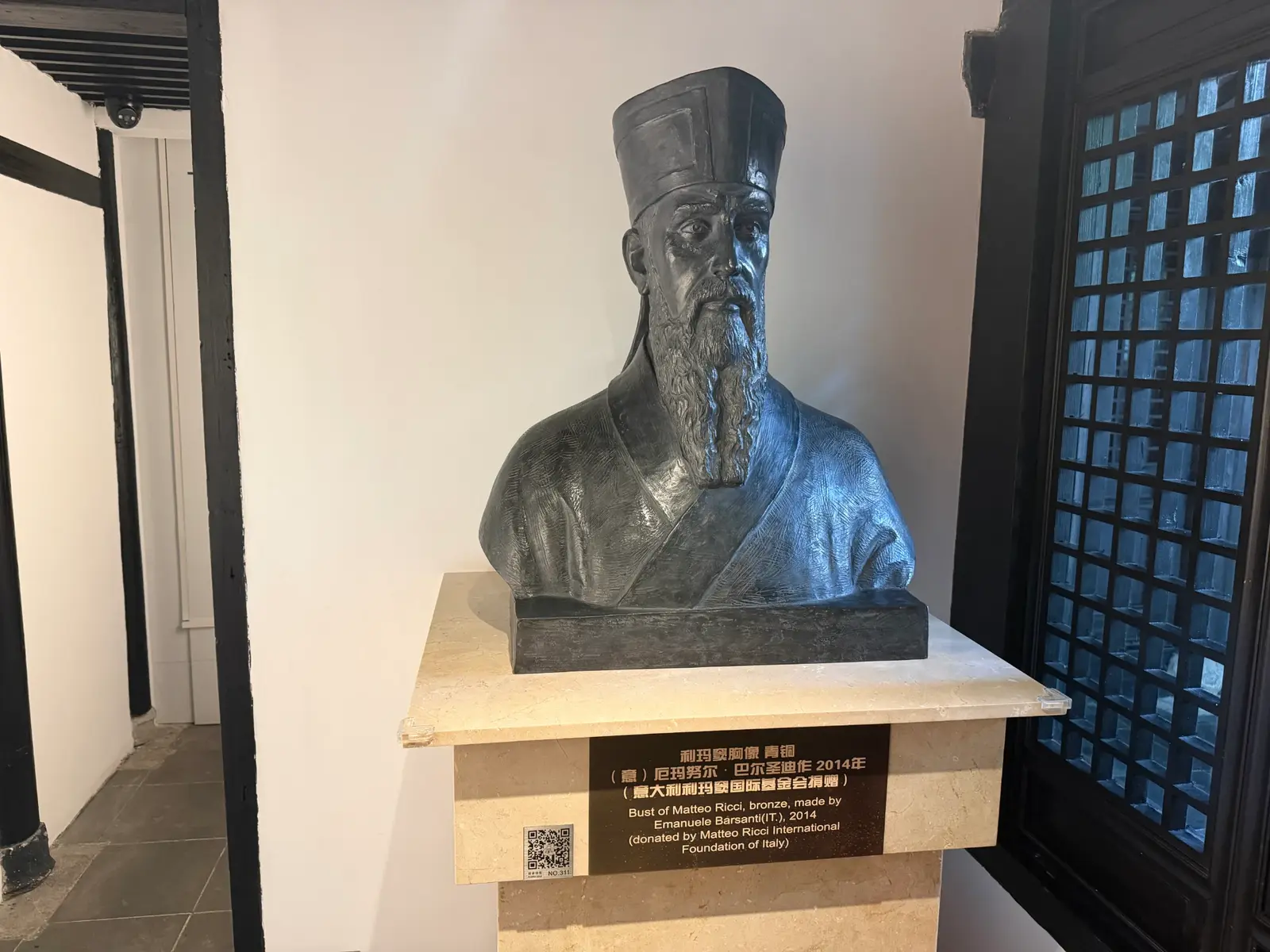
Bronze bust of Matteo Ricci by Emanuele Barsanti (2014), given to the Memorial Hall by the Matteo Ricci International Foundation of Italy.
Photo: the site owner, Shanghai Story MapUseful learning
Xu wanted learning he could put to use. When his father died in 1607 he took the coffin home to Shanghai for three years of mourning, and spent them on surveying and farming. He finished a translation on surveying, Celiang fayi (测量法义), and wrote short works of his own on the right-angled triangle, among them the Gougu yi (勾股义).
In 1608 there was no wheat harvest south of the Yangtze. Xu had heard of a root crop grown in Fujian, the sweet potato. He had seed sent to Shanghai three times, found that it grew as well as in Fujian, and wrote a short guide so that farmers could grow it too. A few years later, on sick leave near Tianjin, he tried growing southern paddy rice in the north.
His interest in water came from the same place. The Western Methods of Hydraulics (泰西水法, 1612) was written by the Jesuit Sabatino de Ursis with Xu taking it down. While they worked, Xu built and tried out the pumps and water-lifting devices described in it and recorded how each was made and how it performed. The book became the last six chapters of his Complete Treatise on Agriculture (农政全书), which his son presented to the throne after Xu’s death and which the emperor ordered printed in 60 juan.
Defending his teachers
In 1616 Shen Que, a vice-minister of rites in Nanjing, asked the throne to ban Catholicism; missionaries were arrested and expelled. With everyone around him keeping quiet, Xu sent up a memorial in their defence, the Bianxue zhangshu (辩学章疏). A copy of its stone rubbing hangs in the Memorial Hall.
He also wrote a preface for Ricci’s world map, the Kunyu wanguo quantu (坤舆万国全图). The map showed the earth as a sphere, ruled with lines of latitude and longitude, the equator and five climate zones.
The calendar and the stars
The Ming calendar was old and often got eclipses wrong. On 21 June 1629 there was a solar eclipse, and Xu’s prediction using Western methods came out right. The emperor put him in charge of reforming the calendar. He set up a calendar bureau with the scholar Li Zhizao and Jesuit astronomers, had craftsmen make instruments, and took readings himself: he once fell from the observation platform and hurt his back and knees. In about four years the bureau drafted 134 juan, of which Xu presented 74 to the throne. They became most of the Chongzhen Calendar (崇祯历书).
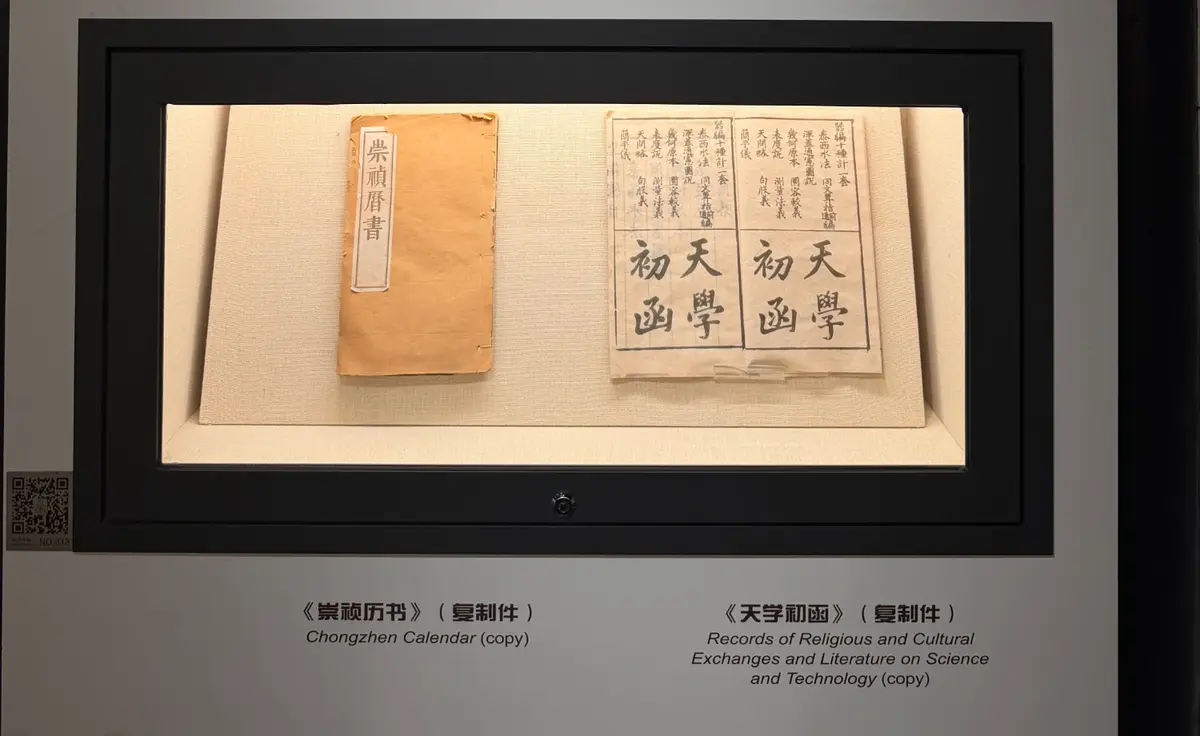
Copies of the Chongzhen Calendar (崇禎曆書, left) and the Tianxue chuhan collection of translated works (天學初函), in the Memorial Hall.
Photo: the site owner, Shanghai Story MapIn 1633, by then Minister of Rites and a Grand Secretary, Xu set out to make a great star atlas on eight screens. It shows the two halves of the sky, divided at the equator, and records 1,812 stars. It also covers the stars round the south celestial pole, which earlier Chinese charts had hardly shown; it drew them from Western material and gave them translated names. Xu died before it was finished. His successor at the bureau, Li Tianjing, completed it and presented it to the emperor.
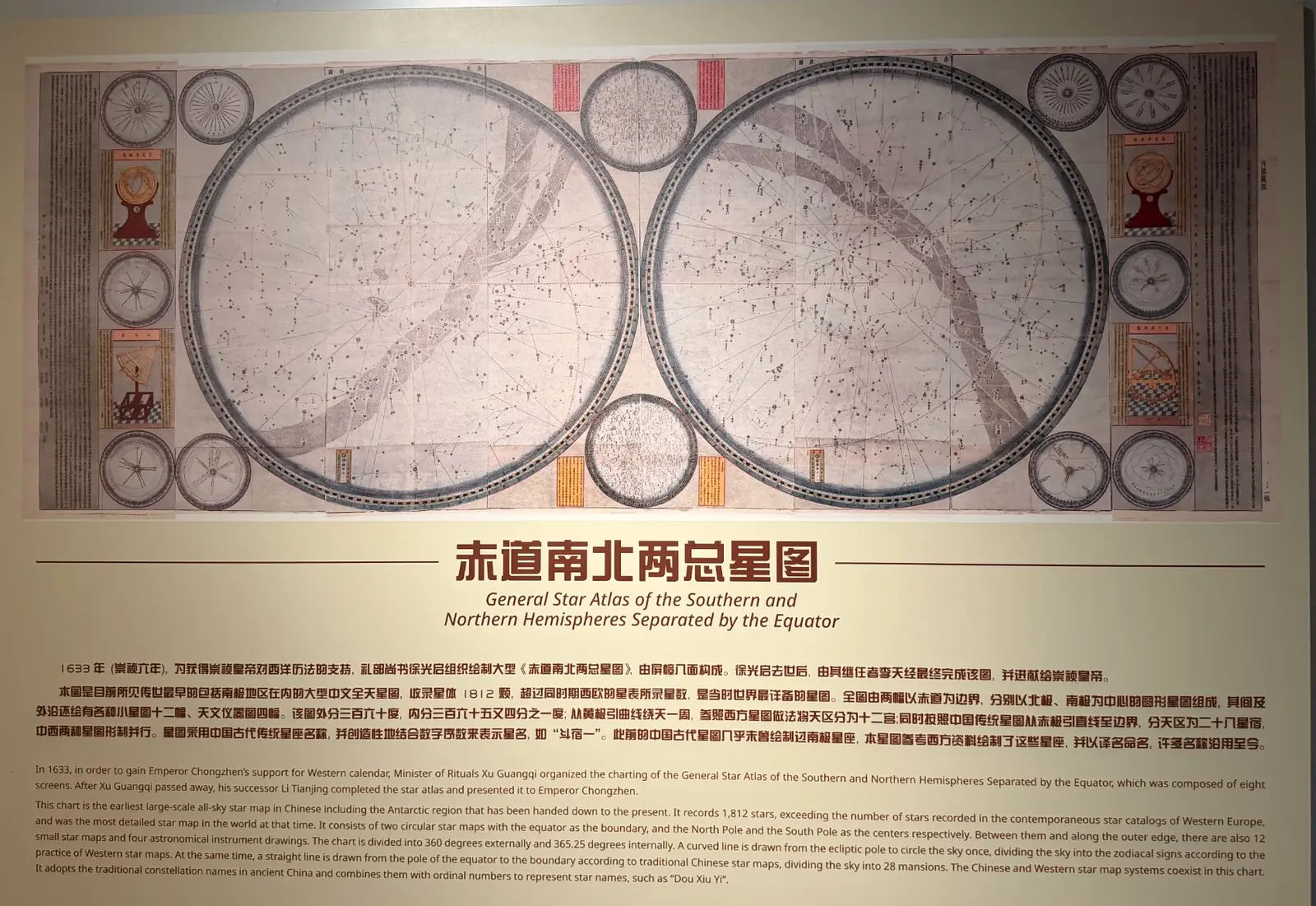
The star atlas of the two hemispheres that Xu began in 1633 and Li Tianjing finished, reproduced on a panel in the Memorial Hall.
Photo: the site owner, Shanghai Story MapWhen Xu died in Beijing that November, a censor reported that on the day his coffin was closed his purse held nothing to spare. The emperor gave him the posthumous name Wending.
The grave that named Xujiahui
Xu’s coffin was brought home to Shanghai and buried in 1641 on open ground west of the county town. His descendants built houses beside the tomb to guard it and stayed, and the settlement became Xujiahui. In 1847 French Jesuits made it the centre of their mission, and a church, a library and later an observatory followed. The series part The tomb that named Xujiahui tells that story.
On 24 November 1933, three hundred years after his death, a commemoration was held at the tomb. Photographs in the Memorial Hall show Bishop Auguste Haouisée leading the service at the grave mound, and a counsellor named Luo attending for the mayor of Shanghai.
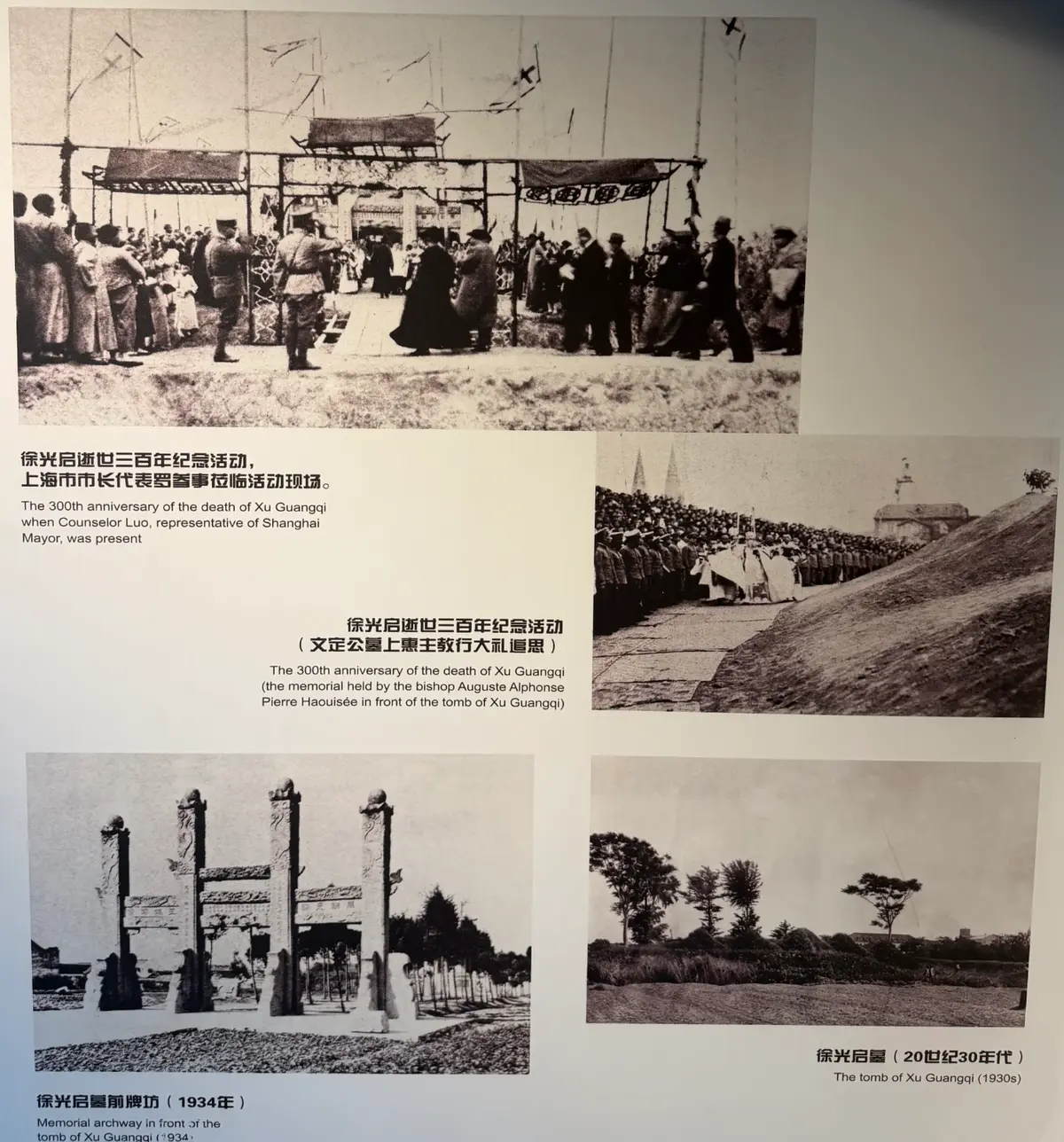
Photographs of the 300th anniversary of Xu's death in 1933 at his tomb in Xujiahui, with the 1934 stone archway and the grave in the 1930s; a panel in the Memorial Hall.
Photo: the site owner, Shanghai Story MapSeeing him in Shanghai today
The grave and the Memorial Hall are both in Guangqi Park, a short walk from Xujiahui metro station. The Memorial Hall occupies South Chunhua Hall (南春华堂), a Ming-dynasty house moved into the park in June 2003 to save it; the museum opened in 2005. Inside are painted portraits of Xu in his red official robes, copies of his books, a facsimile of Clavius’s Latin Euclid, and a bronze bust of Ricci given by an Italian foundation in 2014. Geometry terms in Latin are etched on the glass of the courtyard galleries.
In the Old City, part of the family house survives as Jiujian Lou on Qiaojia Road.
What Shanghai says, and what the record shows
Popular stories, told in our words, checked against the sources listed below.
- Not what the record shows
The story: Xu Guangqi brought the sweet potato to China.
The record: Sweet potatoes were already grown in Fujian. What Xu did in 1608 was have seed sent to Shanghai, prove it would grow there and write a short guide so farmers could copy him.1
Timeline
- 1562Born in Shanghai's walled town1
- 1597Placed first in the provincial examination after years of failure1
- 1603Baptised in Nanjing as Paul2
- 1604Passes the metropolitan examination2
- 1607Euclid's Elements, books 1–6, printed in Chinese1
- 1608Grows sweet potatoes in Shanghai1
- 1612Western Methods of Hydraulics, with Sabatino de Ursis3
- 1616Defends the missionaries in a memorial to the throne1
- 1629Put in charge of reforming the calendar1
- 1632Becomes a Grand Secretary2
- 1633Begins the great star atlas; dies in Beijing on 8 November1,3
- 1641Buried west of Shanghai, at what became Xujiahui1
- 1933Tercentenary commemoration at the tomb3
- 2005Memorial Hall opens in Guangqi Park3
Their Shanghai on the map
Tap a name in the text, or “map” in this list, to see where it is; names with their own page link to it.
- 01
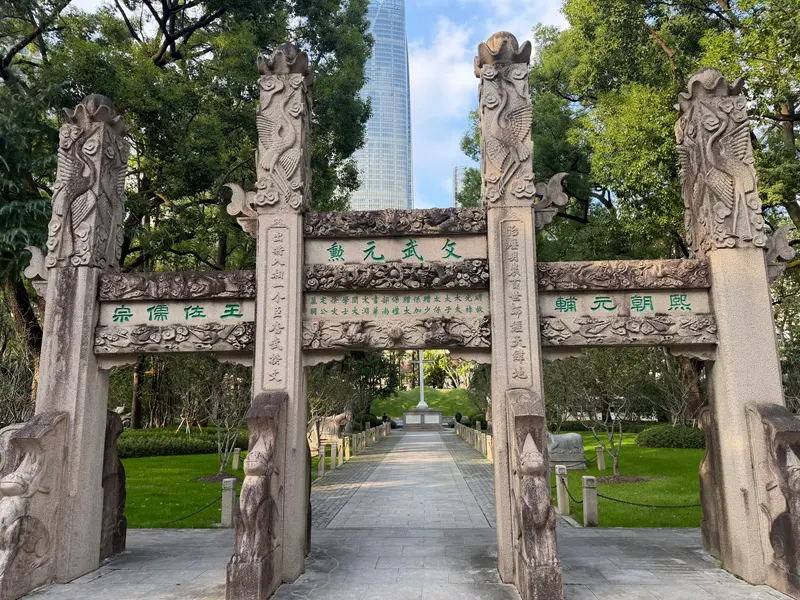 Guangqi Park光启公园sitemapXu's tomb, and the Memorial Hall in South Chunhua Hall.
- 02Jiujian Lou九间楼lived heremapWhat survives of the Xu family house in the Old City.
Places
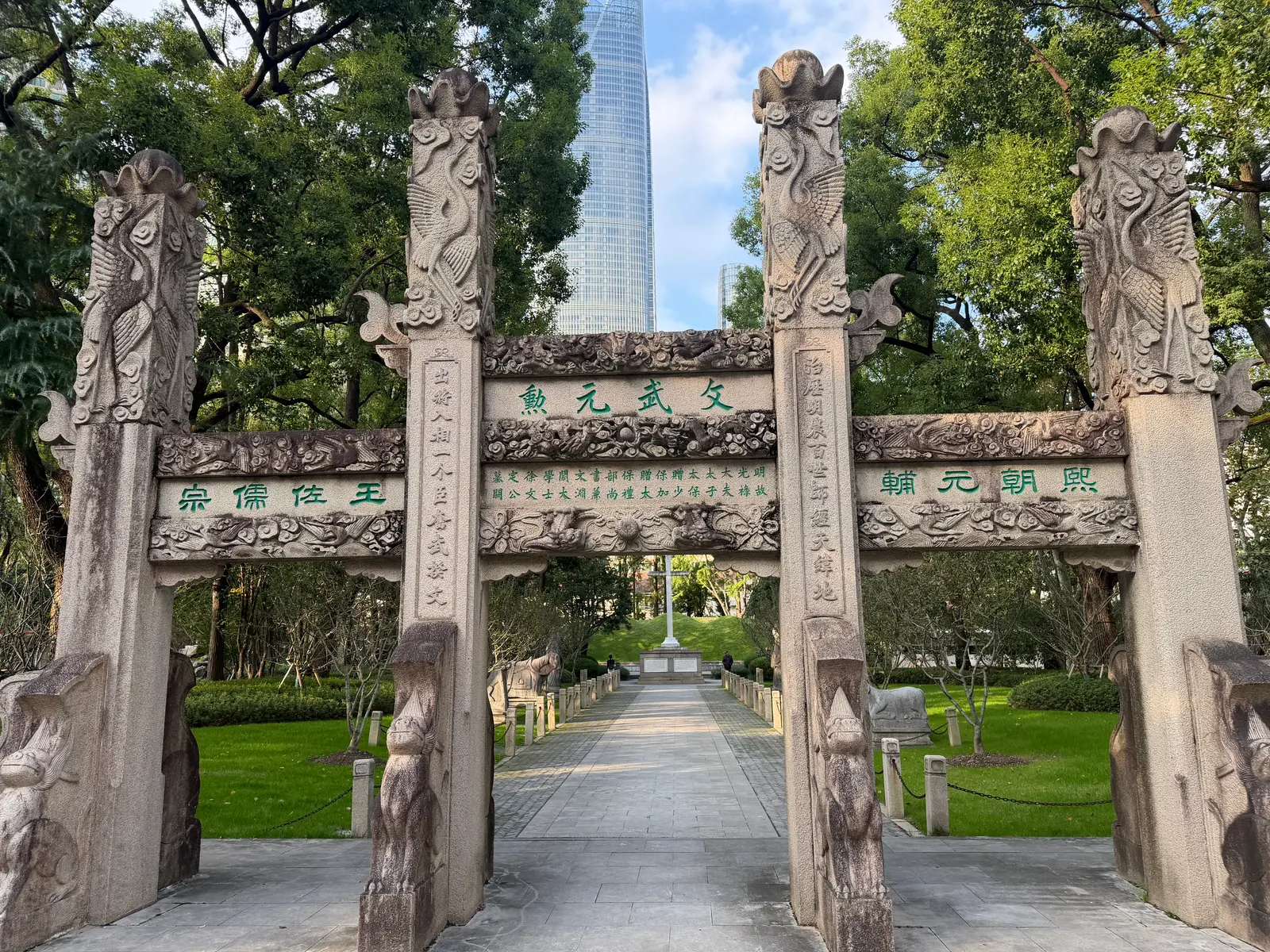
Park· 1641–1983
Guangqi Park
光启公园Guāngqǐ Gōngyuán
A small Xujiahui park around the tomb of Xu Guangqi, the Ming scholar who translated Euclid with Matteo Ricci and gave Xujiahui its name.
Building
Jiujian Lou (Xu Guangqi's former residence)
九间楼Jiǔjiān Lóu
What survives of Xu Guangqi's family house in the Old City: a two-storey Ming dwelling on Qiaojia Road, still lived in.
Stories
- TopicXu Guangqi's Shanghai: the scholar, the old town and the tomb that named Xujiahui
- The tomb that named Xujiahui: Xu Guangqi's grave, 1641–2026
- Xu Guangqi: the Shanghai scholar who put Euclid into Chinese, 1562–1633
- Xu Guangqi's Shanghai: sweet potatoes, a Jesuit guest and the old town's first church
Sources
- 1.Xuhui District Gazetteer (first series), biography of Xu Guangqi (徐汇区志 · 人物 · 徐光启(1562~1633)), 上海市徐汇区志编纂委员会, Shanghai Local Chronicles Office, 1997 — paras. 1 and 11; para. 2; para. 3; para. 4; para. 5; para. 6; paras. 9–10; final paragraphgazetteer
- 2.History of Ming, juan 251, biography of Xu Guangqi (明史 · 卷二百五十一 · 列传第一百三十九 · 徐光启), 张廷玉等, 维基文库, 1739 — 徐光啟, para. 1; para. 1; para. 5; 鄭以偉 paragraph; final paragraphbook
- 3.Permanent exhibition panels, Xu Guangqi Memorial Hall (South Chunhua Hall, Guangqi Park); photographed by the site owner (徐光启纪念馆(光启公园南春华堂)常设展览展板(站长拍摄)), 徐光启纪念馆, Shanghai Story Map, 2026 — 'Great Ambition' panel (1562.4.24—1633.11.8); Jiao Hong portrait panel (No. 302); Clavius portrait panel; Euclid translation-history panel; facsimile No. 307; 'Keeping Improving' panel; 'Global Vision' panel; 'Studying the Nature of Things' panel; 'Pragmatism' panel and book label; 'An Upright Official' panel; world map panel; star atlas panel; tercentenary photographs panel; 'Ex-situ Conservation of South Chunhua Hall' panel; bust plaque (No. 311)fieldwork
- 4.Elisa Giunipero, Xu Guangqi's rediscovery in the contemporary period (Xu Guangqi's rediscovery in the contemporary period), Elisa Giunipero, Bulletin of Portuguese–Japanese Studies (BPJS), II, 2, 2016 — p. 42article
- 5.Xuhui District: Xu Guangqi and Guangqi Park (海派之源,中西使者——徐光启和光启公园), 徐汇区绿化和市容管理局, 上海市徐汇区人民政府, 2021 — 1600 and 1603 sentences; Euclid sentence; memorial hall sentenceswebsite
- 6.Xu Guangqi, preface to the printed Euclid (1607) (刻《几何原本》序), 徐光启, 维基文库, 1607 — paras. 1–2book
- 7.Euclid's Elements in Chinese (Jihe yuanben), book 1, translated by Matteo Ricci with Xu Guangqi, 1607; Wikisource text (幾何原本·卷一(維基文庫本)), 利瑪竇、徐光啟(維基文庫本題「西洋利瑪竇譯」), 維基文庫, 1607 — 卷一之首; 第一界, 第二界; 第一題; note to 第一界; 第一題; 第四十七題; 第四十七題book
- 8.Clavius's Latin edition of Euclid's Elements, Rome 1589 (scan on the Internet Archive) (Euclidis Elementorum lib. XV, accessit XVI de solidorum regularium comparatione (Christophorus Clavius), Romae, apud Bartholomaeum Grassium, 1589), Christophorus Clavius, Bartholomaeus Grassius, Rome; digitised copy on the Internet Archive (ARes41505), 1589 — pp. 27–29, 35 (definitions 1–5 and commentary); pp. 75–76 (prop. 1); pp. 229, 239 (prop. 47 and scholium VIII)book
- 9.Clavius's Latin edition of Euclid's Elements, book 1 (1607 edition, Max Planck Institute for the History of Science transcription) (Euclidis Elementorum libri XV (Christophorus Clavius, ed.), transcription of the 1607 edition), Christophorus Clavius, Max Planck Institute for the History of Science, Berlin (ECHO / MPDL transcription), 1607 — Book 1, definitions 1–2 (1607 edition)book
- 10.Xu Guangqi, preface to the Treatise on the Sweet Potato (甘薯疏序), 徐光启, 维基文库(据《广群芳谱》卷十六), 1608 — full textbook
- 11.Annotated Catalogue of the Imperial Library, juan 102 (agriculture) (四库全书总目提要 · 卷一百二 · 子部十二 · 农家类), 纪昀等, 维基文库, 1782 — 泰西水法 and 農政全書 entriesbook
- 12.Xuhui District Gazetteer, chronicle of events (district archives site) (徐汇区志 · 大事记), 上海市徐汇区志编纂委员会, 徐汇区档案局(馆), 1997 — 1641 entriesgazetteer
- 13.Xuhui District Gazetteer (first series), protected sites, Xu Guangqi's tomb (徐汇区志 · 第一节 文物保护单位 · 一、徐光启墓), 上海市徐汇区志编纂委员会, Shanghai Local Chronicles Office, 1997 — 一、徐光启墓, para. 3gazetteer
- 14.Shanghai Religion Gazetteer, Catholicism, the Society of Jesus (上海宗教志 · 第四编天主教 · 第二章团体 · 第一节 耶稣会), 《上海宗教志》编纂委员会, Shanghai Local Chronicles Office, 2001 — 二、耶稣会士重返上海gazetteer
- 15.Shanghai Civil Affairs Bureau place-name series: Xuhui District (地名文化漫谈|徐汇区:因明末著名科学家徐光启得名), 上海市民政局, 上海市民政局网站, 2023 — Jesuits paragraphwebsite