Stories
Xu Guangqi's Shanghai: sweet potatoes, a Jesuit guest and the old town's first church
Xu Guangqi's family places in and around the walled town: the Nine-Bay House, his sweet-potato gardens, and the church his granddaughter helped buy.
Loading map…
In 1607 Xu Guangqi’s father died in Beijing. Xu, then a junior member of the Hanlin Academy who had just published Euclid in Chinese with Matteo Ricci, took the coffin home to Shanghai. Custom required three years of mourning, away from office. Xu spent them in and around the walled county town where he had been born, and he used them well. The first part of this series tells his life; this part stays in Shanghai.
The house on the Qiaojia Creek
The Xu family lived in Taiqing Fang, a quarter on the south bank of the Qiaojia Creek just inside the south gate. Part of their house still stands on today’s Qiaojia Road as Jiujian Lou, the “nine-room building”: it had nine rooms on each of its two floors.
What is left is small. By 1992 only two rooms up and two down remained, lived in by ordinary families, and centuries of repairs had changed most of it. Ming-style brackets under the eaves and an old well were the clues to its age. It was listed as a protected site in 1959, and in the 1990s it was recorded as the only Ming dwelling left in the old Nanshi district.
Gardens outside the walls
Xu did not stay indoors with the mourning rites. He finished his surveying translation and wrote two short works on geometry, but most of his time went into farming.
He made two bases for his trials. One was a garden in two halves, north and south, called the Shuangyuan (双园, “Double Garden”), at a place named Kangquli just outside the south gate, around today’s Sangyuan Street. In later life he lived there, on ground where as a young man he had planted willows and burned charcoal. The other was a farm with a thatched hall more than ten li west of the town, beside the Zhaojiabang creek. Remember that farm: when Xu was buried in 1641, it was on open ground beside it, and Xujiahui grew up around the grave.
His method was hands-on. He handled the plough himself and tasted plants to learn their nature. He was also arguing against a common belief: that a crop belonged to the soil and climate it came from and would not thrive if moved. Xu thought that if a plant was useful enough to feed people, it was worth the attempt.
The sweet potato
The test case was the sweet potato, a crop of Fujian on the southern coast.
Xu explained what happened in the preface to a short treatise he wrote on it. The year 1608 was a bad one: south of the Yangtze there was no wheat harvest. He wanted crops that could carry people through such years. He had heard how useful the sweet potato was in Fujian, and a Mr Xu, a guest in Putian, sent him seed, three times over. Xu planted it. It grew and multiplied, he wrote, hardly differently from in its own country, and he borrowed an old proverb that says an orange tree moved north of the Huai River turns into a bitter one, in order to say that this time it had not. He could not go round explaining it to every household, so he wrote the treatise instead.
The next year he did the same with turnips brought down from the north, and wrote a second booklet. Both went into the farming notes he was collecting, which became the Complete Treatise on Agriculture. In Guangqi Park a sculpture called “Trial planting at the mulberry garden” shows him at this work in 1608.
An Italian guest
Xu’s other experiment of those years was religious. He had been baptised in Nanjing in 1603, and Shanghai had never had a priest. In 1608 he invited one.
In the winter of 1608 Lazzaro Cattaneo, an Italian Jesuit whom Xu had first met in Guangdong in the 1590s, came down from Nanjing. He stayed two years. The first Shanghai Catholics were Xu’s own relatives and the tenants who worked his farm. This is the beginning of the Catholic Church in Shanghai, and it began, quite literally, at home.
When Cattaneo left for Hangzhou in about 1610, Shanghai again had no priest of its own. For a generation, Jesuits based in Nanjing, Hangzhou and Jiading came every year or two for short visits.
The church in the merchant’s hall
That changed with Francesco Brancati (潘国光, Pān Guóguāng), an Italian Jesuit who arrived from Macau in 1637. Xu had been dead four years. His granddaughter, known by her baptismal name Martina, helped Brancati buy a building.
The building was the Shichun Tang (世春堂), a hall belonging to the family of Pan Yunduan, the Ming official who had laid out Yu Garden. It stood in Anrenli, in the north of the town. Brancati rebuilt it as a church and named it Jingyi Tang (敬一堂), the Hall of Reverence for the One. It opened in 1640. From then on Shanghai had resident priests.
It did not look like a European church. It was a Chinese temple hall, 4.6 zhang high, with pillars of nanmu wood and carved, painted beams. Beside it Brancati put up a two-storey house for the priests and, in front of that, an observation platform two or three zhang high, reached by steps of purple stone and carved with the ecliptic, the equator and lines of latitude and longitude. The platform was gone by the eighteenth century.
Shanghai people called it the Old Catholic Church (老天主堂). It was the earliest and the largest Catholic church in Shanghai. When the Qing banned Christianity, the building was confiscated in 1730. It was returned to the Church in 1861 and after 1949 became a primary school. In the 1990s its main hall was still standing at 137 Wutong Road. It is no longer a church.
Brancati’s own end ties him to the town as well. When the missionaries were expelled to Guangzhou in the 1660s, he died there, and two Jesuits, Philippe Couplet and Giandomenico Gabiani, brought his coffin back and buried him outside Shanghai’s south gate.
Candida Xu
Martina was not the only granddaughter who mattered. Another granddaughter, Candida Xu (许甘第大), gave money for churches in the region. With it Brancati built a church and a priests’ house at Qiujiawan in Songjiang in the mid-seventeenth century; a later church stands on the site. Couplet, the priest who had carried Brancati’s coffin, wrote her life, first published in French in 1688.
The Xu shrine
The family kept its own memory of Xu, too. A shrine to him was built in the old town in the Chongzhen reign, the last years of the Ming. In 1878 it became the Xu clan hall, with a statue of him inside, at what is now Lane 232, Fumin Road. The statue and the ancestral tablets were destroyed in the Cultural Revolution. The building was listed by the district in 1962.
Walking it today
Start at Jiujian Lou on Qiaojia Road and look at it from the street: it is housing. From there walk north through the old town to Wutong Road, where the former Jingyi Tang stands; it is not open as a church. South of the old town, Sangyuan Street marks the area where Xu had his Double Garden and, later, his home.
To see his grave, take Metro Line 9 from Xiaonanmen west to Xujiahui. That is the subject of the last part, The tomb that named Xujiahui.
Places mentioned
Tap a name in the text, or “map” in this list, to see where it is; names with their own page link to it.
- 01Jiujian Lou, the Xu family house九间楼map234–244 Qiaojia Road.
- 02Kangquli, outside the Great South Gate (today's Sangyuan Street)桑园街(康衢里)Where Xu made his Shuangyuan garden and lived in later life; the street is used here as an approximate position.approximate position
- 03Jingyi Tang, the old Catholic church敬一堂(老天主堂)137 Wutong Road; the pin is on Wutong Road near Danfeng Road, approximate position.approximate position
- 04Xu's farm west of the town (now Xujiahui)徐光启农庄(今徐家汇)mapHis farm stood beside the Zhaojiabang, more than ten li west of the town; he was later buried on open ground north of it, now Guangqi Park.
- 05Qiujiawan church, Songjiang邱家湾天主堂mapA church first built with money from Xu's granddaughter Candida Xu.
Places in this story
Building
Jiujian Lou (Xu Guangqi's former residence)
九间楼Jiǔjiān Lóu
What survives of Xu Guangqi's family house in the Old City: a two-storey Ming dwelling on Qiaojia Road, still lived in.
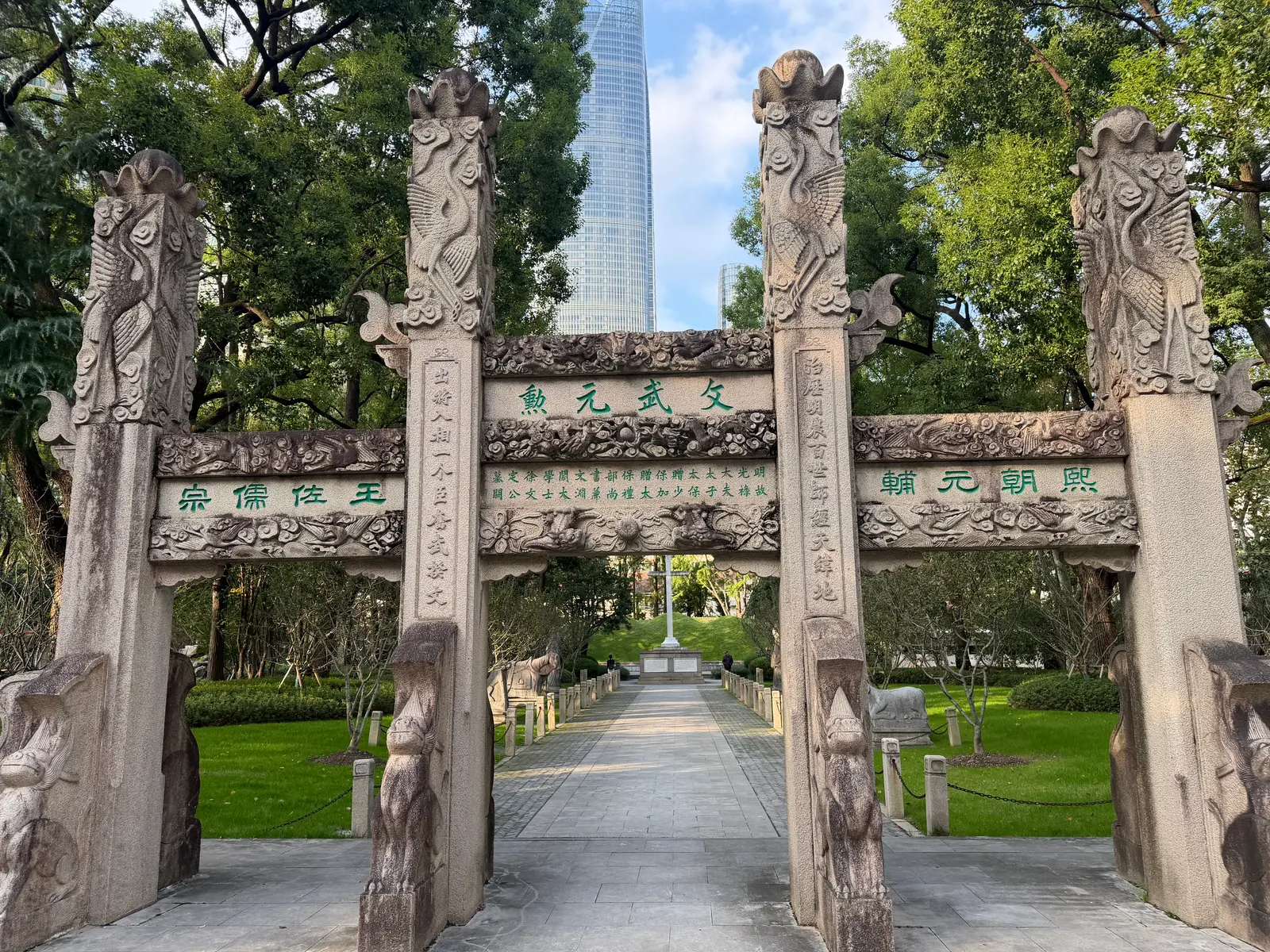
Park· 1641–1983
Guangqi Park
光启公园Guāngqǐ Gōngyuán
A small Xujiahui park around the tomb of Xu Guangqi, the Ming scholar who translated Euclid with Matteo Ricci and gave Xujiahui its name.
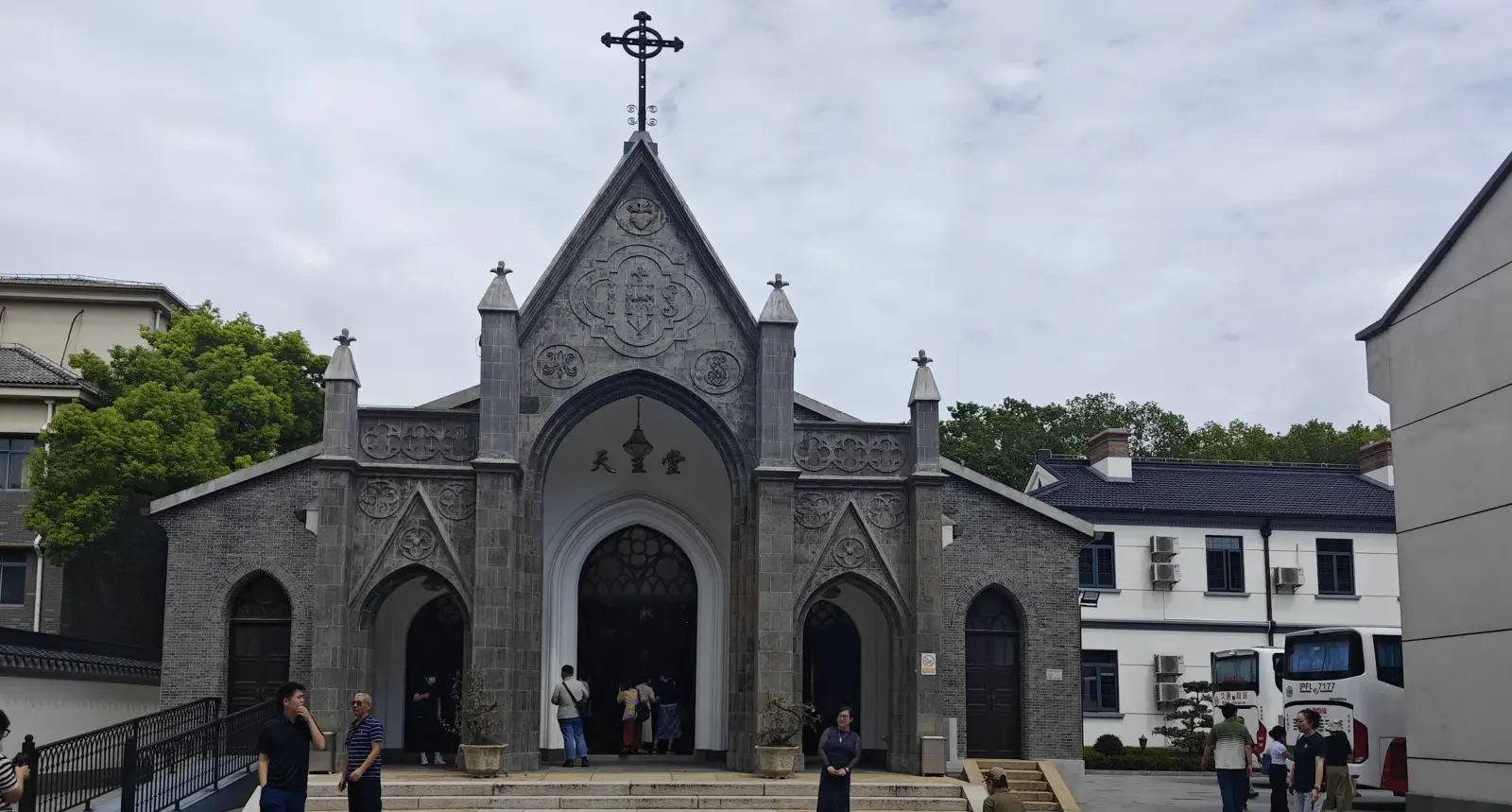
Catholic church· 1871–1874
Sacred Heart Church, Qiujiawan
邱家湾耶稣圣心堂qiū jiā wān yē sū shèng xīn táng
Songjiang's old Catholic centre: a Gothic-and-Chinese cross-plan church rebuilt in 1871-74 to a design by Brother Léon Mariot.
People in this story
- Xu Guangqi徐光启
Sources
- 1.Xuhui District Gazetteer (first series), biography of Xu Guangqi (徐汇区志 · 人物 · 徐光启(1562~1633)), 上海市徐汇区志编纂委员会, Shanghai Local Chronicles Office, 1997 — para. 1; para. 4gazetteer
- 2.Nanshi District Gazetteer, historic sites (Jiujian Lou, Jingyi Tang, Xu clan hall) (南市区志 · 第一节 文物古迹), 上海市南市区志编纂委员会, Shanghai Local Chronicles Office, 1997 — 五、九间楼; 五、九间楼 and site table; 六、敬一堂; site table, 敬一堂 row; site table, 徐光启祠堂 rowgazetteer
- 3.Xuhui District Gazetteer, chronicle of events (district archives site) (徐汇区志 · 大事记), 上海市徐汇区志编纂委员会, 徐汇区档案局(馆), 1997 — 1607 entrygazetteer
- 4.Nanshi District Gazetteer, biography of Xu Guangqi (南市区志 · 人物 · 徐光启(1562~1633)), 上海市南市区志编纂委员会, Shanghai Local Chronicles Office, 1997 — para. 1gazetteer
- 5.Xu Guangqi, preface to the Treatise on the Sweet Potato (甘薯疏序), 徐光启, 维基文库(据《广群芳谱》卷十六), 1608 — full textbook
- 6.Shanghai Religion Gazetteer, Catholicism, the Society of Jesus (上海宗教志 · 第四编天主教 · 第二章团体 · 第一节 耶稣会), 《上海宗教志》编纂委员会, Shanghai Local Chronicles Office, 2001 — 一、明末清初在上海的耶稣会士gazetteer
- 7.Xuhui District Gazetteer, religion and nationalities, overview (district archives site) (徐汇区志 · 第二十四篇 宗教·民族 · 概述), 上海市徐汇区志编纂委员会, 徐汇区档案局(馆), 1997 — para. 1gazetteer
- 8.Nanshi District Gazetteer, religious sites (南市区志 · 第二节 宗教场所), Shanghai Local Chronicles Office — 敬一堂gazetteer
- 9.Shanghai Religion Gazetteer, Catholicism, Open Churches (with table of other open churches) (上海宗教志 · 第四编天主教 · 第一节 开放教堂(附:其他开放教堂一览表)), Shanghai Local Chronicles Office — 二、邱家湾耶稣圣心堂gazetteer
- 10.Guangqi Park reopens after renovation (Xuhui District official account) (光启公园焕新开放(上海徐汇官方账号)), 徐汇绿化市容;姚丽敏, 上海徐汇(网易号转载), 2026 — route sectionarticle
- 11.The Paper: the Xu Guangqi stories kept in Guangqi Park (文史|关于徐光启的故事,全都藏在这座公园内), 澎湃新闻, 2021 — sculptures paragrapharticle
- 12.Xuhui District: Xu Guangqi and Guangqi Park (海派之源,中西使者——徐光启和光启公园), 徐汇区绿化和市容管理局, 上海市徐汇区人民政府, 2021 — 1600, 1603 and Euclid sentenceswebsite
- 13.Elisa Giunipero, Xu Guangqi's rediscovery in the contemporary period (Xu Guangqi's rediscovery in the contemporary period), Elisa Giunipero, Bulletin of Portuguese–Japanese Studies (BPJS), II, 2, 2016 — p. 42article
- 14.Chinese Wikipedia (article given in each fact's locator) (中文维基百科), Wikimedia Foundation — https://zh.wikipedia.org/wiki/豫园wikipedia
- 15.Nadine Amsler, Jesuits and Matriarchs (open access), chapter on Candida Xu (Jesuits and Matriarchs: Domestic Worship in Early Modern China), Nadine Amsler, University of Washington Press, 2018 — Introductionbook