Stories
Xu Guangqi: the Shanghai scholar who put Euclid into Chinese, 1562–1633
How a Shanghai boy who kept failing his exams became a Catholic, translated Euclid with Matteo Ricci, reformed the calendar and died a Grand Secretary.
Loading map…
In 1607 a book called Jihe yuanben (几何原本) went to print. It was the first six books of Euclid’s Elements, the plane geometry of points, lines and circles, in Chinese. It was the work of two men: the Italian Jesuit Matteo Ricci and a Chinese official, Xu Guangqi (徐光启, Xú Guāngqǐ). Xu was from Shanghai, then a county town. This part of the series follows his life; the other two follow the places he left in the city.
A boy from the walled town
Xu was born on 24 April 1562 in Shanghai’s walled town, in a quarter called Taiqing Fang on the south bank of the Qiaojia Creek, just inside the south gate. Part of the family house survives as Jiujian Lou on today’s Qiaojia Road.
The Xus were not grand. His great-grandfather farmed. His grandfather left the fields for trade and did fairly well, but his father, Xu Sicheng, lost the family’s money to robbers and lived by farming and weaving. The way up for a boy like Xu was the civil examinations, and he started early, at a school in Longhua Temple from the age of eight.
He passed the first, county-level examination at about twenty, and then the long wait began. To pass the provincial examination was to become a juren, eligible for office. Xu failed it in 1582, in 1588, in 1592, and earned his living meanwhile by teaching other people’s sons. In the 1590s the teaching took him far south, to Shaozhou in Guangdong, and there he met his first European: the Italian Jesuit Lazzaro Cattaneo, a colleague of Ricci’s. Nobody could have guessed then that the two would meet again in Shanghai.
The break came in 1597, when he sat the examination in the capital prefecture. The chief examiner, the scholar Jiao Hong, picked his paper out of the rejected pile and ranked it first. Xu was thirty-five.
Ricci, and the name Paul
Ricci had come into China in 1583 with a fellow Jesuit, Michele Ruggieri. Xu met him in Nanjing in 1600. Three years later he went back to Nanjing to see him again, found that Ricci had moved on, and instead met another Jesuit, the Portuguese João da Rocha. After a short course of instruction da Rocha baptised him, with the Christian name Paul (保禄, Bǎolù).
In 1604 Xu passed the highest examination, the jinshi, and was chosen for the Hanlin Academy, the training ground for the empire’s top officials. From Ricci he learned astronomy, the calculation of the calendar and the making of firearms. Shanghai tells it more warmly: in his three years at the Hanlin he walked to Ricci’s house every day, rain or shine.
Why Euclid came first
The two men could have started with any Western book. Xu’s preface to the printed translation explains why they chose geometry. Ricci’s learning, he wrote, had three parts. The greatest was cultivating the self and serving Heaven. Below that came the investigation of things, and one branch of that was mathematics. Xu had asked Ricci to put his mathematical books into Chinese. Ricci replied that until Euclid was translated, none of the others could even be discussed. So they worked through “the essentials”, six books on plane geometry, and printed them in 1607.
Xu kept on translating with the Jesuits. A text on surveying followed, and in 1612 The Western Methods of Hydraulics (泰西水法), the Jesuit Sabatino de Ursis’s book on devices for raising and storing water. Years later Xu put the hydraulics book into the last six chapters of his great treatise on farming.
Fields, famine and Tianjin
In 1607 Xu’s father died in Beijing. Custom required three years of mourning at home, so Xu took the coffin back to Shanghai. He finished the surveying translation there and wrote two short works on geometry, but mostly he farmed: he planted crops in gardens around the town, tried out new ones and wrote about the results. That story, including the sweet potatoes he brought in from Fujian, and the Jesuit he invited to stay, belongs to the next part, Xu Guangqi’s Shanghai.
His career did not run smoothly. Late in 1613, out of favour with colleagues at court, he took sick leave and went to the Tianjin area. There he reclaimed waste land, grew grain, herbs and flowers, and tried southern paddy rice in the north. He wrote down what he learned as he went. In 1616, back at court, he spoke up for the foreign missionaries when officials petitioned against them.
A scholar training soldiers
In 1619 a Ming army sent in four columns against the rising Manchu state was destroyed. Beijing panicked. Xu petitioned again and again to be allowed to train troops, and the emperor gave him the job, with a promotion, at Tongzhou east of the capital. He drew up ten proposals for reforming the army.
The work went badly. Pay and weapons were hard to come by, and Xu paid for the soldiers’ food out of his own salary. He quarrelled with the Minister of War, was impeached and went home to Shanghai. When the city of Liaoyang fell to the Manchus in 1621 he was called back, and his advice drew on what he had learned from the Jesuits: cast as many Western cannon as possible for the defence of the walled cities. One of the four sculptures in Guangqi Park shows him overseeing the casting.
Xu was given office again in 1623, as a vice-minister of rites, and dismissed in 1625 after an ally of the powerful eunuch Wei Zhongxian impeached him.
The calendar
In 1628, the first year of the Chongzhen emperor, Xu was recalled. Within a couple of years he was Minister of Rites.
The official Ming calendar had then been in use for more than 260 years, and its predictions of eclipses were often off. On 21 June 1629 there was a solar eclipse, and Xu’s prediction, worked out by Western methods, proved right. He was put in charge of reforming the calendar.
He set up a calendar bureau at the Shoushan Academy inside Xuanwu Gate and brought in the scholar Li Zhizao and the Jesuits Niccolò Longobardo, Johann Schreck, Giacomo Rho and Johann Adam Schall von Bell. Craftsmen built new instruments. Xu, in his late sixties, took readings himself and once fell from the observation platform, hurting his back and knees. In about four years the bureau drafted 134 juan (chapter-books), and Xu presented 74 of them to the throne in three batches. They make up most of what became the Chongzhen Calendar.
Grand Secretary
In the fifth month of 1632 Xu was made a Grand Secretary, a member of the small inner cabinet that drafted the emperor’s decisions, and soon after was promoted again. It was the summit of a Ming official career, and it came too late. He was seventy, and the court was dominated by two other grand secretaries, Zhou Yanru and Wen Tiren. He had the talent and the wish to govern, but by the time he held power he was old and could get little done.
He kept working on the calendar and on his farming book. He died on 8 November 1633 at his lodgings in Bozi Hutong in Beijing. His last instructions were practical: he told his second grandson, Xu Erjue, to hurry the fair copy of the farming treatise for the emperor, and recommended Li Tianjing to take over the calendar bureau.
What he did not leave was money. A censor told the emperor that on the day the coffin was closed, Xu’s purse held nothing to spare, and asked for generous honours as a rebuke to greedy officials. The emperor agreed, and gave Xu the posthumous name Wending (文定), “cultured and steadfast”.
The books he left
Some time later the emperor remembered Xu’s learning and asked the family for his writings. His son Xu Ji presented the Complete Treatise on Agriculture (农政全书, Nongzheng quanshu) in 60 juan, and the emperor ordered it printed. The scholar Chen Zilong had obtained the manuscript from the grandson Xu Erjue and published it with Zhang Guowei and Fang Yuegong. It gathers what earlier farming books said, adds what Xu had found out for himself, and ends with the Jesuit hydraulics.
The rest of his work shows how widely he ranged: the Euclid, the surveying text, the calendar, the farming book and a collection of his memorials on war.
Home to Shanghai
The emperor sent an official to escort Xu’s coffin home. In Shanghai it was laid in one of his own gardens outside the city’s south gate, and in 1641 it was buried on open ground next to his farm, some way west of the town, in what is now Guangqi Park. His descendants built houses to guard the grave and stayed, and the place took their name: Xujiahui. The last part of the series, The tomb that named Xujiahui, follows the grave from the Ming to the 2026 renovation.
At the tomb today, look for the corridor of inscribed stones beside the mound. Among them is his preface to the Euclid, cut from his own handwriting.
Places mentioned
Tap a name in the text, or “map” in this list, to see where it is; names with their own page link to it.
- 01Jiujian Lou, the Xu family house九间楼map234–244 Qiaojia Road, in the old walled town. Xu was born in the town in 1562.
- 02Longhua Temple龙华寺mapWhere Xu went to school as a boy.
- 03Guangqi Park (Xu Guangqi's tomb)光启公园map17 Nandan Road, Xujiahui. Xu was buried here in 1641.
Places in this story
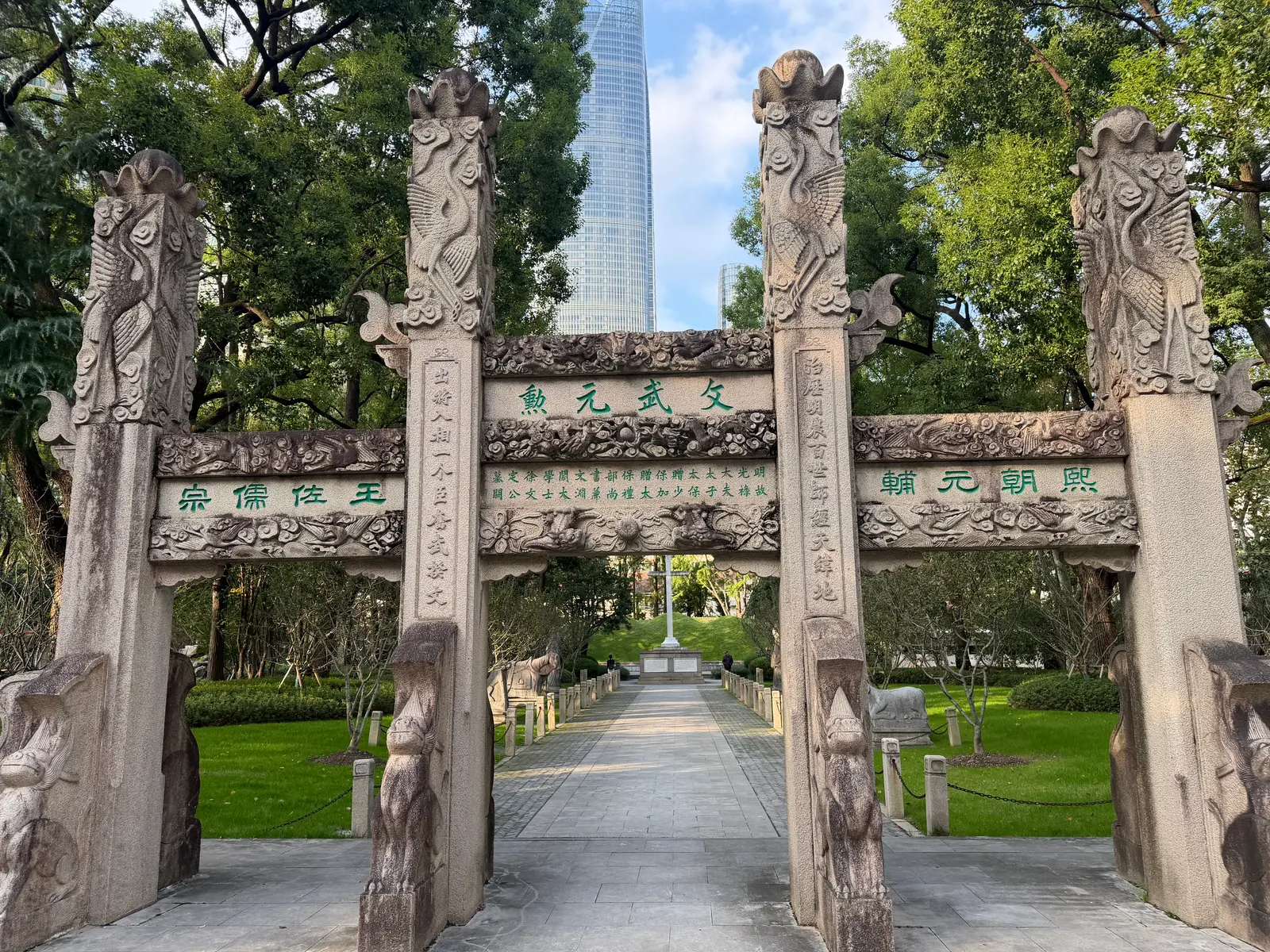
Park· 1641–1983
Guangqi Park
光启公园Guāngqǐ Gōngyuán
A small Xujiahui park around the tomb of Xu Guangqi, the Ming scholar who translated Euclid with Matteo Ricci and gave Xujiahui its name.
Building
Jiujian Lou (Xu Guangqi's former residence)
九间楼Jiǔjiān Lóu
What survives of Xu Guangqi's family house in the Old City: a two-storey Ming dwelling on Qiaojia Road, still lived in.
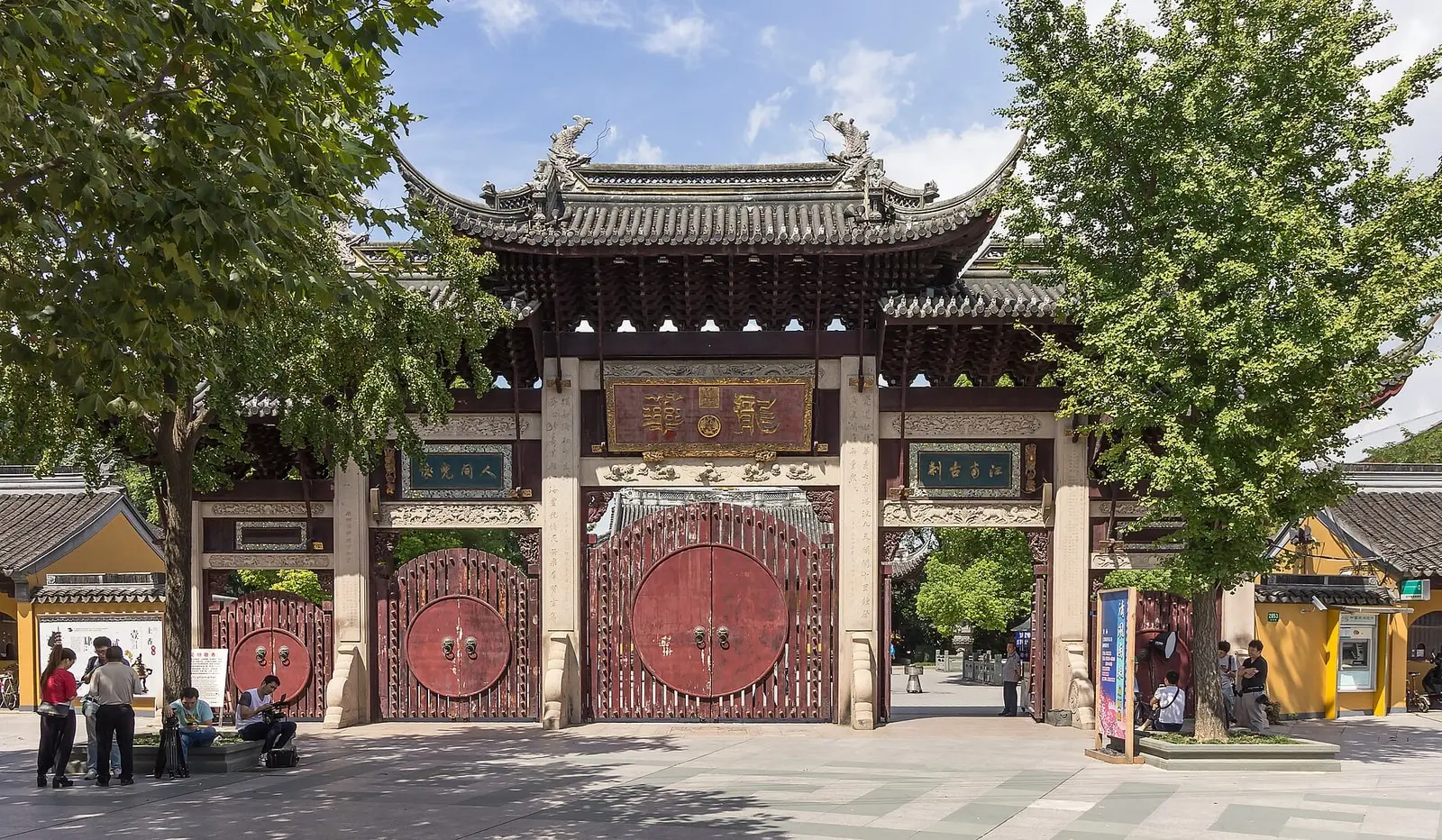

Temple· c. 977
Longhua Temple and Pagoda
龙华寺 / 龙华塔Lónghuá Sì / Lónghuá Tǎ
Shanghai's largest ancient temple complex, laid out as a Song-style Chan monastery beside a seven-storey brick-and-wood pagoda dated to 977.
People in this story
- Xu Guangqi徐光启
Sources
- 1.Xuhui District Gazetteer (first series), biography of Xu Guangqi (徐汇区志 · 人物 · 徐光启(1562~1633)), 上海市徐汇区志编纂委员会, Shanghai Local Chronicles Office, 1997 — para. 1; para. 2; para. 3; para. 4; para. 5; para. 6; para. 7; para. 9; para. 10; para. 11; final paragraph; paras. 7 and 10gazetteer
- 2.History of Ming, juan 251, biography of Xu Guangqi (明史 · 卷二百五十一 · 列传第一百三十九 · 徐光启), 张廷玉等, 维基文库, 1739 — 徐光啟, para. 1; para. 1 (萬歷二十五年舉鄉試第一); para. 1 (又七年成進士。由庶吉士歷贊善); para. 1 (從西洋人利瑪竇學天文、歷算、火器,盡其術); para. 2; para. 3; para. 4; 鄭以偉 paragraph; para. 5; final paragraphbook
- 3.Elisa Giunipero, Xu Guangqi's rediscovery in the contemporary period (Xu Guangqi's rediscovery in the contemporary period), Elisa Giunipero, Bulletin of Portuguese–Japanese Studies (BPJS), II, 2, 2016 — p. 42; p. 42 (1595); p. 43 (1630)article
- 4.Xuhui District: Xu Guangqi and Guangqi Park (海派之源,中西使者——徐光启和光启公园), 徐汇区绿化和市容管理局, 上海市徐汇区人民政府, 2021 — exams sentence; '32岁远行广东韶州'; 1600 and 1603 sentences; Euclid sentence; works sentence; burial and name sentencewebsite
- 5.Nanshi District Gazetteer, biography of Xu Guangqi (南市区志 · 人物 · 徐光启(1562~1633)), 上海市南市区志编纂委员会, Shanghai Local Chronicles Office, 1997 — para. 1 (1596, Shaoguan)gazetteer
- 6.Shanghai Civil Affairs Bureau place-name series: Xuhui District (地名文化漫谈|徐汇区:因明末著名科学家徐光启得名), 上海市民政局, 上海市民政局网站, 2023 — 徐汇区 paragraphwebsite
- 7.Xu Guangqi, preface to the printed Euclid (1607) (刻《几何原本》序), 徐光启, 维基文库, 1607 — paras. 1–2book
- 8.Annotated Catalogue of the Imperial Library, juan 102 (agriculture) (四库全书总目提要 · 卷一百二 · 子部十二 · 农家类), 纪昀等, 维基文库, 1782 — 泰西水法 and 農政全書 entries; 別本農政全書 entrybook
- 9.Shanghai Religion Gazetteer, Catholicism, the Society of Jesus (上海宗教志 · 第四编天主教 · 第二章团体 · 第一节 耶稣会), 《上海宗教志》编纂委员会, Shanghai Local Chronicles Office, 2001 — 一、明末清初在上海的耶稣会士gazetteer
- 10.The Paper: the Xu Guangqi stories kept in Guangqi Park (文史|关于徐光启的故事,全都藏在这座公园内), 澎湃新闻, 2021 — sculptures paragrapharticle
- 11.Guangqi Park reopens after renovation (Xuhui District official account) (光启公园焕新开放(上海徐汇官方账号)), 徐汇绿化市容;姚丽敏, 上海徐汇(网易号转载), 2026 — route sectionarticle
- 12.Xuhui District Gazetteer, chronicle of events (district archives site) (徐汇区志 · 大事记), 上海市徐汇区志编纂委员会, 徐汇区档案局(馆), 1997 — 1641 entriesgazetteer