Stories
The Designated Area: Jewish refugees in Hongkou and the 'Shanghai Ghetto', 1938–1949
How some 18,000 Central European Jews reached Shanghai, how the city tried to stop them, and what life was like in Hongkou's Designated Area.
Loading map…
From the end of 1938 to the end of 1941, Shanghai took in some 18,000 Jewish refugees from Germany, Austria, Czechoslovakia and Poland. They came because Shanghai was then the only city in the world that asked for neither an entry visa nor a financial guarantee. Most settled in the bomb-damaged district of Hongkou (虹口, Hóngkǒu), around Tilanqiao (提篮桥, Tílánqiáo), north of Suzhou Creek. On 18 February 1943 the Japanese authorities ordered every “stateless refugee” who had arrived since 1937 to live and work inside a small part of that district. It was the Designated Area for Stateless Refugees, which English-speakers have called the Shanghai Ghetto ever since.
Two older Jewish communities helped the newcomers: the Baghdadi merchant families and the Russian Jews. Their stories are in From Baghdad to the Bund and From Harbin to Hongkou. The Central European refugees’ experience was different, shaped by closing escape routes, relief work and, from 1943, compulsory residence in Hongkou.
Why Shanghai?
Few destinations remained open to Jews trying to leave Nazi-controlled Europe. When Germany annexed Austria in March 1938, the 185,000 Jews there were driven to emigrate at once. To leave, they had to show the Nazi authorities an entry visa or a boat ticket for somewhere else. At the Évian Conference in July 1938, thirty-two countries met to discuss refugees, and all but the Dominican Republic refused to take more.
Shanghai’s divided administration left gaps in immigration control. Power in the city was split between the Chinese, the Japanese, the British and the French, and after 1937 there was no passport control and no visa requirement anyone could enforce. Small numbers had come since Hitler took power: about a hundred people, in 12 German Jewish families, by 1933, and several hundred by March 1938.
The violence of Kristallnacht, on 9–10 November 1938, made leaving far more urgent. Thousands of Jews were sent to concentration camps, and they were released only if relatives could produce visas or tickets to go elsewhere. Charles Klotzer’s father was arrested in June 1938 and sent to Buchenwald. He was released when his wife got tickets to Shanghai, and the three of them sailed in March 1939. Michael Blumenthal’s father was arrested during Kristallnacht itself, and the Blumenthals sailed on the Japanese liner Haruna Maru in April 1939. A week after Kristallnacht, Horace Kadoorie told a friend in London that 562 more refugees were arriving on Saturday’s steamer and another 700 two weeks later, and that Shanghai could not cope.
The consul in Vienna
One of the papers that got people out was a Chinese visa. Ho Feng-Shan (何凤山, Hé Fèngshān), the Chinese Consul-General in Vienna, issued Shanghai visas to everyone who asked, including people who never meant to go to Shanghai but needed a visa to leave. His superior, Ambassador Chen Jie (陈介) in Berlin, wanted closer ties with Germany and had forbidden visas on that scale. Ho went on anyway. A demerit entered in his file in 1939 is believed to be connected.
Two of his visa holders show how it worked. Eric Goldstaub got Chinese visas in July 1938 for his whole family, about twenty people, after months of being turned away at other consulates. Eric Reisman, a boy of twelve whose mother had been made to scrub the pavement after the Anschluss, got a Chinese visa for his family. They sailed on the Conte Biancamano in November 1938.
The visas helped their holders leave Europe, though Shanghai itself did not require one. Many holders did reach Shanghai, by ship from Italy or overland through the Soviet Union. Others used Ho’s visas to go to Palestine, the Philippines, Cuba or elsewhere. By late October 1938 his visa numbers had passed 1,900, and the true total is not known. He was recalled in May 1940 and accused of selling visas, a charge that was never proved. Ho retired in 1973 and died in 1997 aged 96. Only then did survivors’ evidence reach Yad Vashem, which recognised him as Righteous Among the Nations.
How they came
Most refugees came by sea, on German, Italian and Japanese ships. The Reismans went by train through Switzerland to Italy, then by ship from Naples through the Suez Canal, a month’s voyage. The same names recur in the memories of those who made the trip: the Lloyd Triestino liners Conte Biancamano and Conte Verde, and the Japanese Haruna Maru. After Italy entered the war in 1940 the sea route closed, and ships could sail only from Vichy French ports. People then came overland. Ralph Hirsch’s family left Berlin in October 1940 by train to Moscow and crossed Siberia on the Trans-Siberian Railway. Doris Grey left Berlin on 5 May 1940 for Genoa and caught one of the last Italian sailings, on the Conte Verde.
The last large group came from Japan. About 900 Polish Jews had escaped through Lithuania, Siberia and Vladivostok to Kobe. Among them was the Mir Yeshiva, a rabbinical college of 250 teachers and students from the small town of Mir. Japan would not let them stay, and the United States would not take them. In the autumn of 1941 they were sent on to Shanghai.
The largest arrivals came in the months after Kristallnacht. The German steamer Usaramo landed 459 refugees on a single day, 29 June 1939.
How did the city try to stop them?
Shanghai’s Jewish community took the refugees in, but the authorities tried to stop more from coming. The International Settlement’s governing body, the Shanghai Municipal Council, was trying to close the door from the first winter. Even the relief committee was worried. In December 1938 its honorary treasurer, Michel Speelman, warned the Council and the French Concession of the danger of an “unlimited influx”.
In early 1939 the Council asked the foreign consuls to prevent further arrivals. The consuls agreed to tell their governments three things: unemployment in Shanghai had been acute before the refugees came, the relief committee’s funds were practically exhausted, and the refugees had a “virtual impossibility” of making a living. Governments were to discourage people of little or no means from emigrating, through the press and through posters at ports, railway stations and shipping offices. It failed because the German and Italian governments, whose ships were carrying the refugees, did not cooperate. The ships kept coming.
The Japanese, who held Hongkou, moved separately. Most refugees were settling there, north of the creek, because rents and food were cheaper. In April 1939 Tokyo set up a three-man committee to study the “Jewish problem” in Shanghai: Consul Ishiguro Yoshiaki, Colonel Yasue Norihiro and Navy Captain Inuzuka Koreshige. Their report of 7 July 1939 proposed winning over Shanghai’s Jewish capitalists, chiefly the Sassoon interests, and through them American Jewish opinion. It also said the number of refugees allowed into Hongkou had to be limited. On 10 August, Ellis Hayim, acting chairman of the refugee committee, was called to the Japanese consulate-general and handed a memorandum announcing a “temporary” halt to European immigration. He was ordered to have every refugee living in Hongkou registered by 22 August. Only those registered would be allowed to stay.
The Council followed. In August 1939 it told the consuls that it would bar European refugees from the Settlement, and the French Concession did the same. Japanese, Council and French officials agreed that no one would be landed after four ships already at sea: the Potsdam, the Athos II, the Conte Biancamano and the Hakusan Maru. After June 1941 only a few refugees already on their way were settled in Hongkou.
In October 1939 the Council announced exemptions. The ban no longer applied to adults who had US$400, or children under 13 who had US$100. Nor did it apply to anyone with a Council permit as the parent, spouse or child of a solvent refugee already in Shanghai, as the holder of an employment contract, or as someone intending to marry a resident. Applications went through the Committee for the Assistance of European Jewish Refugees, at Room 446 of the Cathay Hotel, and the police Special Branch vetted each one. The rules covered only the Settlement south of Suzhou Creek. North of it, refugees had to follow the Japanese authorities’ regulations.
The notice never used the word “Jew” except in the committee’s name, but in practice only German and Austrian Jews, with a red “J” stamped in their passports, needed a permit. From 1 July 1940 the rules were tightened again: every refugee needed a police permit valid for four months, and the money had to be deposited in advance. By then the committee had moved to Room 177 of the Embankment Building. Many permits came too late to be used. In March 1941 one emigration official estimated that 2,000 relatives in Germany held Shanghai permits they could not use.
Who fed and housed them?
The first help came from the Baghdadi Jewish families. On 19 October 1938, with more than 1,000 refugees already landed, Elly Kadoorie called the community’s wealthy businessmen to his office and wrote a cheque for $50,000. Victor Sassoon matched it. The Sassoons gave the Embankment Building, on the north bank of Suzhou Creek, as the first reception centre. Each newcomer was given blankets, sheets, a tin dish, a cup and a spoon, and a kitchen in the basement served 1,800 meals a day.
As more refugees arrived, the committees opened seven refugee centres, known by the German word Heime. Four of them can be placed on today’s map:
- Ward Road (华德路, now Changyang Road 长阳路, Chángyáng Lù) No. 138, the No. 1 centre and the largest. It was converted from the barracks of the White Russian unit of the Volunteer Corps, held more than a thousand people, and had a hospital and a maternity ward. Doris Grey was head nurse at its Emigrants Hospital. The Council’s prison stood on the same road; see Ward Road Gaol.
- Alcock Road (爱尔考克路), now 66 Anguo Road (安国路).
- Chaoufoong Road (兆丰路), now 680 Gaoyang Road (高阳路).
- Wayside Road (汇山路), now 150 Huoshan Road (霍山路).
The other three stood on Kinchow Road (荆州路), Pingliang Road (平凉路) and Washing Road (华盛路, now Xuchang Road 许昌路).
The camps filled quickly in 1939. By June about 15,000 refugees were in the city, 3,315 of them in eight camps. Dysentery followed the summer heat, with several deaths among the German Jewish refugees in July and August. By September, as people found rooms of their own, six camps held 2,612. At the peak, the Heime were serving nearly 30,000 meals a day, at three meals a person. Most refugees, 14,000 to 15,000 at the end of 1940, lived in rented rooms in Hongkou. Only about 2,000 stayed in the camps.
There were smaller kindnesses too. In June 1939 the Council lent its empty tuberculosis sanatorium at Hungjao for a summer camp for refugee children. Horace Kadoorie ran it for eighteen days and noted an average weight gain of 3.3 lb a child.
Little Vienna: what did the refugees build?
Many refugees found work and accommodation beyond the camps. They included lawyers, doctors, musicians, craftsmen and pastry cooks, and Hongkou was cheap. Much of Tilanqiao had been left in ruins by the fighting of 1937. The Japanese authorities tolerated the refugees because it suited relations with the United States and might draw Jewish money into rebuilding the district. Victor Sassoon gave US$150,000 as a Rehabilitation Fund, kept separate from relief, which had grown to US$238,000 by 1941. With its help more than 4,000 refugees set up businesses and came off relief.
They rebuilt whole streets around Tilanqiao: Tongshan Road (塘山路, now Tangshan Road 唐山路), Kungping Road, Seward Road and Wayside Road. Chusan Road (舟山路, now Zhoushan Road, Zhōushān Lù) became the shopping street. There were open-air cafés, bakeries, bars and restaurants, concerts by refugee musicians, football matches, dances and Jewish festivals. Many refugees called the area “Little Vienna”. One of the cafés, the White Horse, was opened in 1939 by Rudolf Mosberg and his relatives at the corner of Changyang Road and Lintong Road. The community also supported three German-language newspapers, a chamber orchestra, amateur theatre groups and a European Jewish Artist Society of nearly 300 members.
Religious life split along European lines. The newcomers first used the Russian Jews’ Ohel Moshe Synagogue (摩西会堂, Móxī Huìtáng) on Ward Road. In early 1939 they asked to hold services in their own German rite. For the High Holy Days in September 1939 they rented the Broadway Theatre (百老汇大戏院), and from November 1939 the theatre, today a dance hall at 57 Huoshan Road, was the refugees’ synagogue. Liberal Jews used to an organ and a mixed choir found that too orthodox. From Passover 1940 they held their own services in the Eastern Theatre (东海大戏院), now the Donghai cinema at 144 Haimen Road.
The refugees’ own organisation was the Central European Jewish Association (Jüdische Gemeinde), founded in November 1939 with its office at Lane 416, No. 22 Tongshan Road. It was the largest refugee organisation in the city, and it ran burials as well as relief. In August 1940 it opened a cemetery with 834 graves on Connaught Road, and a second, with 873 graves, followed on Columbia Road in November 1941. The Association also had a women’s league of more than 1,100 members. From April 1942 it published a weekly paper, renamed the Jewish Voice after the war, which ran until 1948.
Children went to the Kadoorie School, run by Horace Kadoorie’s Shanghai Jewish Youth Association. It taught in English, and had some 600 to 700 pupils. Eric Reisman, Ralph Hirsch and Charles Klotzer all went there.
The Polish yeshiva went its own way. Beth Aharon (阿哈龙会堂, Āhālóng Huìtáng), a Sephardi synagogue on Museum Road built by Silas Hardoon, seated more than 400 but had a small congregation. The Mir Yeshiva made it a study hall from August 1941 and kept to its routine of eighteen hours of study a day. The students had lost their books on the way. Chinese printers in Shanghai helped them reprint nearly the whole Talmud, one tractate excepted, along with Maimonides and more than a hundred other works.
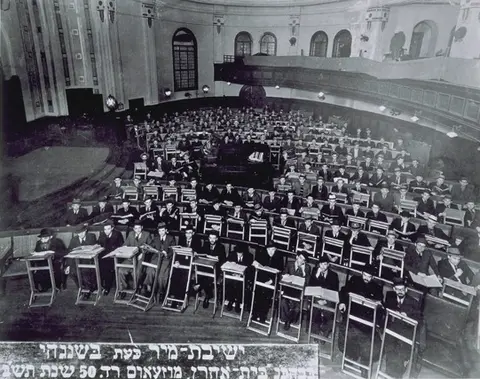
Students and teachers of the Mir Yeshiva at study in Beth Aharon, the synagogue on Museum Road, in 1942.
Unknown photographer, 1942 (public domain), via Wikimedia Commons
The refugees lived among Chinese neighbours, mostly working people, in the same lanes. Those neighbours made room for the newcomers and showed them how to light coal stoves and cook Chinese food. The Huoshan Road primary school took refugee children alongside its own pupils. Some refugees also worked with Chinese institutions. The musician Alfred Wittenberg taught Chinese students on Ward Road and later became a professor at the Shanghai Conservatory, where he worked until his death. The Austrian doctor Jacob Rosenfeld crossed the Japanese lines in April 1941 to join the Communist New Fourth Army. He served ten years and rose to head the health department of a PLA column, the highest post any foreigner held in that army. He died in 1950 on a visit to Israel.
Not every neighbour was friendly. On 23 July 1941 refugees rubbed out a mark painted on the pavement of Chusan Road, a street nicknamed “rumour lane” for the war news picked up on short-wave radio and passed on there. White Russians from the French Concession attacked them, and about fifty people were hurt in the fight that followed.
Repairing a neighbour’s belongings
Refugee Ernest Heppner remembered another kind of encounter in the lanes: Chinese craftspeople offering everyday services. He described shoemakers at work and customers waiting for locksmiths to finish new keys. Repairers recognised that many European newcomers had little money and offered to mend their broken possessions.
Some advertised in German. Heppner recalled a street call promising to put broken things right, a small adjustment that made the offer understandable to the newcomers. Repairing an object meant a living for the craftsperson and a usable possession for its owner.
After Pearl Harbor
The occupation of the International Settlement on 8 December 1941 cut off the refugees’ sources of support. The wealthy Baghdadi Jews held British passports and became enemy aliens, and Horace Kadoorie was interned. The American Jewish Joint Distribution Committee (JDC), whose office at 119–121 Huoshan Road had supplied most of the relief money, could no longer send funds from the United States. The JDC’s representative, Laura Margolis, a social worker from Buffalo who had arrived in May 1941, persuaded Captain Inuzuka to let her borrow against JDC money held in a Swiss bank. She was later interned and was repatriated in September 1943.
Relief shrank anyway. The number of refugees fed fell from 8,000 to 4,000, with one coarse meal a day. Only the poorest people in the camps, and the old, children and the sick living elsewhere, were fed.
The proclamation of 18 February 1943
On 18 February 1943 the Japanese authorities announced the Designated Area. The English text is headed “Proclamation Concerning Restriction of Residence and Business of Stateless Refugees” and is signed by the Commander-in-Chief of the Imperial Japanese Army in the Shanghai Area. It has four articles:
- Citing military necessity, the residence and business of stateless refugees were restricted to an area of the International Settlement lying east of the line of Chaoufoong Road (now Gaoyang Road), Muirhead Road (茂海路, now Haimen Road 海门路) and Dent Road (now Dantu Road 丹徒路); west of Yangtzepoo Creek (杨树浦港); north of East Seward Road (now Dongchangzhi Road 东长治路) and Wayside Road; and south of the Settlement boundary.
- Stateless refugees living or doing business outside that area had to move into it by 18 May 1943.
- Anyone who was not a stateless refugee needed Japanese permission to move in.
- Anyone breaking the proclamation or obstructing it would be severely punished.
The proclamation did not say “Jew”, or “ghetto”. A definition published in the press at the same time explained who counted as stateless: people who had come to Shanghai since 1937 from Germany (including former Austria and Czechoslovakia), Hungary, former Poland, Latvia, Lithuania and Estonia and now had no nationality. In practice that meant the refugees. It did not cover the Russian Jews or the Baghdadi Jews, who had arrived earlier or held other papers. Residents could work outside if they got a pass, and about 100,000 Chinese lived in the same streets. But residence was compulsory, the exits were guarded and passes were rationed, which is why the area is commonly called the “ghetto” all the same.
In practice the enforced area shrank to about 40 blocks, between Dalian Road, Gaoyang, Haimen and Dantu Roads, Huimin Road and Zhoujiazui Road. About 4,000 refugees living south of Suzhou Creek had three months to sell their homes and shops cheaply and move in. They included nearly 1,000 Polish Jews whom the Russian Jewish community had helped to settle. The Reisman family lost a house they had bought outside the area and moved into a single room.
Once inside, people needed a pass to get out. The main entrances were closed with barriers and guarded by Japanese military police, with barbed wire strung across the streets. Residents were organised into baojia (保甲) neighbourhood groups. Anyone who wanted to work or look for work outside had to apply for a pass at the Shanghai Stateless Refugees Affairs Bureau, 70 Muirhead Road. Queues there lasted hours, and a pass was never certain. In its first year the bureau issued about 1,600 quarterly passes and 2,500 short-term passes. The pass officer, Kano Ghoya, called himself “King of the Jews”, kept applicants waiting in the sun and slapped those who annoyed him.
Inside the Designated Area, 1943–1945
The area was poor, crowded and hungry. The Jewish population of Hongkou rose to about 17,000, counting the Russian Jews, and the jobless suffered most as relief money ran out and prices rose. In the early spring of 1943 Shanghai had its worst cold in a century. Refugees sheltered in run-down rooms in jackets sewn from sacking, and beggars wrapped in blankets filled the streets.
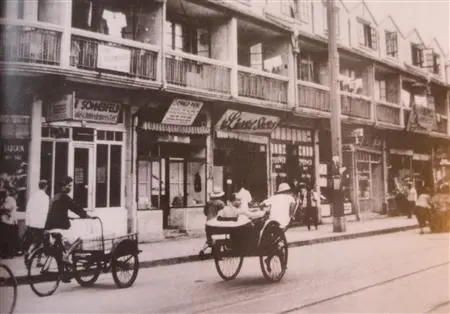
A street in the Hongkou refugee district, about 1943: shopfronts with signs in German, rickshaws and pedicabs in the road.
Unknown photographer, about 1943 (public domain), via Wikimedia Commons
Deaths far outnumbered births in every year. In 1942, the first year after Pearl Harbor, there were 320 deaths and 36 births in Hongkou’s Jewish community. In 1943 there were 311 deaths and 27 births. In 1944 money began to arrive again through neutral countries, and the JDC resumed aid through Switzerland. In November 1944 a count found 14,245 refugees inside the area, 1,171 of them under fifteen: 8,114 from Germany, 3,942 from Austria, 1,248 from Poland and 236 from Czechoslovakia, plus three Chinese women married to refugees and people of other nationalities.
Shanghai tells darker stories about these years too. The best known says that in 1942 the Gestapo officer Josef Meisinger urged Japanese officials to round up the refugees on Rosh Hashanah and drown them, and that the Japanese chose the Designated Area instead. Frightened refugees brought the rumour to Laura Margolis in July 1942, but no document records the meeting. The “Fugu Plan” is another: Captain Inuzuka is said to have compared the Jews to fugu, the puffer fish that is delicious but fatal if badly prepared. The documents that survive show something narrower, a 1939 plan to court Sassoon money and American opinion while keeping the number of refugees in Hongkou down. After the war, refugees spoke up for Inuzuka and the Americans did not prosecute him.
The air raid of 17 July 1945
An air raid brought heavy casualties near the end of the war. At noon on 17 July 1945 American aircraft attacked Japanese communications installations at Tilanqiao, and bombs fell on the refugee area. About 250 people were killed and more than 500 injured, including 31 refugees killed and 250 injured. About 700 refugees were made homeless. Hongkou had no shelters because the water table was too high.
Chinese residents pulled the wounded from the rubble and brought camp beds, mattresses and buckets to first-aid posts staffed mostly by refugee doctors. The doctors treated everyone who came, and refugees tore up tablecloths and sheets for bandages.
Leaving, 1945–1949
When Japan surrendered, the guards simply left. Refugees tore down the signs marking the Designated Area. Then came the news from Europe. Newspapers printed weekly alphabetical lists of survivors, which refugees pinned up around Hongkou and searched for the names of their families.
The refugees had survived, but they could not stay. German and Austrian citizens, Jews included, were in principle to be sent home under the Nationalist government’s rules for German nationals. More than 14,000 German and Austrian Jews had to leave. Few went back to Germany or Austria. Most went, with help from relatives and Jewish agencies, to the United States, Canada, Australia and South America. Doris Grey left in January 1947 on the Marine Lynx, Ralph Hirsch’s family in May 1947, the Klotzers in December 1947 and Eric Reisman in 1949. The Mir Yeshiva, the first group to get American visas, moved to Brooklyn in 1946.
On 22 April 1947, 8,000 Jews met in Wayside Park (汇山公园, now Huoshan Park 霍山公园, Huòshān Gōngyuán) to protest Britain’s execution of four members of the Irgun in Palestine. It was the largest political gathering Shanghai’s Jews ever held.
The last large departures came in 1948 and 1949. Israel was founded on 14 May 1948, and its consul in Shanghai, Moshe Yuval, issued 7,000 visas; about 4,000 Shanghai Jews left for Israel in 1948–49. By 1949 nearly all the refugees had left Hongkou. The Council of the Jewish Community dissolved itself in 1967, when fewer than ten Jews remained in Shanghai.
Rabbi Arthur Schneier, visiting Lane 818 Tangshan Road, put the achievement this way: Schindler’s list saved a thousand people, he said, but Shanghai saved a whole community of tens of thousands.
What to look for
62 Changyang Road. Begin at the former Ohel Moshe Synagogue, built by Russian Jews in 1927. It is now the Shanghai Jewish Refugees Museum. The brass plaque by the door gives the 1927 date. The refugees’ first services were held here before they had their own synagogue.
The White Horse Café. At the museum stands the café rebuilt in 2015 from the Mosberg family’s photographs. The original stood at the Lintong Road corner of Changyang Road until 2009.
Huoshan Park, 118 Huoshan Road. Cross to the park where Zhoushan Road meets Huoshan Road. Refugees came here to sit in the open, and 8,000 Jews rallied here in April 1947. A sign describing the former refugee quarter was unveiled in the park in 1994.
Huoshan Road. The JDC building at 119–121, with its two shopfronts, is close to the park. West along the road, the Broadway Theatre building at No. 57 was the refugees’ synagogue. East is the site of the Wayside Road Heim at No. 150. Not every building here has been checked on site, so expect some to be gone.
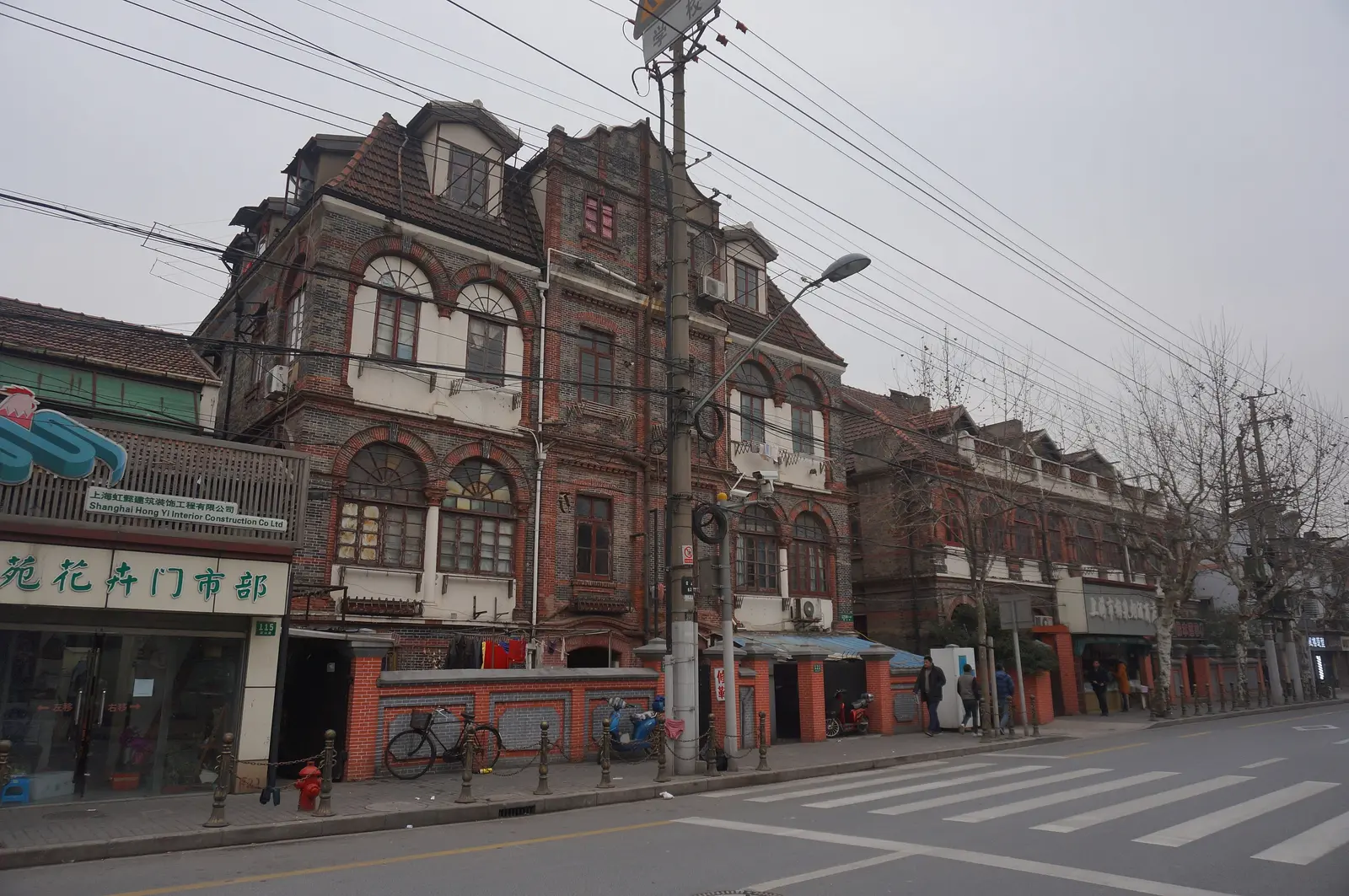
119–121 Huoshan Road in 2015. During the war the American Jewish Joint Distribution Committee had its Shanghai office in this two-fronted building.
Photo: Livelikerw, CC BY-SA 4.0, via Wikimedia Commons (resized) · CC BY-SA 4.0
Zhoushan Road. This was the shopping street of Little Vienna. At No. 59 the Blumenthal family of four lived in a pavilion room of 10 m²; Michael Blumenthal came back to see it in 1979 as US Treasury Secretary.
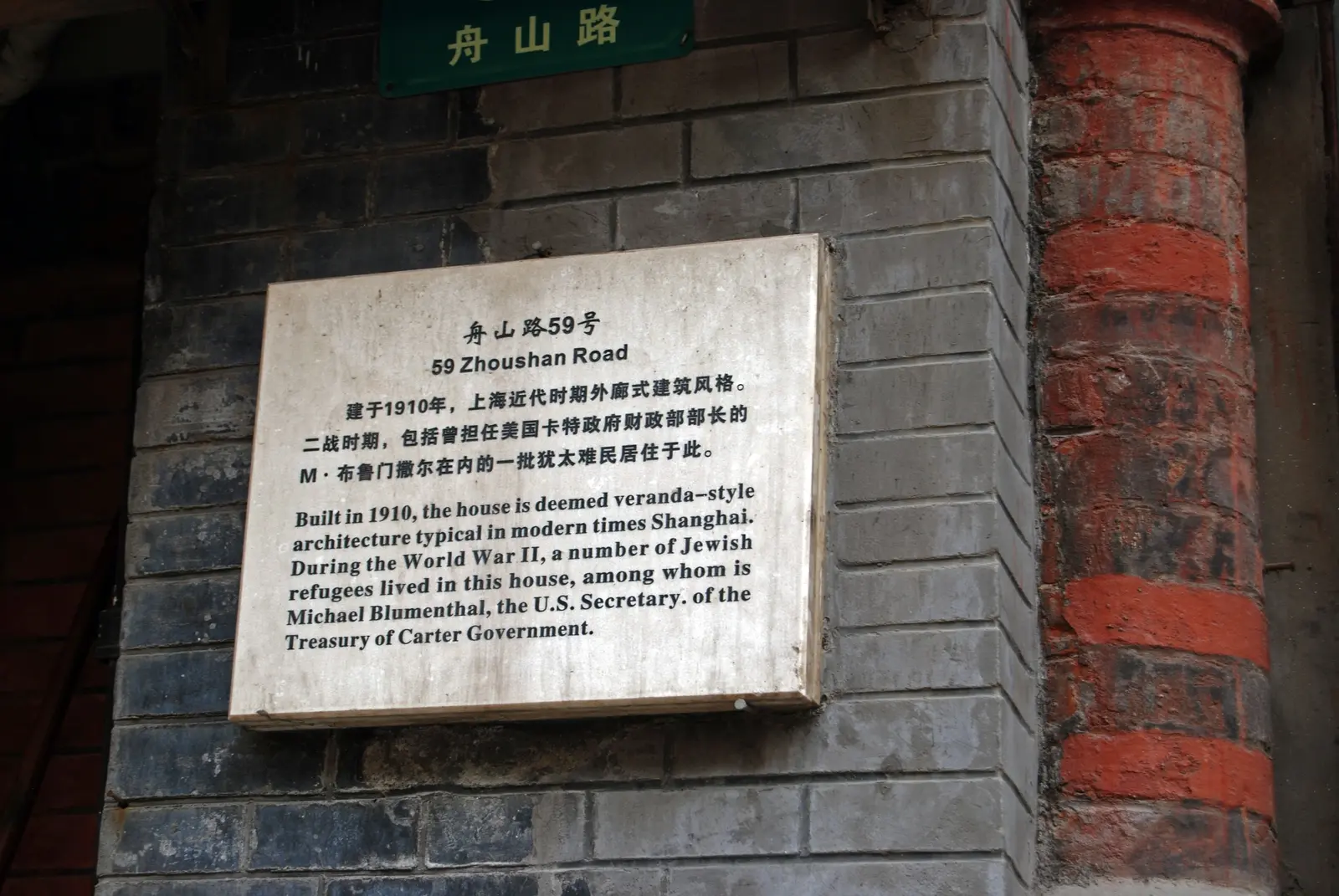
The plaque on 59 Zhoushan Road, where Michael Blumenthal's family lived during the war, photographed in 2012.
Photo: HBarrison, CC BY-SA 2.0, via Wikimedia Commons (resized) · CC BY-SA 2.0
Lane 818 Tangshan Road. The houses of Yuanfu Li still show the alterations refugee tenants made to them. Lane 961 Changzhi Road and Lane 171 Haimen Road were similar refugee clusters.
138 Changyang Road. East along Changyang Road was the Ward Road Heim, the largest of the camps and the site of the refugee hospital. The same road passes the old Ward Road Gaol.
Haimen Road. Old Muirhead Road ran along the west edge of the Designated Area. The pass office stood at No. 70, though its modern number is not known.
What is gone. The Kadoorie School at 627 East Yuhang Road has been demolished. So has Beth Aharon on Huqiu Road, where the Mir Yeshiva studied. Factories now stand on the sites of the refugee cemeteries on Liping Road and Panyu Road.
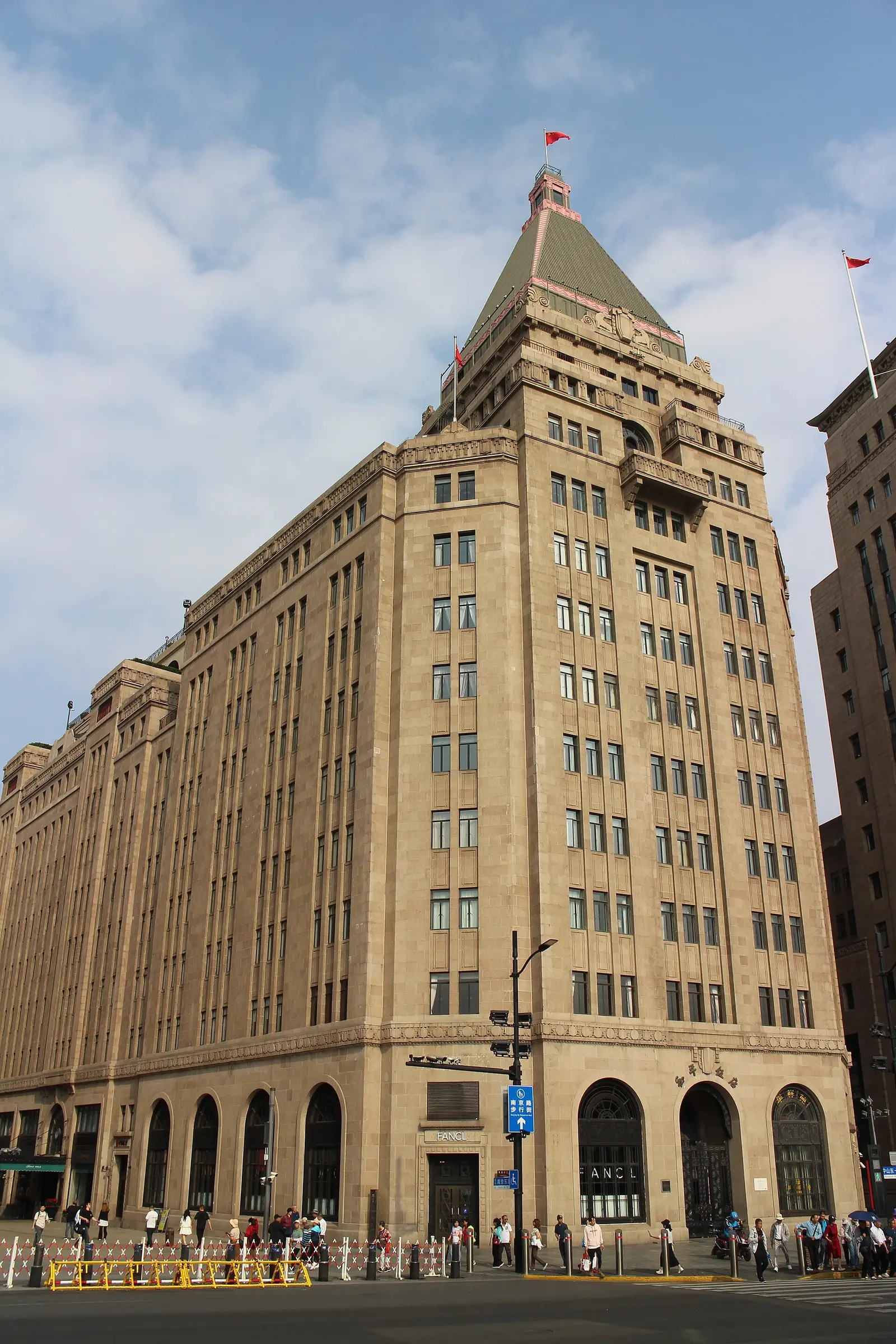
The Embankment Building. On the way back to the Bund, the large block on North Suzhou Road is where the first refugees were received and fed in the winter of 1938–39. Across the creek is the Cathay Hotel, where permit applications were handed in at Room 446.
Places mentioned
Tap a name in the text, or “map” in this list, to see where it is; names with their own page link to it.
- 01Ohel Moshe Synagogue (Shanghai Jewish Refugees Museum)摩西会堂(上海犹太难民纪念馆)map
- 02Huoshan Park (former Wayside Park)霍山公园(汇山公园)mapWhere Zhoushan Road meets Huoshan Road. Refugees came here to relax, and 8,000 Jews rallied here on 22 April 1947.
- 03White Horse Café (rebuilt 2015)白马咖啡馆(2015年复建)Opened in 1939 by a refugee family at the corner of Changyang Road and Lintong Road. The original was demolished for road widening in 2009 and rebuilt at the museum in 2015. The precise house number is unverified; map position approximate.approximate position
- 0459 Zhoushan Road (Blumenthal family room)舟山路59号Michael Blumenthal, later US Treasury Secretary, lived here as a teenager. Approximate position.approximate position
- 05Lane 818 Tangshan Road (Yuanfu Li)唐山路818弄(源福里)A lane of 100 houses that relief committees rented cheaply for refugees. Houses the refugees altered for themselves still stand. Approximate position.approximate position
- 06Ward Road Heim (the No. 1 refugee centre)华德路138号难民中心(今长阳路138号)The largest of the seven Heime, in former White Russian Volunteer Corps barracks, with a hospital and a maternity ward. Approximate position.approximate position
- 07Wayside Road Heim汇山路收容所(今霍山路150号)One of the seven refugee centres. Approximate position.approximate position
- 08Alcock Road Heim爱尔考克路难民中心(今安国路66号)One of the seven refugee centres. Approximate position.approximate position
- 09Chaoufoong Road Heim兆丰路难民中心(今高阳路680号)One of the seven refugee centres. In 1939 the Council turned the top floor of a school on Chaoufoong Road into an isolation block. Approximate position.approximate position
- 10American Jewish Joint Distribution Committee office美犹联合救济委员会旧址(霍山路119、121号)A three-storey building with two shopfronts. The gazetteer records it as housing. Approximate position.approximate position
- 11Broadway Theatre (refugee synagogue)百老汇大戏院(今霍山路57号)Rented as the refugees' synagogue from November 1939 to 1945. Approximate position.approximate position
- 12Eastern Theatre (liberal synagogue)东海大戏院(今海门路144号)Liberal (Reform) refugees held services here from Passover 1940. Approximate position.approximate position
- 13Kadoorie School site (demolished)上海犹太青年学校(嘉道理学校)旧址(东余杭路627号)The school was here from January 1942. The building has been demolished. Approximate position.approximate position
- 14Office for stateless refugees, 70 Muirhead Road上海无国籍避难民处理事务所(茂海路70号)Where refugees queued for passes to leave the area. Muirhead Road is today's Haimen Road. The modern house number is not known. Approximate position.approximate position
- 15Central European Jewish Association office中欧犹太协会旧址(唐山路416弄22号)Headquarters of the largest refugee organisation from 1939. The gazetteer records it as housing. Approximate position.approximate position
- 16Embankment Building河滨大楼mapVictor Sassoon’s block on North Suzhou Road, a refugee reception centre from 1938. The mapped address is 370 North Suzhou Road; older accounts give 400.上海市虹口区北苏州路370号approximate position
- 17Beth Aharon Synagogue site (demolished)阿哈龙会堂旧址(虎丘路42号)Silas Hardoon's synagogue on Museum Road. The Mir Yeshiva studied here from 1941 to 1946. Demolished. Approximate position.approximate position
- 18Cathay Hotel (Sassoon House)华懋饭店(沙逊大厦)map
Places in this story
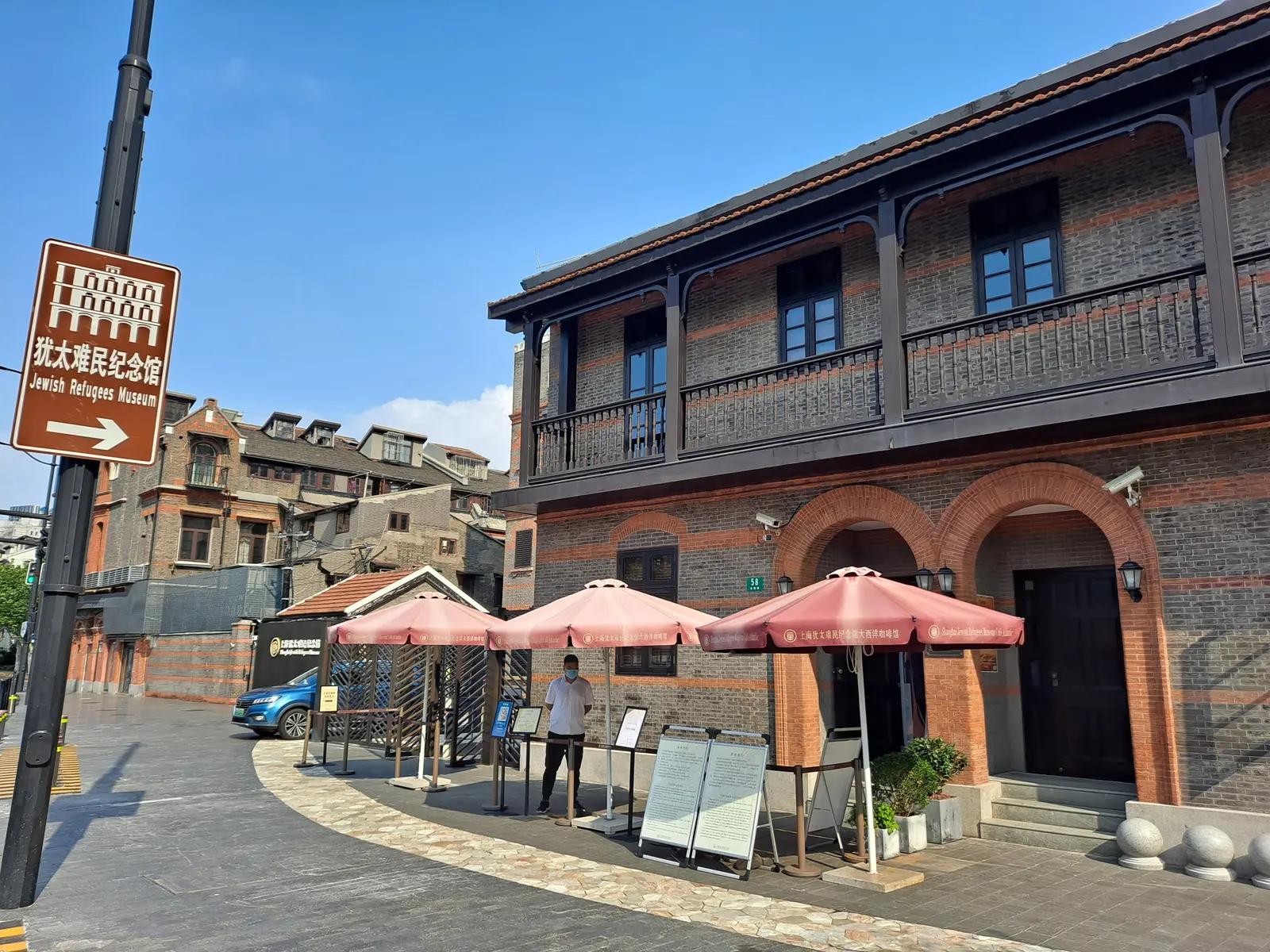

Museum· 1927
Shanghai Jewish Refugees Museum
上海犹太难民纪念馆Shànghǎi Yóutài Nànmín Jìniànguǎn
A 1927 synagogue in Hongkou restored as a museum on the Jewish refugees who lived in Shanghai in the 1930s and 1940s; closed Mondays, ticketed.

Building· 1926–1929
Sassoon House (Fairmont Peace Hotel)
沙逊大厦Shāxùn Dàshà
Victor Sassoon's 1929 granite tower with the green copper pyramid, home of the Cathay Hotel and since 1956 the Peace Hotel, now run by Fairmont.
People in this story
- Sir Victor Sassoon维克多·沙逊
- Kadoorie family嘉道理家族
- Sir Elly Kadoorie艾利·嘉道理
- Sir Horace Kadoorie贺理士·嘉道理
Sources
- 1.Hongkou District Gazetteer, Jews chapter (changes; relations; former sites) (虹口区志·第三编租界·外侨·第三章犹太人), 上海市地方志办公室(上海方志数据库) — 第一节 变迁·1938年犹太难民抵沪; 第一节 变迁·舟山路市场; 第二节 交往; 第三节 旧址、遗迹·三、上海犹太青年学校; 第三节 旧址、遗迹·四、美犹联合救济委员会; 第一节 变迁 (paras. after 舟山路市场); 第一节 变迁; 第一节 变迁, 1939~1944年区境犹太人出生和死亡人数表; 第三节 旧址、遗迹·二、汇山公园; 第三节 旧址、遗迹·八、唐山路818弄; 第三节 旧址、遗迹·一、摩西会堂; 第三节 旧址、遗迹·五、中欧犹太协会; 图片:以色列外宾参观霍山公园犹太难民居住区说明牌(1994年4月19日揭牌)gazetteer
- 2.Shanghai Religion Gazetteer, Judaism chapter (overview; communities, synagogues, organisations, education, religious life, departure) (上海宗教志·第三章犹太教), 上海市地方志办公室(上海方志数据库) — 第一节 社区·三、中欧犹太难民社区; 第一节 社区·四、波兰犹太难民社区; 第四节 教育·一、密尔经学院; 第二节 场所·五、阿哈龙会堂; 第二节 场所·五、阿哈龙会堂; 第二节 场所·七、百老汇会堂; 八 (东海会堂); 第三节 团体·三、中欧犹太协会; 第六节 犹太人离沪·一、欧洲犹太难民离沪; 第六节 犹太人离沪·三、俄罗斯犹太人离沪; 第三节 团体·四、上海犹太联合委员会gazetteer
- 3.Flight to Shanghai, 1938–1940: The Larger Setting (Yad Vashem Studies 28, 2000; Shoah Resource Center PDF, 32 pp.) (Flight to Shanghai, 1938-1940: The Larger Setting), Avraham Altman and Irene Eber, Yad Vashem (Yad Vashem Studies 28; Shoah Resource Center, International School for Holocaust Studies), 2000 — pp. 1–2 (Shoah Resource Center pagination), and n. 3; pp. 15–19; pp. 20–23; pp. 24–25; pp. 29–31 and nn. 92–94; p. 31, Some Concluding Remarks; p. 19article
- 4.Chinese Visas in Vienna: Feng-Shan Ho (Righteous Among the Nations story page) (Chinese Visas in Vienna: Feng-Shan Ho), Yad Vashem — Chinese Visas in Vienna, paras. 2–3; Chinese Visas in Vienna, paras. 1, 4–8website
- 5.The Last Kings of Shanghai: The Rival Jewish Dynasties That Helped Create Modern China (The Last Kings of Shanghai: The Rival Jewish Dynasties That Helped Create Modern China), Jonathan Kaufman, Viking (Penguin Random House), 2020 — ch. 6, 'Me Voila Therefore Walking a Tightrope'; ch. 6; ch. 6; ch. 7, 'War'; ch. 7, 'War'; ch. 7, 'War', and notes to ch. 7; ch. 6; ch. 7, and notes to ch. 6book
- 6.Ho Feng-Shan (English Wikipedia) (Ho Feng-Shan), Wikipedia — Vienna section; Vienna section; Recognition sectionwikipedia
- 7.Shanghai Jewish Community Oral History Collection: Eric Reisman, interviewed by Steve Hochstadt, 17 February 1997 (catalogue record and scope note) (Reisman, Eric oral history interview), Steve Hochstadt, Bates College, Edmund S. Muskie Archives and Special Collections Library, 1997 — Scope and Content Notearchive
- 8.Shanghai Jewish Community Oral History Collection: Charles Klotzer, interviewed by Steve Hochstadt, 4 September 1993 (catalogue record and scope note) (Klotzer, Charles oral history interview), Steve Hochstadt, Bates College, Edmund S. Muskie Archives and Special Collections Library, 1993 — Scope and Content Notearchive
- 9.Shanghai Jewish Community Oral History Collection: Michael Blumenthal, interviewed by Steve Hochstadt, 3 February 1995 (catalogue record and scope note) (Blumenthal, Michael oral history interview), Steve Hochstadt, Bates College, Edmund S. Muskie Archives and Special Collections Library, 1995 — Scope and Content Notearchive
- 10.Shanghai Jewish Community Oral History Collection: Ralph Hirsch, interviewed by Steve Hochstadt, 22 April 1994 (catalogue record and scope note) (Hirsch, Ralph oral history interview), Steve Hochstadt, Bates College, Edmund S. Muskie Archives and Special Collections Library, 1994 — Scope and Content Notearchive
- 11.Shanghai Jewish Community Oral History Collection: Doris Grey, interviewed by Steve Hochstadt, 26 June 1991 (catalogue record and scope note) (Grey, Doris oral history interview), Steve Hochstadt, Bates College, Edmund S. Muskie Archives and Special Collections Library, 1991 — Scope and Content Notearchive
- 12.USHMM Photograph 40211: the Mir Yeshiva in Beth Aharon synagogue, 1941 (courtesy of Rabbi Jacob Ederman) (Students and teachers of the exiled Mir yeshiva study in the sanctuary of the Beth Aharon synagogue on Museum Road in Shanghai.), United States Holocaust Memorial Museum, 1941 — Photograph 40211, captionarchive
- 13.Shanghai Municipal Gazette 1939: dancing saloon licence notices and the Child Protection Section report (The Municipal Gazette, vol. 32 (1939)), Shanghai Municipal Council, Shanghai Municipal Council (digitised on the Internet Archive), 1939 — Health reports for April (Gazette of 26 May 1939), May (30 June), June (28 July), August (22 September), September (27 October); Health reports for July (Gazette of 25 August 1939) and August (22 September 1939); 'Influx of Jewish Refugees', Gazette of 17 February 1939, p. 39; 'Entry of European Refugees', Gazette of 27 October 1939, p. 327; Finance Committee, 5 July, 'Jewish Refugee Children Summer Camp', Gazette of 7 July 1939, p. 230archive
- 14.Shanghai Municipal Gazette 1940 ('Entry of European Refugees', notice issued 1 June 1940) (The Municipal Gazette, vol. 33 (1940)), Shanghai Municipal Council, Shanghai Municipal Council (digitised on the Internet Archive), 1940 — 'Entry of European Refugees', Gazette of 14 June 1940, p. 136archive
- 15.Shanghai Municipal Gazette 1941 (fuel and power rationing report; advertisement rates) (The Municipal Gazette, vol. 34 (1941)), Shanghai Municipal Council, Shanghai Municipal Council (digitised on the Internet Archive), 1941 — 'Cemetery for Jewish Indigents', Gazette of 28 March 1941archive
- 16.Jews in Shanghai over a Century and a Half (ed. Pan Guang), chapter 无国籍难民隔离区, p. 62, as transcribed in a Douban reading note (一个半世纪以来的上海犹太人), 潘光 (Pan Guang), ed., 社会科学文献出版社 (to be confirmed) — 无国籍难民隔离区, p. 62book
- 17.USHMM Photograph 21602: North-China Daily News map of the designated area, 18 February 1943 (courtesy of Eric Goldstaub) (A map from the North China Daily News showing the borders of the zone in Shanghai to which stateless refugees will be confined from February 1943 on.), United States Holocaust Memorial Museum, 1943 — Photograph 21602, captionarchive
- 18.USHMM Photograph 86436: refugees queue for passes from Ghoya, 1943–1945 (photographer Max Reid; courtesy of Ernest G. Heppner) (Jewish refugees confined to the Honkew ghetto queue up to receive special passes to leave the restricted zone from Ghoya, a Japanese official from the Bureau for Stateless Refugees.), Max Reid, United States Holocaust Memorial Museum — Photograph 86436, captionarchive
- 19.Shanghai Ghetto (English Wikipedia) (Shanghai Ghetto), Wikipedia — section 'Designated area'; section on air raidswikipedia
- 20.Foreign Relations of the United States, 1948, vol. VIII (The Far East: China), Document 882: IRO offer of the Wooster Victory and Castelbianca (The Consul at Geneva (Troutman) to the Secretary of State, November 18, 1948), US Department of State, Office of the Historian, US Government Printing Office (online at history.state.gov), 1948 — Document 882, Geneva telegram 1464, 18 November 1948archive
- 21.Foreign Relations of the United States, 1948, vol. VIII, Document 884: request to evacuate 5,000 Jewish refugees from Shanghai (The Assistant Secretary of State for Occupied Areas (Saltzman) to the Under Secretary of the Army (Draper), November 20, 1948), US Department of State, Office of the Historian, US Government Printing Office (online at history.state.gov), 1948 — Document 884, Saltzman to Draper, 20 November 1948archive
- 22.The past and present of a café (White Horse Café), Wenhui Bao online, 20 January 2016 (一座咖啡馆的前世今生), 文汇网综合, 文汇报 (whb.cn), 2016 — paras. 2–5article
- 23.White Horse Café reopens: the Jewish owner's descendant revisits the site (The Paper, 26 August 2015) (白马咖啡馆重开:犹太店主后裔重访故地,感叹“像回家一样”), 陈伊萍、王闲乐, 澎湃新闻 (The Paper), 2015 — paras. 1–4article
- 24.USHMM Photograph 23577: a Heim on Ward Road, c. 1939–1948 (Siegmund Sobel collection, courtesy of Mary Catalina) (Refugees walk past a Heim on Ward Road in Shanghai.), United States Holocaust Memorial Museum — Photograph 23577, captionarchive
- 25.Beyond the Neon Lights: Everyday Shanghai in the Early Twentieth Century, Hanchao Lu, University of California Press, 1999 — Printed p. 210; chapter 5, note 62 on p. 374 cites Ernest Heppner, Shanghai Refuge, p. 54, via Lu; PDF p. 217.book