Stories
Baghdad to the Bund: Shanghai's Baghdadi (Sephardi) Jews, 1845–1950
Who Shanghai's Baghdadi Jews were, how a few hundred people built synagogues, a school and a paper, and why they had gone by about 1950.
Loading map…
In 1904, Shanghai’s Jewish School taught more than eighty children in two rooms above a house on Seward Road. Three volunteer teachers gave morning lessons, Hebrew followed in the afternoon, and trading firms paid much of the bill. The school served families who could not afford other fees.
These families belonged to a community often remembered through its richest members. Most Baghdadi Jews in Shanghai were clerks, brokers and shopkeepers, brought east through Bombay by the Sassoon firms and the businesses their former employees founded. Their synagogues, school and newspaper supported a community of hundreds, not thousands. Of their synagogue buildings, Ohel Rachel survives.
The Sassoon, Kadoorie and Hardoon fortunes formed part of this history, alongside the smaller households dependent on their firms. For the businesses, see The hongs; for the later communities, Harbin to Hongkou and The Designated Area.
Who came, and why Shanghai?
The community began with a branch office. Elias David Sassoon (沙逊, Shāxùn), second son of the Bombay merchant David Sassoon, set up in Shanghai around 1845. The family had moved from Baghdad to Bombay around 1830. Its China trade, which David Sassoon & Co. and later E. D. Sassoon & Co. built on Indian opium and cotton, needed people its owners could trust. They found them among Jews from Baghdad and from India’s Baghdadi families, and recruited office managers, clerks and warehouse men in both places.
The firm was a household as well as an employer. The early Sassoon office housed its staff, closed on the Sabbath and festivals, held services by Baghdadi custom, and taught young employees to slaughter poultry by ritual rules so they could keep kosher on the road. Former clerks then left to set up their own import-export houses, dealing in tea, silk, cotton and opium. By 1906 there were eleven Baghdadi Jewish firms in Shanghai employing 42 Baghdadis, and twenty-two of them still worked for the Sassoons.
A portrait of the community written around 1905 by insiders, one of them the editor N. E. B. Ezra, counts about 500 Jews in a city of some 620,000, roughly one person in 1,240. It says many came from India as Sassoon clerks and calls the community mainly “Asiatic”, with smaller German, Russian, Austrian, French and Italian groups. That fits its Middle Eastern and Indian origins, even as many members sought recognition as British subjects.
The everyday language shows the same mixed origins. The first two waves of arrivals spoke Judaeo-Arabic, written in Hebrew letters, and smaller firms kept their accounts in it until the early 1890s. Families with Indian ties also used Hindustani. Within a generation English had taken over in print. Arabic could still be heard in public, though: in 1904 Israel’s Messenger reported a Zionist literary evening at the Jewish School on Seward Road where a Mr E. Solomon read his paper on “Unity” in Arabic.
How many were there?
Nobody ever counted the Baghdadis on their own, but the numbers stayed small. About 175 lived in the foreign settlement in 1895, mostly in the Indian cotton and opium trade. By around 1905 there were about 500 Jews of all origins, the Baghdadis the largest group. In the 1920s there were around 700 Sephardi Jews, many living in the western districts, and they probably never rose above 1,000.
The Russian community was much larger, with perhaps four to six times as many people at its peak. Between 1938 and 1941 the European refugees outnumbered the Baghdadis many times over: relief committees were caring for about 16,000 of them by the end of 1939. The Baghdadis were the oldest Jewish group in Shanghai and always the smallest.
Within that small group the gap between rich and poor was wide. Most Baghdadi Jews were poor and worked for the companies of the wealthy few. In 1904 a shoemaker named Isaac David begged outside the Sassoon offices. Sassoon and Rachel Reuben kept a muslin shop from 1895 to 1903, and Rachel spoke Hindustani when she went to court. Benjamin David Benjamin rose briefly as a sharebroker and property dealer and nearly went bankrupt in 1883.
Why did a few hundred people need four synagogues?
The first services were held in a rented hall early in the 1870s. The first synagogue proper, Beth El (埃尔会堂, Āi’ěr Huìtáng), followed in 1887, called into being in the Sassoon name on leased land on Peking Road, at what is now 40 Beijing Road East (site). It was very small. An American visitor, Simon Adler Stern, found 30 to 40 members in 1888 and thought the congregation would not have survived without the Sassoons’ money. He noted that the women’s section was railed off “in true orthodox fashion”. One of its founders, Lewis Moore, was an Ashkenazi auctioneer, so the first synagogue was never purely Baghdadi.
The second congregation came from a quarrel. The story goes that on the Day of Atonement some worshippers rode to Beth El in a carriage, which orthodox law forbids on that day, and the synagogue’s officers were furious. A breakaway congregation, Shearith Israel (舍里特·以色列会堂, Shělǐtè Yǐsèliè Huìtáng), was set up around 1900 in rented rooms on Seward Road, today’s Changzhi Road (长治路), on the Hongkou side of Suzhou Creek. Its founder was D. E. J. Abraham. In 1904 it held its New Year services at No. 9 Seward Road, the same house as the Jewish School, and it had an afternoon Talmud Torah class and a ritual bath.
By 1905 there were three congregations, and they cooperated more than the split suggests. At Purim, on 21 March 1905, the proprietress of the New Traveller’s Hotel gave a dinner for about 32 Russian Jewish soldiers then quartered in Shanghai, and the congregations sent representatives: M. Myer for Beth El, N. E. B. Ezra for Shearith Israel, and G. Dietrich, president, for the Russian congregation Ohel Moishe. That year Beth El elected a committee of seven, and the names show how small the governing circle was. Ezras sat on the committees of both Baghdadi synagogues and of the Zionist association.
The third Baghdadi synagogue was the first built for the purpose, and it came from a bereavement. Sir Jacob Elias Sassoon paid for Ohel Rachel (拉结会堂, Lājié Huìtáng) on Seymour Road in memory of his wife Rachel. He died before it was finished, and the community dedicated it to both of them. It was completed in March 1920, and Rabbi W. Hirsch, the first rabbi the Shanghai Sephardim had employed, consecrated it on 23 January 1921. Its plan drew on two London synagogues, Bevis Marks and Lauderdale Road, and Beth El closed once it opened. Hirsch left in 1923 for South Africa, and Ohel Rachel had no rabbi after him.
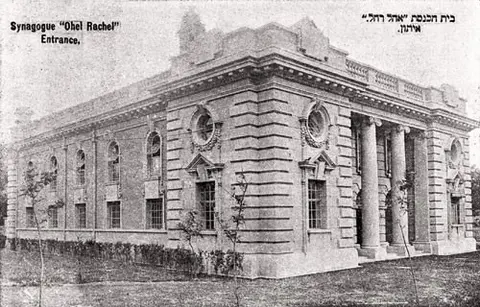
Ohel Rachel in its early years, from a printed view captioned in French and Hebrew.
Unknown photographer, 1920s or 1930s (public domain), via Wikimedia Commons
The fourth, Beth Aharon (阿哈龙会堂, Āhālóng Huìtáng), was Silas Hardoon’s gift. It was named for his father and stood at 20 Museum Road, today 42 Huqiu Road (虎丘路42号), behind the Bund. It held more than 400 people and replaced Shearith Israel, but few came to pray there. The building found its fullest use only after its founder’s death. In August 1941 the Mir yeshiva, about 400 teachers and students who had fled Poland, settled into it to study. That story belongs to The Designated Area.
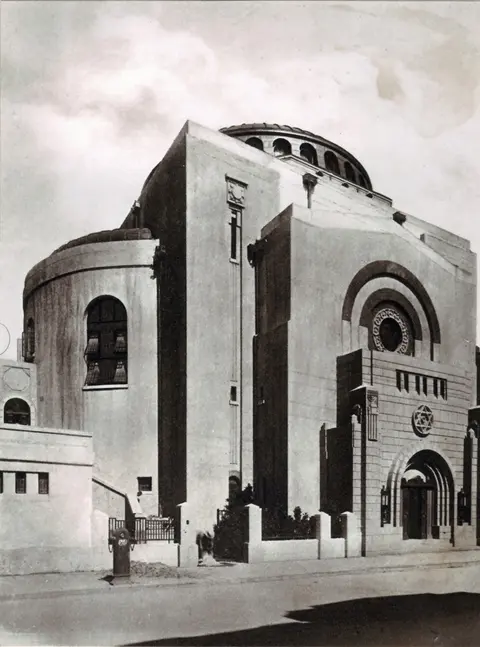
Beth Aharon on Museum Road in the 1930s. The synagogue was later demolished.
Unknown photographer, 1930s (public domain), via Wikimedia Commons
There was also a small synagogue on Broadway, today’s 125 Daming Road (大名路125号), given early in the twentieth century by a Sephardi merchant named Abraham. Four buildings for a few hundred people did not mean four separate communities. Rival founders wanted their own buildings, worshippers were split between the two sides of the creek, and families paid for memorials.
Who ran community life?
Formally, the Shanghai Jewish Communal Association (上海犹太协会) did, from about 1910. It was the main Sephardi body, running cultural, educational and religious work. Schools, the press, Zionist organisations and burial societies also shaped community life.
The school. In November 1902 the community resolved to start a Talmud Torah to be called the Shanghai Jewish School. Its first annual report, printed in Israel’s Messenger in 1904, shows a modest charity school. It had 80 to 84 pupils on the first floor of a house on Seward Road, in two classrooms and four classes. Three volunteer women taught English, arithmetic and geography in the mornings, and the school had to hire a paid teacher, Miss Rangel, as numbers grew. Hebrew came in the afternoons. The committee said the school was for children whose parents could not afford the fees of non-denominational schools. An outside examiner praised it, writing that children who “would probably be only tolerated” elsewhere were here taught they belonged. The firms paid: E. D. Sassoon & Co. gave 150 a month, David Sassoon & Co. 75 and Ellis Kadoorie & Co. 25.
The school later moved into its own building in the Ohel Rachel compound on Seymour Road. When Horace Kadoorie visited in January 1937 he found the children underfed, some ill with tuberculosis and with few prospects of work. He founded the Shanghai Jewish Youth Association the next month. In February 1943 a police report records the headmaster, Mr Kahan, at 544 Seymour Road, asking permission for a Purim prize-giving for about 400 people, with pupils acting the story of Esther.
The paper. Israel’s Messenger (以色列传讯报) published its first issue on Friday 22 April 1904, from 16 Peking Road. Its opening editorial promised a bond among “the scattered remnants” of Jews in the Far East. Its editor was N. E. B. Ezra, born in Lahore in 1883, who edited it for more than 30 years until his death in Shanghai on 5 December 1936. He was a domineering editor, and the paper liked to present the community as more united than it was. It was also the organ of the Shanghai Zionist Association, which shaped what it covered.
The Zionists. The community’s Zionist association was among its earliest bodies, founded in April 1903. It began with hardly 16 members and had nearly 80 a year later, with Edward I. Ezra as president and N. E. B. Ezra as secretary. Shanghai’s voice at the Sixth Zionist Congress in Basel was a proxy: Joseph Cowen of the English Zionist Federation wrote from London in April 1904 to thank the association for trusting him with its mandate. Elly Kadoorie later led the movement in China, though he quit as head of the Shanghai Zionists after a donation for a “garden city” in Palestine was spent on other causes. The Sassoons kept their distance from Zionism.
The community’s charity also reached China’s own Jews. A society formed in 1900 to contact the descendants of the old Jewish community of Kaifeng, and eight of them came to Shanghai in April 1901. Money was raised around 1902 to rebuild the Kaifeng synagogue and pay teachers. The effort faded, and the war of 1937 ended it.
The dead. The first Jewish cemetery opened in 1862 on Mohawk Road, today’s Huangpi Road North (黄陂北路) (site), on land given by David Sassoon. In May 1904 Israel’s Messenger reported the consecration there of a black granite tomb for Lewis Moore, shipped from Nagasaki. Some 304 graves were counted there.
British subjects or “Orientals”?
Being British mattered to this community, and the status was uncertain. Many Baghdadis were legally Ottoman subjects until 1918, and in principle under French protection. Some prominent families had been treated as British “without any legal grounds”, and the Foreign Office discovered this in 1906. Local opinion was harsher. In 1873 the North-China Herald called them “in reality not British merchants but Orientals under British protection”. In 1908 the reference book Twentieth Century Impressions listed Shanghai’s Baghdadis among the European merchants and Hong Kong’s under the “Oriental Mercantile Community”.
The Baghdadis still won a share of political power. From 1869 to 1921 they elected a member almost every year to the six seats reserved for British councillors on the Shanghai Municipal Council, and until 1904 that councillor was always a Sassoon partner. Socially they were less welcome. The British Shanghai Club admitted only a handful of Baghdadis, Edward Ezra among them, and was still reluctant in the 1920s and 1930s. In 1918 a merchant called club members “Baghdad camel drivers”, and in the 1930s Victor Sassoon was sometimes met in bars with chants of “Back to Baghdad”. Russian Jews, too, used the Baghdadis’ Middle Eastern roots against them. Most Baghdadi traders joined the American Club, the Cercle Sportif Français or the Race Club.
Private life became more British, or more international. Weddings moved from Baghdad-style ceremonies to receptions at the Majestic and Astor House hotels, with brides brought from Bombay, Calcutta, Hong Kong or Singapore. Women kept Baghdadi cooking and the Sabbath at home, and the well-off took up Western furnishing, gardening and, in 1914–18, British war charities. Rivka Toeg, interviewed in 1992, remembered a four-storey house in the International Settlement where everyone spoke English except her grandmother, who spoke only Judaeo-Arabic. Her father had come out as a young Sassoon clerk and become a millionaire. Reuben Abraham studied Talmud with his sons from six to eight every morning under their grandfather, Rabbi D. E. J. Abraham, head of the Baghdadi community.
Did the rich take part?
The best-placed Sephardim, the Sassoons, Ezras, Hayims, Hardoon and the Kadoories, held British nationality and gave money for synagogues, but seldom took part in communal activity. Some joined the British Club instead, to show that they were British. The rich paid for buildings and endowed schools, and the committee work fell to brokers, clerks and editors such as the Ezras and Abrahams.
Hardoon took a different path from the Shanghai Club. He married Luo Jialing (罗迦陵, Luó Jiālíng), a Buddhist of mixed Chinese and European descent, and never converted. He had himself pictured in Chinese scholars’ gowns in the books he sponsored, modelling himself on a Chinese merchant-philanthropist rather than an English gentleman. He spoke English with a thick Arabic accent and still jotted notes in Judaeo-Arabic in the late 1920s. He lived on his estate, Aili Garden (爱俪园, Àilì Yuán), on Bubbling Well Road, and he still paid for Beth Aharon. When he died there in June 1931, his widow’s Buddhist rites clashed with the Jewish burial society, whose president resigned. Hardoon was buried in a mausoleum in his garden, not in a Jewish cemetery. His page and Luo Jialing’s tell the rest.
What did the war do to them?
Before December 1941 the Baghdadis were the hosts. In 1938 a Kadoorie organised the relief committee, the Sassoons opened Embankment House (河滨大楼), north of Suzhou Creek, as a shelter and Victor Sassoon gave US$150,000 as a rehabilitation fund. By the end of 1939 he had housed about 2,500 refugees. That work is part of The Designated Area.
The Japanese occupation of the International Settlement in December 1941 reversed the community’s position. The British passports it had worked to obtain now made its members enemy nationals. British and American residents were told to report to Hamilton House and were issued red armbands, B for British. British-subject Baghdadis were classed as “first-class” enemy nationals and interned in civilian camps. Others were “second-class”, wore armbands and had their movements limited. Property was confiscated, and many families became destitute. The Sephardim could no longer pay for refugee relief.
Nationality divided families. Aviva Shabi, writing in 1992, describes the community as “severed in half”. Wealthier families with British papers were held until the war ended. Relatives with Iraqi papers, sometimes from the same family, stayed at home and carried on with daily life.
The best-documented cases are the richest. Lawrence Kadoorie, his wife and their two infant children were held in the Chapei (闸北) camp, in dormitories of an abandoned university, while Elly and Horace were confined in the stables behind their own house, Marble Hall. Elly died in 1944. Ellis Hayim, a Baghdadi who had become Victor Sassoon’s deputy and had played a large part in feeding and housing refugees, was held in Embankment House, the building he had helped turn into a shelter. A fellow prisoner quoted him saying he was breaking down after 82 days.
Community institutions felt it too. In April 1942 the Japanese gendarmerie took over the Shanghai Jewish Club’s new house at 722 Bubbling Well Road, which the club had bought from the US Marines, and questioned whether a sale of former enemy property was valid. The club’s membership fell from 453 to 424 by its 1943 annual meeting, partly because some members were enemy nationals. A Japanese garrison is said to have used Ohel Rachel as a stable. The Toeg family hid its Torah scrolls and pews.
Why did they leave, and what happened to the buildings?
The sharp changes in China and the wider world after the war ended it. The Sassoon group withdrew first, on a large scale, in 1948, and other Jewish firms followed. By the end of that year Jewish businesses were closing, and the club, the school, the hospital and the old people’s home had stalled for lack of money. Victor Sassoon flew out on 28 November 1948 with a return ticket booked for spring 1950. The Baghdadis went to Israel, Australia, England, the United States and Canada, and most had left by the late 1940s and early 1950s.
The remaining communal organisations were brought together. In the second half of 1949 the Sephardi association and the Ashkenazi religious association combined into a single Council of the Jewish Community (犹联). By then most of the Jews still in Shanghai were Russian. There were about 7,000 in October 1949, 440 in 1953 and 84 in 1958.
Each building had a different fate.
- Ohel Rachel was used for services into the early 1950s, with the last wedding there on 23 January 1951. In 1952 the Toegs sent its 30 Torah scrolls to Israel and handed the building over. It became the auditorium of the Shanghai Education Bureau and was listed as a protected building on 18 March 1994. See the place page.
- Beth Aharon became part of the Wenhui Bao (文汇报) newspaper compound after 1949 and was later demolished.
- Beth El and Shearith Israel had closed around 1920, and neither building is known to survive.
- The cemeteries were cleared. In 1958 tombs from four Jewish cemeteries were moved to a site at Minzhu Cun near Xujing, which was destroyed in the Cultural Revolution. Red Guards wrecked the cemetery where Elly and Laura Kadoorie lay. When Lawrence came back he was shown a stone in a new foreigners’ cemetery that may have been a copy.
- Marble Hall became the China Welfare Institute Children’s Palace on 1 June 1953, with the Kadoorie family’s consent.
What to look for
Ohel Rachel, 500 North Shaanxi Road (陕西北路500号). Stand on the pavement opposite. You see the columned portico of 1920 inside the Shanghai Education Commission compound. The building is normally closed and is used only on major Jewish holidays. The school building, once 544 Seymour Road, stands in the same compound.
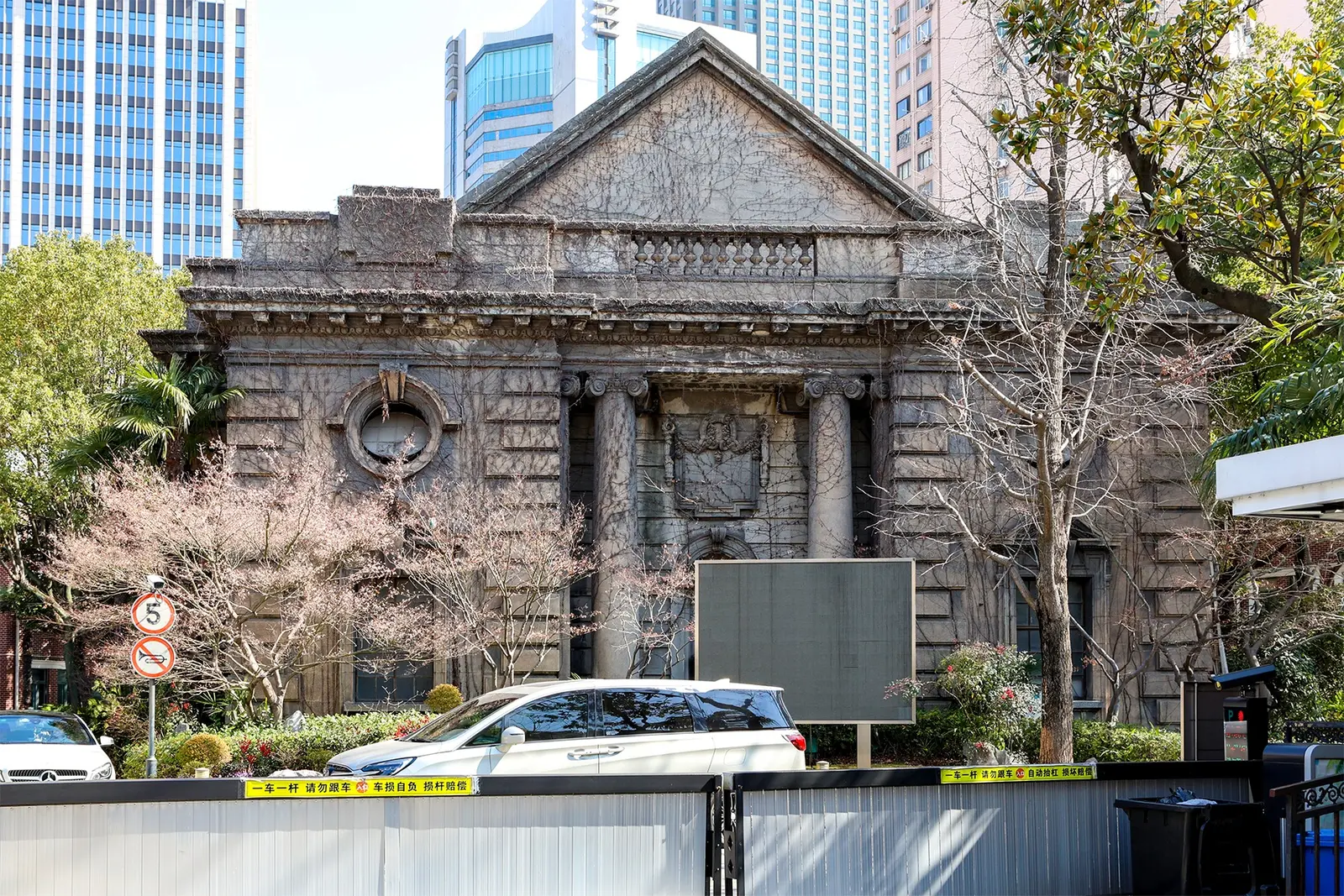
Ohel Rachel at 500 North Shaanxi Road in February 2026, seen across the road.
Photo: Windmemories · CC BY-SA 4.0
Marble Hall, 64 Yan’an West Road (延安西路64号). The Kadoorie house has been the Children’s Palace since 1953. It is described as closed to the public, though visitors can walk in the grounds.
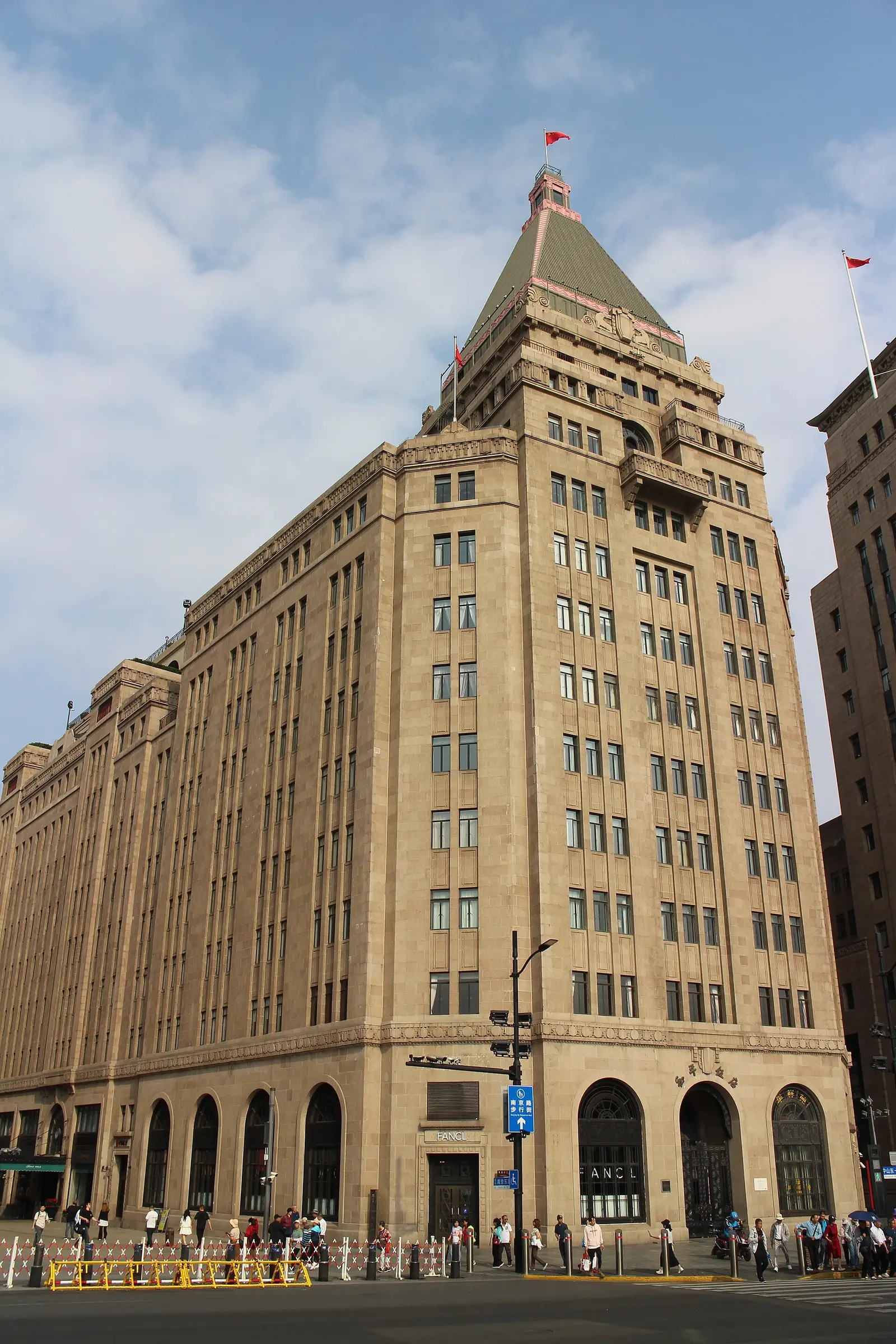
The Bund and Nanjing Road East. Sassoon House, now the Peace Hotel, is the community’s most visible landmark. Its money came from the same firms that brought the clerks east. The Beth El site, at 40 Beijing Road East (北京东路40号), is a short walk north, behind the Bund. Nothing remains of the synagogue.
42 Huqiu Road (虎丘路42号). Beth Aharon stood here, on Museum Road. The synagogue was pulled down and the Wenhui Bao tower took its place; nothing of it is left.
Across Suzhou Creek. Embankment House stands on the north bank. Shearith Israel and the first Jewish School met in rented rooms near the western end of Changzhi Road (长治路), once Seward Road. No marked trace survives there.
What is gone. The Mohawk Road cemetery lay on today’s Huangpi Road North, and there is nothing to see there. Hardoon’s garden is now the site of the Shanghai Exhibition Centre.
Places mentioned
Tap a name in the text, or “map” in this list, to see where it is; names with their own page link to it.
- 01Ohel Rachel Synagogue拉结会堂(西摩会堂)map
- 02Shanghai Jewish School (544 Seymour Road)上海犹太学堂旧址The school building in the Ohel Rachel compound on Seymour Road (now North Shaanxi Road). Approximate position.approximate position
- 03Beth El Synagogue, site of埃尔会堂旧址Shanghai's first synagogue, founded 1887. The Religion Gazetteer places it at today's 40 Beijing Road East (北京东路40号), the former Friendship Store site; Betta places it in a room on Foochow Road. Approximate position, on the gazetteer's address.approximate position
- 04Shearith Israel congregation, No. 9 Seward Road, site of舍里特·以色列会堂旧址The second congregation met in rented rooms on Seward Road (today's Changzhi Road, 长治路); Israel's Messenger gives No. 9 Seward Road in 1904. Approximate position at the western end of the road.approximate position
- 05Broadway synagogue, site of百老汇路会堂旧址The Hongkou District Gazetteer places this small synagogue, given by the merchant Abraham, at today's 125 Daming Road (大名路125号); part was pulled down for road widening. Approximate position.approximate position
- 06Beth Aharon Synagogue, site of阿哈龙会堂旧址Hardoon’s synagogue at 20 Museum Road, today 42 Huqiu Road (虎丘路42号), has been demolished. The map marks the plaza named after it (阿哈龙广场), north of Beijing East Road.
- 07Mohawk Road Jewish cemetery, site of马霍路以色列公墓旧址The first Jewish cemetery, opened 1862 on Mohawk Road, today's Huangpi Road North (黄陂北路). Nothing remains. Approximate position.approximate position
- 08Sassoon House (Peace Hotel)沙逊大厦(和平饭店)map
- 09Embankment House河滨大楼mapVictor Sassoon’s block on North Suzhou Road, a refugee reception centre from 1938. The mapped address is 370 North Suzhou Road; older accounts give 400.上海市虹口区北苏州路370号approximate position
- 10Marble Hall (Kadoorie house), now the Children's Palace大理石大厦(中国福利会少年宫)mapElly Kadoorie’s house, home to the China Welfare Institute Children’s Palace since 1 June 1953.上海市静安区延安西路64号
- 11Aili Garden (Hardoon Garden), site of爱俪园(哈同花园)旧址Hardoon’s estate on Bubbling Well Road. The map marks the Shanghai Exhibition Centre, which now occupies the site.
- 12Shanghai Jewish Club, 722 Bubbling Well Road上海犹太人总会(南京西路722号)The club's house from October 1941 until November 1942, on today's Nanjing Road West. Approximate position.approximate position
Places in this story
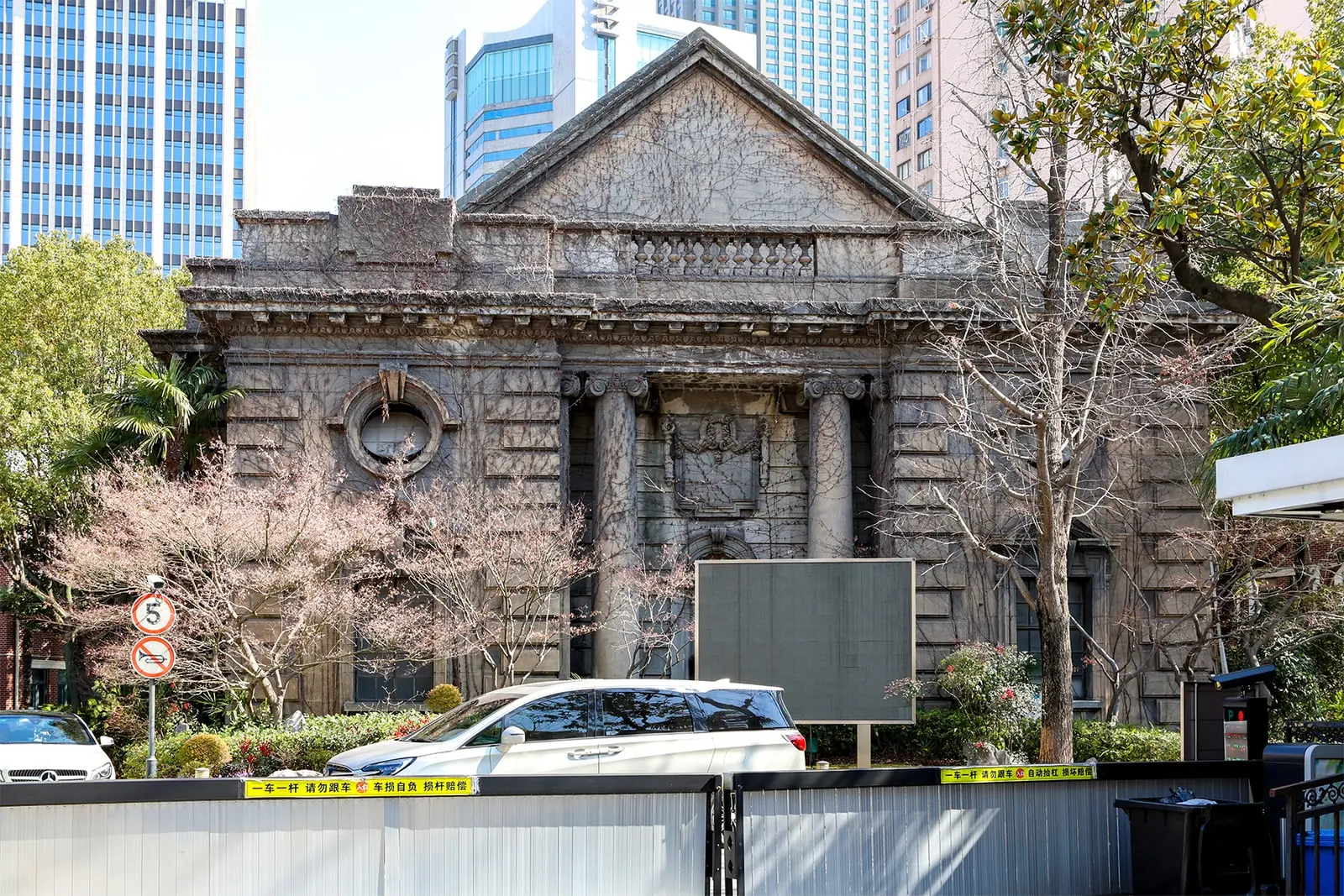
Site· 1920
Ohel Rachel Synagogue
拉结会堂Lājié Huìtáng
Built in 1920 by the Sassoon family, Shanghai's first purpose-built synagogue seated 700. It sits in a compound and is rarely open to visitors.

Building· 1926–1929
Sassoon House (Fairmont Peace Hotel)
沙逊大厦Shāxùn Dàshà
Victor Sassoon's 1929 granite tower with the green copper pyramid, home of the Cathay Hotel and since 1956 the Peace Hotel, now run by Fairmont.
People in this story
- The Sassoon family沙逊家族
- Sir Victor Sassoon维克多·沙逊
- David Sassoon & Co.老沙逊洋行
- E. D. Sassoon & Co.新沙逊洋行
- Elias David Sassoon以利亚·大卫·沙逊
- Silas Aaron Hardoon哈同
- Luo Jialing (Liza Hardoon)罗迦陵
- Kadoorie family嘉道理家族
- Sir Elly Kadoorie艾利·嘉道理
- Lawrence Kadoorie, Baron Kadoorie劳伦斯·嘉道理
- Sir Horace Kadoorie贺理士·嘉道理
Sources
- 1.Baghdadi Jews in Early Shanghai (Baghdadi Jews in Early Shanghai), Maisie J. Meyer, Iraqi Jewish Association of Ontario (ijao.ca), 2009 — opening section; sections on settlement and numbers; religious life; refugee relief; war and internment; closing section; Kaifeng Jewsarticle
- 2.From Orientals to Imagined Britons: Baghdadi Jews in Shanghai (From Orientals to Imagined Britons: Baghdadi Jews in Shanghai), Chiara Betta, Modern Asian Studies 37(4), Cambridge University Press (text read at jewsofchina.org), 2003 — introduction; Baghdadis as Settlers; section on Beth El; section on language; section on Hardoon; section on the communal press; sections on nationality and on 'Orientals'; section on clubs; section on municipal politics; The Other Baghdadis; section on women and familyarticle
- 3.Shanghai (Jewish Encyclopedia, 1901–1906; article signed J. and N. E. B. E.) (Shanghai), Joseph Jacobs and N. E. B. Ezra, Funk & Wagnalls, The Jewish Encyclopedia (online text at jewishencyclopedia.com), 1905 — Shanghai, paras. 1–2; Shanghai, synagogues and cemetery; Shanghai, societies; Shanghai, schoolbook
- 4.Review of Maisie J. Meyer (ed.), Shanghai's Baghdadi Jews: A Collection of Biographical Reflections (Blacksmith Books, 2015) (Shanghai's Baghdadi Jews (review)), Bill Gladstone, billgladstone.ca, 2022 — paras. 2–3article
- 5.Shanghai Religion Gazetteer, Judaism chapter (overview; communities, synagogues, organisations, education, religious life, departure) (上海宗教志·第三章犹太教), 上海市地方志办公室(上海方志数据库) — 第一节 社区·一、赛法迪姆犹太人社区; 第二节 场所·一、埃尔会堂; 第二节 场所·二、舍里特·以色列会堂; 第二节 场所·四、拉结会堂(西摩会堂); 第二节 场所·五、阿哈龙会堂; 第三节 团体·一、上海犹太协会; 第四节 教育; 第二节 场所·四; 第六节 犹太人离沪·二、赛法迪姆犹太人离沪; 第三节 团体·四; 第六节 犹太人离沪·三gazetteer
- 6.The Sephardi Jewish Community of Shanghai 1845–1939 and the Question of Identity (PhD thesis, London School of Economics; repository record and abstract only — full text not read) (The Sephardi Jewish Community of Shanghai 1845-1939 and the Question of Identity), Maisie J. Meyer, London School of Economics (record in SOAS Research Online), 1994 — abstractbook
- 7.Israel's Messenger (Shanghai), vol. 1, 1904, from no. 1 of 22 April 1904 (microfilm scan, Internet Archive item IsraelsMessenger_1904) (Israel's Messenger, Volume 1, 1904), N. E. B. Ezra (editor), Israel's Messenger, 16 Peking Road, Shanghai; scan on Internet Archive, 1904 — vol. 1 (1904), 'Shanghai Zionist Association' report on Col. Goldsmid; vol. 1 (1904), 'Shearith-Israel' service notice, September 1904; vol. I no. 1, 22 April 1904, masthead and editorial 'Ourselves'; vol. I no. 1, 'Stray Notes' and notices; vol. 1 (1904), 'A Letter of Appreciation'; vol. 1 (1904), 'Shanghai Jewish School, First Annual Report', examiner's report and subscriber list; vol. 1 (1904), 'The late Mr. Lewis Moore'; item descriptionarchive
- 8.Israel's Messenger (Shanghai), vol. 1 nos. 20–26, 1905 (microfilm scan, Internet Archive item Israelsmessenger1905) (Israel's Messenger, 1905), N. E. B. Ezra (editor), Israel's Messenger, Shanghai; scan on Internet Archive, 1905 — vol. 1, 1905, Purim dinner report; vol. 1, 1905, p. 317–318, Beth El annual meetingarchive
- 9.English Wikipedia (article given in each fact's locator) (English Wikipedia), Wikimedia Foundation — Ohel Rachel Synagogue; Beth Aharon Synagogue; N.E.B. Ezrawikipedia
- 10.Shanghai Synagogue - The House of Rachel (Shanghai Synagogue - The House of Rachel), Historic Shanghai — whole article; section on the schoolwebsite
- 11.Hongkou District Gazetteer, Jews chapter (changes; relations; former sites) (虹口区志·第三编租界·外侨·第三章犹太人), 上海市地方志办公室(上海方志数据库) — 第三节 旧址、遗迹·九、百老汇路会堂; 第一节 变迁; 第三节 旧址、遗迹·三gazetteer
- 12.China-West chronology, University of Zurich, entry for 1909 (citing Irene Eber, 'Overland and by sea', Chinese Journal of International Law 4:1, 2005) (China und der Westen: Chronologie, Eintrag 1909 (Gründung der Sephardi Shanghai Jewish Community Association)), University of Zurich, Asien-Orient-Institut — entry 1909website
- 13.The Last Kings of Shanghai: The Rival Jewish Dynasties That Helped Create Modern China (The Last Kings of Shanghai: The Rival Jewish Dynasties That Helped Create Modern China), Jonathan Kaufman, Viking (Penguin Random House), 2020 — ch. 4, 'Shanghai Rising'; ch. 6, 'Me Voila Therefore Walking a Tightrope' (closing pages); ch. 7, 'War'; ch. 8, 'I Gave Up India and China Gave Me Up'; ch. 9, 'The Reckoning'; ch. 10, 'The Last Taipan'; ch. 6book
- 14.Shanghai Municipal Police report on a Purim prize-giving at the Shanghai Jewish School, 544 Seymour Road, February–March 1943 (NARA RG 263, M1750; Internet Archive item smpa-files-2516) (Re a Letter Submitted by Mr. Kahan, Headmaster of Shanghai Jewish School - Shanghai Municipal Police File), Shanghai Municipal Police, US National Archives (RG 263, M1750), via Internet Archive, 1943 — police report and attached programme, 26 February 1943archive
- 15.Baghdadi Jews in Shanghai (excerpt of a 1992 Yediot Aharonot article, in The Scribe no. 72) (Baghdadi Jews in Shanghai), Aviva Shabi, The Scribe (Exilarch's Foundation, dangoor.com), 1992 — paras. 2–3; final paras.article
- 16.Shanghai Municipal Police file on the Shanghai Jewish Club, 1933–1943 (reports of 1933, 1942 and 1943; NARA RG 263, M1750; scan on Internet Archive item smpa-files-1384) (Re Shanghai Jewish Club Premises, 1623 Avenue Road - Shanghai Municipal Police File), Shanghai Municipal Police, Special Branch, US National Archives (RG 263, M1750), via Internet Archive, 1943 — SMP reports of 1933 and 1942–43; report on annual general meeting, July 1943 (OCR text)archive
- 17.Shanghai's lost foreigner cemeteries (blog article reposted on the Jews of China site, 14 Nov 2013) (Shanghai's Lost Foreigner Cemeteries), YangziMan, jewsofchina.org, 2013 — table of cemeterieswebsite
- 18.A Lost Legacy (A Lost Legacy), Dovi Safier and Yehuda Geberer, Mishpacha, issue 857 (21 April 2021), 2021 — section on his funeralarticle
- 19.Inside Hardoon's Garden (Inside Hardoon's Garden), Historic Shanghai, historic-shanghai.com — first paragraph; The Gardenwebsite
- 20.Kadoorie Mansion (Chinese Wikipedia) (嘉道理爵士公馆), Wikimedia Foundation — 1953 sectionwikipedia
- 21.Shanghai Children's Palace (Shanghai Children's Palace), Lonely Planet — listing textwebsite
- 22.Aili Garden (Chinese Wikipedia; cites Huang Guoxin, Hardoon Garden Traces, 2009) (爱俪园), Wikipedia contributors, Chinese Wikipedia — construction and designwikipedia
- 23.Horace Kadoorie (Wikipedia) (Horace Kadoorie), Wikimedia Foundation — Early life; Shanghai Jewish Youth Associationwikipedia
- 24.The Lost Records Revealed: Hong Kong Heritage Project's Jewish Collection (The Lost Records Revealed: Hong Kong Heritage Project's Jewish Collection), Amelia Allsop, eJewishPhilanthropy, 2011 — paragraph on the SJYAarticle
- 25.Israel's Messenger (Sino-Judaic / Jews of China site note on the paper) (Israel's Messenger), jewsofchina.org — whole pagewebsite